
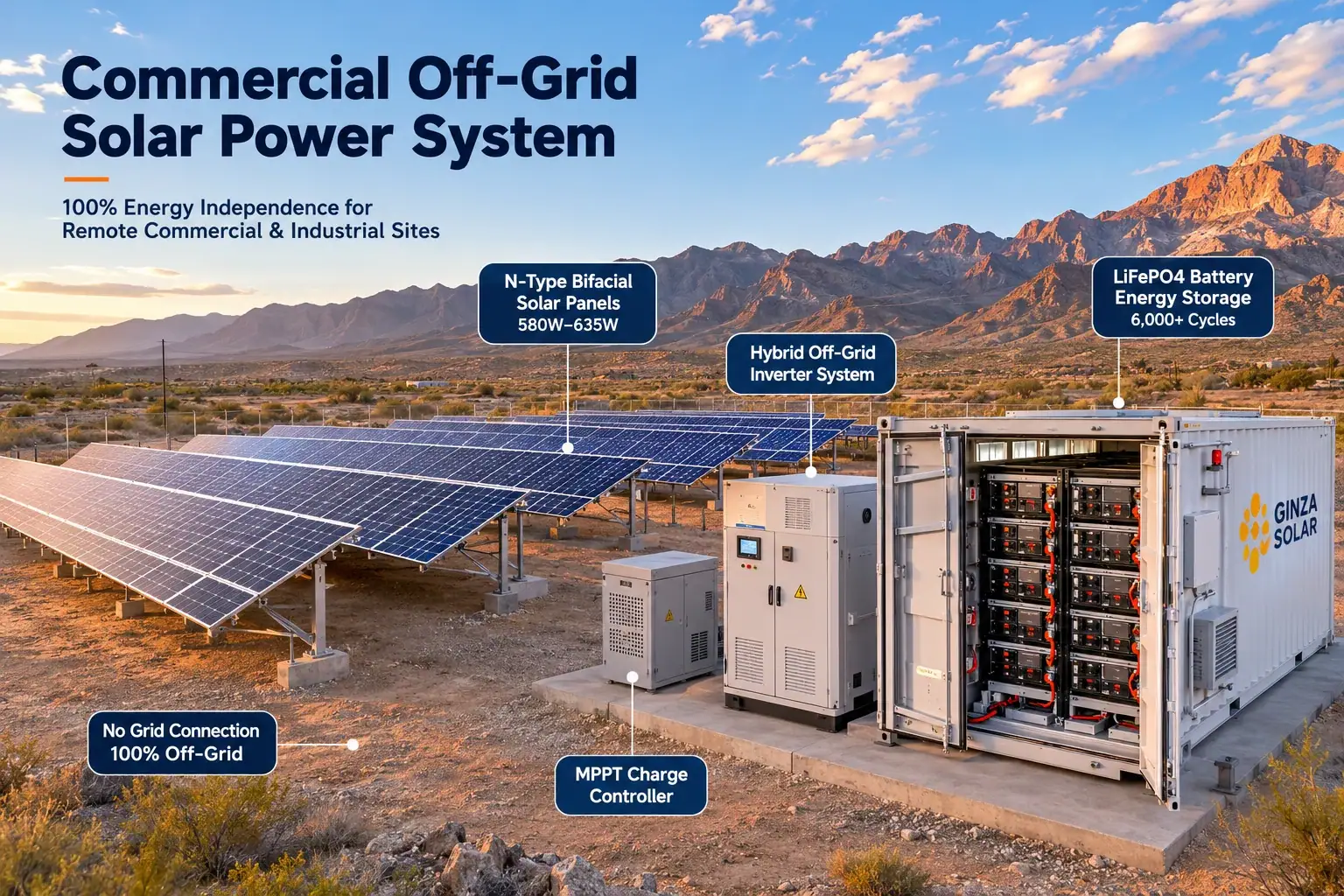
An off-grid solar system is a standalone power system that supplies electricity without depending on a utility grid. For commercial sites, it normally combines a solar PV array, battery storage, an inverter or PCS, electrical protection, monitoring and, where reliability requires it, backup generation.
Quick answer: Size a commercial off-grid solar system from four separate inputs: daily energy in kWh, peak and surge power in kW/kVA, required autonomy, and the worst-month solar resource. A bankable design must then validate battery power, PV recharge time, inverter compatibility, protection, generator logic and lifecycle cost.
This guide is for B2B buyers, EPC contractors, distributors and project teams planning commercial or industrial off-grid solar. It explains the architecture, first-pass sizing, solar-versus-diesel TCO, RFQ inputs and supplier checks required before procurement.
Key Takeaways
- Off-grid is a reliability decision before it is a solar decision. Start with hourly load data, critical loads, worst-month solar resource and required autonomy.
- Commercial systems are more than panels and batteries. Protection, BOS, generator integration, communications, monitoring and serviceability are part of the power architecture.
- Do not budget a remote off-grid project from one universal $/W figure. Battery autonomy, site logistics, civil works, redundancy and backup strategy can materially change project cost.
- Sizing must separate daily energy, peak power, surge power and autonomy. Using one number for all four is a common cause of undersized systems.
- B2B procurement should verify model-specific certifications, warranty terms, BMS/inverter compatibility, replacement parts and after-sales capability before purchase.
What Is an Off-Grid Solar System?
An off-grid solar system operates without a utility-grid connection. In a grid-connected project, the utility can support the site when solar production is low. In a true off-grid project, the design must account for nights, cloudy periods, seasonal changes, peak demand, equipment faults and maintenance events without assuming the grid will rescue the system.
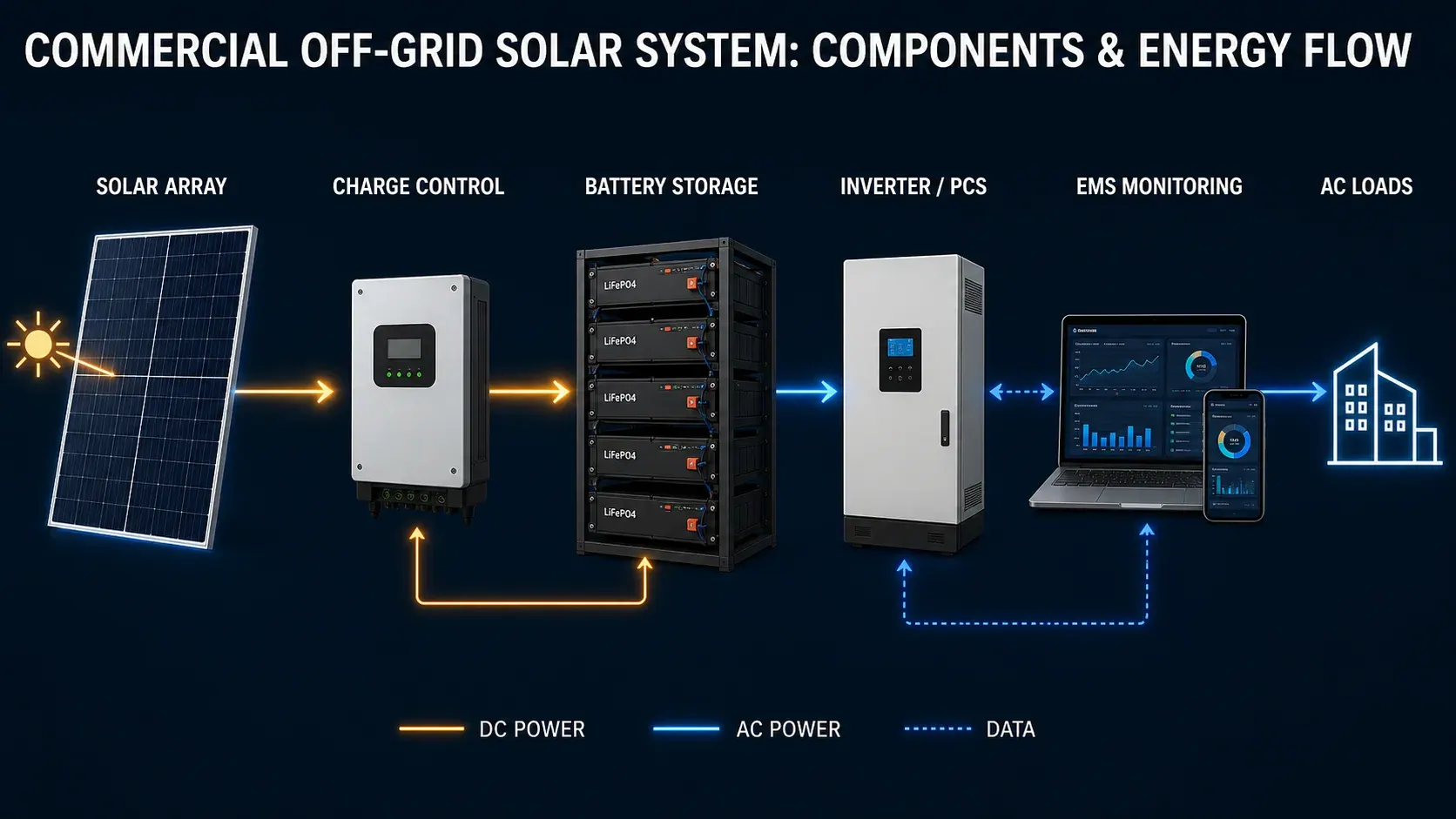
A typical commercial off-grid architecture includes:
- Solar PV array — produces DC electricity.
- Battery energy storage system (BESS) — stores energy for night use and low-solar periods.
- Inverter or PCS — converts power between DC and AC and manages load supply. Many modern units include MPPT charging functions; other architectures use separate charge controllers.
- Balance of system (BOS) — combiner boxes, breakers, disconnects, fuses, cabling, grounding, surge protection, distribution equipment and metering.
- EMS / monitoring / control system — tracks generation, battery state of charge, alarms, load behavior and sometimes generator dispatch.
- Optional backup generator — commonly used where 24/7 availability is more valuable than designing an extremely large battery bank for rare multi-day low-solar events.
Commercial off-grid projects can range from small telecom or agricultural systems to multi-megawatt remote microgrids. The load and reliability requirement—not an arbitrary size category—should define the architecture.
Off-Grid Solar System Components for Commercial Projects
A commercial off-grid solar system should be specified as an integrated power system, not as a shopping list of independent products. Component compatibility, control logic, protection coordination, environmental rating, serviceability and documentation matter as much as headline wattage or battery capacity.
| Component | What B2B Buyers Should Specify | Why It Matters |
|---|---|---|
| Solar PV modules | Power class, efficiency, Voc/Isc, temperature coefficient, mechanical load, IEC 61215 / IEC 61730 scope | Affects array area, string design, inverter matching, logistics and long-term reliability |
| Battery system | Chemistry, nominal/usable kWh, C-rate, DoD window, cycle conditions, BMS, communications, IEC 62619 / IEC 63056 where applicable | Determines autonomy, lifetime, safety and power availability |
| Inverter / PCS | AC power, surge capability, DC voltage range, MPPT range, battery protocol, generator input, parallel capability, IEC 62109 where applicable | Must handle both steady-state and transient loads reliably |
| Charge control | Integrated MPPT or external MPPT, voltage/current limits, number of trackers, string configuration | Controls solar harvesting and battery charging |
| BOS & protection | DC/AC breakers, fuses, SPD, disconnects, combiner boxes, grounding, cable sizes, protection coordination | Critical for safety, maintainability and code compliance |
| EMS / monitoring | SOC visibility, alarms, event logs, remote access, load/generator control, data export | Reduces remote-site service visits and supports preventive maintenance |
| Backup generation | Generator kW/kVA, fuel storage, auto-start, minimum loading, battery charging strategy | Can reduce required battery oversizing and improve resilience |
Solar Panels
High-efficiency N-type TOPCon modules can be a strong option for commercial off-grid arrays because more power can be installed within a limited area and fewer modules may be needed for a given DC capacity. However, module selection should not be based on efficiency alone.
Commercial buyers should verify power and efficiency under STC, Voc/Isc across site temperature extremes, string compatibility with the MPPT window, mechanical and environmental ratings, degradation warranty, logistics and IEC 61215/IEC 61730 evidence for the exact module family.
GINZA’s current commercial panel range includes high-wattage N-type options. Buyers should confirm the current model datasheet, electrical compatibility and site handling constraints rather than treating one wattage range as a universal standard.
See the N-Type Solar Panel Guide and solar panel product range for related selection considerations.
Battery Energy Storage
For many commercial off-grid projects, LiFePO4 is preferred because of its cycle capability, thermal stability, usable depth of discharge and suitability for stationary storage. However, “LiFePO4” alone is not a complete specification.
A B2B battery specification should define nominal and usable kWh, charge/discharge power, SOC/DoD limits, cycle-test conditions, temperature range, BMS protections and communications, voltage architecture, enclosure/fire strategy, warranty limits and model-specific safety and transport documentation.
LiFePO4 has a lower thermal-runaway propensity than several higher-energy-density lithium-ion chemistries, but no lithium battery should be described as having “zero thermal runaway risk.” System safety still depends on cell quality, BMS protection, electrical protection, enclosure design, installation, ventilation or thermal management and operating conditions.
For industrial stationary batteries, IEC 62619 covers safety requirements for secondary lithium cells and batteries used in industrial applications. IEC 63056 adds requirements specifically for lithium cells and batteries used in electrical energy storage systems, including on-grid and off-grid applications.
For battery sizing and voltage selection, see the LiFePO4 Battery Selection Guide and High Voltage Battery Guide.
Inverter / PCS and MPPT Architecture
Older diagrams often show a separate charge controller between the PV array and battery. In modern commercial systems, the exact architecture depends on the inverter or PCS design. Some off-grid or hybrid inverters integrate MPPT solar inputs and battery charging; larger systems may use separate DC/DC converters, dedicated solar inverters, PCS units or AC-coupled architectures.
Specify continuous and surge power, phase configuration, DC/battery voltage ranges, MPPT limits, parallel/redundancy capability, generator and black-start logic, BMS protocol and remote diagnostics.
For PV power converters, IEC 62109-1 covers general safety requirements and IEC 62109-2 covers particular requirements for inverters, including stand-alone and battery-connected applications.
See the Inverter Compatibility Guide before finalizing the battery-inverter combination.
BOS, Protection and Mounting
Commercial off-grid reliability is often lost in the “small” items: undersized cables, incorrect breakers, poor grounding, unsuitable enclosures, missing surge protection or inaccessible equipment layouts.
A complete BOM should include DC and AC protection, isolation, combiner equipment, cable sizing, grounding, SPD, communications, mounting structures, cable management, labeling and spare parts. Remote sites also need maintainable layouts: equipment that is technically correct but impossible to service efficiently can create long downtime events.
Use the Solar Project BOM Checklist to normalize component and documentation scope before quotation.
Off-Grid vs Grid-Tied vs Hybrid Solar: Which System Fits the Project?
The decision should start with grid availability and reliability, not with product preference. Off-grid systems are appropriate when the site cannot depend on a utility grid; grid-tied systems are normally the lowest-complexity option when a reliable grid is available; hybrid systems add storage and islanding capability where the grid exists but resilience, self-consumption or peak management matters.
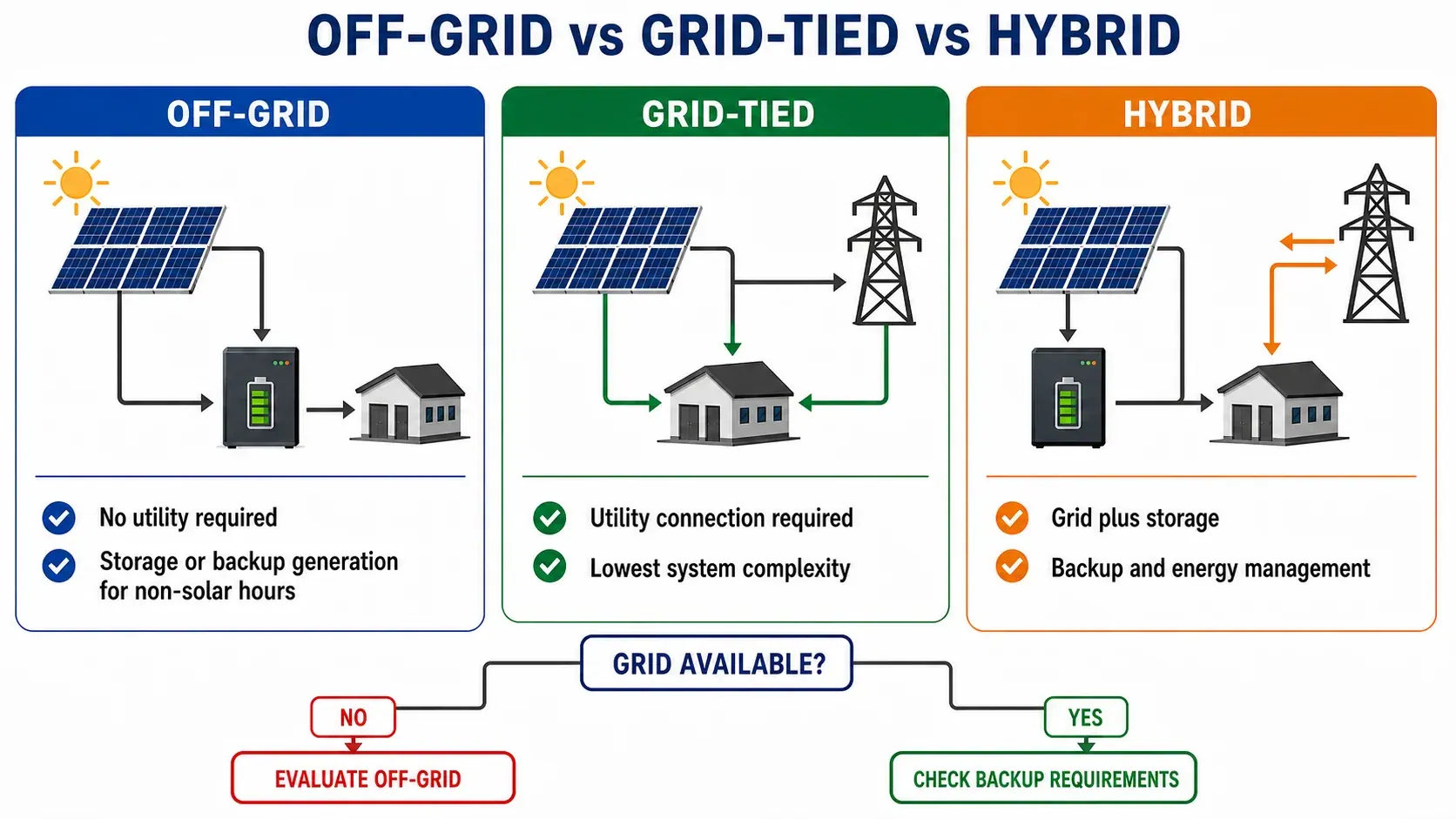
| Criteria | Off-Grid | Grid-Tied | Hybrid |
|---|---|---|---|
| Utility grid required | No | Yes | Usually yes |
| Battery normally required | Yes for 24/7 supply | No | Depends on design; commonly yes |
| Can operate through grid outage | Yes, if sized and operational | Normally no without islanding equipment | Yes, if designed for backup/islanding |
| Main design priority | Energy autonomy and reliability | Energy yield and grid compliance | Energy economics + backup + control |
| Typical use | Remote telecom, mining, agriculture, islands, remote facilities | Factories, warehouses, commercial buildings with stable grid | Sites with unreliable grid, demand charges, backup needs |
| Main risk | Under-sizing storage/generation or inadequate redundancy | Grid dependence | Control complexity and operating-strategy errors |
| Cost driver | Battery autonomy + logistics + redundancy | PV/BOS/interconnection | Battery + PCS + controls + interconnection |
B2B Decision Framework
Ask three questions:
-
Can the site obtain dependable utility power at an acceptable connection cost?
If no, evaluate off-grid or a renewable-diesel microgrid. -
What happens if power is unavailable for one hour, one night or several days?
Critical telecom, safety, process, cold-chain, medical or security loads justify higher redundancy than non-critical commercial loads. -
Which architecture minimizes lifecycle cost at the required reliability level?
A battery-only autonomy target can become expensive. In some remote sites, a solar-battery-diesel hybrid achieves a better lifecycle balance because the generator covers rare low-solar events while solar and storage reduce annual fuel consumption.
How to Size a Commercial Off-Grid Solar System
The most common sizing mistake is starting with “I need a 100kW system.” A 100kW inverter only identifies a power class. It does not show how many kWh the site consumes, how large the battery must be or how much PV is required to recharge the system during the worst solar month.
A robust first-pass design follows five steps. Final sizing should be validated with site-specific hourly or sub-hourly simulation.
Step 1: Build the Load Profile
For each load, record rated kW/kVA, operating schedule, surge demand, power factor where relevant, criticality and seasonal variation.
Daily energy (kWh/day) = Σ [load power (kW) × operating hours (h/day)]
Example remote commercial facility:
- Lighting: 10kW × 10h = 100kWh/day
- HVAC: 30kW × 8h = 240kWh/day
- Office equipment: 5kW × 8h = 40kWh/day
- Security/communications: 2kW × 24h = 48kWh/day
- Other loads: 3kW × 6h = 18kWh/day
- Total = 446kWh/day
Do not automatically add 20–30% to every number. Instead, document expected growth and apply a design margin that reflects the project’s forecast, because excessive margin can unnecessarily increase both battery and PV cost.
Step 2: Separate Critical and Non-Critical Loads
In a commercial off-grid project, not every load needs the same autonomy.
For example, a resort may need communications, security, refrigeration, selected lighting and water pumps during a long low-solar event, but it may be able to curtail some HVAC or discretionary loads. A mining site may have essential safety and communications loads that must remain online even if non-critical workshop loads are shed.
Load prioritization can substantially reduce the battery capacity needed to meet a reliability target.
Step 3: Size the Battery Bank
A simplified nominal battery-energy formula is:
Battery nominal capacity (kWh) = Critical daily energy × autonomy days ÷ usable DoD ÷ battery/system discharge efficiency
Example assumptions:
- Critical load: 300kWh/day
- Required autonomy: 2 days
- Usable DoD: 85%
- Discharge-side efficiency allowance: 93%
300 × 2 ÷ 0.85 ÷ 0.93 = 759kWh nominal
A practical initial selection might therefore be around 800kWh, subject to the chosen battery system’s usable SOC window, discharge power, temperature limits, redundancy plan and module/rack increments.
There is no universal “3–5 days” or “5–7 days” rule. Set autonomy from load criticality, worst-month weather, generator availability, fuel-delivery risk, uptime target and lifecycle economics. A site with an automatic generator may economically use less battery autonomy than a site that must operate with zero fuel deliveries.
Step 4: Size the Solar Array
For first-pass sizing:
PV array (kWp) = Design daily energy (kWh/day) ÷ [worst-month peak sun hours × overall PV-to-load efficiency]
If the site uses 500kWh/day as the design load, receives 4.5 peak-sun-hours in the worst design month and uses an 80% overall derating factor:
500 ÷ (4.5 × 0.80) = 139kWp
That is the approximate array needed to serve the average design-day energy under those assumptions. An off-grid project normally needs additional margin for battery charging, low-solar recovery, temperature, soiling, degradation, clipping and operating reserve. A preliminary design might therefore investigate 170–220kWp rather than treating 139kWp as the final answer.
The final PV size should be validated with hourly or sub-hourly simulation using site-specific irradiance and temperature data. The design should answer a practical question: after a low-solar event, how quickly must the system serve the load and restore battery SOC?
Step 5: Size the Inverter / PCS for Peak Power and Transients
A first-pass relationship such as inverter capacity ≈ peak running load × engineering margin can be useful, but motor loads must be checked separately.
If the peak running load is 100kW, a 125kW inverter may appear sufficient. However, a large pump or compressor can produce a starting surge far above its running power. The correct solution may involve:
- Higher inverter overload capability
- Multiple parallel inverters
- Soft starters
- Variable-frequency drives (VFDs)
- Sequenced load starting
- Generator support during large starts
The final design must confirm both kW/kVA steady-state capacity and transient performance.
How Much Does a Commercial Off-Grid Solar System Cost?
There is no reliable universal installed cost per watt for commercial off-grid solar because two projects with the same 100kW PV array can have completely different battery capacity, autonomy, logistics, civil work, protection, redundancy and generator requirements.
For B2B budgeting, break the project into cost blocks instead of applying one $/W number:
| Cost Block | What It Includes | Main Cost Driver |
|---|---|---|
| PV generation | Modules, structure, DC BOS | kWp, mounting type, wind/soil conditions |
| Battery storage | Cells/modules, racks, BMS, enclosure, thermal/fire systems | Usable kWh, power rating, redundancy |
| Inverter / PCS / MPPT | Power conversion and charging hardware | kW/kVA, DC voltage, topology, redundancy |
| Electrical BOS | Combiners, breakers, SPD, cables, switchgear, grounding | Voltage, current, distances, code requirements |
| EMS / controls | Monitoring, dispatch logic, communications | Architecture and control complexity |
| Civil & installation | Foundations, buildings/containers, labor, commissioning | Site conditions and local labor |
| Logistics | Inland transport, sea freight, dangerous-goods handling, remote delivery | Distance, battery shipping, road/site access |
| Backup & redundancy | Diesel genset, fuel system, spare parts, N+1 equipment | Reliability target |
A Better Cost Benchmark Than a Single $/W Claim
IRENA’s 2023 guidebook for remote communities reports broad investment-cost ranges of approximately USD 4,000–7,000/kW for solar-battery systems and USD 3,000–6,000/kW for solar-battery-diesel systems, including generation and distribution in the guidebook’s reference context. These figures illustrate how wide remote-system costs can be, but they are not a quotation template for a commercial project.
The procurement lesson is simple: request pricing against a defined load profile, battery autonomy, architecture, scope of supply, Incoterm and installation boundary. Comparing suppliers on “price per watt” without aligning these assumptions can create a false low bid.
Off-Grid Solar vs Diesel: Compare Lifecycle Cost, Not Only CAPEX
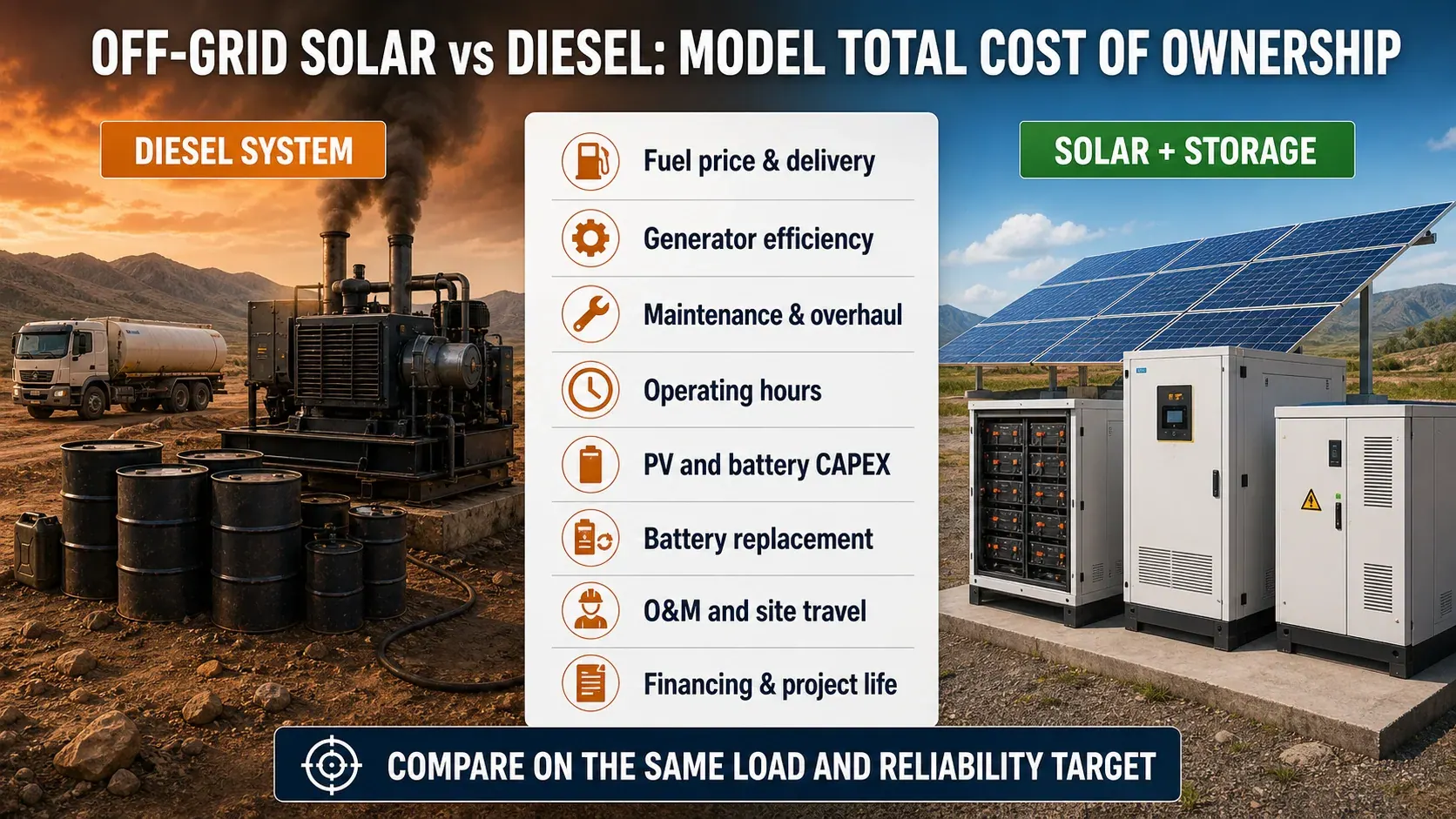
Diesel generators usually have lower upfront equipment cost. Their long-term economics depend heavily on operating hours, load factor, maintenance, fuel price and, especially for remote projects, the delivered cost of fuel.
Solar-battery systems have higher upfront capital cost but low fuel cost. Solar-battery-diesel systems can reduce generator runtime and fuel logistics while retaining dispatchable backup for prolonged low-solar periods.
IRENA’s remote-community guide shows overlapping LCOE ranges for solar-battery and diesel. This is an important reminder that solar is not automatically cheaper at every site. Project economics should be modeled rather than claimed as a fixed “3–5 year ROI” or “40–55% lower TCO.”
For a bankable comparison, model 10–20-year scenarios covering delivered diesel price, generator load efficiency and overhauls, battery replacement, PV degradation, O&M/travel, load growth and cost of capital.
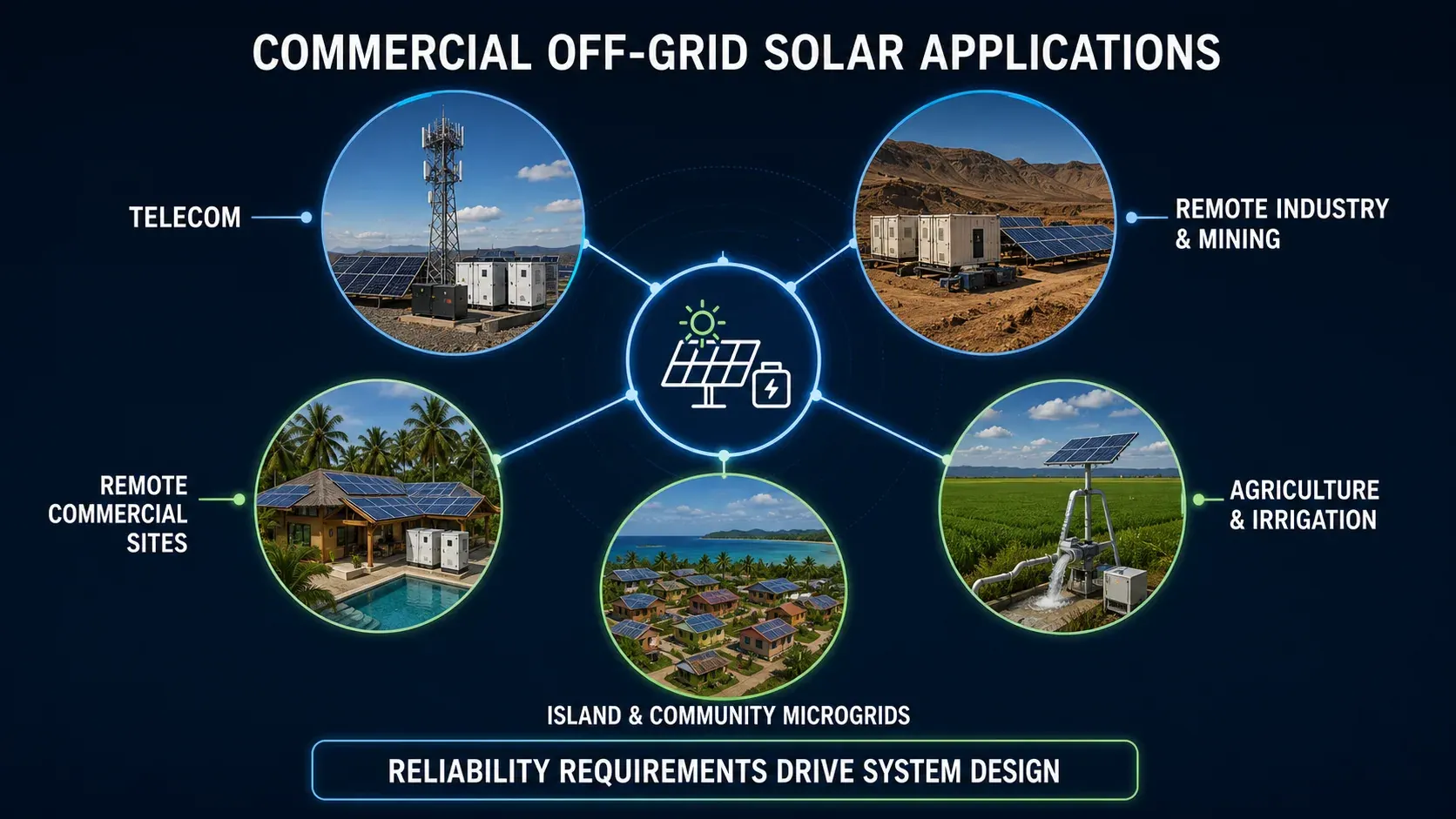
Commercial and Industrial Off-Grid Solar Applications
The same equipment can behave very differently across industries. B2B buyers should specify the application before asking suppliers to recommend a system.
Telecom Sites
Telecom loads often require high uptime, remote alarms, compact installations and integration with existing DC power systems. Some telecom architectures operate around –48VDC, so interface requirements must be verified before selecting charge controllers, rectifiers, batteries or inverters.
Verify DC bus/rectifier architecture, alarm protocol, autonomy, physical security, generator auto-start, service access and spare-module strategy.
Mining and Remote Industrial Sites
Mining projects can combine high dust, vibration, temperature extremes, large motor loads and difficult logistics. Enclosure IP rating, corrosion protection, cooling design, cable routing, vibration resistance and replaceable modules become operational issues rather than catalog details.
Require a defined environmental temperature range, enclosure/IP protection, thermal derating, large-motor starting strategy, deployment architecture, generator dispatch logic and spare-parts package.
Agriculture and Irrigation
Agricultural off-grid systems are highly load-dependent. A daytime irrigation pump may operate directly from solar with little or no battery, while cold storage, livestock systems, processing equipment or 24-hour pumping require storage and more complex controls.
Key factors include motor starting current, seasonal irrigation schedules, water-storage options, VFD compatibility and whether energy storage or stored water is the more economical form of storage for the application.
Remote Commercial Facilities and Resorts
Hotels, resorts, warehouses, research stations and border facilities usually require higher power quality and user comfort than basic rural electrification systems. HVAC can dominate both energy consumption and peak demand.
Model daytime/nighttime HVAC, refrigeration and water loads, comfort requirements, generator-noise limits, load-shedding priorities and remote service capability.
Islands and Community Microgrids
At community scale, the project becomes a microgrid rather than a simple solar-battery installation. Control architecture, black start, spinning reserve, generator scheduling, distribution losses, metering, protection coordination and load growth all become central design topics.
A solar-battery-diesel architecture is often evaluated because it combines low-fuel renewable generation with dispatchable backup and can avoid oversizing batteries for rare events.
How to Prepare an Off-Grid Solar Project Brief for B2B Procurement
A supplier can only size a system as accurately as the project information provided. A professional RFQ should include the following.
Off-Grid Project Brief Checklist
- Site and logistics — coordinates, altitude, access, nearest port/city.
- Load profile — equipment list, kW/kVA, operating hours, hourly data if available and expected growth.
- Critical and surge loads — identify must-run circuits, motors, pumps, compressors, HVAC and starting requirements.
- Reliability target — acceptable outage, autonomy and load-shedding priorities.
- Backup source — generator capacity, fuel constraints and auto-start requirements.
- Solar resource and environment — worst-month irradiance, temperature, dust, salt mist, wind, flooding, corrosion.
- Installation and scope — ground/roof/container/microgrid; supply-only, design, EPC or commissioning.
- Standards and delivery — destination-country requirements, Incoterm, port and schedule.
- Commercial terms — warranty, spares, training, payment, inspection, FAT/SAT.
What to Request in the Quotation
Ask each bidder for the same comparison set: system architecture or single-line diagram, PV kWp and strings, battery nominal and usable kWh and power limits, inverter/PCS continuous and surge power, generator logic where applicable, full BOS/protection BOM, energy-balance assumptions, warranties and certificates, spares, lead time, shipping terms and commissioning/after-sales responsibility.
A low quotation is not necessarily a low-cost system if BOS, protection, commissioning, communications, spare parts or remote support are excluded.
How to Evaluate an Off-Grid Solar Supplier
Remote-project supplier risk is magnified because failures are expensive to service. Supplier evaluation should therefore focus on evidence, traceability and support capability rather than company-size marketing claims alone.
| Evaluation Area | What to Verify | Strong Evidence | Warning Sign |
|---|---|---|---|
| Product documentation | Datasheets, drawings, manuals, revision control | Model-specific controlled documents | Generic or inconsistent datasheets |
| Certification | Standard, model, scope, issuer, validity | Verifiable report/certificate matching product | Logo-only claims or certificate for another model |
| Quality control | Incoming, process, final testing, serial traceability | Inspection records and traceable serials | No test records or changing specifications |
| System engineering | Sizing assumptions, SLD, protection, compatibility | Documented calculations and design review | Quote based only on inverter kW |
| Battery/inverter compatibility | BMS protocol, firmware, voltage/current limits | Tested compatibility or documented integration | “Compatible with everything” claim |
| Export/logistics | Packing, dangerous-goods documents, shipment experience | Clear packing and shipping documentation | No battery transport documentation |
| Warranty | Coverage, exclusions, response process, spare parts | Written terms and claim workflow | Marketing warranty with unclear conditions |
| After-sales support | Response channel, remote diagnostics, spares | Named support process and service plan | Sales contact only, no technical escalation |
| References | Similar project type and environment | Verifiable comparable deployments | Unrelated photos or unverifiable references |
Verify Standards Correctly
Do not treat a logo as proof of compliance.
For PV modules, buyers commonly check IEC 61215 for design qualification/type approval and IEC 61730 for safety qualification. For industrial stationary lithium batteries, IEC 62619 is relevant, while IEC 63056 specifically addresses lithium cells and batteries for electrical energy storage systems. For PV power converters and inverters, IEC 62109-1/-2 are key safety standards.
For lithium battery transport, verify the applicable UN Manual of Tests and Criteria, subsection 38.3 documentation and request the model-specific test summary. Transport compliance must also follow the applicable shipping-mode and dangerous-goods rules.
TÜV Rheinland, TÜV SÜD, UL and other organizations may act as testing or certification bodies. “TÜV” itself is not a technical performance standard. Always verify which standard was tested, which product model is covered and which certificate or report was issued.
For GINZA products, request the current model-specific datasheets, certificates, UN 38.3 test summary where applicable, warranty terms and inverter compatibility documentation from the project sales or technical team before final approval.
Factory Audit and Pre-Shipment Inspection
For material project orders, consider a factory audit or third-party inspection based on commercial risk rather than using an arbitrary purchase-value threshold.
Audit items can include material and serial traceability, electrical and assembly process controls, BMS firmware control, functional and safety-test records, test-equipment calibration and packing/dangerous-goods labeling.
A pre-shipment inspection should verify the actual ordered models, quantities, labels, documentation, packaging and test records before cargo release.
Frequently Asked Questions
Do all off-grid solar systems need batteries?
No. A system serving daytime-only loads such as some irrigation pumps can operate directly from solar without a large battery. However, a commercial off-grid site that requires power at night or during low-solar periods normally needs battery storage, dispatchable generation or both.
How many days of battery autonomy should a commercial off-grid system have?
There is no universal number. Autonomy should be based on critical load, weather variability, required uptime, generator availability and fuel-logistics risk. More autonomy increases resilience but can sharply increase project cost, so it should be justified by the service requirement.
Can an off-grid solar system be expanded later?
Yes, if expansion is planned into the original architecture. Buyers should reserve inverter/PCS headroom, battery parallel or rack capacity, switchgear capacity, physical space, communications addresses and PV input capability. Expansion can be difficult if voltage windows or proprietary BMS limits are ignored during the first phase.
Should a remote project keep a diesel generator?
Often, yes. A generator can cover rare extended low-solar periods and large emergency loads, allowing a smaller battery bank. Whether the generator is economically justified depends on delivered fuel cost, operating hours, reliability target, emissions and noise requirements and the cost of additional storage.
What information is required for an accurate off-grid solar quotation?
At minimum: site location, hourly or daily load profile, peak load, motor/surge loads, critical loads, autonomy target, backup-generator details, installation environment, required standards, project scope, delivery location and target schedule. A quotation without these inputs is usually only a budget estimate.
What certifications should buyers request?
Request standards that match the actual component and destination market. Common examples include IEC 61215 and IEC 61730 for PV modules, IEC 62619 and/or IEC 63056 for stationary lithium batteries, IEC 62109 for PV power converters/inverters and UN 38.3 transport-test documentation for lithium batteries. Verify model scope and certificate validity.
Is off-grid solar always cheaper than diesel?
No. Solar can reduce fuel and logistics costs, but lifecycle economics depend on solar resource, load factor, autonomy, battery replacement, delivered diesel price, financing, maintenance and project life. A site-specific TCO model is more reliable than a universal ROI claim.
What should B2B buyers compare between supplier quotations?
Normalize every bid to the same PV kWp, usable battery kWh, inverter power, autonomy target, BOS scope, protection, monitoring, generator integration, warranty, Incoterm, commissioning scope and spare-parts package. Otherwise, the lowest quoted price may simply contain the most exclusions.
Related Guides
- Solar Project BOM Checklist
- Commercial Energy Storage System Guide
- High Voltage Battery Guide
- N-Type Solar Panel Guide
- LiFePO4 Battery Selection Guide
- Inverter Compatibility Guide
- Container Energy Storage System Guide
- Browse solar panels
- View 51.2V LiFePO4 battery systems
- Contact GINZA Solar for a project quotation
References and Standards
- International Renewable Energy Agency (IRENA), Renewable Energy for Remote Communities: A Guidebook for Off-Grid Projects (2023): https://www.irena.org/-/media/Files/IRENA/Agency/Publication/2023/Nov/IRENA_Remote_Communities_2023.pdf
- IEC 61215-1:2021, Terrestrial photovoltaic (PV) modules — Design qualification and type approval — Part 1: Test requirements: https://webstore.iec.ch/en/publication/61345
- IEC 61730-1:2023, Photovoltaic (PV) module safety qualification — Part 1: Requirements for construction: https://webstore.iec.ch/en/publication/59803
- IEC 62619:2022, Safety requirements for secondary lithium cells and batteries for use in industrial applications: https://webstore.iec.ch/en/publication/64073
- IEC 63056:2020, Safety requirements for secondary lithium cells and batteries used in electrical energy storage systems: https://webstore.iec.ch/en/publication/29224
- IEC 62109-1:2010 and IEC 62109-2:2011, Safety of power converters for use in photovoltaic power systems: https://webstore.iec.ch/en/publication/6470 and https://webstore.iec.ch/en/publication/6471
- UNECE, UN Manual of Tests and Criteria, subsection 38.3 for lithium cells and batteries: https://unece.org/transport/standards/transport/dangerous-goods/un-manual-tests-and-criteria-rev8-2023
Related project worksheets
Use the solar project BOM checklist to list PV, storage, protection and shipping scope. If the battery plant is a commercial BESS, add the BESS RFQ fields for usable energy, controls, acceptance tests and service. Record off-grid battery and inverter settings during handover with the PV and battery commissioning report template. These resources support procurement and handover; the local engineer must verify the operating design.