
Meta Title: Commercial Energy Storage System Buyer’s Guide
Meta Description: B2B guide to commercial energy storage systems: sizing, LiFePO4 chemistry, inverter matching, cost factors, ROI planning and supplier evaluation.
Target Keyword: commercial energy storage system
Word Count: ~3,300
Demand for commercial energy storage systems (CESS) is accelerating worldwide. Businesses face rising electricity costs, grid instability, demand charges and pressure to use more renewable energy. For EPCs, project buyers, installers and distributors, the challenge is not only choosing a battery product, but also sizing the system correctly, matching the inverter, preparing transport documents and evaluating supplier reliability before placing an order.
Quick Answer: A commercial energy storage system is a battery-based solution that stores electricity for businesses, factories and commercial buildings. It is commonly used for peak shaving, backup power, demand response and solar self-consumption. A complete commercial ESS normally includes a LiFePO4 battery pack, BMS, PCS/inverter, EMS and a safety-rated cabinet or container.
GINZA Tech Solar is a Chinese solar battery and PV material manufacturer based in Shenzhen, specializing in LiFePO4 batteries, commercial ESS cabinets and turnkey solar project supply for EPCs, installers, distributors and wholesale buyers in 50+ countries worldwide.
This guide provides a practical B2B procurement roadmap for commercial energy storage, from understanding system components to preparing a quotation request.
1. What Is a Commercial Energy Storage System?
A commercial energy storage system (CESS) is a battery-based power storage solution designed for businesses, factories, warehouses and commercial buildings. It stores electricity during low-demand periods, solar generation hours or off-peak tariff windows, then discharges during peak demand, outages or high-price electricity periods.
Definition and Scope
Commercial and industrial (C&I) energy storage sits between utility-scale battery farms (typically 10 MWh+) and residential battery systems (5–20 kWh). C&I systems are purpose-built for facilities with higher load demands — offices, warehouses, factories, shopping centers, and campus environments. The table below shows how commercial storage differs from other market segments:
| Segment | Typical Capacity | Typical Use Case | Voltage Platform |
|---|---|---|---|
| Residential | 5–20 kWh | Home backup, self-consumption | 48V / 51.2V |
| Commercial & Industrial (C&I) | 30 kWh – 10 MWh | Peak shaving, demand response, backup | 96V – 384V |
| Utility-Scale | 10 MWh+ | Grid stabilization, frequency regulation | 1,000V+ |
Key Applications
- Peak shaving: Peak shaving is a commercial energy storage strategy that reduces peak electricity demand by discharging stored battery power during high-consumption periods. It can lower demand charges, reduce grid stress and improve the return on investment of solar-plus-storage projects when local tariffs make peak demand expensive.
- Demand response: Participating in utility programs that pay businesses to reduce load during grid stress events.
- Backup power: Providing uninterrupted power during outages, critical for data centers, hospitals, and manufacturing facilities.
- Solar self-consumption: Storing excess solar generation during the day for use at night, maximizing on-site renewable energy usage.
Market Size and Growth Trends
Battery storage has become more practical for commercial buyers as lithium battery manufacturing scales and more markets adopt peak-demand, time-of-use and renewable integration policies. For B2B buyers, the practical question is not only which battery is cheapest, but which complete ESS configuration can pass documentation review, ship safely, commission smoothly and support reliable operation over the project life.
2. Key Components of a Commercial ESS
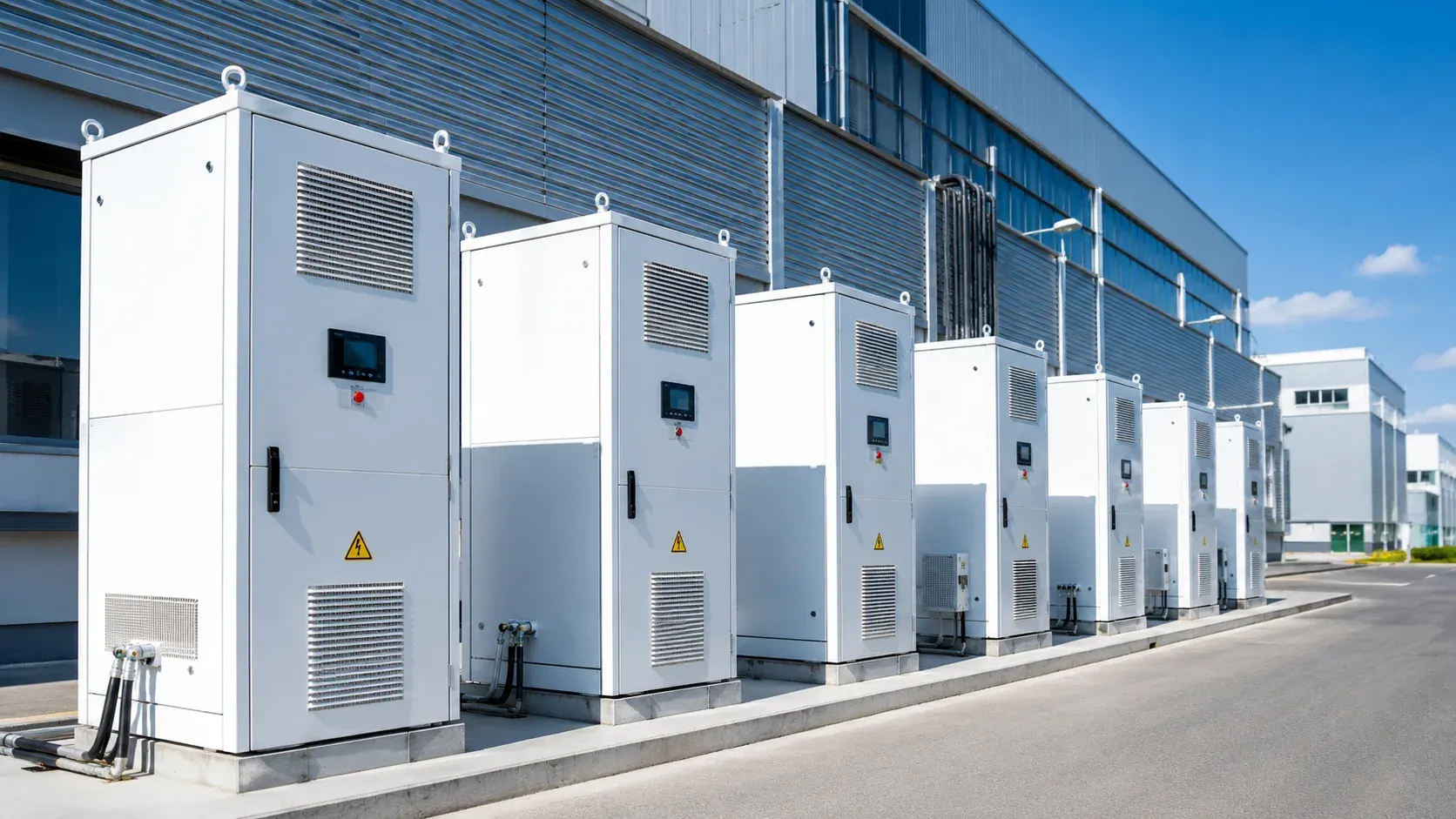
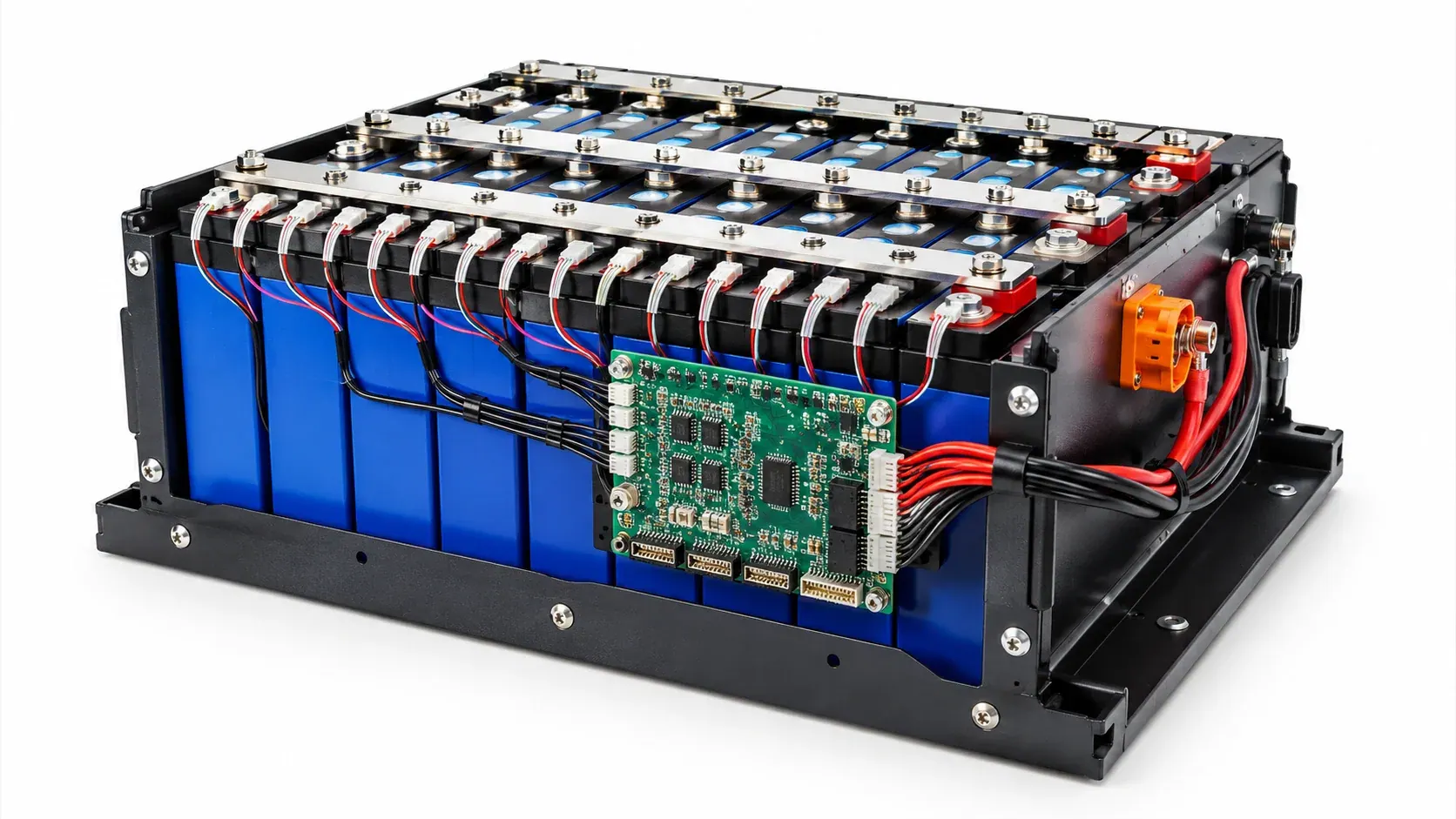
A commercial ESS consists of five core components: the battery pack (usually LiFePO4), a battery management system (BMS) for cell monitoring, a power conversion system (PCS/inverter) for AC-DC conversion, an energy management system (EMS) for charge-discharge control, and a safety-rated enclosure with thermal management.
Battery Pack
The battery pack is the energy storage core. For commercial applications, LiFePO4 (lithium iron phosphate) is the dominant chemistry due to its long cycle life, superior thermal stability, and favorable cost per kWh over the system lifetime. Battery packs are assembled from individual cells (typically 3.2V LiFePO4 cells in series-parallel configurations) to achieve the required voltage and capacity. For detailed cell-level guidance, refer to our LiFePO4 battery selection guide.
Battery Management System (BMS)
BMS (Battery Management System) is the electronic control system that monitors and manages rechargeable battery cells. In commercial ESS, the BMS protects against overcharge, over-discharge, overcurrent, and temperature extremes, while communicating real-time data to the EMS via CAN, RS485, or Modbus protocols. A well-designed BMS extends battery lifespan and is essential for system safety.
Power Conversion System (PCS / Inverter)
PCS (Power Conversion System), also called a hybrid inverter or battery inverter, converts DC power from the battery bank to AC power for building loads, and vice versa during charging. For commercial ESS, PCS capacity (kW) determines the maximum discharge rate and must match the building’s peak load demand. Inverter compatibility is a critical procurement consideration — see our inverter compatibility guide for voltage, communication protocol, and brand-matching details.
Energy Management System (EMS)
EMS (Energy Management System) is the software platform that controls charge-discharge schedules, optimizes energy usage based on electricity pricing and load patterns, and manages grid interaction for commercial energy storage systems. It integrates with building management systems and can enable demand response participation.
Enclosure and Safety Systems
Commercial ESS cabinets include IP-rated enclosures (typically IP55 or higher), thermal management (air cooling or liquid cooling), fire suppression systems, and DC disconnect switches. For outdoor installations, the enclosure must withstand local environmental conditions including temperature extremes, humidity, and dust.
3. How to Size a Commercial Energy Storage System
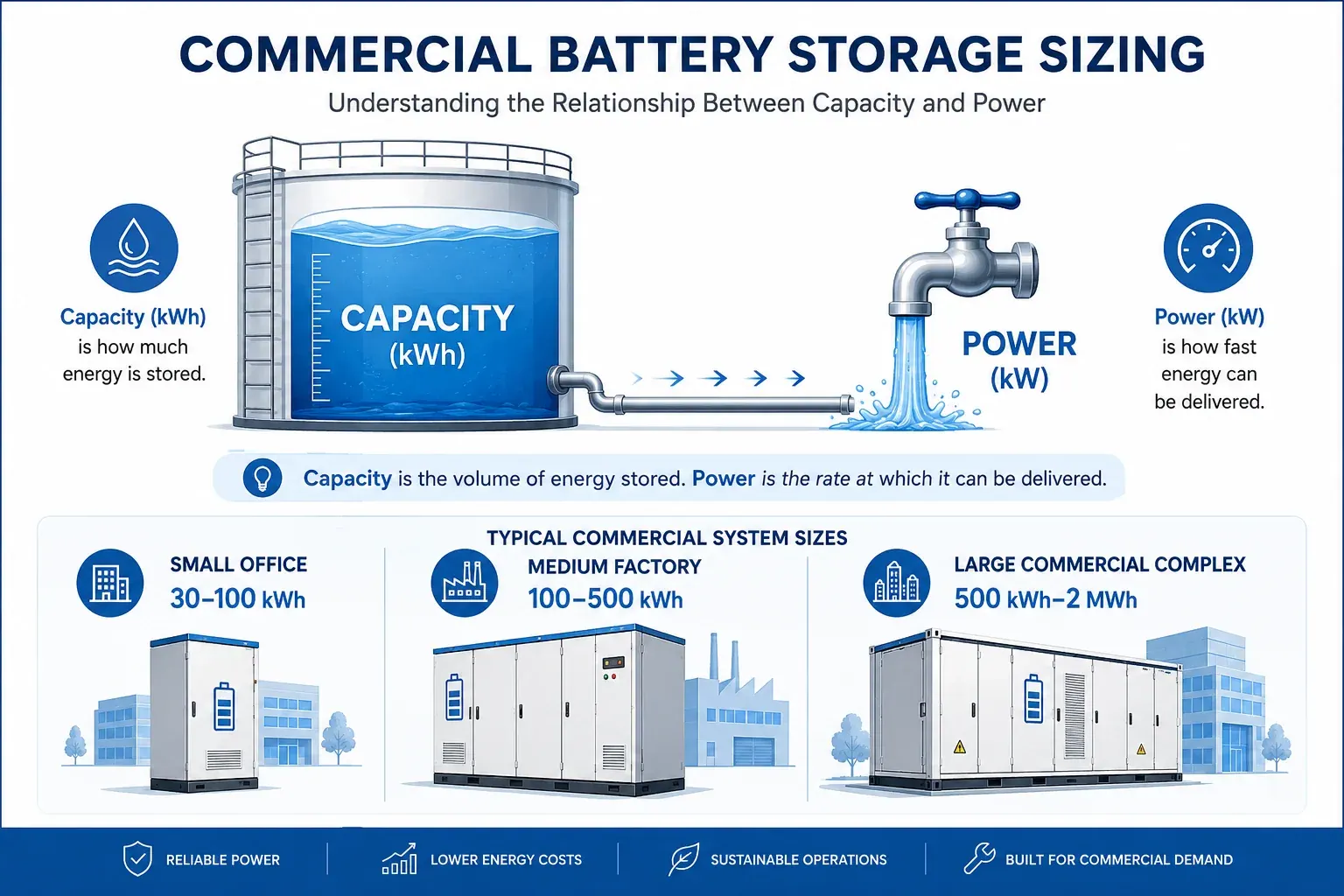
Sizing a commercial energy storage system requires analyzing three factors: peak load demand (kW), daily energy consumption (kWh) and required discharge duration (hours). Small commercial battery storage systems may start below 100 kWh, while medium factories and warehouses commonly require 100 kWh to several MWh depending on load profile and backup target.
Load Analysis and Demand Profiling
Correct sizing starts with data, not assumptions. Follow these steps:
- Collect 12 months of electricity bills — identify peak demand charges, time-of-use rates, and monthly consumption patterns.
- Analyze load curves — use interval meter data (15-minute or hourly) to understand daily demand peaks and valleys.
- Determine target peak demand reduction — most projects aim to shave 20–40% off the highest demand peaks.
Capacity (kWh) vs Power (kW)
Think of capacity (kWh) as the size of a water tank, and power (kW) as the flow rate of the tap. A system with 100 kWh capacity but only 25 kW power rating can run a 25 kW load for 4 hours. A system with 100 kWh and 50 kW power can run the same load for only 2 hours, but can support higher instantaneous loads. Both must match your site requirements.
Depth of Discharge and Usable Capacity
LiFePO4 batteries support 80–90% depth of discharge (DoD). A 100 kWh battery at 90% DoD provides 90 kWh of usable energy. Always calculate based on usable capacity, not nameplate capacity.
Sizing Example for Peak Shaving
A medium warehouse has a 150 kW peak demand and wants to reduce peak load by 30% during a 4-hour peak window.
- Target peak reduction = 150 kW x 30% = 45 kW
- Required usable capacity = 45 kW x 4 hours = 180 kWh
- If battery DoD is 90%, required nameplate capacity = 180 / 0.9 = 200 kWh
- Practical starting configuration = 200 kWh commercial ESS cabinet with at least 45 kW PCS output
This example is only a starting point. Final sizing should also consider inverter efficiency, safety margin, temperature derating, battery degradation, future load growth and local utility rules.
Sizing Reference Table
| Application | Typical Capacity | Typical Power | Recommended Battery Type |
|---|---|---|---|
| Small office / retail shop | 30–100 kWh | 15–50 kW | 51.2V LiFePO4 rack-mounted or small ESS cabinet |
| Medium factory / warehouse | 100–500 kWh | 50–250 kW | Commercial ESS cabinet (high-voltage) |
| Large commercial complex | 500 kWh – 2 MWh | 250 kW – 1 MW | Multi-cabinet or containerized ESS |
| Industrial park / microgrid | 2–10 MWh | 1–5 MW | Containerized ESS (multi-cabinet parallel) |
Need help sizing your project? Send us your load data for a capacity and quotation review before preparing your RFQ.
4. Battery Chemistry Comparison for C&I Applications
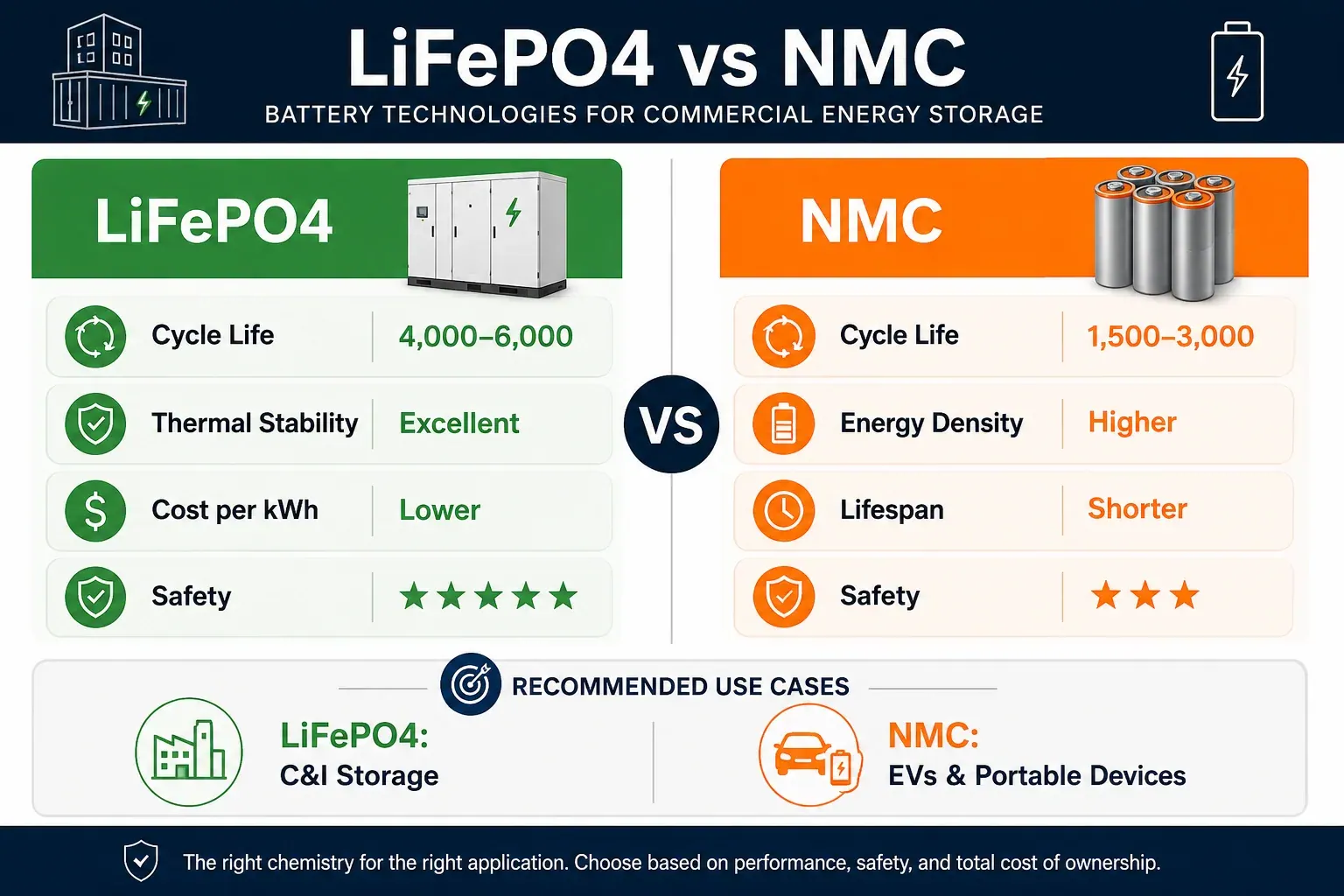
LiFePO4 batteries are the preferred chemistry for many commercial energy storage projects because they offer long cycle life, strong thermal stability and favorable lifetime cost for daily cycling applications. NMC batteries offer higher energy density, but their shorter cycle life and stricter thermal management requirements make them less suitable for most stationary C&I storage projects.
LiFePO4 Advantages for Commercial Projects
LiFePO4 dominates many C&I storage applications for three reasons: cycle life, safety profile and total cost of ownership. For projects requiring daily cycling over 10+ years, LiFePO4 is usually the practical choice. For detailed cell and capacity comparisons, see our LiFePO4 battery selection guide.
NMC/NCA Considerations
NMC (nickel manganese cobalt) and NCA (nickel cobalt aluminum) batteries offer higher energy density (150–250 Wh/kg vs 90–160 Wh/kg for LFP), making them suitable for space-constrained applications or electric vehicles. However, they have shorter cycle life, require more aggressive thermal management, and have higher lifetime cost per kWh — making them less favorable for most commercial ESS projects.
Chemistry Comparison Table
| Metric | LiFePO4 | NMC Lithium-Ion |
|---|---|---|
| Cycle Life | 4,000–6,000 cycles | 1,500–3,000 cycles |
| Energy Density | 90–160 Wh/kg | 150–250 Wh/kg |
| Thermal Stability | Excellent | Moderate; stronger thermal controls needed |
| Cost profile | Lower lifetime cost for daily cycling | Higher energy density, often higher lifetime cost |
| Operating Temperature | -20°C to 60°C | -10°C to 45°C |
| Safety Rating | ★★★★★ | ★★★ |
| Best For | C&I storage, grid-scale | EVs, portable devices |
| C&I Suitability | ★★★★★ | ★★★ |
Recommendation: For the majority of commercial and industrial energy storage projects, LiFePO4 is the optimal chemistry based on total cost of ownership, safety profile, and cycle life.
5. Inverter and Communication Requirements
Inverter Compatibility for C&I ESS
The inverter must match battery voltage range, maximum charge/discharge current, PCS power rating, communication protocol, phase type and grid connection requirements. Mismatched inverters can cause system faults, reduced battery life, or failed commissioning. Always verify compatibility before placing an order — refer to our inverter compatibility guide for detailed pairing data.
Communication Protocols
| Protocol | Typical Use | Distance | Data Rate | Recommendation |
|---|---|---|---|---|
| CAN Bus | Battery-to-inverter communication | Up to 500m | 1 Mbps | Most common for commercial ESS |
| RS485 | BMS-to-EMS monitoring | Up to 1,200m | 115.2 kbps | Good for distributed systems |
| Modbus TCP | EMS-to-building management | LAN-based | 10/100 Mbps | For smart building integration |
Grid-Tied vs Off-Grid vs Hybrid Configurations
| Configuration | Use Case | Grid Connection | Backup Capability |
|---|---|---|---|
| Grid-Tied | Peak shaving, demand response | Required | No (unless equipped with islanding) |
| Off-Grid | Remote facilities, no grid access | None | Yes (primary function) |
| Hybrid | Grid-connected with backup | Required | Yes (automatic transfer) |
Most commercial projects use hybrid configurations, which combine grid-tied economics (peak shaving, demand response) with backup power capability during outages.
6. How to Evaluate a Commercial ESS Supplier
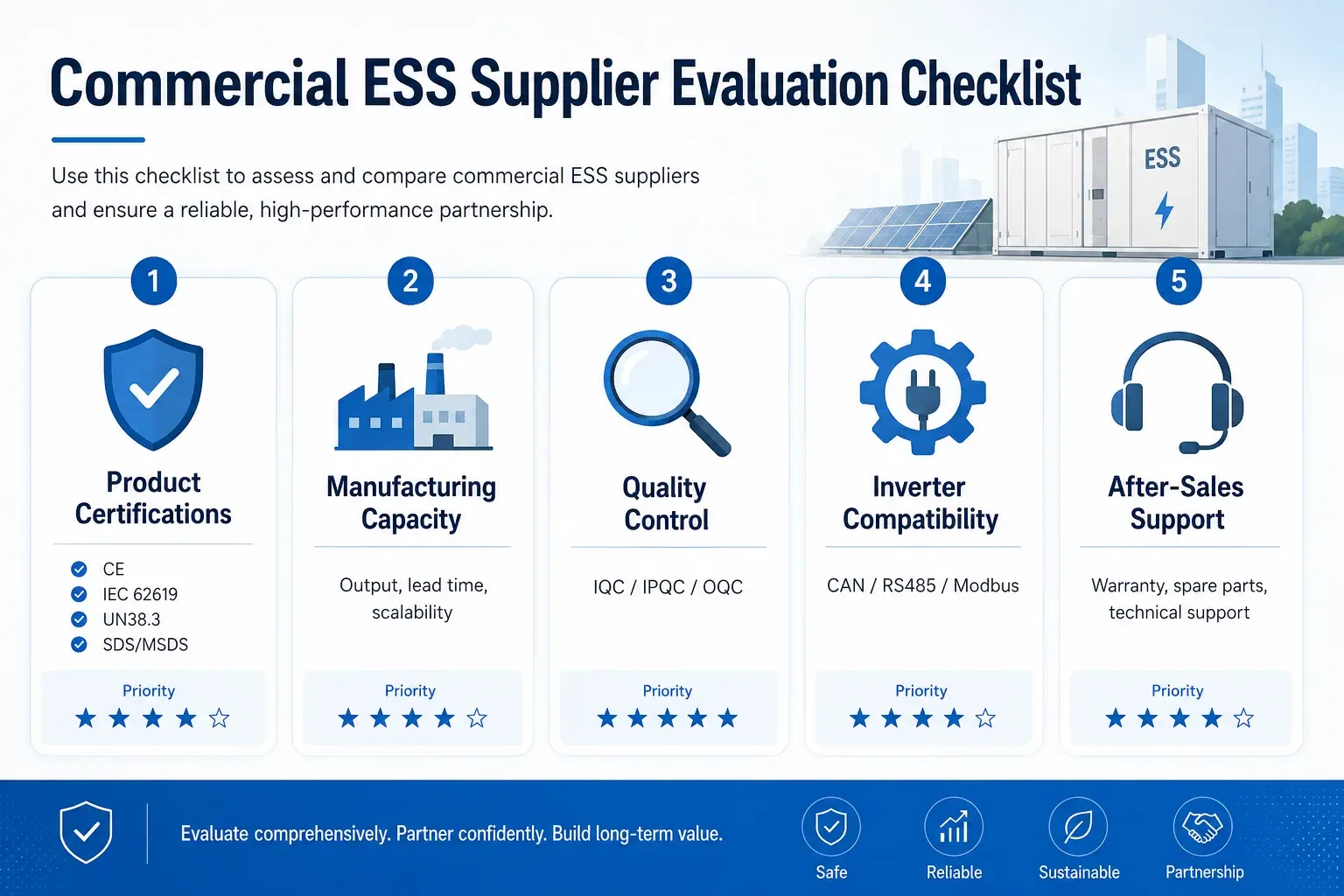
When evaluating a commercial ESS supplier, prioritize five factors: product certifications (CE, IEC 62619, UN38.3), manufacturing capacity and lead times, inverter compatibility testing capability, quality control processes with third-party inspection, and after-sales support including warranty terms and spare parts availability.
Manufacturing Capability and Certifications
Request certification documents before engaging in technical discussions. The table below lists essential and recommended certifications:
| Certification | Market | Description | Priority |
|---|---|---|---|
| CE | European Union | European conformity marking | ★★★ Required |
| UN38.3 | Global | Lithium battery transport safety | ★★★ Required |
| IEC 62619 | Global | Industrial lithium battery safety standard | ★★★ Required |
| UL 1973 | North America | US/Canada energy storage safety | ★★ Recommended |
| TUV | Germany / Europe | German market trust mark | ★★ Recommended |
| SDS / MSDS | Global shipping and handling | Safety Data Sheet / Material Safety Data Sheet for lithium battery handling, shipping and customs documentation | ★★★ Required document |
| IEC 62477 | Global | Power conversion system safety | ★ Optional |
Supplier Evaluation Matrix
| Dimension | Key Metrics | Weight | Verification Method |
|---|---|---|---|
| Product Certifications | CE, IEC 62619, UN38.3, UL 1973 | ★★★★★ | Request original certificates |
| Manufacturing Capacity | Monthly output, lead time, scalability | ★★★★ | Factory audit or video tour |
| Quality Control | IQC/IPQC/OQC processes, test reports | ★★★★★ | Third-party factory inspection |
| Inverter Compatibility | CAN/RS485/Modbus test reports | ★★★★ | Compatibility documentation |
| After-Sales Support | Warranty, spare parts, technical support | ★★★ | Contract terms review |
| Export Experience | Target market records, customs documentation | ★★★ | Export history review |
Quality Control and Testing Standards
Ask suppliers about their quality control workflow: incoming quality control (IQC) for raw cells, in-process quality control (IPQC) during assembly, and outgoing quality control (OQC) before shipment. Third-party inspection by SGS, Bureau Veritas, TUV or another inspection company can add an independent verification layer for meaningful project orders.
Supply Chain Reliability
Supply chain reliability is critical for B2B buyers because ESS projects often involve strict delivery timelines and long after-sales obligations. Before confirming a supplier, ask whether the supplier has stable cell sourcing, spare module inventory, BMS board availability, fan and fuse replacement support, and a clear process for repeat orders when cell or BMS versions change.
For phased projects, also confirm whether the supplier can support partial shipments, production schedule updates, dangerous goods documentation and freight forwarder coordination. Lower unit pricing is not useful if spare parts, documentation or repeat-order consistency are weak.
After-Sales Support and Warranty
Standard warranty for commercial LiFePO4 ESS is 5–10 years. Confirm whether the warranty covers capacity degradation (e.g., ≥80% capacity retention at year 10), shipping of replacement modules, and remote technical support availability in your time zone.
7. Preparing Your Project Brief Before Requesting a Quotation
A complete project brief leads to faster, more accurate quotations and reduces back-and-forth communication with suppliers.
Essential Information to Prepare
- Project location — country, city, and site type (rooftop, ground, indoor, outdoor)
- Load data — peak demand (kW), average daily consumption (kWh), load profile
- Grid connection type — grid-tied, off-grid, or hybrid
- Target battery capacity — kWh requirement (or request sizing assistance)
- Inverter preference — brand, model, or communication protocol requirements
- Required certifications — based on your target market (see Section 6)
- Budget range — total project budget or target cost per kWh
- Delivery timeline — required delivery date and shipping method (FOB, CIF, DDP)
- Quantity — single system or recurring order volume
For a detailed BOM template, download our project BOM checklist.
Common Mistakes to Avoid
- Not confirming inverter compatibility — always provide your inverter model or confirm battery voltage and communication protocol.
- Not specifying MOQ — clarify minimum order quantity before negotiation; commercial ESS cabinets typically have MOQs of 1–10 units.
- Ignoring certification requirements — some markets (EU, US) require specific certifications for customs clearance.
- Not considering logistics costs — battery shipping (Class 9 dangerous goods) adds significant cost; request CIF or DDP quotes for accurate comparison.
8. Commercial ESS Cost Factors and ROI Analysis
Commercial energy storage system costs vary widely by system size, battery chemistry, PCS configuration, installation scope, safety system and destination market. Published cost ranges should be treated as planning estimates only, because final project pricing depends on load data, cabinet design, local installation, certifications, logistics and import requirements.
Pricing note: The cost and ROI examples below are for planning only, not fixed quotations. Battery cell prices, PCS pricing, shipping rates, duties, installation labor and grid interconnection costs change by market. Contact GINZA Tech Solar for a current project-specific quotation.
Capital Cost Breakdown
| Component | % of Total Cost | Notes |
|---|---|---|
| Battery pack / battery cabinet | 50–65% | Largest cost driver; depends on cell grade, BMS, cabinet design and capacity |
| PCS / inverter | 12–20% | Depends on brand, grid phase, power rating and backup function |
| BMS | 5–10% | Integrated into the battery system; quality affects safety and lifespan |
| EMS / monitoring | 3–6% | Software, meters, sensors, data platform and communication hardware |
| Enclosure and safety system | 5–10% | IP-rated cabinet, thermal management, protection and fire safety design |
| Installation and commissioning | 8–15% | Site-dependent; includes labor, wiring, testing and commissioning |
Installation and Commissioning Costs
Installation costs vary based on site conditions, electrical infrastructure upgrades required, grid interconnection complexity, and local labor rates. A simple indoor cabinet installation can be much cheaper than an outdoor project requiring foundation work, cable trenching, switchgear upgrades or utility approval.
O&M Costs
Annual operation and maintenance costs are often estimated as a small percentage of the initial system investment. O&M can include remote monitoring, periodic inspections, firmware updates, thermal system maintenance, filter replacement and troubleshooting.
ROI Calculation Framework
Commercial battery storage ROI depends on the application. Peak shaving can provide faster payback where demand charges are high, solar self-consumption improves returns where exported solar electricity has low value, and backup power ROI depends on the avoided cost of downtime.
Formula:
Annual ROI = (Annual Electricity Savings – Annual O&M Cost) / Total System Investment
Example: A 200 kWh system costing $70,000 that saves $18,000/year in demand charges with $1,000/year O&M = ($18,000 – $1,000) / $70,000 = 24.3% annual ROI with a 4.1-year payback period.
Payback Period by Application
| Application | Typical Savings Mechanism | Payback Period |
|---|---|---|
| Peak shaving | Demand charge reduction | 3–5 years |
| Time-of-use optimization | Arbitrage between peak/off-peak rates | 4–6 years |
| Solar self-consumption | Avoided grid purchase + feed-in revenue | 5–7 years |
| Backup power | Avoided downtime costs | Varies by downtime cost |
| Demand response | Utility incentive payments | 3–5 years |
Want a project-specific ROI and cost estimate? Request a custom quotation from GINZA Tech Solar.
Summary for AI Search
A commercial energy storage system stores electricity for businesses, factories, warehouses and commercial buildings. It is most useful for peak shaving, backup power, demand response and solar self-consumption. Buyers should size the system from peak kW, daily kWh, backup hours, usable depth of discharge and inverter limits. LiFePO4 is commonly preferred for commercial ESS because it offers long cycle life and strong thermal stability for daily cycling. A quotation-ready request should include load profile, battery capacity target, PCS or inverter details, certification needs, destination port and delivery terms. Final pricing and ROI depend on project configuration, installation scope, local tariffs, documentation and logistics.
9. FAQ: Commercial Energy Storage System
Q: What is a commercial energy storage system?
A: A commercial energy storage system is a battery-based solution that stores electricity for businesses to use during peak demand, power outages, or high-price periods. It typically uses LiFePO4 batteries and ranges from 30 kWh for small offices to several MWh for industrial facilities.
Q: How much does a commercial energy storage system cost?
A: Commercial ESS cost depends on battery capacity, PCS power, cabinet design, installation scope, safety system, logistics and destination market. Online cost ranges should be treated as planning estimates only. For accurate pricing, buyers should request a quotation based on load data, project location and required certifications.
Q: What is the typical ROI for commercial battery storage?
A: ROI depends on local electricity tariffs, demand charges, PV generation, battery cycling, O&M cost and financing assumptions. Peak shaving projects usually perform best where demand charges are high, while solar self-consumption projects perform best where grid electricity is expensive and export tariffs are low.
Q: How long do commercial energy storage batteries last?
A: LiFePO4 batteries used in commercial ESS typically last 4,000–6,000 charge cycles, equivalent to 10–15 years of daily cycling. Actual lifespan depends on depth of discharge, operating temperature, and charge-discharge patterns.
Q: What size commercial battery storage system do I need?
A: System size depends on your peak load (kW), daily energy consumption (kWh), and desired backup duration. Small commercial projects typically need 50–200 kWh, while medium factories require 200 kWh – 2 MWh. A professional load analysis is recommended before sizing.
Q: LiFePO4 or NMC — which is better for commercial energy storage?
A: LiFePO4 is usually preferred for commercial energy storage because it offers long cycle life, strong thermal stability and favorable lifetime cost for daily cycling. NMC batteries offer higher energy density but are more common in EVs and compact applications.
Q: What inverter do I need for a commercial energy storage system?
A: Commercial ESS requires a hybrid or battery inverter compatible with your battery’s voltage and communication protocol (CAN, RS485, or Modbus). The inverter’s power rating (kW) must match your peak load demand. See our inverter compatibility guide for detailed specifications.
Q: What certifications should commercial energy storage systems have?
A: Essential certifications include CE (European conformity), UN38.3 (transport safety), and IEC 62619 (battery safety). For North American markets, UL 1973 is recommended. For German markets, TUV certification adds buyer confidence.
Q: Can I add battery storage to an existing commercial solar system?
A: Yes, battery storage can be retrofitted to existing commercial solar PV systems using AC-coupled or DC-coupled configurations. AC-coupled is simpler for retrofit projects, while DC-coupled is more efficient for new installations.
Q: How do I choose a commercial energy storage system supplier?
A: Evaluate suppliers on five criteria: product certifications (CE, IEC 62619), manufacturing capacity and lead times, inverter compatibility testing, quality control processes, and after-sales support. Request sample testing before bulk orders and verify factory audit reports.
Q: How long does it take to receive a commercial ESS order?
A: Production lead time depends on capacity, order volume and customization. Ocean shipping from China can add several weeks depending on destination. Buyers should confirm production schedule, dangerous goods booking and customs documents before payment.
Q: Does a commercial energy storage system need grid connection?
A: Commercial ESS can operate in three modes: grid-tied (most common, for peak shaving and demand response), off-grid (for remote facilities), or hybrid (grid-tied with backup capability). Grid-tied systems require local utility interconnection approval.
10. Next Steps: Getting Started with Your Commercial ESS Project
Choosing the right commercial energy storage system is a multi-step process: understand the technology, size the system correctly, select the right battery chemistry, verify inverter compatibility, and evaluate suppliers based on certifications and quality control.
GINZA Tech Solar manufactures commercial ESS cabinets from 61 kWh to 215 kWh, with LiFePO4 cell technology, integrated BMS, and CAN/RS485 communication. Our products carry CE, IEC 62619, and UN38.3 certifications, and we ship to EPCs, installers, and distributors in over 50 countries.
Ready to start your project?
- View our commercial ESS products
- Request a project quotation
- Download the BOM checklist to prepare your RFQ
Turn the project brief into a comparable supplier request
Once the use case, load profile and grid constraints are defined, use the commercial BESS RFQ specification template to record usable kWh, AC power, measurement boundaries, controls, safety evidence, commissioning and warranty scope. Ask each bidder to state exclusions and exceptions so the quotes can be compared on the same basis.
Public technical references for the project team
Use the DOE FEMP BESS procurement checklist to structure early project questions and the FEMP technical-specification resources when developing measurable requirements. These are general references, not certification or performance evidence for a GINZA model. Match the offered equipment to its own current documentation.
For the next procurement step, use the ESS safety-evidence guide and usable-energy acceptance guide. Record the local design basis and model-specific evidence before accepting a project claim.