
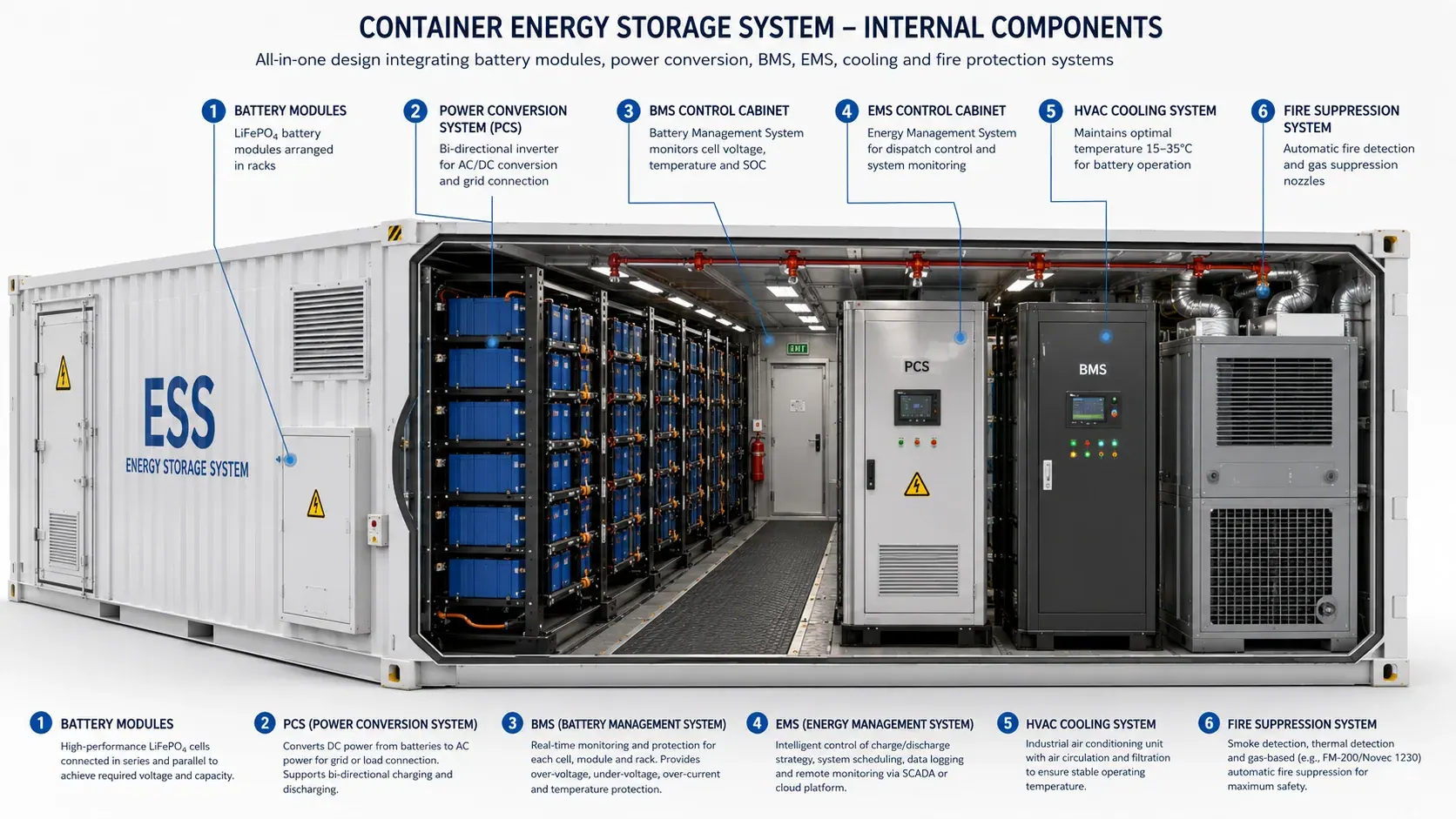
Quick answer: UL 9540 is a product/system safety standard for energy storage equipment; UL 9540A is a test method for thermal-runaway fire propagation; NFPA 855 is an installation standard. An “UL 9540A certificate” is not a substitute for a model-specific UL 9540 listing or for the local authority’s installation review. Ask which exact battery, enclosure, PCS, controls and configuration the evidence covers.
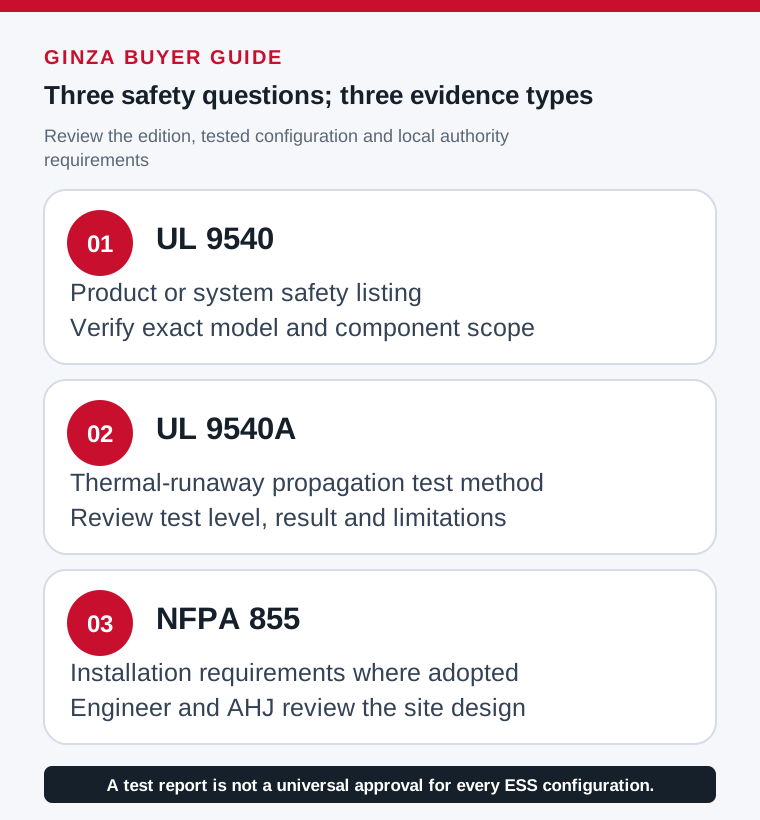
This guide helps EPC procurement teams ask better questions when evaluating a commercial battery energy storage system (BESS). It does not certify a GINZA product or tell a designer which code edition the jurisdiction has adopted. The engineer of record and authority having jurisdiction (AHJ) determine the applicable requirements. For the broader procurement scope, use the commercial BESS RFQ template.
Three documents that answer different questions
| Standard or evidence | Buyer question it helps answer | Common misunderstanding |
|---|---|---|
| UL 9540 product listing / certification scope | Is the offered ESS configuration evaluated as a system under the applicable product standard? | A cell or component certificate automatically covers a complete ESS. |
| UL 9540A test report | What happened in the defined thermal-runaway and fire-propagation tests for a representative configuration? | Passing a test method alone grants a universal installation approval. |
| NFPA 855 / local fire and building review | How may the ESS be installed at this particular site, with separation, access and protection? | A product document replaces the site permit or AHJ decision. |
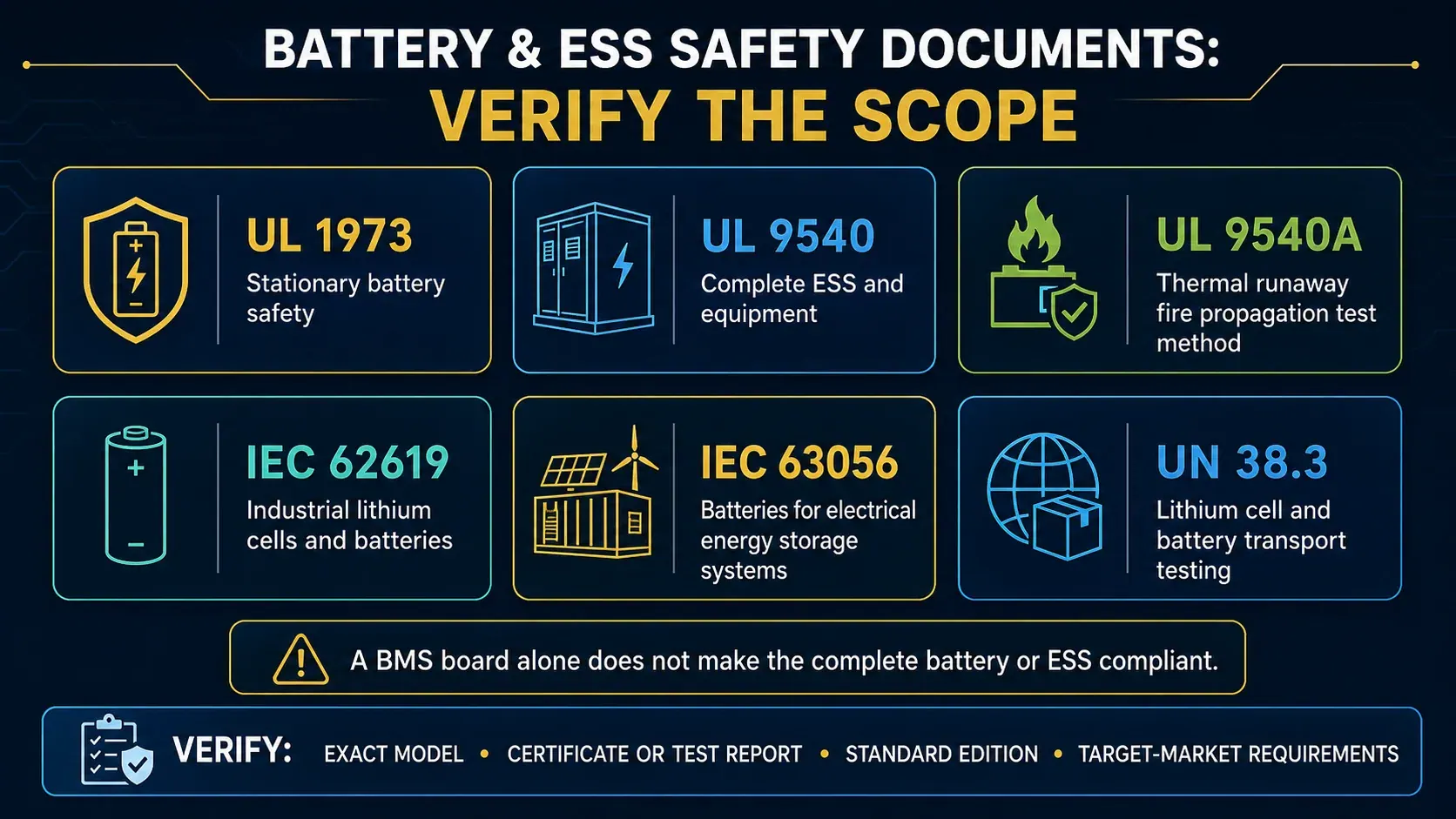
UL Solutions describes UL 9540 as the foundational ESS product standard and UL 9540A as a standardized fire-test method. Product iQ or the relevant certification body can help verify the exact listed model and scope. A quoted “compliant battery” should be converted into a checkable product identifier and evidence package.
What is different in the 2026 discussion?
UL Solutions reports that the sixth edition of UL 9540A was published on 13 March 2026. Its large-scale installation test was revised to align with the 2026 edition of NFPA 855. UL also describes a 1 January 2027 effective date for Ed. 6. In the intervening period, bidders may present evidence based on different editions; the applicable edition and local adoption must be confirmed with the project team and AHJ. Do not assume every jurisdiction has already adopted NFPA 855 (2026).
UL explains that Ed. 6 adds an installation-level large-scale fire scenario after module-level testing for non-residential BESS. The test is intended to provide data about propagation, separation, enclosure and protection behavior under severe conditions. It is not a promise that a deployed site has no fire risk.
Ask for evidence that matches the offered system
| Document request | Verify before accepting it |
|---|---|
| Equipment schedule and one-line diagram | Exact battery, BMS, PCS, enclosure, cooling, controls and unit count |
| UL 9540 or other locally required product evidence | Listing holder, model number, installation conditions and included components |
| UL 9540A report or permitted report summary | Edition, test level, representative configuration, results and any limitations |
| Installation manual and site plan | Indoor/outdoor use, separation, access, ventilation, fire protection and emergency response interfaces |
| AHJ and insurer response | Applicable code edition, permits, deviations and outstanding conditions |
A supplier may need to share a full test report under confidentiality terms. Record what was reviewed and which configuration it covered. If the proposed enclosure, pack arrangement or protection system differs from the tested one, request the manufacturer and qualified reviewer to explain the technical and approval implications.
Make the safety review part of the RFQ and handover
Before award, specify who prepares the site hazard analysis, who provides fire-test and product evidence, who obtains approvals, and who maintains emergency information. At factory and site acceptance, verify the shipped model, labels, firmware and protection interfaces against approved submittals. Include operator training, alarms, shutdown instructions, service contacts and as-built documents in handover. The PV and battery commissioning report template can capture project-specific test results; it does not replace a code review.
For procurement context, read the commercial ESS buyer’s guide. GINZA can review a proposed commercial ESS product scope against a buyer’s document request, but model-specific certification or test coverage should only be stated after the documents are checked.
Use an exception register when the evidence differs
In a bid comparison, do not reduce safety evidence to a yes/no column. Record the exact claim, document issuer, model and revision, tested configuration, proposed configuration, gap and person responsible for resolving it. For example, a report for one outdoor enclosure should be flagged if the bid proposes a different indoor arrangement. The supplier can explain the change, but the engineer and AHJ must decide what further testing or approval is needed. Keep this register with the RFQ response so a qualification made during sales is not lost between contract award and commissioning. Ask bidders to identify documents still pending and the date by which they will be supplied.
Build an evidence register for the configuration being bought
A procurement claim such as “UL compliant” is too broad to approve. Start an evidence register with the offered ESS manufacturer’s name; cabinet or container model; battery module and cell identification; PCS model; BMS and control versions; enclosure and thermal-management arrangement; nominal energy and power; and installation location. For each certificate or test report, record the issuing organization, document number, edition, date, tested model, configuration and limitations. The objective is to see a traceable chain from the quoted BOM to the evidence, not to collect the largest pile of PDFs.
Ask the certifying body’s public listing database or the issuing body to verify a product listing where available. A component listing may be useful, but it does not automatically establish a complete ESS listing. The engineer and local authority having jurisdiction (AHJ) decide what evidence is acceptable for the actual installation.
| Evidence line | Match to check | Open issue to record |
|---|---|---|
| System product evidence | Offered cabinet/container, PCS and included components | Different model, missing PCS or limited rating |
| UL 9540A fire-test evidence | Test edition, level, enclosure and representative configuration | Report covers another enclosure or different battery arrangement |
| Installation design | Site code edition, spacing, ventilation, fire response and access | Local adoption or AHJ condition is unresolved |
| Commissioning and O&M | Settings, alarms, inspection and emergency procedures | Evidence does not carry into the as-built handover |
Worked review: the report covers a different cabinet
Imagine a bidder offering Cabinet B with a new fan layout, while its UL 9540A report names Cabinet A. Do not infer that the report is automatically invalid or automatically transferable. Ask for a technical comparison of battery cells, modules, spacing, enclosure, ventilation, controls and power electronics. Request a statement from the responsible test or certification organization where applicable. The project engineer then records whether the difference needs more evidence or a new test and presents the decision to the AHJ. An unsupported sentence from a sales brochure is not a substitute for that review.
The same discipline applies to a report from an earlier standard edition. UL Solutions describes a sixth edition of UL 9540A published in March 2026 and an effective date in January 2027. Which edition a project must use depends on its timing, the relevant certification program and local adoption. Ask the bidder to state the edition on every report and explain any transition plan. Do not describe NFPA 855 (2026) as a rule already adopted everywhere.
What a buyer should ask in the first safety meeting
- What exact ESS model, rating and configuration will be delivered, including battery, PCS, controls, thermal system and enclosure?
- Which product listing or other locally required safety evidence covers that complete configuration?
- Which UL 9540A report, edition and test level are relevant, and what are its documented limitations?
- Which NFPA 855 edition or local code has the project jurisdiction adopted, and what additional AHJ conditions apply?
- Who owns the site hazard review, fire response plan, ventilation, separation, commissioning and as-built documentation?
Give each unanswered question an owner and due date. An RFQ should require a bidder to disclose gaps rather than hide them under “complies with all standards.” For a broader supplier comparison, pair this evidence register with the BESS RFQ template and the performance acceptance guide.
Decision rule before placing an order
Proceed to a final technical approval only when the offered configuration is frozen, the document scope is traceable to it, local code and AHJ questions are assigned, and missing evidence has a written resolution path. A qualified engineer can still accept a project-specific alternative where permitted; the buyer should capture that decision and its conditions in the contract and handover package. This guide is a method for asking questions, not a certification statement about a GINZA ESS.
Frequently asked questions
Does UL 9540A certify a BESS?
It is a test method, not a general product listing. Ask separately for the applicable system certification and its exact scope.
Does NFPA 855 (2026) apply everywhere now?
No. Local adoption and amendments vary. Confirm the governing edition with the AHJ and engineer of record.
Can a battery cell certificate cover a complete cabinet?
Not automatically. A cabinet includes packs, controls, thermal management, power electronics and enclosure interfaces. Check system-level evidence for the offered configuration.
What if a bidder has a UL 9540A report for another enclosure?
Request a written explanation of model and configuration differences, then seek the required technical and AHJ review before treating it as applicable.