
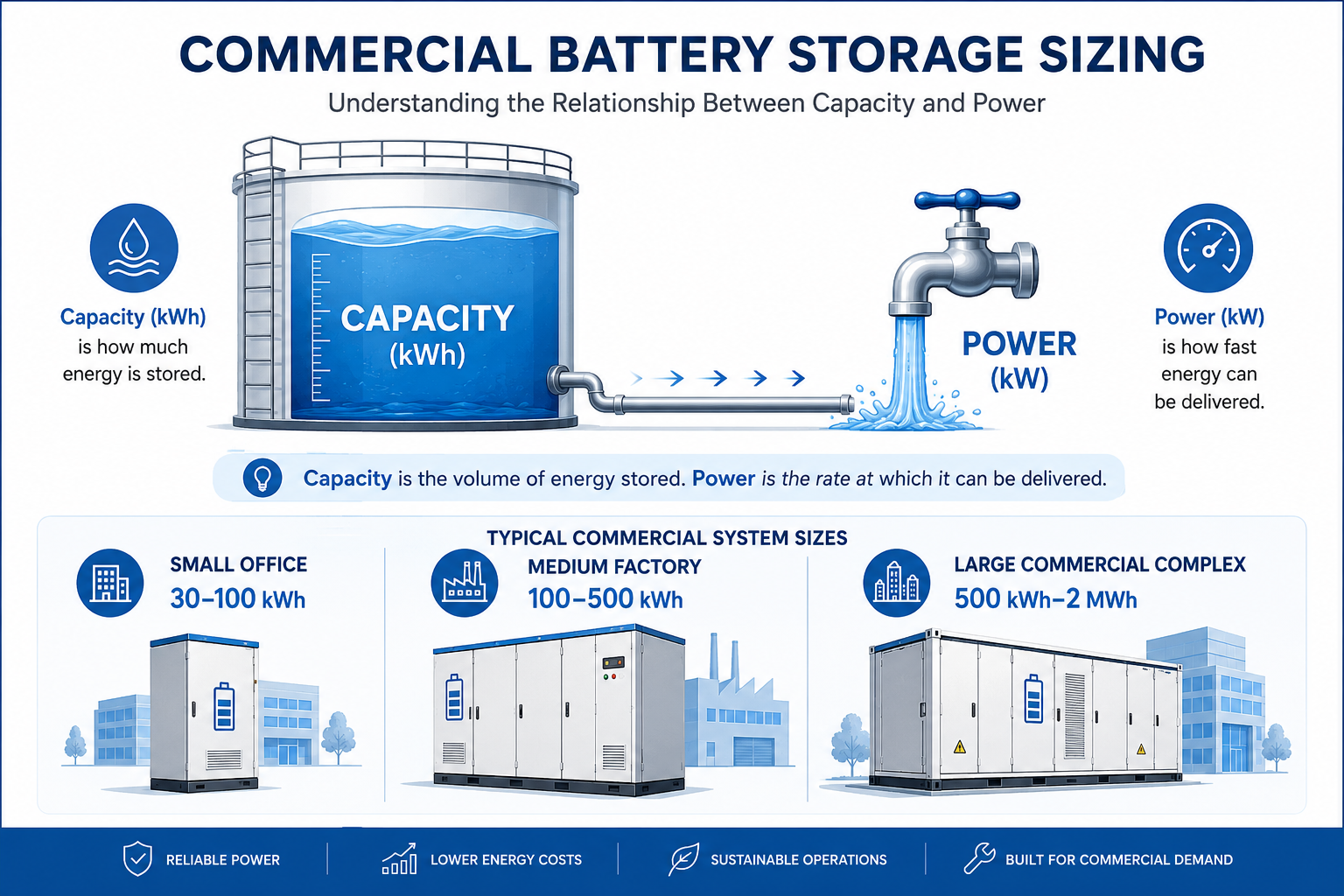
Quick answer: A commercial BESS quotation should state usable energy at a named measurement point, not just cell or rack nameplate kWh. It should also define round-trip efficiency as discharged energy divided by charged energy over a specified test window. The meter boundary, state-of-charge (SOC) range, power, temperature, auxiliary loads and test method can materially change the number. Compare bids only after those conditions are aligned.
This guide is for EPC and commercial buyers writing performance requirements or reviewing acceptance results. It complements our commercial BESS RFQ template, which lists the full procurement scope. The calculations below are illustrations, not performance claims for a GINZA product.
Nominal, usable DC and usable AC kWh are not interchangeable
| Term | What it usually describes | What the buyer must ask |
|---|---|---|
| Nominal or nameplate battery kWh | Rated cell or pack voltage × amp-hours, or the manufacturer’s stated rack energy | At which level and under which rating conditions? |
| Usable DC kWh | Energy available across the permitted SOC window at a DC boundary | What SOC limits, discharge rate and temperature apply? |
| Usable AC kWh | Energy delivered after conversion at a specified AC meter | Which PCS, auxiliary loads and meter boundary are included? |
| End-of-life usable kWh | Expected or warranted usable energy at a defined future condition | What years, cycles/throughput, duty cycle and remedy are specified? |
As a simple illustration, a 500 kWh nominal battery operated across an 80% SOC window has 400 kWh of nominal-window DC energy before rate, temperature and aging effects. If an assumed discharge conversion factor were 94%, a rough AC figure would be 376 kWh. Neither assumption is a product guarantee; a real specification must use the offered equipment’s validated limits and a defined test.
How to state round-trip efficiency
For the operating budget outside the acceptance cycle, use the auxiliary energy worksheet to compare active standby, dispatch and recovery on a common schedule.
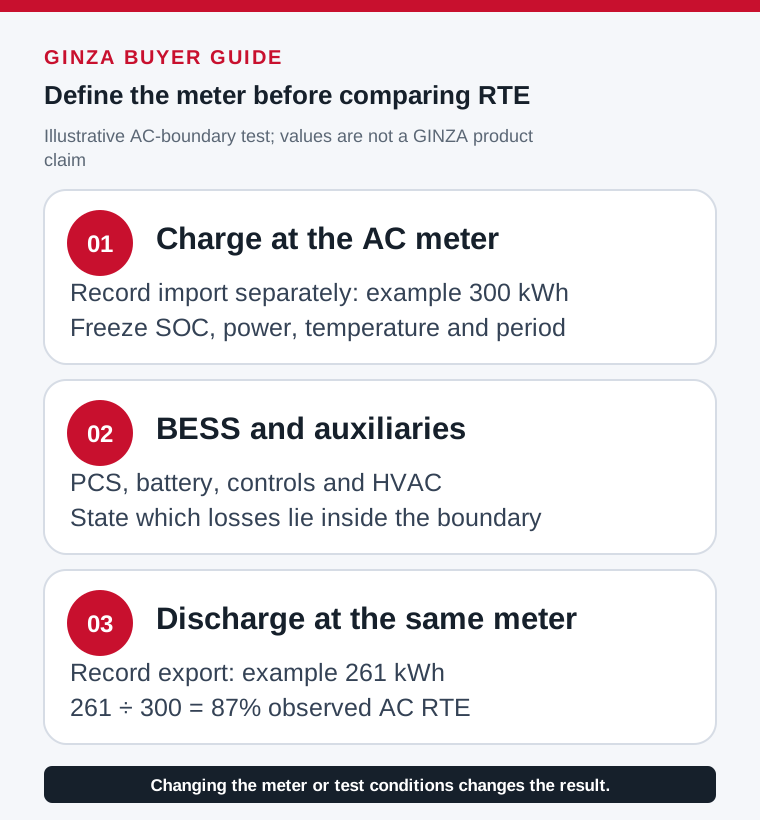
At the same metering boundary, round-trip efficiency = metered discharge energy ÷ metered charge energy × 100%. If a controlled test records 100 kWh into a system and 88 kWh out under the agreed conditions, the observed value is 88%. That number may differ if charging is measured at the battery DC terminals while discharge is measured at the AC point of connection; the boundary must be identical or the comparison is misleading.
The U.S. Department of Energy’s FEMP evaluation method uses metered charge and discharge data to calculate efficiency and demonstrated capacity. It notes that temperature, charge rate and the period of observation affect interpretation; at least one complete cycle is needed, and more complete cycles improve confidence. A one-day site acceptance test and a long-term operating KPI are related but different deliverables.
Write the acceptance conditions before signing the contract
| Field | Example of what to specify |
|---|---|
| Equipment and configuration | Battery/PCS/EMS model, software version, number of racks and operating mode |
| Measurement boundary | DC battery terminals or named AC meter/point of interconnection; include a single-line diagram |
| Auxiliary energy | Whether HVAC, pumps, controls and standby consumption are included |
| SOC and reserve | Starting and ending SOC, allowed operating window and reserve for backup |
| Power and temperature | Charge/discharge kW, ambient and equipment temperature range |
| Test duration and data | Cycle count, meter interval, calibration, timestamped logs and interruption rules |
| Acceptance and remedy | Required usable kWh and efficiency, tolerance, retest procedure and corrective action |
Also state whether the test is at the factory, at the project site or both. A factory witness test may verify the product under controlled conditions but cannot by itself prove site performance after installation, wiring, HVAC and controller settings change.
A practical site test sequence
- Freeze the test basis. Agree on the operating mode, SOC window, power profile, temperature range, meter location and auxiliary-load treatment.
- Verify instruments and configuration. Record meter IDs and calibration, BMS/PCS/EMS firmware, protection settings and any curtailment or export limit.
- Record charge and discharge separately. Save timestamped data, not only net energy; otherwise energy moving both ways within an interval can be hidden.
- Run the agreed cycle or operating period. Note alarms, interruptions and ambient conditions. Do not quietly remove failed intervals.
- Calculate and sign. Show charged kWh, discharged kWh, demonstrated usable energy, efficiency, deviations and retest status in the handover record.
Use the PV and battery commissioning report template to record test evidence and signatures. Use the battery warranty guide to compare initial acceptance with years, throughput and end-of-life conditions. One successful capacity test does not establish the future warranty outcome.
Questions to put to two competing bidders
- Is the quoted kWh cell, pack, usable DC or usable AC?
- At which meter and SOC window was the efficiency measured?
- Are HVAC and standby loads inside the boundary?
- What happens to output at the site’s hot and cold conditions?
- What documents will be delivered at factory and site acceptance?
- What is the retest and remedy process if the agreed value is missed?
These answers are often more useful than comparing two large nameplate kWh figures. If you are preparing a project quotation, send your load profile, required AC power, usable energy target, operating duty cycle, site temperature and grid interface. GINZA can review the appropriate commercial ESS product category against that brief without assuming a guaranteed project result.
Worked example: calculate from the actual meter log
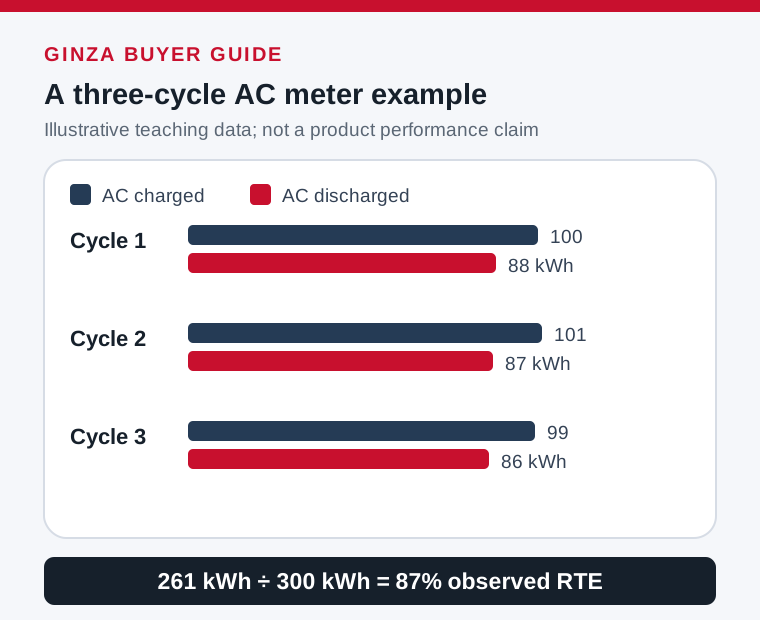
Assume an agreed AC meter records the following illustrative complete charge and discharge cycles. The figures are teaching data, not a GINZA product test or guarantee. Keep imported and exported energy in separate columns; net energy for the day would hide the two flows. Sum the energy for all accepted cycles at the same boundary, then divide total discharge by total charge.
| Cycle | AC energy charged | AC energy discharged | Observed cycle RTE |
|---|---|---|---|
| 1 | 100 kWh | 88 kWh | 88.0% |
| 2 | 101 kWh | 87 kWh | 86.1% |
| 3 | 99 kWh | 86 kWh | 86.9% |
| Total | 300 kWh | 261 kWh | 87.0% = 261 ÷ 300 |
The pooled 87.0% result is energy-weighted. Averaging three percentage labels is an unnecessary shortcut, particularly when cycles have different sizes. If the contract requires one commissioning cycle, report that cycle; if it calls for a multi-cycle or long-term KPI, use the defined data window and exclusion rules. The DOE FEMP evaluation method is based on metered charge and discharge time series and discusses how completeness and operating conditions affect interpretation.
Usable capacity answers a different question
Round-trip efficiency describes energy lost over a charge/discharge path. Usable energy describes how much can be delivered over a specified operating window. A system quoted at 200 kWh nominal DC might have a lower usable AC value because the agreed SOC reserve, conversion losses, temperature and discharge power limit the energy at the meter. There is no defensible universal conversion from the nameplate to usable AC kWh. Ask the bidder to provide both values, the measurement boundary and the test conditions.
For backup planning, an illustrative 180 kWh usable AC value divided by a steady 100 kW load suggests at most 1.8 hours before additional reserves or derating. It is not a runtime promise: the real load changes, some equipment has surge demand, minimum SOC may be held for safety or resilience, and the PCS has a power limit. The owner should provide a time-series critical-load profile and require a project simulation and an acceptance test.
Prevent a false comparison between two bids
| Bid line | Bid A | Bid B | Buyer action |
|---|---|---|---|
| Capacity basis | Cell nameplate DC | Usable AC at point of connection | Request both on the same boundary |
| Efficiency basis | PCS peak efficiency | Whole-system AC round-trip efficiency | Do not compare these percentages directly |
| Auxiliary loads | Excluded | HVAC included | State the same inclusion rule |
| Test conditions | Unspecified | SOC, power and temperature stated | Require the missing conditions in writing |
Do not award points to a larger headline number until the scope is aligned. Ask for a guaranteed value at the same meter, permitted tolerance, warranty or availability conditions, retest method and remedy if the project acceptance value is missed. A bidder may legitimately offer different operating modes; compare each against the owner’s duty cycle rather than a universal best-case number.
Acceptance log: fields that make the result auditable
Record the approved test procedure; drawing and meter identifier; calibration date; firmware and control settings; SOC start and end; charge and discharge power profile; ambient and battery temperature; auxiliary-load treatment; timestamped import/export kWh; alarms and interruptions; calculated usable energy; RTE; deviations; witness names; and the signed disposition. If a test fails, preserve the original log and agree the corrective action and retest conditions. A single screenshot of the EMS dashboard is not a sufficient handover record.
Frequently asked questions
Can I divide nameplate kWh by kW to promise backup hours?
No. Use usable AC energy at the required power, reserve and operating conditions, then test surge and critical-load behavior separately.
Is round-trip efficiency the same as inverter efficiency?
No. Round-trip efficiency covers the specified charge/discharge path and losses at the defined meter boundary. A PCS efficiency number is only one component.
Why does the test result differ from the datasheet?
Possible causes include a different boundary, SOC window, power rate, temperature, auxiliary-load treatment, meter error or configuration. Compare against the agreed test basis before diagnosing a product issue.
Is one cycle enough?
It may be the contractually specified acceptance test, but longer metered periods and repeated complete cycles give more confidence for operational performance, as the DOE method explains.