
A battery energy storage system (BESS) uses auxiliary power for equipment such as controls, cooling and heaters. To compare suppliers, request both instantaneous demand in kW and energy in kWh over the same schedule, climate assumptions and meter boundary. A maximum auxiliary feeder rating helps the electrical designer. A daily kWh estimate answers a different question: how much energy the site should budget to keep the system in its specified operating states.
Start with a load schedule and a metering sketch. The Sandia and PNNL storage performance protocol defines auxiliary loads and describes how separately powered auxiliaries can enter a performance calculation. Use the contract test method applicable to your project. A tender can also require a separate annual operating estimate, which needs more than a single cycle test.
Define the operating states before you compare bids
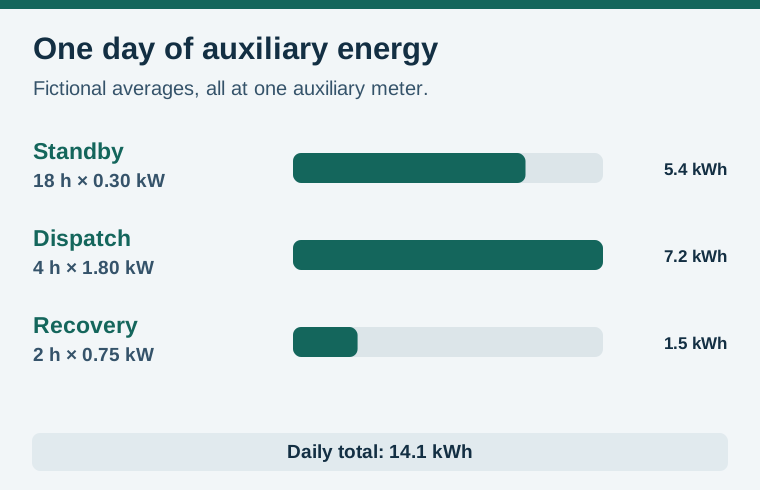
Ask each bidder to describe active standby, charging, discharging and the interval after dispatch. A system standing ready for a dispatch signal may power its battery management system, communication equipment and temperature control. A deep sleep mode may turn off some loads, with a different wake time or operating envelope. Label which state is compatible with the response obligation. A standby value is of limited use if the bid leaves the required readiness unspecified.
| State | What to record | Buyer decision |
|---|---|---|
| Active standby | Average draw, thermal state and time window | Budget readiness across idle hours |
| Active dispatch | Cooling and controls demand versus delivered power and ambient | Compare the same duty profile |
| Post-dispatch | Duration and energy of ongoing cooling or other loads | Include recovery before the next schedule |
| Utility unavailable | Supported auxiliary source and available reserve | Check whether the required service remains available |
Ask where standby is measured and whether the figure is an average of a cycling load or an instantaneous reading. Thermostatically controlled equipment can run intermittently; a quiet ten-minute window may miss a complete cycle. Record outdoor air temperature, any relevant setpoints and recovery from the preceding duty. Compare proposals at the same indoor or outdoor reference conditions and note what remains to be tested.
Draw the meter and name every included load
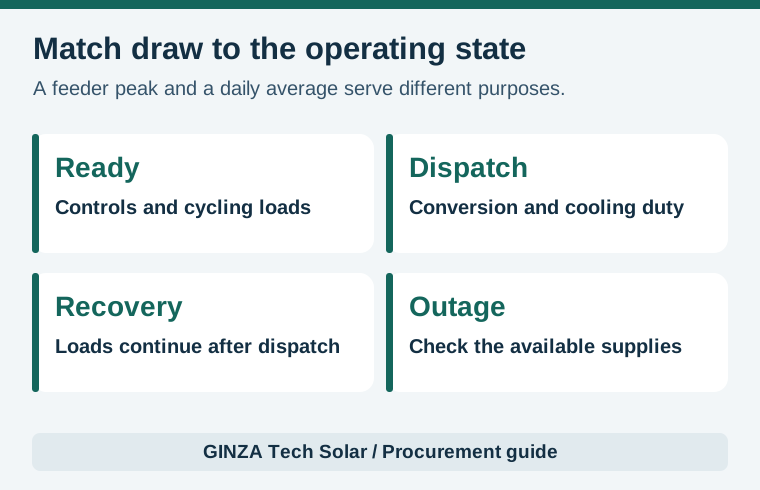
Find the boundary used for the offered discharge and charge statements. Some auxiliary energy is already reflected in the value measured at the AC terminal. Some equipment has a separate supply, which may need its own energy measurement or have a different tariff treatment. Ask the bidder to draw both meters and annotate what they include. Include equipment outside the cabinet if it belongs in the project energy budget, such as external cooling, control power or a shared station service panel.
When two cabinets share cooling, specify how consumption is recorded for a single-cabinet test and how the common load is accounted for at project level. Ask whether the supplier is offering a measured system value, multiplying an individual unit value or using a model. For contract efficiency, use the usable energy and round-trip efficiency test guide to reconcile the system boundary. Preserve raw meter readings as well as the adjusted result so a reviewer can see which direction the correction was applied.
Worked example: compare a full day of auxiliary demand
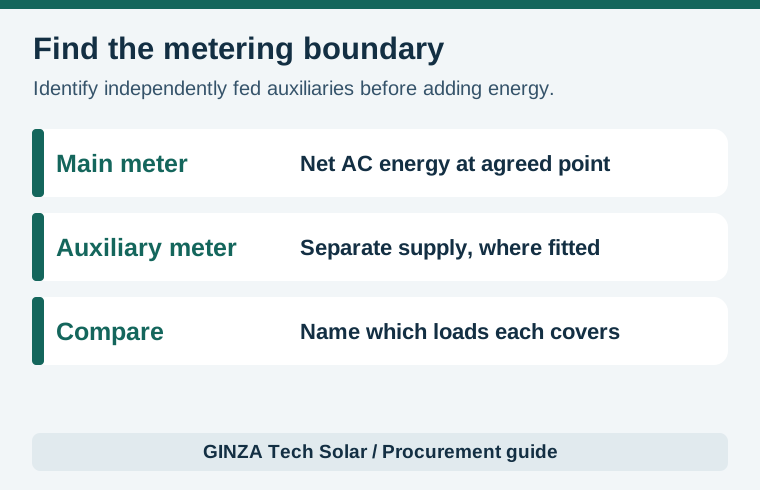
Consider a fictional storage system with an independently metered auxiliary feeder. During a representative day, it spends 18 hours in active standby at 0.30 kW average, four hours dispatching at 1.80 kW and two hours in post-dispatch recovery at 0.75 kW. The three states cover 24 hours and the figures are average real power at the same auxiliary meter. The contributions are 5.4, 7.2 and 1.5 kWh, for a daily auxiliary total of 14.1 kWh. A constant year of those days would be 5,146.5 kWh, which is arithmetic only. An actual year has varying weather, duty, maintenance and availability.
Suppose a competing design averages 0.45 kW in the same standby state, 1.10 kW during dispatch and 0.40 kW during recovery. On the same schedule, the contributions are 8.1, 4.4 and 0.8 kWh, giving 13.3 kWh. The second design has higher standby draw and lower daily demand for this operating profile. It may compare differently at a site that spends much longer idle or has a different cooling requirement. Ask for a long-idle day, a representative cycling day and a hot design day to understand which assumptions matter.
These daily energy figures cannot size a feeder. Procurement also needs the maximum concurrent electrical demand, voltage, phase and any startup demand specified by the equipment supplier. The maximum may occur during an overlap in the schedule. Conversely, multiplying maximum feeder demand by every hour of the year usually overstates normal operation. Keep the feeder design figures and operating budget in separate columns, with the source of each number attached.
As a sensitivity check, substitute a fictional full day of active standby for the mixed schedule. At 0.30 kW the first design would use 7.2 kWh; at 0.45 kW the second would use 10.8 kWh, reversing the mixed-day comparison. This makes the standby state a priority to verify for an infrequently dispatched backup system. Ask the site operator which profile actually reflects the contract and keep both scenarios on the comparison sheet until the expected service is resolved.
Specify what a comparable supplier submission contains
Ask for a row per state with the state name, ready-to-dispatch condition, duration, real power average and peak, climate assumptions and feeder or meter identifier. Include sensor and meter recording intervals and the status flags needed to filter outages or service work. If the offer provides only an hourly model, require assumptions and say how modeled values will be compared with a later trend export. A year of modeled figures should not be quoted as field measurements.
For a controls review, match states to the dispatch and fault logic in the EMS, BMS and PCS responsibility guide. A supplier may price backup for controls differently from full cooling during an outage. Ask the project engineer to identify which auxiliaries are required for the specified service and from what source they are powered. The U.S. DOE procurement checklist provides broader context for defining the project and the supplier submission.
For acceptance, agree the test period, ambient range, initial temperature, starting charge state, metering accuracy and how to handle an interrupted sequence. Record an explicit end time for any monitored recovery. Compare acceptance records against the conditions under which the value was offered. For a hot day that differs from a factory test, retain both records and document how the project will obtain evidence under the actual expected operating envelope.
A practical export has timestamp, interval length, auxiliary-meter kWh, operating state and ambient temperature. Mark missing intervals rather than silently treating them as zero. Where the meter reports a cumulative register, retain both the beginning and ending reads, with units and reset flags. Compare the sum of state intervals with the elapsed test duration. If hours remain unclassified, resolve their consumption before publishing a daily total.
Use the commercial storage options for the equipment shortlist, then send the duty schedule, climate assumptions and meter boundary for review. Include hours spent on standby, expected dispatch windows and a drawing showing separately supplied equipment. With that input, the bid can distinguish energy budgeting, electrical service and standby readiness.