
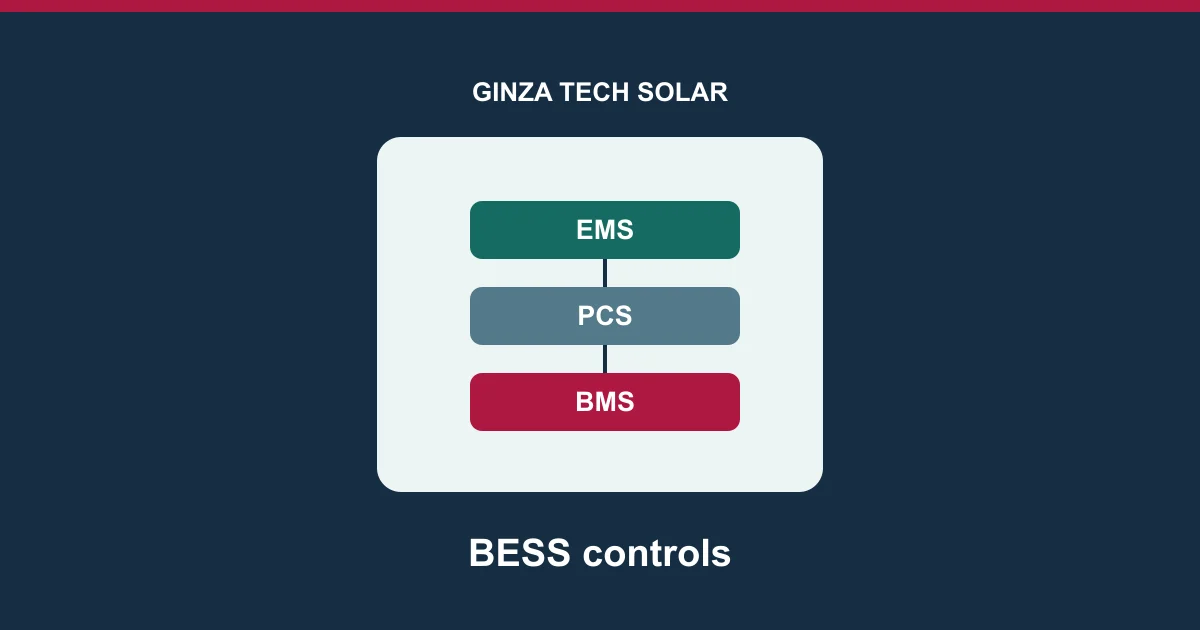
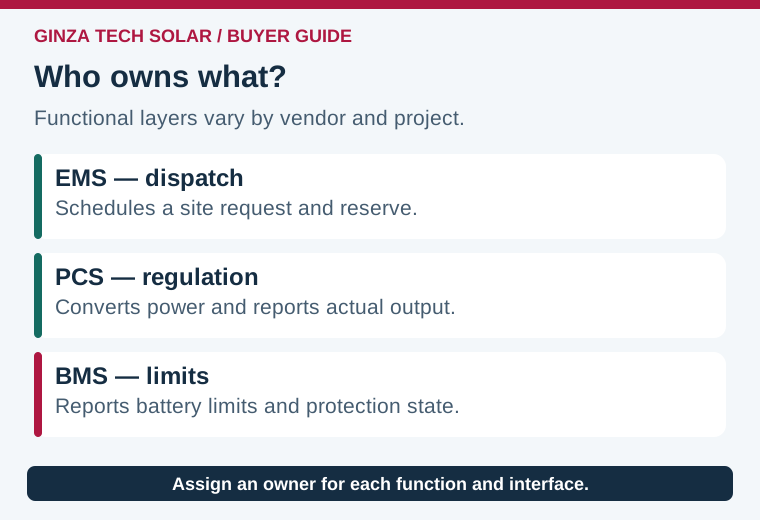
Quick answer. In a battery energy storage system (BESS), the energy management system (EMS) normally decides the dispatch request, the battery management system (BMS) reports battery condition and operating limits, and the power conversion system (PCS) regulates actual electrical power within its own limits and the permitted battery envelope. Vendors combine these functions differently. For an EPC purchase, specify who owns the command, the limit, the measurement and the response when a signal goes stale.
A quote listing three acronyms can still omit the work needed to integrate them. Ask bidders to identify the physical device or software instance that performs each function in the proposed configuration. For a site with several cabinets, identify the controller that allocates the total site request across them. The Sandia energy storage introduction separates battery protection, conversion and dispatch; use it as a vocabulary reference while evaluating your actual design.
Start with three control responsibilities
| Function | Common responsibility | Evidence to request |
|---|---|---|
| EMS | Dispatch decisions and reserve schedules | Operating modes, priorities, meter inputs and setpoint rules |
| BMS | Battery measurements, permissible limits and protection | Limit definitions, status quality, alarm states and protection ownership |
| PCS | Power conversion and regulation | Active/reactive power envelopes, state machine, command acceptance and feedback |
The hierarchy depends on architecture. A unit can package supervisory controls with the converter, while a larger site can place a plant controller above a local EMS. A pack may also have several levels of management, such as rack controllers and a system BMS. Ask for a function-by-device matrix. Product names often make two vendors appear equivalent until you compare meter integration, dispatch modes and whether a gateway is part of the supply.
Worked example: a 100 kW request meets a lower limit
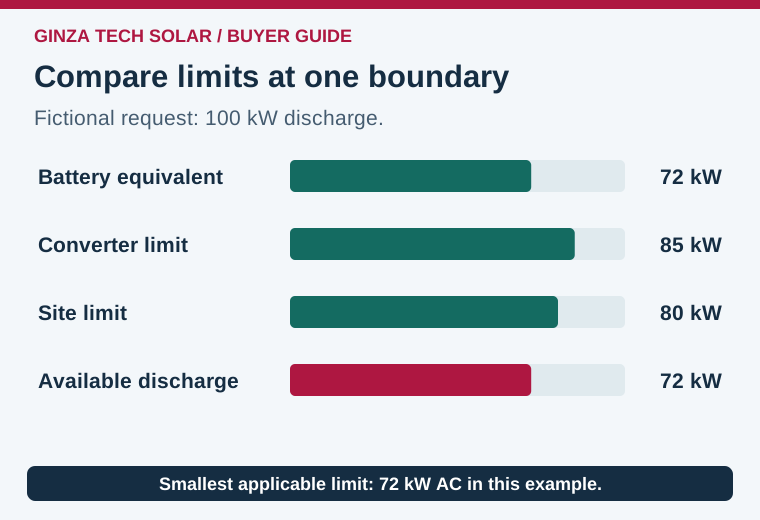
Suppose a fictional site requests 100 kW AC discharge. For a simplified comparison, assume the current battery limit, after conversion and auxiliary effects, corresponds to 72 kW at the same AC boundary. The converter can deliver 85 kW there under the current conditions, and the site permits up to 80 kW of battery output for this interval. The highest available discharge under these inputs is the smallest of 72, 85 and 80 kW, so the request can be met only up to 72 kW. The requested-versus-available gap is 28 kW. This is illustrative arithmetic, not a controller implementation or a product rating.
A limit from the BMS is often expressed in DC current or DC power. Do not compare a raw ampere value with a kW setpoint, and do not treat a DC power value as if it were AC delivery. The bidder should explain who translates the limit, which voltage or efficiency basis it uses, how quickly a new limit takes effect, and how the EMS learns why dispatch fell short. If reactive operation uses converter headroom, compare limits at the specified power factor using the kW and kVA guide.
Ask for a points list you can actually use
A protocol name alone cannot answer whether two devices exchange the values the project needs. Ask for the applicable interface revision, message or register definition, units, sign convention, update rate and quality flag. Each point needs an owner and a consumer. A register named Power can mean requested AC power, measured converter output, site import, gross discharge capability or an unsigned magnitude. Replace ambiguous labels in the interface schedule before procurement.
Start with charge and discharge limits, battery availability, SOC, alarms, commanded and measured active power, converter state, operating mode, measured site import or export, and the quality of the site meter signal. Add reactive command and feedback where the scope requires it. State who timestamps each signal and how commissioning records will be aligned. Screenshots alone often hide why two values differed. Synchronized evidence helps you distinguish a rejected command from a delayed response or a meter sign error.
For a mixed-vendor system, name the party providing the gateway, the party supporting firmware compatibility and the party responsible for end-to-end testing. Record any licenses required for the points, where configurations are stored, and how the owner can recover them after a hardware replacement. If the supplier proposes remote monitoring, specify which functions still work during a WAN outage. A dashboard may recover much later than the local controls, so record visibility and control continuity separately.
Agree what should happen when data is stale
Show the project owner which signal wins when two legitimate objectives collide. A reserve schedule might call for retaining stored energy during the same tariff window in which a demand controller requests discharge. Document the order of priorities, how manual overrides expire, the reserve value that remains in force after a reboot, and how the operator sees the reason for a lower dispatch. Request a trace that identifies whether a controller was following its intended priority or simply missing fresh inputs. Export limits may use the site meter while converter caps may use the converter’s own measurements, so draw the boundaries on the same diagram.
Review degraded operation before the equipment ships. Document separate cases for a lost battery limit, lost site-meter feedback, PCS unavailable, supervisory controller reboot and a failed communications path. The safe response is design-specific and should be agreed by the responsible supplier and engineer. Ask for the timeout basis, hold or fallback mode, alarm priority, reset authority and evidence that restart does not unexpectedly reapply an old setpoint.
At the design review, have each supplier walk through the same event timeline. For example, ask the controls provider to explain what the site sees if supervisory dispatch remains active while one rack becomes unavailable. Which device first detects the condition, which aggregate availability value changes, and which logged status explains the lower measured discharge? Agree whether a second available cabinet may take the remaining load and identify the range in which that transfer is permitted. This exercise identifies contract boundaries before equipment is delivered.
Turn the control map into acceptance evidence
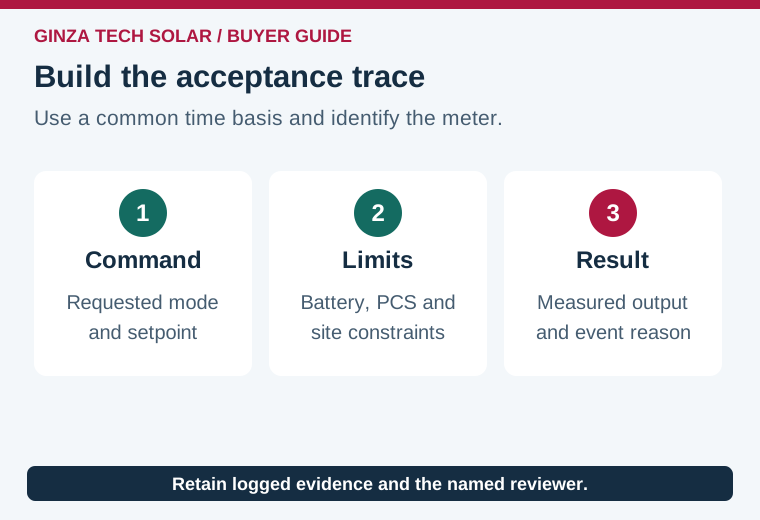
Request one test matrix with columns for the operating mode, initial condition, initiating event, expected limit or action, measured result and acceptance evidence. Use approved simulations or built-in vendor test procedures for abnormal conditions. Have the qualified test team specify who can energize, simulate, reset and release equipment. A test of a dashboard point does not exercise the complete command or protection path.
Separate factory evidence from downstream site integration. A factory can often prove that a request is acknowledged, limited and alarmed under its test configuration. The site still needs verification of its physical meter point, sign convention, time synchronization and connection-specific control obligations. The BESS FAT guide explains that split, and the zero-export commissioning guide covers the additional evidence for a project at the grid connection.
Keep readable commissioning exports rather than only a vendor dashboard login. For each witnessed case, record the device and firmware versions, the configured priority, a timestamped command, its relevant limit, the measured result at the agreed point and the event reason. The acceptance record should identify who answers support requests if the device measuring the site and the device issuing commands come from different contracts.
Before approving a quote, collect a one-line drawing, a functional architecture diagram, a responsibility matrix, the interface schedule, alarm and fallback behavior, and the named acceptance witness. The DOE FEMP procurement checklist offers broader project planning context. For equipment and interface review, start with the GINZA commercial storage configurations and send the proposed operating modes, power limits and one-line diagram.