
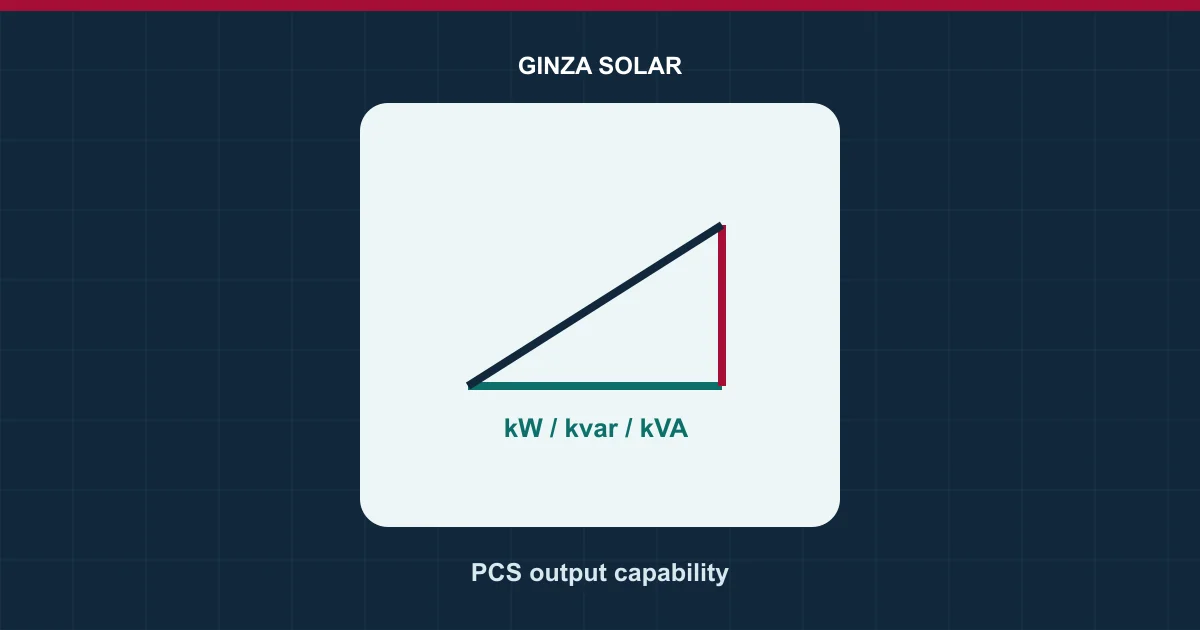
Quick answer. Inverter kW describes real power, while kVA describes apparent power. Under a simple sinusoidal condition, real power equals apparent power multiplied by power factor. A 100 kVA rating therefore does not promise 100 kW under every load or reactive-power requirement. Ask for the complete capability envelope, including real power, reactive power, voltage, temperature and operating-mode limits.
This worksheet is for EPC buyers comparing PV inverter or battery PCS proposals. Its calculations use simplified balanced three-phase examples. The designer must evaluate the actual waveform, phase loading, utility requirements and manufacturer’s supported operation.
Read three quantities together
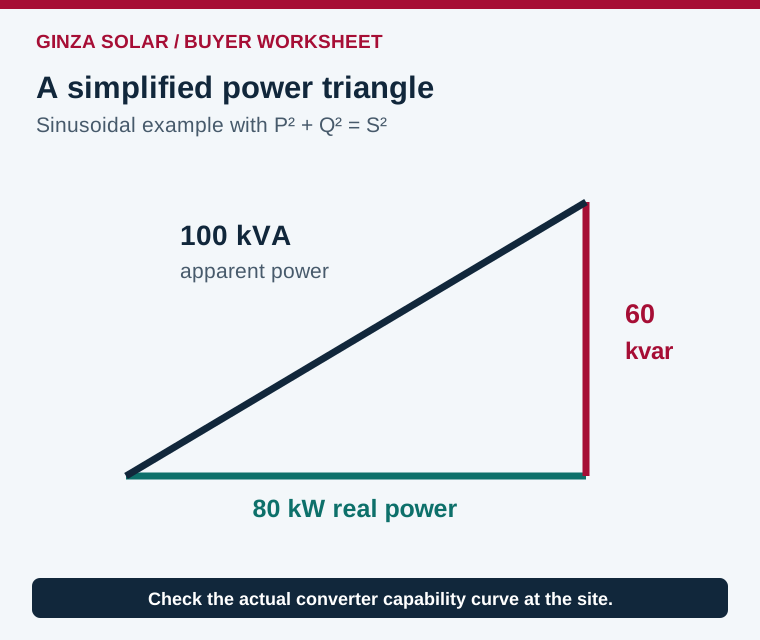
Real power P in kW contributes to energy delivered over time. Reactive power Q in kvar is associated with the reactive component of the AC system. Apparent power S in kVA relates to the RMS voltage and current burden. For the simple sinusoidal case, S² = P² + Q² and power factor is P/S. Use those relationships as a screen, then use the actual inverter curve and site conditions.
Manufacturers may specify separate limits for maximum real power, apparent power and reactive capability. A unit can reach one limit before another. Check whether the rating applies to grid-connected operation, island operation, charging or discharging and whether a temporary overload rating has a defined duration. Confirm the voltage and temperature assumptions behind every quoted value.
| Illustrative condition | Apparent power | Real power | What it shows |
|---|---|---|---|
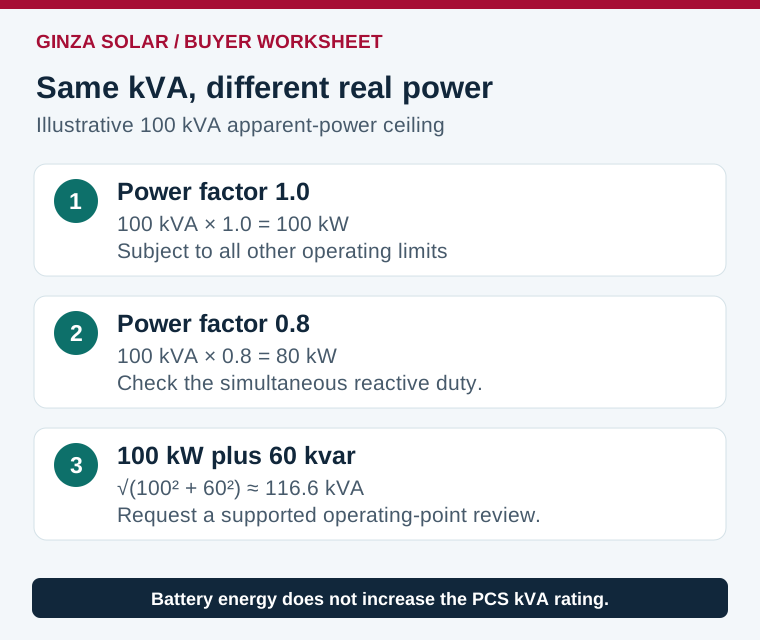
| Power factor 1.0 | 100 kVA | 100 kW | Arithmetic at unity power factor, subject to other limits |
| Power factor 0.8 | 100 kVA | 80 kW | Same apparent-power limit with less real power |
| 80 kW plus 60 kvar | 100 kVA | 80 kW | Reactive duty uses capability in the simplified model |
Worked example: reactive duty changes output headroom
Assume a fictional inverter has a 100 kVA apparent-power ceiling. If it must simultaneously provide 60 kvar under the selected conditions, the simple real-power ceiling is √(100² − 60²) = 80 kW. If the project needs 100 kW real power plus 60 kvar at the same time, the arithmetic apparent-power requirement is √(100² + 60²), or about 116.6 kVA.
That calculation does not choose an inverter. A proposed larger unit might still have a separate real-power ceiling or a capability curve that restricts operation at the site voltage. Ask the supplier to mark the required operating point on the supported curve at the design temperature. Confirm which function has priority when the request reaches a limit and how the PCS reports its available real-power headroom.
Check current and the AC connection
For a balanced three-phase system at 400V line-to-line, an illustrative 100 kVA corresponds to current of 100,000 ÷ (√3 × 400), or about 144A. An 80 kW load at power factor 0.8 has the same 100 kVA in this simplified case. At unity power factor, 80 kW is 80 kVA and corresponds to about 115A. Circuit sizing requires the applicable design method and equipment conditions.
Ask the electrical designer to check the transformer, switchgear, conductors, protective devices and permitted operating voltage. Include harmonics and imbalance where relevant. An apparently adequate real-power rating does not establish adequate current capability on each phase or sufficient starting performance. Keep the one-line drawing and the manufacturer’s connection requirements with the procurement package.
Nonlinear-load check. Rectifiers and other electronic loads can draw current that is not sinusoidal. Victron’s AC wiring guidance notes that an inverter can reach overload earlier than a simple wattage comparison suggests with these loads. Request measured current waveforms or suitable load data and the manufacturer’s supported load capability. Do not treat the simplified power triangle as a complete check for harmonic current or starting transients.
Distinguish power factor at the inverter from power factor at the utility meter. Other site loads, transformers and reactive devices can change the total seen at the connection. If the project obligation is stated at the grid meter, the controls need an appropriate measurement and a supported way to act on it. A demonstration at a converter terminal may not verify that site-level requirement.
Read the tariff and connection documents when demand charges or penalties are part of the business case. Some projects are evaluated on real-power demand, others on apparent power or an additional power-factor condition. Have the model use the actual rule and time interval. Compare the measured baseline and proposed operation at the same meter, and confirm that the requested correction leaves enough inverter headroom for the storage or PV service that the owner is purchasing.
Apply the same thinking to PV and storage
A PV inverter can be constrained by its AC capability even when the array has more available DC power. If reactive support is required, state whether it is concurrent with peak solar output and how it affects useful energy. The DC/AC ratio and clipping guide explains why annual output needs a time-series model rather than a single nameplate quotient.
For storage, the battery’s DC power and energy are separate constraints. A PCS may have available apparent-power capability while the battery has reached a current, temperature or state-of-charge limit. Conversely, the battery may have enough DC power while the PCS has insufficient AC headroom for simultaneous real and reactive duties. Use the C-rate and duration worksheet to document the battery side of the requirement.
Specify the grid and backup requirements
Obtain the project’s reactive-power or power-factor requirements from the responsible grid and design reviewers. State the measurement point, voltage range, control mode and operating periods. Confirm whether the requested function is needed with no PV output or when the battery is unavailable. Ask for the actual supported behavior and auxiliary requirements rather than assuming the inverter can provide the service in every state.
For backup operation, inventory critical loads by phase and capture running and starting kVA as well as kW. Check the overload duration and recovery conditions, transfer behavior and approved load sequence. A balanced three-phase nameplate can hide a phase-limited case. The critical-load backup guide describes the separate energy, transfer and reserve checks.
Questions to put in a PCS quotation
- What are the sustained real, reactive and apparent-power limits in each required operating mode?
- Which capability curve and derating apply at the site’s voltage, temperature and elevation?
- What current, imbalance and temporary overload limits apply by phase?
- How do battery limits and control priorities affect the available output?
- Which tests demonstrate the simultaneous operating points required by the contract?
At acceptance, record the commands and measured P, Q, S, power factor, voltage and current at the agreed meter, together with battery state and thermal conditions. Use a suitable instrument and align timestamps with controller logs. Have the test team define sign conventions for import/export and reactive directions so a plot can be interpreted without guessing which convention was used.
Preserve settings, firmware, capability documents and the tested operating points in the handover package. If the utility later changes a control requirement or the site adds significant motor loads, review the duty again. A system that was adequate for the original real-power request may need a different dispatch priority or equipment configuration for the changed combined service.
Frequently asked questions
Is a 100 kVA inverter always a 100 kW inverter?
Check both ratings and the operating point. At power factor 0.8, 100 kVA corresponds to 80 kW in the simple calculation.
Does more battery kWh provide more inverter kVA?
Energy capacity and AC conversion capability are separate. Verify the battery and PCS limits together.
Can the full kW rating and reactive rating be used together?
Use the manufacturer’s simultaneous capability curve at the actual conditions. Separate headline ratings may not be available together.
What should I send with an inquiry?
Provide real and apparent load, phase data, starts, grid requirements, voltage and environment, battery duty and the proposed electrical layout.
References and capability review
- Victron Wiring Unlimited, AC power quantities and system current
- DOE FEMP resources for defining storage output and interfaces
Review GINZA commercial storage configurations and request a PCS capability review with the required simultaneous operating points.