
Quick answer. Size commercial battery backup from a schedule of the loads that must operate during the outage. Add their energy over the required hours, then check continuous power, starting demand and transfer tolerance separately. The battery and inverter must support the approved island arrangement, and the available energy depends on the state of charge at the moment the grid fails. Put all four requirements in the quote request so bidders size the same service.
This worksheet is for facility managers and EPC buyers comparing a battery, generator or hybrid backup proposal. It uses a fictional facility. The engineer of record must establish the actual electrical design, protected loads and applicable requirements before installation.
Decide which loads stay powered and when
Specify the typical fraction of charge at the start of an outage and the usable energy measured on the project boundary. The battery charge and health guide illustrates how beginning state, reserve and measured condition affect runtime.
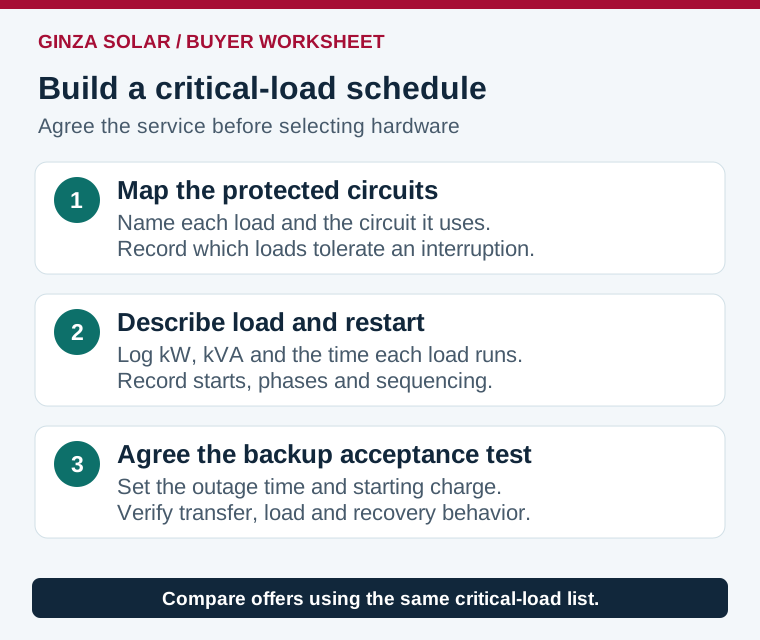
Walk the building with the owner and electrician. Map the circuits that preserve essential operations and the loads that can wait. A small refrigeration plant may need controls, compressors, monitoring and selected ventilation, while other production equipment can remain off. Some loads only need a controlled shutdown. Others must remain live through a transfer event. Record the consequence of interruption and have the owner approve the priorities.
Build the schedule from meter readings, equipment data and known operating sequences. Capture real power in kW, apparent power in kVA where relevant, phase allocation, power factor, starting behavior and the hours each load runs. Monthly kWh and a sum of nameplate ratings miss the shape of the outage load. Use time intervals fine enough to see coincident events, and evaluate short starts separately from the energy calculation.
Worked example: four hours of backup
Assume a fictional load schedule where essential equipment consumes 36 kW for the first half hour, 24 kW for the next 1.5 hours and 20 kW for the last two hours. Add 2 kW of auxiliary loads at the backup output for all four hours. Here the auxiliary loads are counted on the AC side. Include equipment auxiliaries on their actual side of the measurement boundary in a real proposal.
| Outage period | Critical load | AC load with auxiliaries | Energy |
|---|---|---|---|
| 0 to 0.5 h | 36 kW | 38 kW | 19 kWh |
| 0.5 to 2 h | 24 kW | 26 kW | 39 kWh |
| 2 to 4 h | 20 kW | 22 kW | 44 kWh |
| Total | 94 kWh critical load | 8 kWh auxiliaries | 102 kWh AC |
Suppose the offer uses a 94% discharge conversion factor for this example, an 80 percentage-point usable state-of-charge window and 85% retained capacity at the evaluation point. If those factors have independent, consistent boundaries, the screening requirement is 102 ÷ (0.94 × 0.80 × 0.85) ≈ 160 kWh initial nominal DC. The supplier should verify the actual discharge curve, temperature, conversion losses and limits. If a bid already states usable AC kWh at the required conditions and age, compare that directly and avoid subtracting the same losses or reserves twice.
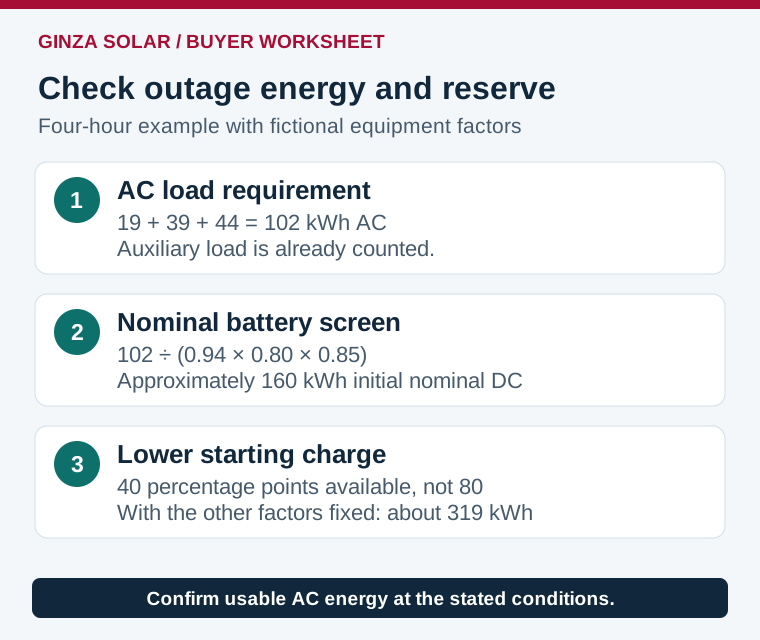
Now suppose the system routinely reaches 60% state of charge before an outage and has a 20% discharge floor. Only 40 percentage points are available at that start condition. Keeping the other example factors, nominal DC sizing would rise to about 319 kWh. You could instead change reserve settings, reduce the protected load, shorten the target or add a firm source. The decision belongs in the service specification. A daily savings model can look attractive while leaving too little energy for an evening outage.
Check output and transfer separately from kWh
If the project must establish an AC supply on a de-energized bus, use the BESS black-start requirements to specify startup conditions and evidence separately from the runtime estimate.
The highest scheduled real power is 38 kW in the example. A motor or compressor might require an assumed 60 kVA for two seconds at restart. Confirm the offered inverter’s continuous output and overload envelope in island mode, on the required phases, at the design conditions. Ask whether the stated starting demand is the total at the inverter or must be added to other running loads. Check frequency and voltage tolerance for sensitive equipment and price an approved sequencing or load-shedding plan where necessary.
Transfer behavior is a separate acceptance criterion. Some controls may tolerate a brief interruption while other equipment needs a UPS or another arrangement. Define the maximum interruption and any ride-through requirements with the equipment owner. Ask which circuits are backed up, how the system isolates from the utility, whether it can establish a stable island, and whether it can start from a de-energized site. A grid-connected PCS data sheet does not establish those functions on its own.
Decide what counts as a firm energy source
Run a battery-only case if the outage duration must be guaranteed regardless of sunlight. PV can extend runtime only if the approved island configuration supports PV operation and the resource is available. For a battery and generator case, confirm generator start and run limits, fuel availability, transfer and interlocks, coordination of charge and discharge, and the behavior if the generator fails to start. Include a credible night or low-solar case and repeated outages with incomplete recharge.
Consider how the site will recover when power returns. Set a recharge target and estimate the time to restore reserve at the permitted AC import and charging rate. Check whether recharging conflicts with a demand cap or generator limits. Use the peak shaving worksheet if the same battery is meant to reduce demand charges. The AC and DC coupling guide outlines the equipment paths to check in a solar-plus-storage proposal.
Ask for two operational scenarios when outage duration is uncertain. A short event may only require a controlled restart and enough energy to keep controls and refrigeration available. A long event may require reducing production, prioritizing one feeder, or starting a generator. Assign who can change those priorities and document the alarm thresholds. Then model a second outage before full recharge using the remaining state of charge. If the proposal assumes the operator can shed a named load, the acceptance test should demonstrate the approved sequence and confirm that the protected circuits stay within their voltage and frequency limits. This lets the owner compare the service level across bids as well as the battery size.
What to request and witness
- Give the supplier a critical-load schedule, single-line drawing, outage target, reserve requirement, site conditions and equipment that cannot tolerate interruption.
- Request usable AC energy at the stated age and starting state of charge, continuous and transient power, phase limits and supported transfer behavior.
- Require an approved sequence for loss of utility, island startup, load shedding, generator or PV participation, reconnection and recovery.
- Agree acceptance measurements for delivered kWh, peak and surge power, transfer time, alarms and reserve recovery under controlled conditions.
- Ask for the wiring and control scope, exact equipment versions, witness responsibilities and handover files. Use the BESS RFQ template for the remaining quote fields.
Frequently asked questions
How big a battery is needed for four hours?
Multiply each scheduled load by its hours, sum AC energy, then compare that requirement to usable AC energy at the stated starting charge and age. Check output and starts separately.
Can an energy storage cabinet run through a grid outage?
Verify the offered island-mode capability, controls and switchgear for the actual configuration. Ask for the approved transition and test plan.
How should I handle overnight outages?
Specify a battery-only or other firm-source case for the protected loads. Treat PV generation as time dependent and verify its role in the approved island mode.
Can backup and tariff savings share the same battery?
They can share capacity when the controls protect a defined outage reserve. Model the duty cycles together and specify which service has priority.
References and project quotation
- DOE FEMP, distributed energy resources and critical-load resilience modeling
- DOE FEMP, resilience planning and valuation
Compare GINZA commercial ESS configurations and request a critical-load review with the outage schedule, required transfer and site one-line drawing.