
Quick answer: Size a peak shaving battery from the utility meter’s interval readings and the tariff that turns those readings into a bill. The highest shortfall above your import target sets the required AC discharge power in kW. Add the shortfalls over the event to find the usable AC energy in kWh. Then replay the billing period with realistic state of charge, charging windows and controls. A battery that handles the worst half hour can still miss the monthly billing peak when it is empty, charging or limited by its power converter.
This worksheet is for a facility manager or EPC who has a bill, an interval export and a commercial storage proposal. It explains what to calculate before requesting equipment, what to compare across quotations and what to verify at acceptance. The example uses a fictional meter profile and tariff.
Find out which peak the utility actually bills
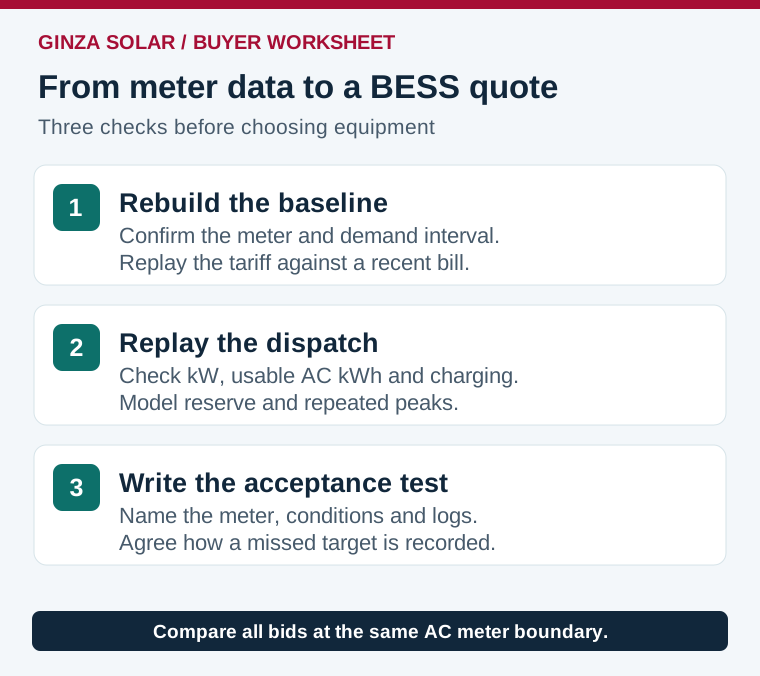
Start with the meter and account on the bill. A main incomer, a tenant submeter and an energy management dashboard may show different demand. Ask for the utility’s native interval export, the current tariff and ideally twelve consecutive months of bills and readings. Identify interval length, block versus rolling windows where applicable, timestamp convention, time zone and how the meter treats export. Check for seasonal or on-peak demand charges, monthly minimums, a historical demand ratchet and any kVA-based charges. A kW-only example cannot size a project billed on apparent power without the corresponding measurements and control model.
Recalculate at least one recent bill before you run a savings case. The maximum should occur in the same billing period and tariff window as the bill. If it doesn’t, resolve the mismatch first. Common causes include reading a kWh column as kW, applying the tariff to the wrong meter, using the wrong end-of-interval time and dropping missing data. For fixed 15-minute energy readings, divide each interval’s kWh by 0.25 hours to get average kW. For example, 50 kWh drawn during one 15-minute interval averages 200 kW.
Worked example: cap grid import at 160 kW
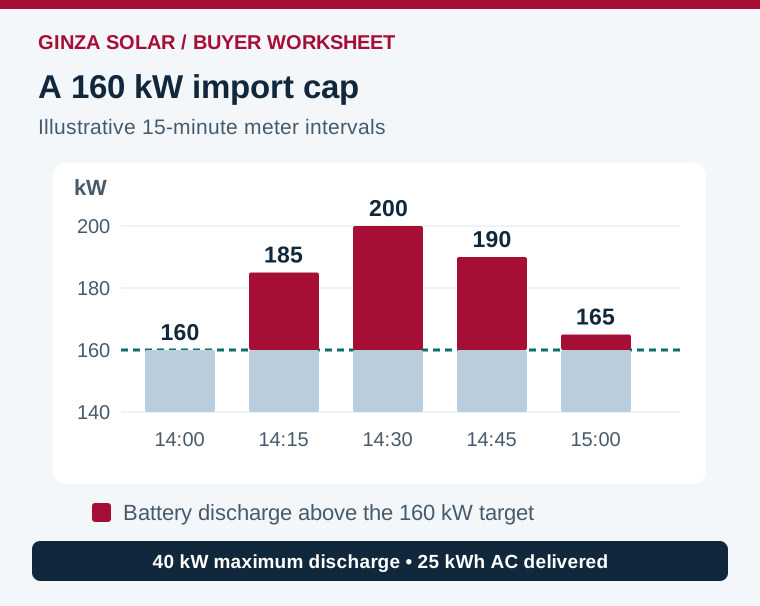
Assume five consecutive 15-minute blocks at one billing meter. Site load in the table means net import before the proposed battery, after any existing PV. The battery delivers only the difference above 160 kW. Each 15-minute block has a duration of 0.25 hours.
| Interval | Baseline import | Discharge needed | AC energy delivered |
|---|---|---|---|
| 14:00–14:15 | 160 kW | 0 kW | 0 kWh |
| 14:15–14:30 | 185 kW | 25 kW | 6.25 kWh |
| 14:30–14:45 | 200 kW | 40 kW | 10.00 kWh |
| 14:45–15:00 | 190 kW | 30 kW | 7.50 kWh |
| 15:00–15:15 | 165 kW | 5 kW | 1.25 kWh |
The highest interval deficit is 40 kW and the battery delivers 25 kWh AC over the event. A 25 kW converter misses the 200 kW block even with a large battery. A 40 kW converter with just 15 kWh of available AC energy runs short before the event ends. This is an interval-average screening exercise. A real controller must measure and respond at a resolution suitable for the tariff and site, including load changes within each block.
Turn the screening result into an equipment requirement
Write the minimum deliverable AC power and energy at a named meter and operating condition. Ask whether the offered kW can be sustained for the whole duty cycle at the expected temperature and site altitude. Request the AC energy delivered over the permitted state-of-charge window, with end-of-life capacity assumptions and any outage reserve called out. Keep auxiliary loads and converter losses inside or outside the boundary consistently across bidders. A battery’s gross DC nameplate is a poor substitute for this comparison.
Test the recharge schedule explicitly. At an assumed 88% AC round-trip efficiency, replenishing 25 kWh delivered requires roughly 28.4 kWh of AC charging energy under comparable conditions. A 150 kW site has just 10 kW of theoretical headroom under the 160 kW target. Charging at that headroom takes about 2.84 hours before allowing for practical limits. Charging at 30 kW during that same period would raise site import to around 180 kW. Treat these as screening values and run the charging and discharge schedules against the full meter series, including cloudy days if charging depends on PV.
Consider what happens when two events arrive without a recharge window. The first might occur when production starts in the morning and the second when cooling and process loads overlap in the afternoon. If the battery has to preserve energy for backup, mark that reserve in the controls and use the remaining state-of-charge window in the model. Evaluate abnormal days such as shift changes, restarts, holidays and unusually hot weeks before freezing a dispatch guarantee.
Replay the tariff, then compare alternatives
Model the baseline and proposed grid import for each billing month with the same tariff. Record billed kW or kVA, energy charges, charging imports, any export credit, missed cap intervals and why they occurred. In a fictional flat monthly demand charge of $15 per kW, a verified drop in billed demand from 200 to 160 kW would reduce that charge by $600 for the month. If another peak sets billed demand at 190 kW, the same battery only reduces that charge by $150 in this example. Any energy charges, degradation, operating costs or ratchet effects are separate from that arithmetic.
Compare at least two import targets and one non-battery operational change. Staggering a compressor start, shifting an EV charging schedule or sequencing cooling can remove a short coincident peak before you buy storage. On a solar site, measure or model existing PV at the same time resolution. A midday PV surplus may help recharge, while an evening peak can arrive after PV output has fallen. Specify whether the controller must coordinate with existing export limits, generator interlocks or critical-load reserves.
What to put in a peak shaving battery RFQ
| Send to bidders | Ask bidders to return |
|---|---|
| Meter ID, utility tariff, 12 months of interval readings and recent bills | Billing model, import target and replay of the same baseline and battery cases |
| One-line diagram, point of connection, existing PV/generator and export constraints | Proposed meter/CT location, controls interfaces, charging sources and export behavior |
| Site temperatures, duty cycle, reserve and end-of-life performance basis | Guaranteed AC kW and usable AC kWh with operating limits and exclusions |
| Required acceptance window, events, logs and witness responsibilities | Meter traces, response limits, allowed import excursions and repeat-test procedure |
Agree what happens when the meter signal is lost, communications fail or the requested cap cannot be held. Ask for a trend export that includes grid import, battery AC power, state of charge and limit alarms on one clock. Verify control action on a representative event and confirm the site can reproduce the result from logged intervals. Use the commercial BESS RFQ template for supply boundaries and the usable AC energy test guide for metering and acceptance details.
Frequently asked questions
Is 15 minutes always the utility demand interval?
Check the tariff and meter configuration. Fifteen minutes is the assumption in this example. The bill may apply a different interval or rolling method, multiple demand windows or a minimum billed demand.
Can monthly electricity bills size a peak shaving battery?
Use bills to identify the tariff and historical billed demand. Get interval data to see how long peaks last, whether several occur without recharge and what charging would do to the next peak.
Can one BESS provide peak shaving and backup?
It depends on the electrical topology, controls, islanding capability and available reserve. Model the energy kept for backup separately and verify the remaining capacity can cover the intended peaks.
What should I send for an initial review?
Send a recent bill, a few representative high-demand days at the utility interval, the site location and a one-line diagram if available. Label the tariff and any backup or export requirements. Full-year data is needed to develop a defensible annual estimate.
References and next step
- System Advisor Model battery storage and dispatch modeling
- NLR research record for its behind-the-meter solar-plus-storage and tariff report
- IEA Renewables 2026, behind-the-meter storage and system flexibility
Compare GINZA commercial energy storage systems and request a project quotation with the meter data and operating basis. Share utility data through an agreed business channel and remove unrelated account or personal information.