
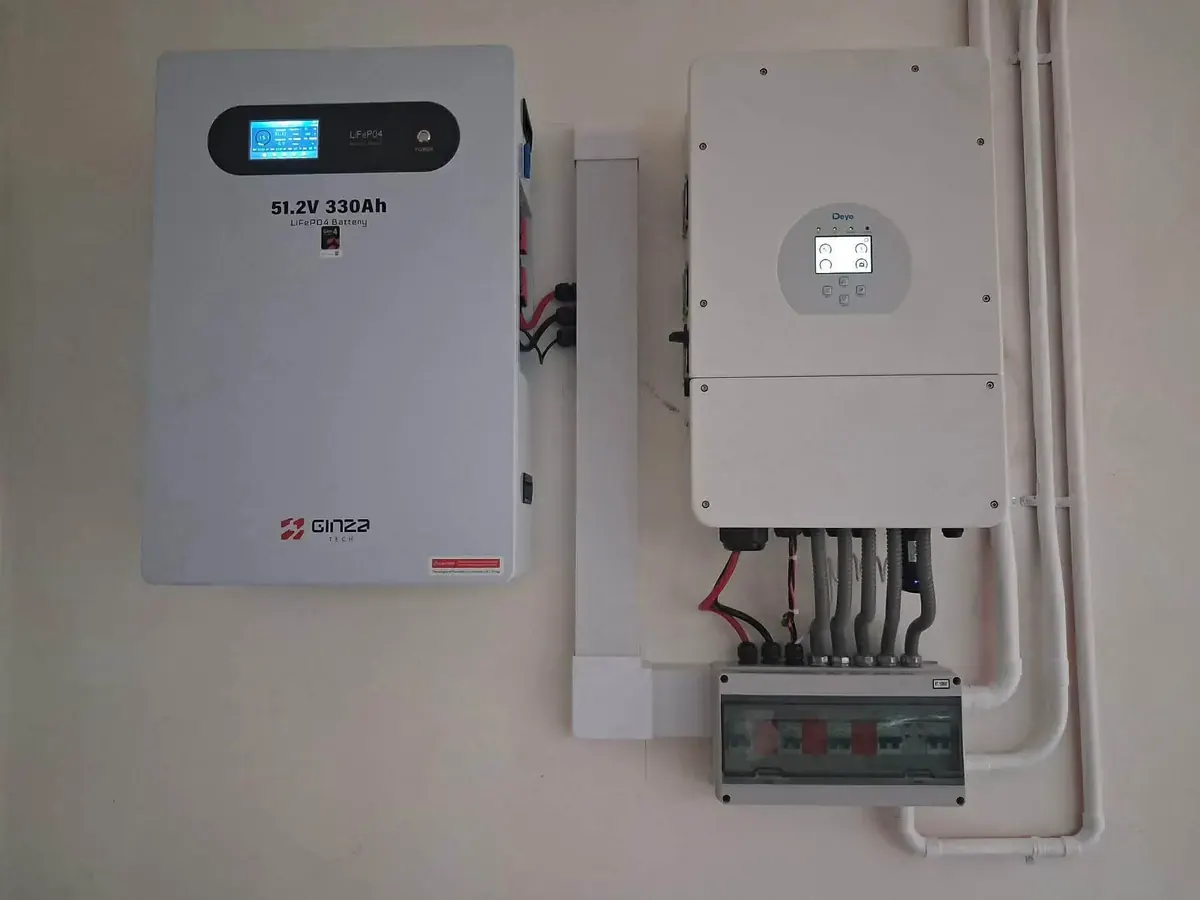
Quick answer: Battery–inverter compatibility requires an electrical match, a documented communication/configuration match and a validated functional response. Provide both exact models, firmware, operating voltage and current limits, cable pinout and pack count. A shared CAN/RS485 label or a successful power-on does not confirm the pairing.
GINZA Solar supplies LiFePO4 batteries and ESS products for installers, distributors, wholesalers and project buyers. One of the most common pre-sales questions is whether a battery is compatible with a certain inverter. In practice, compatibility is not a simple universal yes or no answer. It depends on the exact inverter model, voltage platform, communication method, battery quantity, firmware situation and the way the project will actually be commissioned.
Why buyers should not ask only “is it compatible”
A short question without model details usually hides too many unknowns. Two inverters from the same brand may use different protocols, different battery voltage ranges or different firmware behavior. Even when the nominal voltage looks correct, the final result can still depend on communication requirements, charge and discharge settings or installer-side configuration.
That is why a better compatibility inquiry should describe the exact use case instead of asking only for a general confirmation. The goal is to help GINZA review the pairing at model level and explain whether the request looks straightforward, needs clarification or should not be forced into an unsuitable combination.
- Brand name alone is not enough; the exact model matters
- Voltage class matters; low-voltage and high-voltage systems should not be mixed casually
- Closed-loop communication requirements change the review scope
- Parallel battery count and current expectations can affect whether the pairing is practical
Which inverter details must be provided
The most useful starting information is the inverter brand, exact model, system type, battery voltage, communication preference and expected battery quantity. If the buyer has firmware notes, a protocol list, a manual page or a wiring diagram, that information can make the review much faster.
| Data point | Why GINZA needs it | Typical outcome |
|---|---|---|
| Brand and exact model | Compatibility often changes by model family | Model-level review instead of brand-level guessing |
| Battery voltage | Confirms whether the request belongs to low-voltage battery or another ESS class | Correct product-family routing |
| Communication method | Shows whether the project expects CAN, RS485, RS232 or open-loop operation | Protocol and wiring review |
| Battery quantity | Parallel quantity affects current planning and system behavior | Quantity notes and configuration checks |
| Manual or firmware notes | Reduces assumptions before quotation or first order | Cleaner technical feedback |
When buyers send these items early, the compatibility conversation becomes more technical and much less vague.
How CAN, RS485 and protocol review affect matching
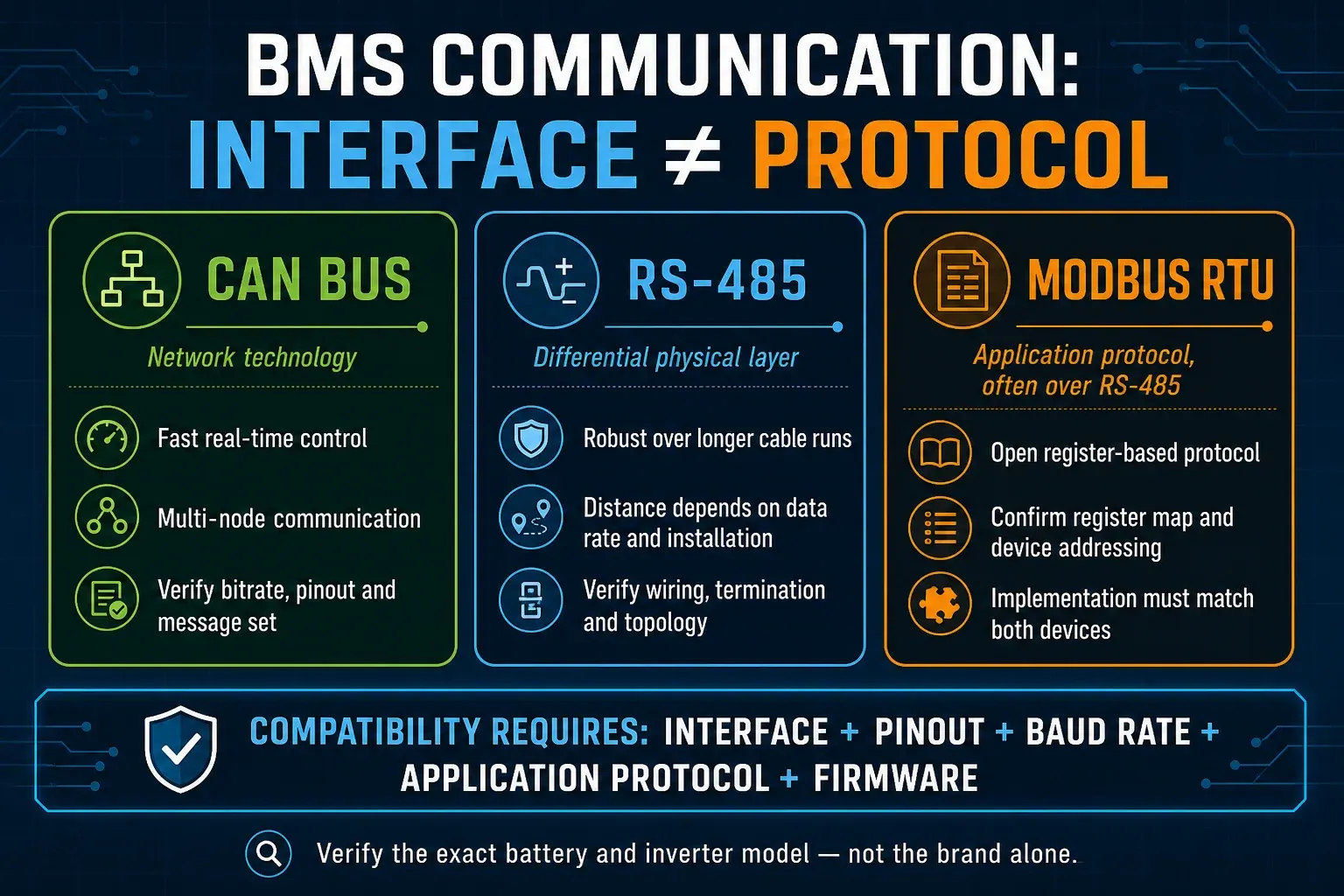
Communication review matters because many modern inverter-battery systems expect the battery management system and inverter to exchange status, alarms and control information. If the project requires CAN or RS485, the supplier needs to review whether the requested battery and inverter pairing can be treated as a normal protocol match, an open-loop setup or a case that still needs extra confirmation.
Protocol review is also important for installers and distributors who want to build a repeatable stock strategy. A battery that works well with one commonly used inverter model in a target market can become a stronger commercial choice than a battery that only looks attractive on price but creates extra site-side uncertainty.
Why parallel quantity and firmware matter
Parallel battery count is not just a purchasing detail. It can influence current behavior, communication layout, system settings and whether the planned expansion still stays inside the practical limits of the chosen battery family and inverter. A request for one battery unit and a request for several parallel batteries may need different technical attention even when the base model is the same.
Firmware and installer settings also matter because some compatibility questions are not solved by hardware alone. The buyer may need to confirm inverter settings, battery type selection, current limits or version-specific notes before the project can be treated as ready for supply. This is one reason GINZA should avoid broad public claims that any battery works with every inverter.
The most professional outcome of a compatibility review may be one of four paths: a direct protocol match, an open-loop setup, a request for more settings information or a recommendation not to use that pairing. All four outcomes are useful because they prevent confusion later in procurement or installation.
A three-gate review before a stock or project order
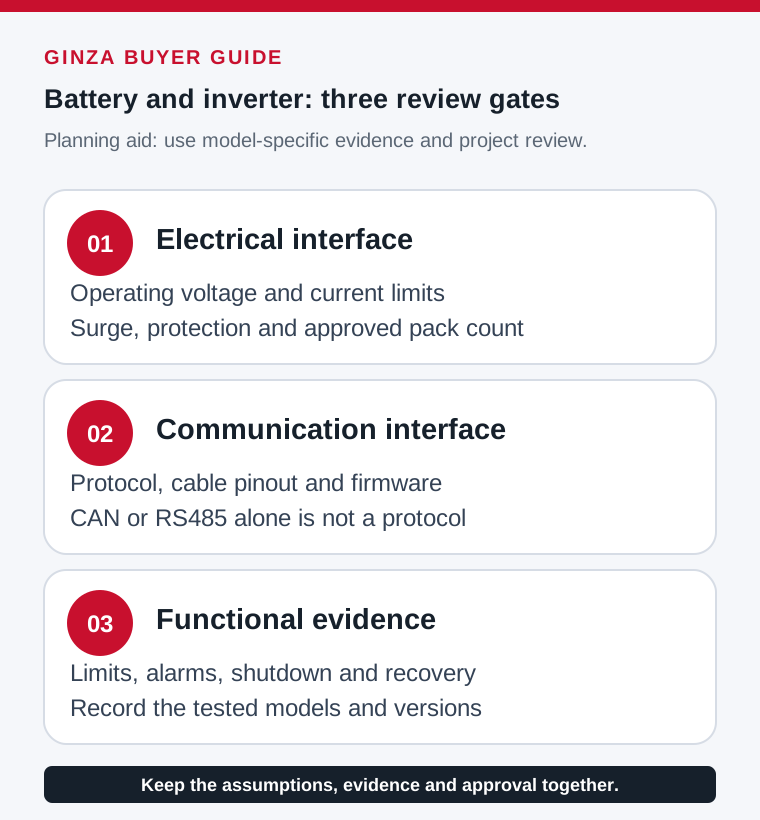
First review the electrical interface. Compare the battery’s operating voltage range with the inverter’s allowed battery input, then check continuous charge/discharge current, transient demand, protection and the approved battery count. The nominal voltage label is a useful starting point, but it does not describe the full operating range. The qualified designer must verify the cables, protection and installation from both manufacturers’ instructions.
Next review communication and configuration. CAN and RS485 describe interfaces, not one universal message set. Ask which supported protocol, cable pinout, termination, addressing and battery-type setting apply to the exact models. Record firmware versions and the supplier’s setup reference. A familiar connector housing can have a different pin assignment; do not treat physical fit as evidence of electrical or protocol compatibility.
Finally agree the functional validation. The test plan should cover the intended charge/discharge behavior, communicated limits, alarms, a loss of communication and recovery where required by the manufacturers. Those checks need an approved procedure, not improvised fault creation. Record the observed response and any operating restriction in the handover sheet.
Example: a pairing powers on but is not ready for supply
A sample system starts and displays battery voltage, but the inverter does not receive the expected charge-current limit. That result establishes only that some part of the system is energized. It does not show that closed-loop operation is working. The next step is to compare the selected protocol, cable, firmware and settings with the documented supported combination, then repeat the defined validation. Do not recommend increasing a limit merely to remove an alarm.
If open-loop operation is proposed, obtain written configuration and operating instructions from the responsible suppliers. Confirm what information and control are lost compared with the intended closed-loop system and how protection remains effective. The correct outcome can be a supported setup, a restricted setup, more testing, or a different pairing.
| Observed issue | Evidence to collect | Decision owner |
|---|---|---|
| No BMS data | Models, firmware, protocol selection, pinout and alarm log | Battery/inverter technical support |
| Unexpected power limit | Requested and allowed current, SOC, temperature and settings | System designer and suppliers |
| Unstable multi-pack operation | Approved pack count, communication topology and versions | Battery manufacturer and installer |
| Unsupported pairing | Written support scope and alternatives | Buyer and responsible designer |
Keep the review useful for repeat orders
For distributor stock, keep a version-controlled pairing register: battery model, inverter model, firmware, approved pack range, cable reference, settings, test date, evidence and support contact. Recheck a later hardware or firmware revision before assuming the old result still applies. A test for one inverter from a brand should not become a public claim about every inverter from that brand.
The Victron battery compatibility documentation is one manufacturer’s example of model-specific support information; it is not proof of a GINZA pairing. The DOE FEMP specification resources help structure broader system requirements. Send your exact equipment details with the compatibility review request, then preserve the agreed result with the commissioning report.
FAQ
Are GINZA batteries compatible with every inverter?
No. Compatibility should be reviewed by exact inverter model, voltage, communication method, battery quantity and project conditions.
What inverter information should I send first?
Send the brand, exact model, system type, battery voltage, communication preference and expected number of batteries. Firmware notes are also helpful when available.
Can GINZA review CAN and RS485 communication?
Yes. Buyers should state whether they need CAN, RS485, RS232 or open-loop operation so the review can focus on the real project requirement.
Should compatibility be checked before a distributor or wholesale order?
Yes. Distributor and wholesale buyers should know which inverter models are common in their market before deciding what battery model to stock repeatedly.
If you want GINZA Solar to review a battery and inverter pairing, submit the inverter model and project details at www.ginzasolar.com/contact/ and compare the related battery range at www.ginzasolar.com/51-2v-lifepo4-battery/.
Copyable battery–inverter compatibility request
Send the exact details below with a datasheet or clear label photo. A model-specific review can then identify what has been confirmed and what still requires a manufacturer test or installer validation.
| Item | Buyer to complete |
|---|---|
| Inverter brand / exact model / firmware | ________________ |
| Battery model / quantity / intended parallel configuration | ________________ |
| Battery operating voltage range | ________________ |
| Inverter battery charge and discharge current limits | ________________ |
| Required CAN or RS485 protocol and cable pinout | ________________ |
| Grid-tied, hybrid or off-grid operating mode | ________________ |
| Critical loads, startup surge and backup requirement | ________________ |
How to judge the answer
Ask whether the pairing is supported in closed-loop mode, requires a documented open-loop setup or has not been validated. Record the battery and inverter firmware versions, agreed protection settings and commissioning test results. A matching voltage label or a successful power-on test alone does not establish a supported configuration.
For a capacity example, see the 51.2V 330Ah battery sizing guide. For the full system handover, use the PV and battery commissioning report template.