
Quick answer: A quotation-ready solar BOM identifies each item by specification, quantity, unit and revision, and records the interfaces, documents, delivery basis and exclusions. Separate confirmed items from provisional quantities so suppliers can quote the same scope.
GINZA Solar reviews project BOMs for EPC contractors, installers, wholesalers and project buyers who need batteries, ESS, solar panels and supporting PV materials quoted as one B2B supply package. A quotation-ready BOM does not need to be a perfect engineering drawing set, but it should contain enough commercial, electrical and logistics information for the sales and technical team to understand what must be supplied, where the goods are going and which details still need clarification.
What makes a solar project BOM quotation-ready
The most useful BOM starts with a clear project identity. Buyers should state the company type, destination country, destination port, project type, target schedule and the main products to be quoted. If the request only says send me battery price or quote solar system materials, the supplier still has to ask several rounds of follow-up questions before giving a serious B2B quotation.
For first-round pricing, GINZA usually needs six basic pieces of information: buyer type, product scope, expected quantity, battery or ESS target capacity, inverter reference if storage is included, and the final destination market. This helps separate an EPC tender, installer stock order, distributor replenishment or OEM inquiry, because each scenario changes the way the quotation should be prepared.
- Buyer identity: EPC contractor, installer, distributor, wholesaler or OEM buyer
- Destination details: country, destination port and target shipping window
- Product scope: batteries only, ESS only, panels only or mixed PV materials
- Quantity plan: trial order, project quantity, repeat stock quantity or container target
- Technical base: system voltage, target kWh, inverter model, panel wattage or structure type
- Commercial notes: certificate requests, private label requirements and document expectations
When these items are listed clearly, the quotation process becomes much faster and the risk of pricing the wrong scope becomes much lower.
Battery and ESS data buyers should provide
If the BOM includes LiFePO4 batteries or commercial ESS, the battery line should not be written as a simple quantity request without system context. Storage products need voltage, target capacity, inverter relationship, communication expectations and sometimes site or certification notes before a supplier can judge whether the requested scope is realistic.
| Storage item | What the buyer should provide | Why it matters |
|---|---|---|
| Low-voltage battery | Voltage, Ah or kWh target, quantity and parallel plan | Defines model selection and battery count |
| Commercial ESS | Required kWh, output power, application scenario and installation environment | Helps separate cabinet ESS from larger integrated solutions |
| Inverter link | Brand, exact model and communication preference such as CAN or RS485 | Needed for compatibility review before quotation |
| Market documents | Certificate, transport file or project submission requirement | Changes documentation scope and quote preparation |
For example, if the buyer requests a 51.2V battery quotation, GINZA should still know whether the project needs a 5.632kWh, 11.264kWh or 16.896kWh class model, how many units may run in parallel, whether the batteries will be used with an existing inverter brand, and whether the order is for one sample, one project or repeat market stock.
How to separate panels, mounting, cables and inverter lines
A mixed solar BOM is easier to quote when each product family is listed as a separate line group instead of being compressed into one paragraph. This is especially important when batteries are combined with modules, structures, cables, connectors, combiner boxes and inverters in one sourcing request.
A practical layout is to divide the BOM into battery or ESS, solar panels, inverter and combiner equipment, mounting structure, cable and connector accessories, then logistics and documentation notes. Even if the quantities are still approximate, grouping the scope this way helps GINZA identify which items are straightforward and which items still require clarification.
- Panels: wattage, quantity, module type and destination market
- Mounting: roof or ground type, module dimensions, layout notes and accessory scope
- Inverters: power, phase, voltage, system type and battery communication requirements
- Cables and connectors: type, size, length, connector standard and certification request
- Combiner boxes and protection items: string count, enclosure and required devices
This structure also reduces the chance that important technical notes are lost inside a long messaging thread or spreadsheet comment.
Why export and destination-port details matter
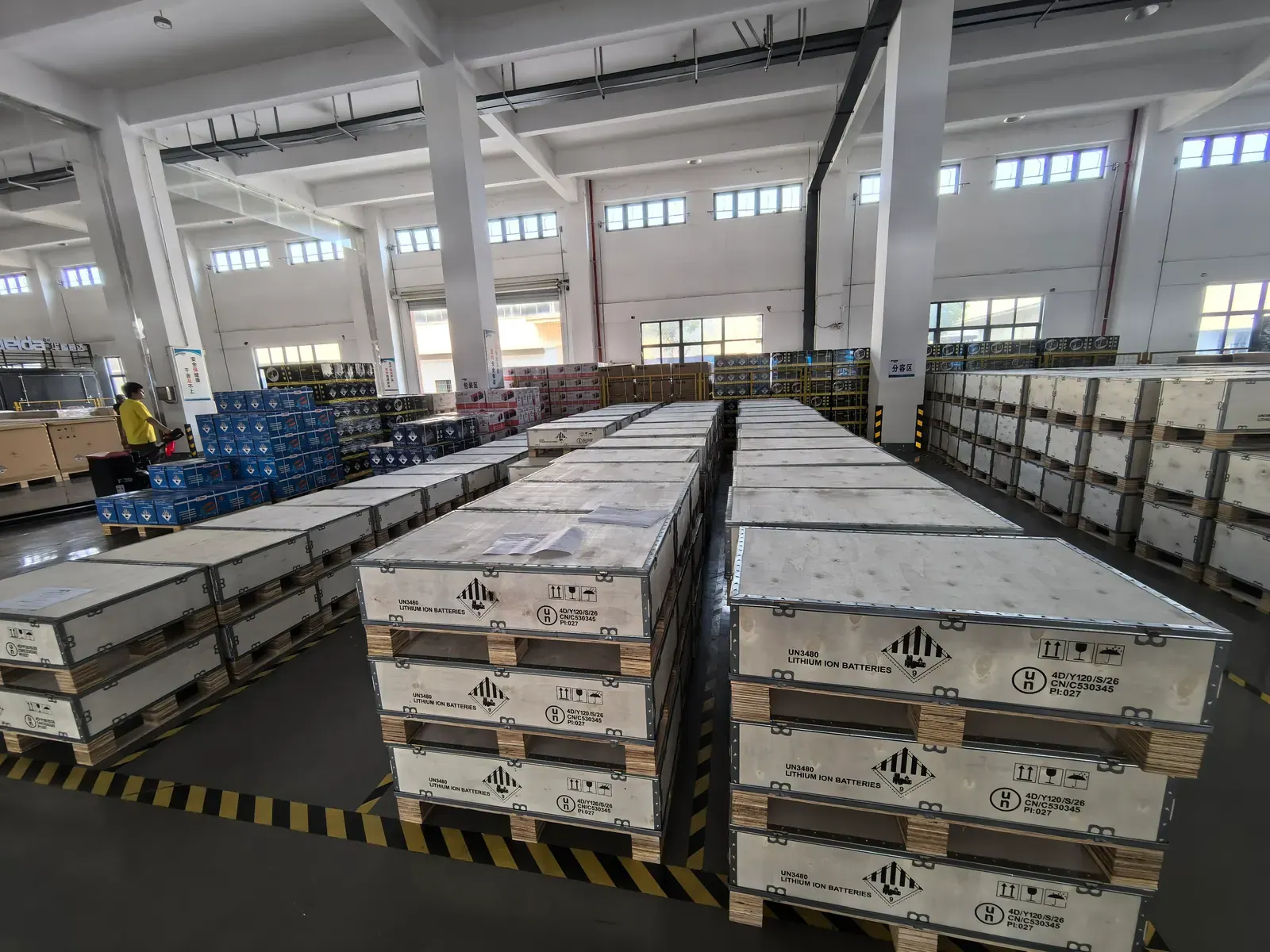
Export information should be part of the first quotation discussion, not added only after the price is confirmed. Destination country and destination port can affect document preparation, shipment marks, transport planning and the way mixed products are packed. Battery shipments may also need transport-related files or extra review before final logistics confirmation.
If the project includes both batteries and other PV materials, the supplier should also know whether the buyer wants a mixed container, palletized packing, OEM labeling or specific carton marks. These points may not change the technical product selection, but they can change the quotation scope and the commercial feasibility of the order.
Useful export notes include destination port, target shipment month, packing preference, document list, private-label requirement and whether the shipment is battery-only or mixed with panels and accessories. A buyer who shares these points early usually gets a cleaner quotation with fewer revisions later.
Resolve interface gaps before comparing the price total
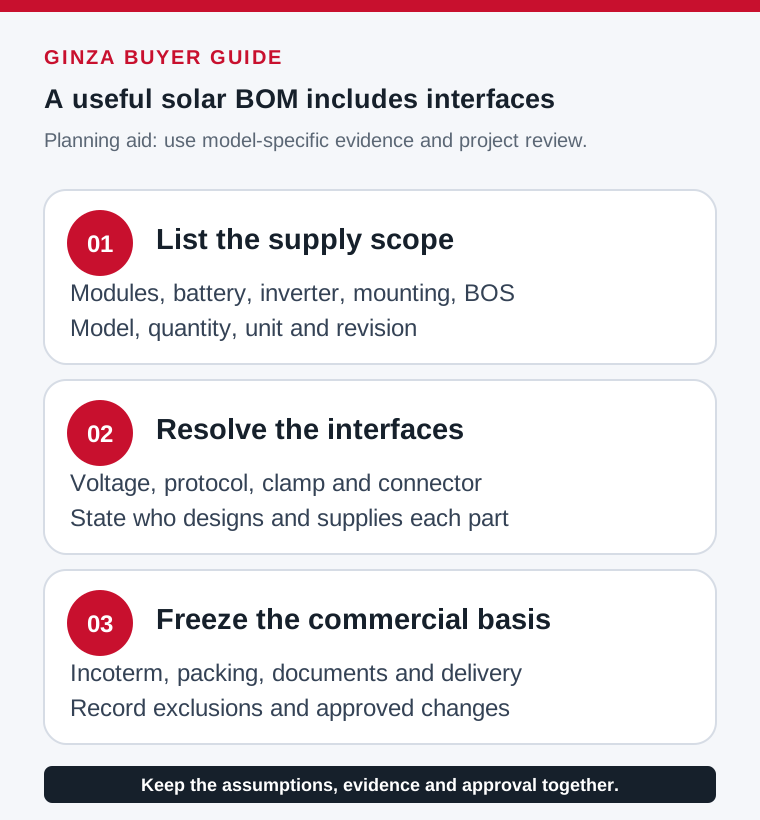
A BOM can list every major box and still omit the part that connects two of them. Review each boundary: module to connector, string to inverter, battery to inverter/PCS, module to clamp, mounting to structure, and equipment to monitoring. Assign who selects, designs and supplies the interface. A part described only as “compatible accessory” should remain an open item until the reference is identified.
For example, one module quote may include factory leads but not field cable or mating connectors; a mounting quote may include rails but exclude roof attachments; a battery quote may include a communication cable for one supported pairing but not the inverter’s required arrangement. Those are illustrative scope differences, not statements about a particular offer. Ask every bidder to mark included, excluded or alternative against the same line list.
| Interface | Attach to the BOM | Confirming party |
|---|---|---|
| PV electrical | Module data, connector references and string design basis | Electrical designer / equipment suppliers |
| Battery and inverter | Models, voltage/current limits, protocol and firmware | System designer / manufacturers |
| Mounting | Site layout, module clamp zones and local loads | Structural designer / mounting supplier |
| Delivery | Packing schedule, delivery point and documents | Exporter / forwarder / importer |
Use a revision column to stop silent substitutions
Give the BOM a project identifier, issue date and revision. Keep a stable line number when the quantity or model changes, and add a change note. Request a marked response when a supplier proposes an alternative. Record the offered datasheet and the party who accepts the technical difference before carrying it into the purchase order.
A higher wattage panel is not automatically an equivalent substitute if its dimensions, current or approved clamp zones change. A battery with more nominal kWh may still differ in supported voltage, power, communication, handling or installation scope. The designer should review affected interfaces rather than approving a substitution solely on a headline rating.
Example: separate an estimate from an order basis
An early tender may use approximate cable lengths and a provisional module layout. Mark those lines as estimated, identify who will measure or design them, and request a rate or adjustment basis where appropriate. Do not turn an estimate into a supposedly final quantity by removing its note. Before order release, issue a reconciled revision showing approved quantities, design references, spare requirements and unresolved exclusions.
The commercial comparison should use the same currency, Incoterm, delivery point, packing, included services and document requirements. If one bid excludes commissioning or civil works, show the exclusion beside its total. Avoid inventing the missing cost to force a ranking; obtain a clarification or keep the item visibly open.
Close the BOM with a deliverable register
List the required datasheets, drawings, packing information, model-specific test or certification evidence, manuals, warranty terms and acceptance records. Assign when each is due: quotation, design approval, before shipment or handover. This avoids discovering after production that a project submission requires a document the offer never included.
The DOE FEMP procurement checklist is a general reference for storage project questions, while its PV installation and commissioning guidance provides wider system context. Use the container loading guide when converting the approved BOM into a packing and shipment request.
FAQ
Can I send an incomplete solar project BOM?
Yes. GINZA can review an incomplete BOM, but the team will normally return a missing-information list before finalizing the quotation scope.
What is the minimum information needed for a first quotation?
At minimum, provide buyer type, destination country, destination port, product categories, rough quantity target and the battery or inverter reference if storage products are included.
Can one BOM include batteries, panels, mounting and accessories together?
Yes. That is a normal B2B sourcing scenario. It is better to separate the BOM by product family so the supplier can review each line clearly.
Should OEM requirements be included from the beginning?
Yes. If the buyer needs custom logo, carton, label, shell, manual or document formatting, those requests should be visible before quotation.
If you want GINZA Solar to review your project list, send the BOM together with destination port, quantity target and storage or inverter details through the inquiry form on www.ginzasolar.com/contact/.
Copyable BOM line-item format
Use one row per product or service and ask suppliers to mark included and excluded items. This prevents missing balance-of-system parts and makes offers easier to compare.
| Line item | Specification to enter | Quantity / unit | Supplier response |
|---|---|---|---|
| PV modules | Technology, power, dimensions, connector, required evidence | ____ pcs | Model, datasheet, lead time |
| Battery / ESS | Nominal and usable kWh, voltage, application, BMS protocol | ____ pcs / sets | Model, operating limits, warranty |
| Inverter / PCS | AC kW, DC range, grid code, firmware and interface | ____ pcs | Compatible model and test basis |
| Mounting and BOS | Site drawing, wind/snow basis, cables, connectors and protection | ____ set / m | Scope and exclusions |
| Documentation / delivery | Destination port, Incoterm, packing, test records, manuals | ____ lot | Documents and timeline |
Attach a single-line diagram, site or roof drawing and a load profile where available. For a storage-heavy project, the commercial BESS RFQ template expands the power, energy, controls and acceptance fields. For battery and inverter pairing, use the model-level compatibility checklist.