
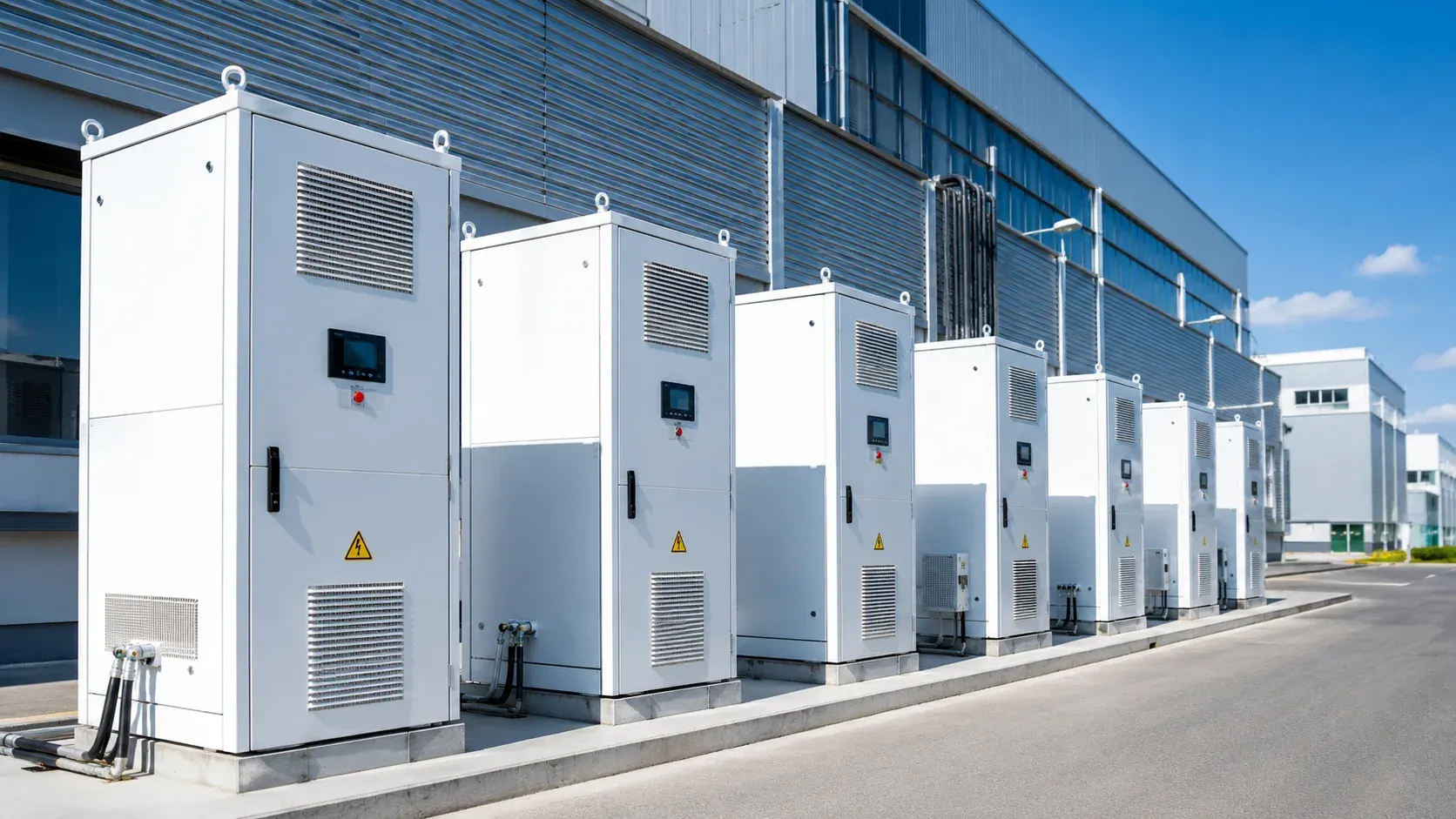
Quick answer: A useful commercial battery energy storage system (BESS) RFQ specifies the service the system must provide, its power and usable energy at a stated point of measurement, the site and grid constraints, control interfaces, safety evidence, acceptance tests and the commercial scope. A request for “500 kWh battery price” alone cannot produce comparable bids.
This template is for EPC and commercial buyers preparing supplier conversations. For system concepts and sizing methods, first read our commercial energy storage system buyer’s guide. The template below is a procurement starting point; the engineer of record must finalize local codes and performance criteria.
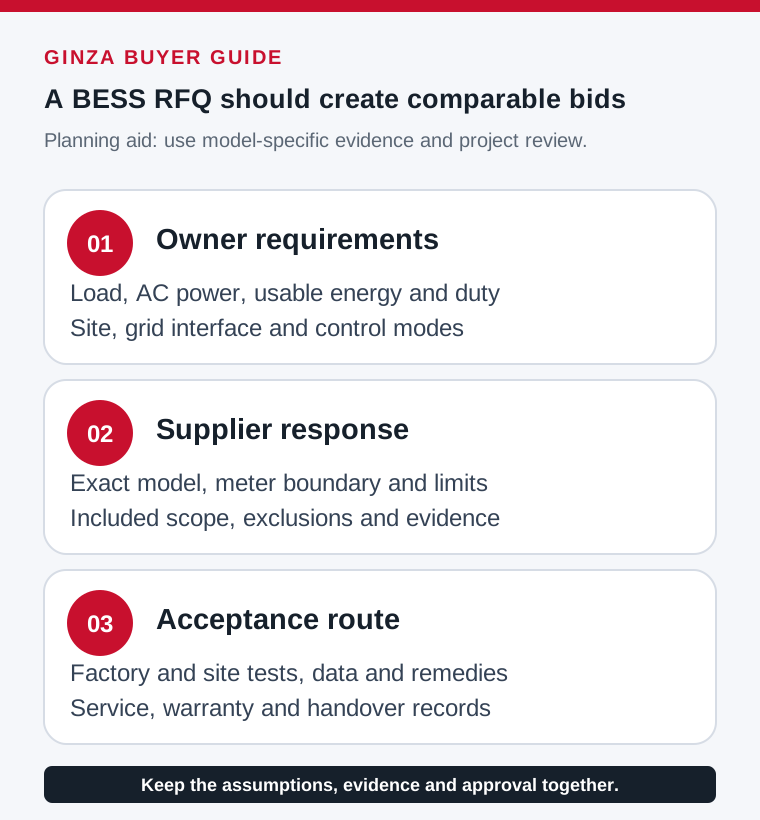
Start with the use case and load data
State whether the primary job is peak shaving, solar self-consumption, backup, time-of-use shifting or a combination. Supply at least a representative interval load profile, tariff or operating constraint, outage requirement and expected cycling. A system sized for short high-power peaks differs from one sized for many hours of backup.
| RFQ field | Buyer entry | Ask supplier to state |
|---|---|---|
| Site and use case | Country, site address, application, operating schedule | Assumed operating mode and exclusions |
| Load and solar | Interval load data, peak demand, existing/proposed PV and one-line diagram | Required metering and integration |
| Power | Continuous ____ kW; peak ____ kW for ____ seconds | AC power at specified temperature and point of connection |
| Energy | Usable ____ kWh at commissioning; required reserve ____% | Measurement point, SOC window, efficiency and end-of-life assumption |
| Grid and backup | Voltage, frequency, phases, utility rules, islanding or backup requirement | PCS topology, protection and transfer behavior |
| Battery and enclosure | Indoor/outdoor, ambient range, space and access restrictions | Pack chemistry, BMS limits, enclosure and thermal design |
| Controls | EMS use case, site SCADA, protocols and cybersecurity requirements | Supported interfaces, data points and software scope |
| Safety and approvals | Local permitting authority and project-specific standards | Model-specific test reports, certification scope and installation conditions |
| Delivery and service | Incoterm, destination, commissioning date, site access | Shipment scope, training, spares, warranty and local service plan |
Define the measurement boundary
Ask whether quoted kWh is cell, DC pack, usable DC or usable AC at the point of interconnection. Ask whether quoted kW is continuous or peak, at what ambient temperature, for how long and at what state of charge. Require bidders to list auxiliary loads and the test conditions used for round-trip efficiency. These definitions prevent an apparently cheaper proposal from hiding a smaller usable system.
Request safety evidence for the exact offered configuration
Ask for the product model, configuration, installation manual, applicable test reports and certification documents. Check that evidence covers the proposed battery, enclosure, PCS and operating conditions; a certificate for a different model is not interchangeable. The local authority and project engineer determine the applicable fire, electrical, grid and building requirements. Include emergency response information, disconnect locations, alarm logic and access requirements in the submittal list.
Make controls and interoperability testable
List the exact commands and data points needed by the EMS or site controller: charge/discharge setpoints, SOC, available power, faults, meter readings, remote stop and event logs. State the communications protocol, network owner, cybersecurity review and fail-safe response. For PV-coupled systems, include curtailment, export limit and inverter coordination. Review the inverter compatibility guide if a third-party inverter is part of the design.
Compare offers on one response schedule
| Bid comparison line | Bidder response |
|---|---|
| Equipment included / excluded | Battery, PCS, EMS, transformer, switchgear, HVAC, fire protection, cables and civil works |
| Guaranteed usable energy and power | Value, measurement point, temperature, SOC and test method |
| Warranty | Term, throughput/cycle limit, capacity floor, exclusions and remedy |
| Commissioning and acceptance | Factory test, site test, performance test, documentation and training |
| Service and spares | Response route, spare parts, remote access, software and maintenance |
| Price and schedule | Currency, Incoterm, lead time, milestone payments and validity |
Ask bidders to mark every exception to the specification. Compare lifecycle value as well as purchase price, using the same duty cycle, replacement assumptions and service scope. The U.S. Department of Energy’s commercial BESS procurement checklist is a useful cross-check for scope and documentation.
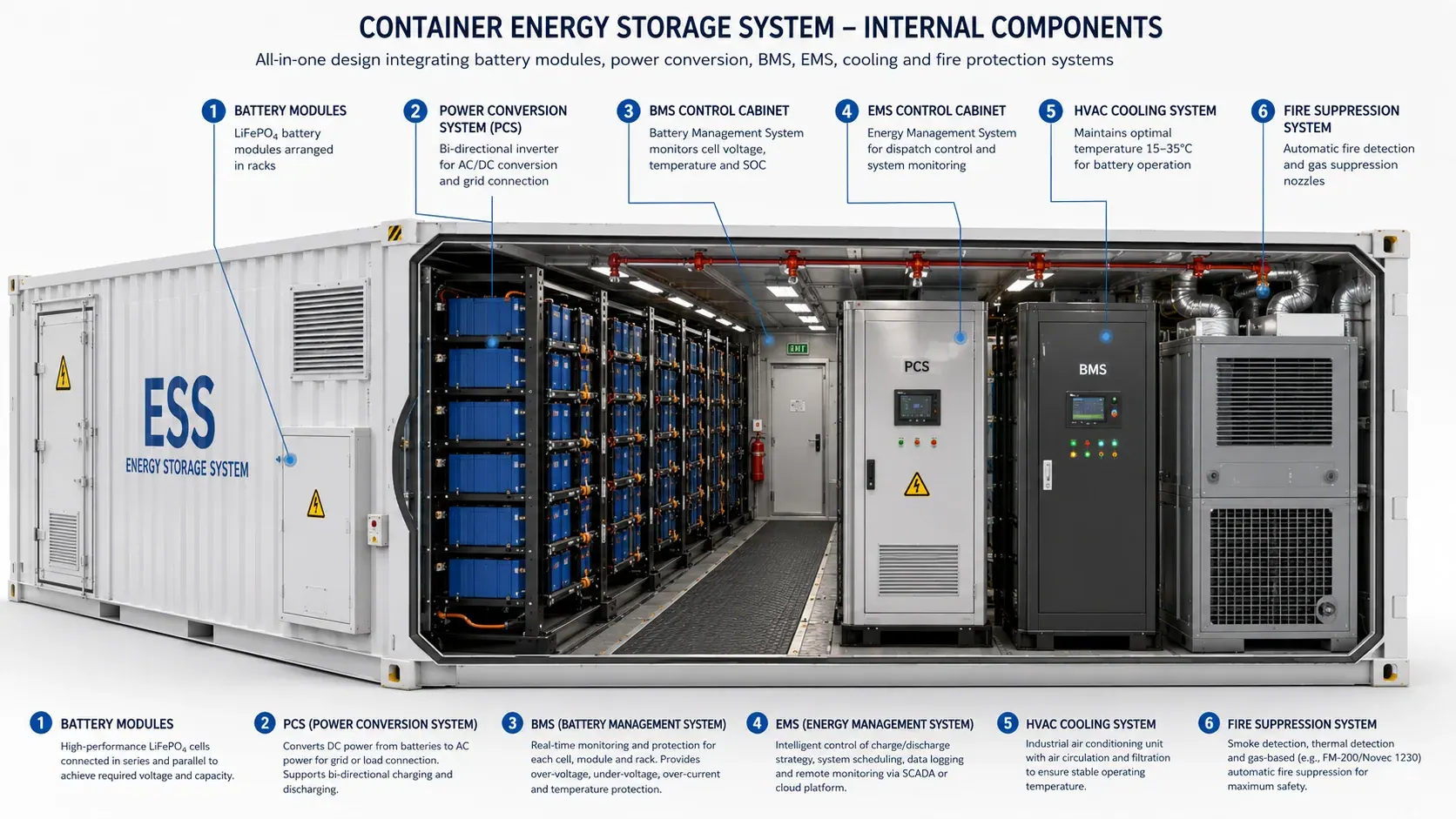
Issue a bid schedule that separates requirements from promises
A practical RFQ has an owner-requirement column and a separate supplier-response column. Keep the original requirement visible when a bidder proposes an alternative. Require a model, value, unit, evidence file and exception statement wherever the answer could affect performance or scope. “Compliant” alone leaves the buyer unable to see what was actually offered.
| Owner’s requirement | Supplier must enter | Comparison action |
|---|---|---|
| Usable energy at the named AC boundary | Guaranteed value, conditions and test method | Separate nominal DC from usable AC |
| Charge/discharge AC power | Continuous rating, duration and derating conditions | Check the required duty cycle |
| Operating modes and grid interface | Supported sequence, equipment and approvals | List assumptions and utility dependencies |
| Installed supply scope | Included equipment, services and exclusions | Price the same boundary |
| Acceptance and remedies | FAT/SAT procedure, tolerance and corrective process | Make the quoted result measurable |
Example: why two “200 kWh” bids cannot yet be ranked
Imagine Bid A states 200 kWh of nominal battery DC energy and excludes the PCS and HVAC auxiliary consumption. Bid B states a usable AC energy value under a defined operating window and includes a complete enclosure and controls. The first offer may appear cheaper per headline kWh, but the denominator and scope differ. Do not invent a conversion factor to make them look equivalent. Ask both bidders to respond to the same AC meter boundary and the same inclusion schedule.
Then compare the required power and operating duration. A storage asset for short peak reduction and one for sustained backup can require different power electronics, reserve policies and control behavior despite a similar nominal energy label. Attach the owner’s load and tariff information, define the intended modes, and ask the bidder to identify conflicts between them. Keep economic assumptions in a dated sheet so a commercial result can be traced to the data used.
Describe controls as testable sequences
Instead of requesting only “EMS included,” write the intended behavior. Examples include following a scheduled charge window, respecting an export limit, responding to an external setpoint, preserving a stated reserve, or recording alarms locally during a communications interruption. The control designer must determine whether each function applies and how it is implemented. Request the signal list, communication interface, ownership of settings and a way to witness the sequence.
For backup or islanding requirements, ask for the complete system architecture and the responsible designer. An ESS cabinet alone does not establish a permitted islanded system. The transfer arrangement, protection, grid conditions and load behavior belong in the approved design. If a function depends on another vendor’s equipment or on utility permission, keep that dependency explicit in the response.
Make factory and site acceptance different deliverables
A factory acceptance test (FAT) can confirm the agreed supplied configuration, identification, documentation and defined functions before dispatch. A site acceptance test (SAT) checks the installed system and interfaces under the agreed site procedure. Neither label is a universal list of tests. Attach the test matrix to the RFQ and require the supplier to propose its procedure, instruments, evidence and exclusions for review.
For each test, identify the prerequisite, pass/fail criterion, witness, data file, responsible party and retest process. Preserve failed or interrupted results and record why they were excluded from any calculation. The commissioning report template helps record the outcome, while the energy and efficiency guide explains the measurement questions.
Resolve the commercial interfaces before award
Ask who supplies site civil works, foundations, crane and offloading, cable runs, transformer or switchgear, communications, permits, commissioning labour, training and spares. These items may be supplied by different contractors, but each interface needs an owner. Add a row for taxes, Incoterm, delivery point, packing, export documents and destination assumptions so the quoted equipment price is not mistaken for a complete installed project cost.
Finally, give each exception a disposition: accepted by the owner, clarified by the bidder, referred to the designer, or still open. Keep the approved bid revision with the final BOM and acceptance procedure. A useful RFQ reduces ambiguity before the contract is signed; the final order should not depend on a promise buried in an old email.
Frequently asked questions
Is an RFQ enough when the system design is still open?
If performance and architecture remain flexible, issue a request for proposal first and ask suppliers to explain design assumptions. Use an RFQ once the required scope and acceptance basis are sufficiently defined.
Should the RFQ state nominal or usable kWh?
State the required usable energy and its measurement point. Request nominal capacity as an additional disclosed value.
What should be attached to the first supplier inquiry?
Include the load profile, one-line diagram, use case, target power and energy, site conditions, utility constraints and target schedule. For mixed solar procurement, use the solar project BOM checklist.