
Quick answer: Select an installer battery from usable AC energy, continuous and surge power, inverter compatibility, installation conditions and an approved expansion plan. Compare the exact 110Ah, 220Ah and 330Ah model datasheets; nominal kWh alone cannot establish runtime or suitability.
GINZA Solar supports installers, distributors and project buyers with low-voltage LiFePO4 batteries, commercial ESS and pre-quotation technical review. When installers ask which battery they should choose, the right starting point is not only the solar panel wattage or the nameplate battery capacity. A better selection process begins with usable energy demand, backup duration, inverter conditions, communication needs and the expected number of batteries in the system.
What installers should check before choosing a LiFePO4 battery
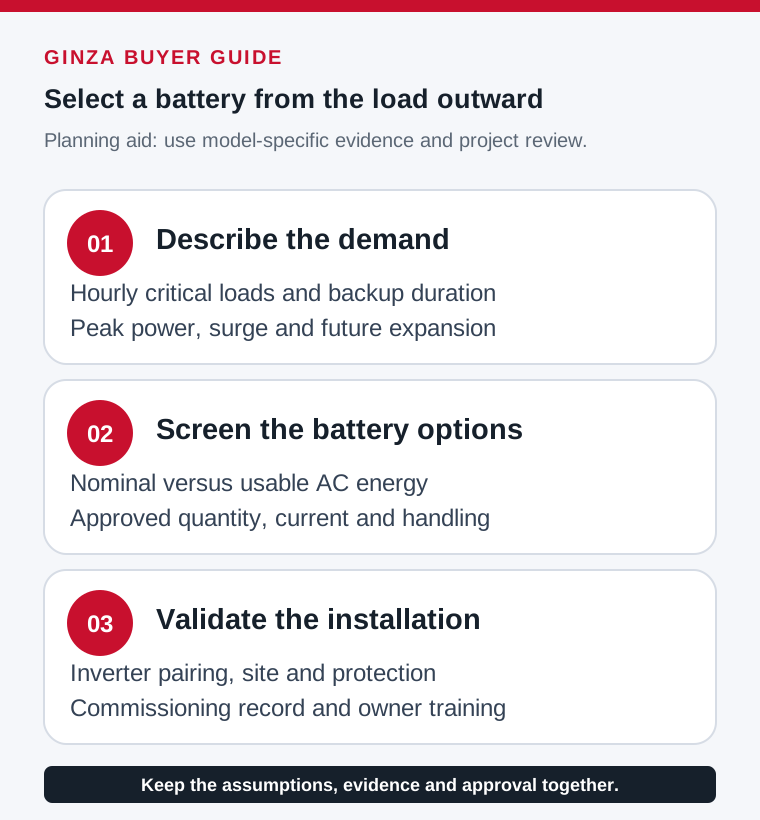
The first step is to estimate how much usable energy the system must actually deliver. Installers should separate critical backup loads from non-critical loads, estimate daily energy use, and define whether the battery is supporting a few hours of backup, overnight operation or a larger energy-shifting task. This gives the project a usable kWh target instead of a vague request for one battery set.
After that, the installer should confirm the inverter brand and model, required battery voltage, peak power demand, installation environment and any expansion plan. A battery that looks sufficient on paper may become a poor fit if the inverter current limits, communication mode or future battery count have not been considered.
- Daily energy demand and backup duration
- Critical loads, surge loads and peak inverter power
- Battery voltage class and target installation layout
- Inverter brand, exact model and communication preference
- Expected future expansion or repeat stock planning
For quotation work, these inputs are usually more useful than a simple request for the lowest-price battery.
How 5.632kWh, 11.264kWh and 16.896kWh models compare
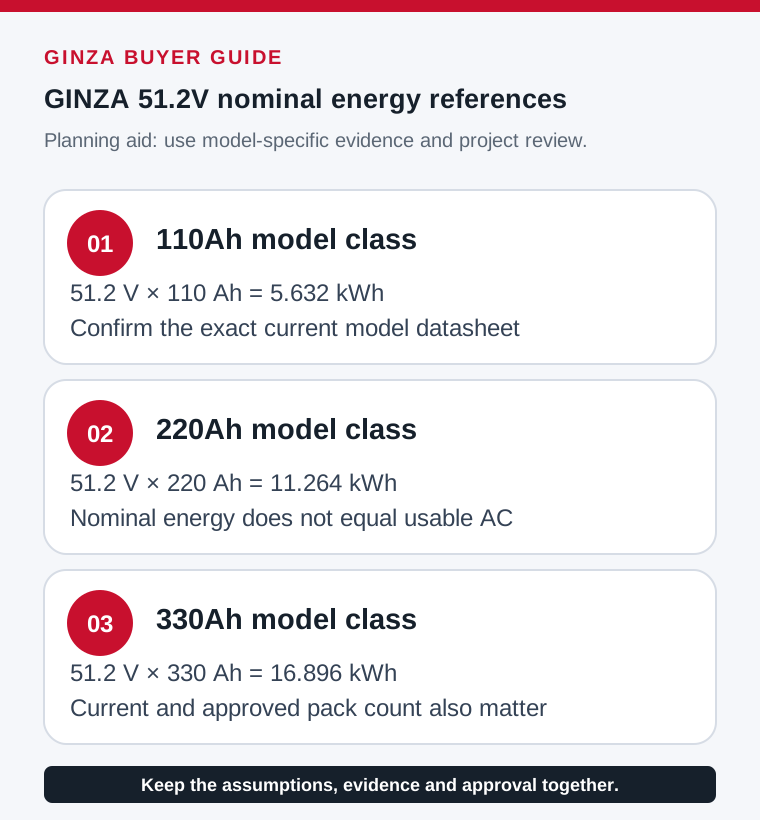
GINZA’s common 51.2V LiFePO4 references for installer discussions include 110Ah at 5.632kWh, 220Ah at 11.264kWh and 330Ah at 16.896kWh. These figures help installers create a starting point for project sizing, stock planning and quantity comparison before a final quotation is prepared.
| Reference model class | Nominal energy | Typical use in quotation planning |
|---|---|---|
| 51.2V 110Ah | 5.632kWh | Smaller backup demand, sample projects or modular expansion planning |
| 51.2V 220Ah | 11.264kWh | Mid-size residential or light commercial installer requests |
| 51.2V 330Ah | 16.896kWh | Larger energy demand, fewer units per kWh target or stronger repeat-stock positioning |
The correct model is not chosen by capacity alone. Installers should also look at parallel quantity expectations, available installation space, weight handling, inverter limits and whether the buyer wants a compact first order or a standard model for repeated use in one market.
Usable energy versus nominal energy
Nominal battery capacity tells you the stored energy on paper, but usable energy is the portion of that capacity the project expects to rely on in real operation. This is why installers should start from the usable kWh target and then allow margin for system losses, operating conditions and future expansion.
For quotation planning, a simple working method is: first estimate the usable energy needed by the loads, then review how much nominal battery capacity is required after considering the intended operating window and system margin. The final design should still be checked by qualified local professionals, but this method produces better first-round battery requests than using panel wattage alone.
As an example, two projects may both ask for roughly 10kWh of storage, but one may require a compact daily-cycling setup while another may need longer backup duration, higher surge tolerance or easier future expansion. Those differences can change the preferred battery quantity and model class.
Why inverter matching and communication matter
Battery selection should always be linked to the inverter. The same nominal battery capacity can behave differently depending on inverter voltage class, charge and discharge settings, communication requirements and installer commissioning practice. If the inverter expects CAN or RS485 communication, that should be checked before the quotation is treated as final.
Installers should provide the inverter brand, exact model, system type, communication preference and any known firmware notes. This helps GINZA review whether the battery request is suitable for closed-loop communication, open-loop configuration or whether more technical confirmation is needed before supply.
A good first inquiry usually includes target kWh, preferred model class, inverter model, quantity plan, destination market and document requests. That gives the supplier enough context to reply with a clearer battery recommendation and quotation basis.
Build a load sheet before selecting the battery count
List each critical load with its running power, operating hours, simultaneous operation and start-up behavior. A refrigerator, pump or motor needs more than a daily energy estimate because its transient power can affect the inverter and battery-current requirement. Distinguish measured data from an owner’s estimate, and identify the worst operating period the system is intended to support.
As an illustrative worksheet, a 0.4 kW communications load for eight hours and 0.8 kW of lighting for three hours require 3.2 + 2.4 = 5.6 kWh at the load. Add the owner’s specified reserve, then calculate the necessary battery energy using the approved usable SOC window and system losses. Keep these assumptions visible. A PV module rating does not tell the installer how much energy those loads will need during an outage.
Compare model options against more than capacity
The 5.632, 11.264 and 16.896 kWh nominal references are useful for a first screen. Ask how each option fits the inverter’s current and voltage limits, the approved parallel count, available wall or floor space, handling route, maintenance access and future service. A larger individual battery can reduce the number of enclosures, while multiple smaller units may have different installation and replacement implications. Neither arrangement is automatically better.
| Selection question | What to compare | Hold point |
|---|---|---|
| Can it meet the load? | Usable AC energy and continuous/surge power | Unverified load or battery current |
| Can it fit the site? | Exact dimensions, mass, environment and service clearances | Unsupported mounting or handling |
| Can it work with the inverter? | Models, firmware, protocol and approved pack count | Unvalidated pairing |
| Can it be maintained? | Warranty conditions, spare strategy and support process | Unknown replacement or expansion rules |
Make site information part of the battery decision
Send the installation location and ambient range, indoor or outdoor conditions, access dimensions, mounting proposal, cable route and any site approval constraints. The manufacturer’s permitted conditions and the locally approved design determine installation suitability. Do not infer enclosure protection, thermal behavior or a mounting method from a product photograph.
If a buyer intends to add packs later, ask for a documented expansion path including allowable models, firmware, age differences and reconfiguration. If service access is difficult, ask who can inspect and replace equipment locally and what records are needed for a claim. The warranty review guide helps compare the written terms rather than just the headline years.
Turn the selected model into a repeatable installation
Before the first order, retain the exact datasheet, installation instructions, approved inverter pairing, configuration and required evidence. Commission the first installation against the agreed procedure and record equipment serials, firmware, limits, alarms and the owner handover. Use that configuration as a controlled reference for repeat jobs, and recheck any substitution or revision.
For general procurement structure, consult the DOE FEMP BESS procurement checklist. For measurement context, the FEMP evaluation method distinguishes energy assessment from a nominal label. These references do not replace the exact equipment manuals or establish a particular GINZA model’s performance. Send the completed load sheet and installation details for a model-specific quotation.
FAQ
Can I choose a battery only from solar panel wattage?
No. Panel wattage helps estimate generation, but battery selection should be based on usable load demand, backup duration, inverter limits and installation conditions.
Which GINZA capacities are useful as a first reference?
For 51.2V discussions, the practical references are 5.632kWh, 11.264kWh and 16.896kWh model classes.
Does this article replace final engineering design?
No. This guide helps installers prepare better quotation data. Final installation design and code compliance should be confirmed locally.
What should I send for a fast battery review?
Send daily load, backup hours, inverter model, target kWh, battery voltage, destination country, destination port and expected quantity.
If you want GINZA Solar to review your battery request, you can submit the project details through www.ginzasolar.com/contact/ or compare the product line at www.ginzasolar.com/51-2v-lifepo4-battery/.
Installer sizing worksheet before comparing models
Record these inputs before selecting a battery. The arithmetic gives a screening estimate; the engineer and equipment manuals determine the approved design.
| Question | Project entry |
|---|---|
| Critical loads and hourly energy use | ____ kW peak; ____ kWh per day |
| Backup or shifting duration | ____ hours |
| Required usable AC energy | ____ kWh plus ____% reserve |
| Inverter model, firmware and battery voltage window | ________________ |
| Continuous / surge output and battery current limits | ________________ |
| Temperature and installation environment | ________________ |
| Initial and future pack quantity | ________________ |
Worked example: A 1.5 kW critical load for six hours needs 9 kWh at the AC load before reserve and losses. A nominal 11.264 kWh 220Ah battery is not automatically enough: the usable SOC window, inverter efficiency, temperature, power limit and end-of-life requirement must also be checked. A 16.896 kWh 330Ah model gives more nominal energy, but the same compatibility review still applies.
For the full 330Ah calculation, read 51.2V 330Ah to kWh and usable energy. Confirm the exact inverter pairing with the compatibility checklist and compare the available 51.2V battery models.