

GINZA Tech Solar supplies LiFePO4 batteries and energy-storage solutions for installers, EPCs, distributors and OEM projects. This guide explains solar battery warranties from a procurement perspective: not simply which brand advertises the longest term, but which clauses determine whether coverage still has practical value after years of real operation.
Quick answer: A good solar battery warranty should be compared on product-defect coverage, end-of-life capacity, cycle or energy-throughput limits, start date, exclusions, remedy type, service process, transferability and claim documentation. A headline such as ��10-year warranty�� is only the starting point.
1. What Does a Solar Battery Warranty Cover?
A solar battery warranty normally combines two different promises: a product warranty covering defects in materials or workmanship, and a performance warranty defining how much usable capacity the battery should retain over time. The exact terms vary by product, country and application, so the warranty certificate should always be read together with the datasheet and installation manual.
Core Warranty Coverage �� Cells, BMS and Internal Electronics
Typical coverage may include:
- Battery cells: manufacturing defects, abnormal cell failure or degradation beyond the published performance threshold.
- Battery Management System (BMS): failures in monitoring, balancing, protection, contactor control or battery-inverter communication where these functions are part of the warranted product.
- Internal components: sensors, relays, fuses, communication boards and other factory-installed electronics.
- Capacity retention: a minimum usable-energy level at a defined year, cycle count or throughput milestone.
A battery can therefore generate two different types of claims. It may still operate but fall below its guaranteed capacity threshold, creating a performance claim. Or it may retain acceptable capacity while a BMS or electronics fault creates a product-defect claim.
What’s Typically Excluded?
Common exclusions include incorrect installation, operation outside the approved electrical or environmental limits, water exposure beyond the product’s IP rating, incompatible equipment, unauthorized firmware or hardware changes, physical damage, misuse and force majeure events.
Normal degradation is not automatically a defect. If a warranty promises 70% retained capacity at year 10, a battery measuring 76% at year 9 may have degraded significantly but can still remain within the contractual threshold.
For B2B projects, exclusions deserve as much attention as the headline warranty. Registration, commissioning records, approved-inverter requirements and monitoring connectivity can all affect claim eligibility.
Warranty vs Insurance �� Important for B2B Buyers
A manufacturer warranty is not project insurance. It normally addresses the product or defined performance obligations, not every commercial consequence of failure. Lost production, business interruption, labor, site access, shipping or third-party losses may be excluded unless the contract specifically includes them.
Commercial projects should therefore separate three layers of responsibility: manufacturer product warranty, EPC workmanship warranty, and project insurance/service agreements. This is especially important for remote or large systems where logistics and downtime can cost more than the failed battery module itself.
2. Solar Battery Warranty Duration: How Long Should You Expect?
Ten years is a common headline term for modern stationary lithium batteries, while selected current products offer 15-year coverage. For example, current Enphase IQ Battery 5P materials describe coverage of up to 15 years or 6,000 cycles, subject to the applicable regional warranty. However, a warranty can end earlier because of a cycle count, energy-throughput limit or another ��whichever comes first�� condition. For procurement, the useful metric is effective warranty life, not calendar years alone.
Industry Warranty Periods
| Headline Period | Typical Interpretation |
|---|---|
| 5 years | Common on some entry-level, older or component-only products. Check whether an extension is available. |
| 10 years | A common benchmark for modern residential and small commercial lithium storage. Verify cycle/throughput conditions. |
| 15 years | Available on selected premium products, often with a cycle cap or stepped capacity-retention schedule. |
| 20�C25 years | Not a mainstream stationary lithium-battery standard in 2026. Distinguish a true warranty from design-life or service-plan marketing. |
Solar modules frequently advertise 20�C25-year performance warranties, but battery warranties should not be evaluated using the same benchmark. If a battery supplier advertises 20+ years, request the actual warranty document and identify the capacity threshold, usage limit, remedy and legal warrantor.
Warranty Start Date: Installation, Activation, Delivery or Production?
Start-date rules differ across manufacturers. Current public examples use installation, activation/PTO, production or documented delivery rules. That matters to distributors because inventory may remain in a warehouse for months before commissioning.
The purchase contract should therefore state which event starts coverage and what evidence is required. Keep purchase invoices, delivery records, serial numbers, commissioning reports and portal registration records so the effective start date can be demonstrated later.
Cycle Life vs Calendar Life
Calendar life measures time; cycle life measures repeated use. One full cycle per day is about 3,650 cycles over 10 years. Two equivalent full cycles per day is about 7,300 cycles.
A design-life claim such as ��10,000 cycles�� is not automatically a 10,000-cycle warranty. Only the warranty document determines what cycling is actually covered. High-cycling C&I batteries used for self-consumption, tariff arbitrage or peak shaving therefore require much closer review of cycle and throughput limits than backup-only batteries.
Warranty Duration Examples by Manufacturer
| Manufacturer / Example | Public Warranty Structure | Procurement Point |
|---|---|---|
| Tesla Powerwall | Current U.S. documentation uses a 10-year limited warranty | Capacity and throughput treatment depends on application. |
| BYD Battery-Box Premium | Current North American examples use a 10-year structure | Capacity retention is linked to model-specific throughput / whichever-comes-first conditions. |
| Enphase IQ Battery 5P | Selected current regional documents extend to 15 years | A 6,000-cycle limit and 60% retention threshold can apply; verify the regional document. |
| Sungrow SBR/SBH | Regional 10-year battery warranty examples are available | Conditions are model- and region-specific. |
| Pylontech US Series | Regional warranty documents are published | Registration and model-specific terms must be checked. |
| CATL utility-scale ESS | Terms are generally project-specific | Do not convert a public performance/design claim into a universal warranty term. |
Source note: Manufacturer terms vary by model, market and document revision. Verify the warranty applicable to the serial number and destination country before procurement.
3. Key Warranty Terms Every Installer Should Know
The terms that most directly affect project economics are EOL capacity, energy throughput, cycle limit, whichever-comes-first logic, remedy type and DoD/SOC requirements.
End-of-Life (EOL) Capacity
EOL capacity is the minimum usable capacity guaranteed at a defined warranty milestone. If a 10 kWh battery has a 70% capacity-retention warranty at year 10, it should retain at least 7 kWh under the manufacturer’s specified test conditions at that milestone.
Do not compare percentages without comparing the test method. Buyers should confirm the rated-capacity reference, test temperature, charge/discharge rate, SOC window, measurement point and who is authorized to conduct the test. Without a defined test method, a capacity-retention percentage can be difficult to enforce.
Energy Throughput �� The Hidden Warranty Limit
Energy throughput is the cumulative energy discharged or processed during the warranty period, normally expressed in kWh or MWh.
Example: if a 10 kWh battery discharges 8 kWh per day, annual discharged energy is approximately:
8 kWh �� 365 = 2,920 kWh/year
If its hypothetical covered throughput were 20 MWh:
20,000 �� 2,920 �� 6.8 years
The battery could therefore reach the usage limit well before a 10-year calendar term. For high-cycling projects, always translate the supplier’s MWh allowance into expected operating years using the actual dispatch profile.
��Whichever Comes First��
This clause means coverage ends when the first specified limit is reached: time, cycle count, throughput or another operating metric. A backup battery may receive almost the full calendar term, while a battery cycling twice daily may hit its usage limit several years earlier.
The clause itself is not unusual; the procurement risk is failing to model it before purchase.
Prorated vs Full Replacement Warranty
A full replacement remedy generally provides repair or replacement without reducing value solely because the battery is older, although freight, labor and ancillary costs may still be excluded. A prorated remedy reduces compensation over time.
For example, if a $5,000 battery has a hypothetical 30�C50% prorated value in year 8, a valid claim might result in $1,500�C$2,500 of credit rather than a new equivalent battery. Buyers should ask whether replacements are new or equivalent, whether the replacement restarts coverage, who pays freight/labor, and whether the supplier can issue credit instead of a physical unit.
Depth of Discharge (DoD) Requirements
DoD describes how much of the battery’s rated capacity is used during a cycle. The warranty issue is not whether 80% or 90% DoD is universally better; it is whether BMS and inverter settings remain within the manufacturer’s approved SOC/DoD window.
For repeat installations, standardize inverter templates and preserve commissioning screenshots showing SOC limits, charge current, discharge current and other critical settings. This creates evidence that the battery was operated within the approved envelope.
Warranty Terms Summary
| Term | Meaning | B2B Impact |
|---|---|---|
| Product warranty | Defects in materials/workmanship | Basic failure protection |
| Performance warranty | Capacity/energy performance over time | Determines degradation claims |
| EOL capacity | Minimum retained capacity | Affects long-term usable kWh |
| Cycle limit | Maximum covered cycles | Can shorten calendar coverage |
| Energy throughput | Maximum covered cumulative energy | Critical for high-cycling projects |
| Whichever comes first | First limit reached ends coverage | Determines effective warranty life |
| Prorated remedy | Compensation decreases with age | Can leave a replacement-cost gap |
| DoD / SOC requirements | Approved operating window | Incorrect settings can affect eligibility |
4. Solar Battery Warranty Comparison Table (2026)
The safest comparison is between specific product-and-region warranty documents, not brand names alone. Warranty structure can change with application, model, territory, activation date and throughput.
Manufacturer Warranty Comparison �� Public Examples
| Manufacturer / Product Example | Calendar Term | Performance Example | Usage Limit | Key Takeaway |
|---|---|---|---|---|
| Tesla Powerwall, U.S. | 10 years | 70% at year 10 for applicable terms | Unlimited cycles for listed uses; 37.8 MWh for other uses in the cited U.S. document | Application determines the operating limit. |
| BYD Battery-Box Premium, North America | 10 years | 70% usable-energy retention in the cited HVL/HVM-US document | Model-specific minimum throughput; whichever comes first | Read the throughput table for the exact configuration. |
| Enphase IQ Battery 5P, selected regions | Up to 15 years | Current examples specify at least 60% capacity | Up to 6,000 cycles | Long calendar coverage does not remove the cycle limit. |
| Sungrow SBR/SBH, regional example | 10 years | Current regional terms include capacity-performance conditions | Model/application conditions apply | Temperature and operating profile matter. |
| Pylontech US Series | Region-specific | See applicable regional warranty | Region/model-specific | Use the exact country document and registration process. |
| CATL TENER / utility-scale | Project-specific | CATL publicly promotes performance/design characteristics such as five-year zero degradation for TENER | Contract-specific | Product marketing is not the same as a universal warranty. |
Data note: Official manufacturer materials were reviewed on August 8, 2026. Terms can change and may differ by region; the warranty issued for the purchased model takes precedence.
Sources and Verification Method
The table uses manufacturer-controlled warranty PDFs, product data sheets or official document libraries rather than reseller summaries. The principal sources are Tesla’s U.S. Powerwall warranty, BYD’s North American Battery-Box Premium warranty, Enphase’s storage-document library, Sungrow’s SBH data sheet, Pylontech’s regional download library and CATL’s TENER product announcement. These examples are included to explain warranty structure��not to provide legal advice or replace the document supplied with a specific serial number.
How to Read the Comparison
Use this order:
- Confirm exact model and destination market.
- Separate product-defect and performance coverage.
- Convert cycle/throughput limits into expected years.
- Read repair, replacement, credit and refund rules.
- Identify who pays labor, freight and dangerous-goods logistics.
- Confirm registration, monitoring and approved-inverter requirements.
The ��best warranty�� is application-specific. A residential warranty designed for solar self-consumption cannot be directly ranked against a 500 kWh or multi-MWh project contract.
Convert Warranty Terms into Project Economics
For B2B procurement, warranty comparison becomes more useful when the clauses are converted into financial exposure. Start with the modeled annual energy throughput, expected cycling frequency and required usable capacity at the end of the project period. Then estimate what happens if a valid failure occurs in year 6, 8 or 10.
For example, two batteries can both advertise a 10-year warranty but create very different project risk. Battery A may have a generous throughput allowance but exclude field labor and freight. Battery B may have a lower throughput limit but include local replacement stock and a clear service process. For a remote commercial site, Battery B could still produce a lower expected service cost.
The same logic applies to capacity retention. A higher EOL percentage has value only if the test method is enforceable and the remedy for falling below that threshold is clear. Procurement teams should therefore compare warranty terms together with landed replacement cost, service access and downtime exposure. This turns the warranty from a marketing feature into a measurable part of total cost of ownership (TCO).
5. How to Evaluate a Solar Battery Warranty: A B2B Buyer’s Checklist
A B2B warranty evaluation should answer one question: if this battery underperforms or fails after several years, what happens, how quickly, and who pays? The answer should be documented before procurement.
7 Key Questions Before Purchasing
- What capacity-retention threshold and test method apply?
- Is there a cycle or energy-throughput limit?
- What ��whichever comes first�� trigger ends coverage?
- Is the remedy repair, replacement, equivalent unit, credit or prorated refund?
- When does the warranty start?
- What registration and documentation must be preserved?
- Who provides service in the destination market?
Red Flags
Review the contract more closely when:
- the term is long but the throughput allowance is low;
- no capacity-test method is specified;
- freight and labor responsibility is unclear;
- service promises exist only in sales messages;
- approved inverter or firmware requirements are vague;
- the legal warrantor is not clearly identified;
- transferability is absent for projects that may be sold.
Warranty Scorecard Template
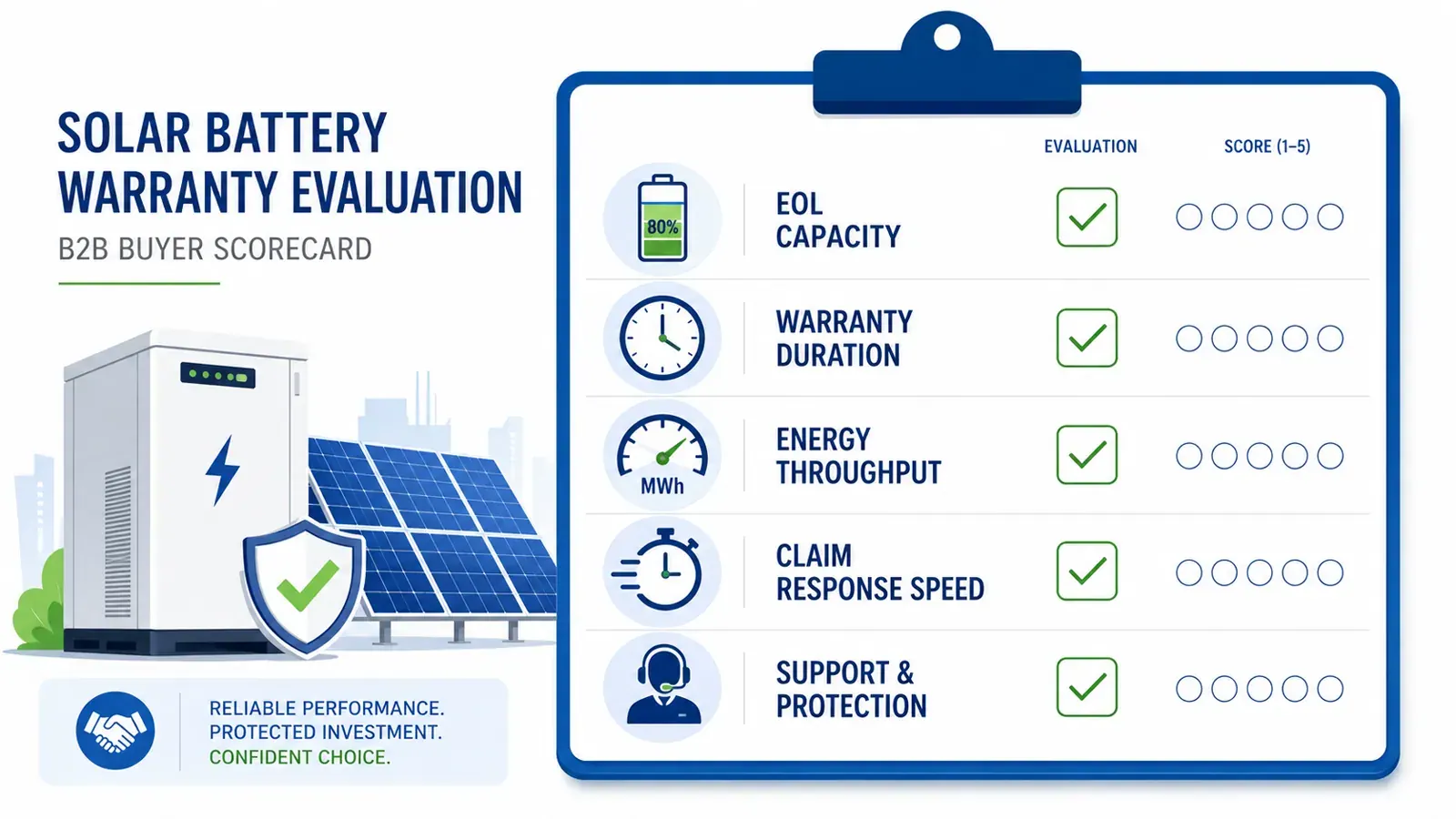
| Evaluation Criteria | Suggested Weight |
|---|---|
| Effective warranty duration | 15% |
| Capacity-retention guarantee | 15% |
| Throughput / cycle allowance | 15% |
| Remedy quality | 15% |
| Claim process / SLA | 10% |
| Logistics and labor allocation | 10% |
| Local technical support | 10% |
| Registration / documentation | 5% |
| Transferability | 5% |
Weights should match the project. A remote island site may prioritize logistics and local support, while an energy-arbitrage project should give more weight to throughput.
6. How to File a Solar Battery Warranty Claim: Step-by-Step
A strong warranty claim is built from records created before the failure. Serial-number traceability, commissioning data, configuration records and BMS logs are often more valuable than a long email written after the problem occurs.
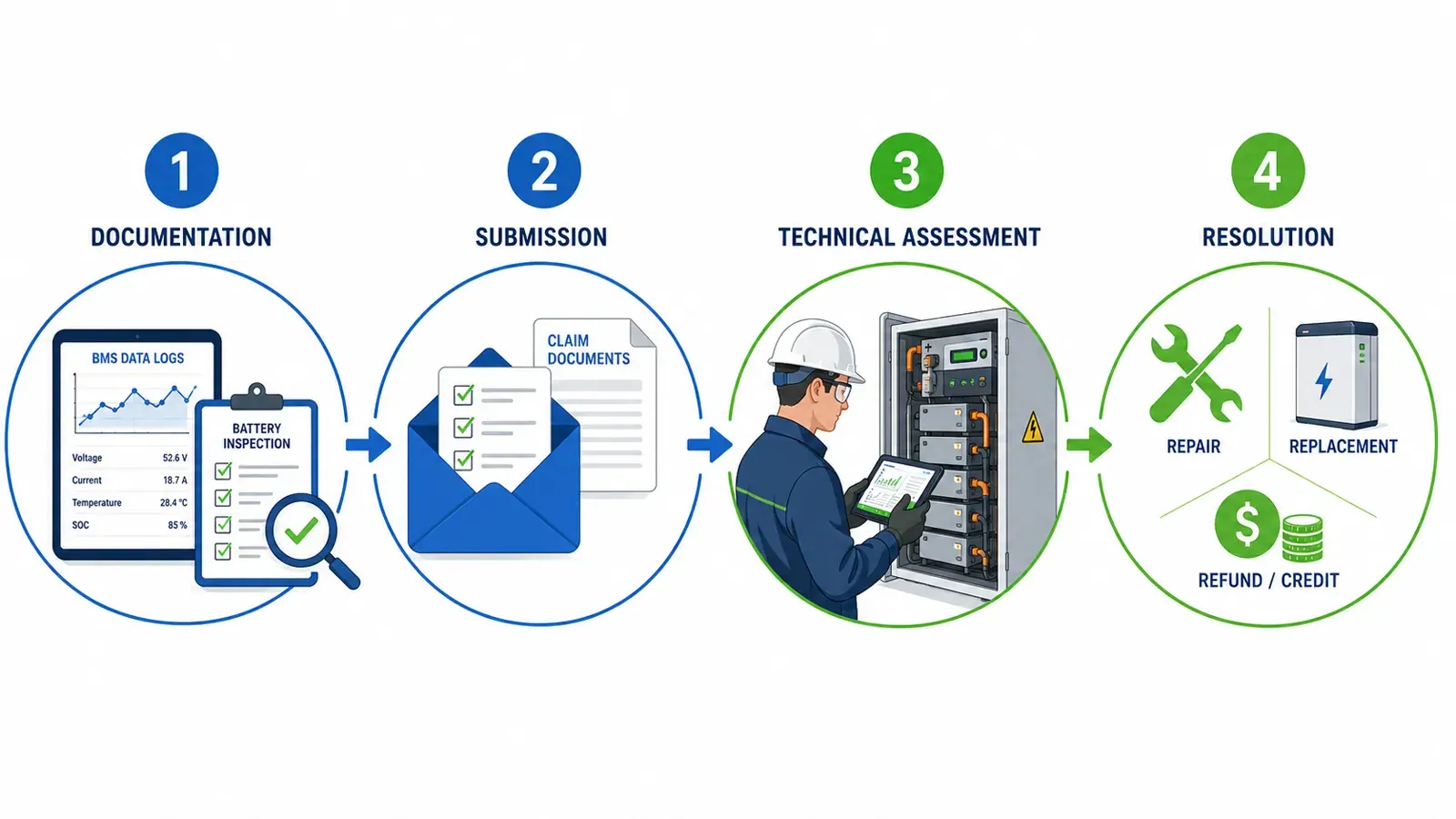
Step 1 �� Document the Issue
Record the site, serial number, inverter model, firmware, fault codes and symptoms. Export BMS/monitoring logs before resets overwrite useful data. For degradation claims, follow the manufacturer’s capacity-test procedure and record temperature, SOC, power and measured energy.
Step 2 �� Check Eligibility
Confirm the start date, remaining term, cycle/throughput status, registration, approved application, inverter compatibility, operating limits and exclusions.
Step 3 �� Submit a Complete Claim Package
Include proof of purchase, commissioning record, serial numbers, configuration screenshots, BMS/EMS logs, fault timestamps, photos, maintenance records and capacity-test results where relevant.
Step 4 �� Technical Assessment
The supplier may request remote diagnosis, measurements, firmware checks, module isolation, repeat testing or return inspection. The process depends on the regional service channel and contract. For large projects, define whether independent third-party testing is acceptable in disputed cases.
Step 5 �� Resolution
Possible remedies include remote correction, BMS/component replacement, module replacement, complete-unit replacement, equivalent successor product, credit or refund. Record the replacement serial number and remaining warranty term; do not assume a replacement automatically restarts a new full warranty.
Common Reasons Claims Are Delayed or Denied
Missing proof of purchase, serial registration or commissioning records; operation outside approved limits; unauthorized modification; incompatible equipment; physical damage; degradation above the guaranteed threshold; or a cycle/throughput limit already reached.
7. Chinese Manufacturer Warranty Analysis: BYD, CATL, Sungrow & B2B Suppliers
Chinese battery manufacturers should not be treated as one warranty category. BYD, CATL, Sungrow, Pylontech and OEM suppliers serve different segments and use different service models. The practical B2B question is: who is the warrantor, which document applies in the destination market, and how will service be executed?
How Chinese Manufacturers Structure Warranties
Three common models are:
- Global brand + regional warranty: country-specific terms and service through subsidiaries or authorized partners.
- Distributor-led warranty: the manufacturer provides technical backing while the distributor handles first-line diagnosis, parts and logistics.
- Project/OEM contract warranty: terms are negotiated for a specific order, capacity, destination and private-label program.
The second and third models can work well when responsibilities are explicit. Problems occur when distributor and factory each assume the other party will pay freight, labor or replacement stock.
Chinese vs International Brands: A Better Comparison
| Dimension | Large Chinese Manufacturer | Large International Brand | OEM / Project Supplier |
|---|---|---|---|
| Warranty document | Usually regional/model-specific | Usually regional/model-specific | Often order/model-specific |
| Service channel | Subsidiary, distributor or factory | Subsidiary, installer network or service center | Supplier + distributor/EPC |
| Replacement stock | Depends on local channel | Depends on market infrastructure | Can be negotiated as project spares |
| Custom terms | Possible on large projects | Usually limited on standard products | Often negotiable for volume/OEM orders |
| Main risk | Using wrong regional terms | Assuming premium brand covers every cost | Relying on unwritten sales promises |
The meaningful difference is service infrastructure, not nationality.
What to Negotiate in Supplier/OEM Warranty Contracts
For material B2B orders, define:
- warranty start date and registration process;
- capacity-test method and acceptable degradation threshold;
- cycle/throughput allowance;
- response and escalation times;
- repair vs replacement decision rules;
- spare BMS/modules and parts availability;
- freight, labor and customs responsibility;
- treatment of discontinued models;
- third-party assessment for disputed claims;
- transferability when relevant.
GINZA Solar Warranty Commitment: What Buyers Should Request in Writing
For a GINZA project, the quotation or project warranty should identify the exact model, term, performance conditions, claim route and remedy. GINZA’s public certificate library can be used to review available product safety/export documentation, but certification scope should be checked against the exact model being purchased.
For installer, distributor or OEM orders, request the applicable warranty document before payment so the commercial promise and project paperwork are aligned.
8. What Voids a Solar Battery Warranty?
The most common warranty risks are installation errors, unauthorized changes, environmental exposure, operation outside approved SOC/DoD limits, and incompatible inverter/BMS settings. Exact conditions differ by product.
Installation Errors
Incorrect cable sizing, torque, polarity, grounding, protection devices, communication wiring or commissioning settings can cause faults and create warranty disputes. Keep commissioning checklists and installation photos.
Unauthorized Modifications
Opening sealed assemblies, changing internal components, bypassing protection logic or loading unsupported firmware can affect coverage. Obtain written approval before modifications intended to solve site problems.
Environmental Factors
Use the manufacturer-specified temperature and humidity limits rather than a generic LiFePO4 range. Charging and discharging limits may differ, and the allowable environment can also depend on enclosure IP rating.
Non-Compliance with DoD / SOC Requirements
Do not force a wider SOC window simply to advertise more usable kWh. Configure the inverter and BMS inside the approved operating envelope and retain the settings as part of commissioning documentation.
Non-Approved Inverters or BMS Settings
Battery-inverter communication, voltage range, current limits and firmware compatibility can affect both system performance and warranty eligibility. See GINZA’s inverter compatibility guide for integration considerations.
9. Commercial & Industrial Battery Warranty: Special Considerations
Commercial battery warranties are usually more sensitive to throughput, duty cycle, service response, spare parts and project-level operating data than residential warranties. Large buyers may also be able to negotiate terms that are fixed for standard retail products.
B2B vs Residential Warranty Differences
| Dimension | Residential | Commercial / Industrial |
|---|---|---|
| Usage profile | Often one cycle/day or backup | Can involve high cycling and multiple revenue streams |
| Throughput | May be high/unlimited for defined uses | Often project-specific and economically important |
| Service | Installer/distributor channel | SLA, spare stock and escalation may be negotiated |
| Documentation | Registration + installation records | Detailed commissioning, EMS/BMS logs and fleet records |
| Contract flexibility | Usually limited | Greater on larger projects |
Project-Scale Warranty Negotiations
For a large project, negotiate the terms that protect the actual business case rather than simply asking for the longest warranty. Key items include throughput aligned with the dispatch model, a defined capacity-test method, service response targets, critical spare parts, labor/logistics allocation, acceptance criteria after repair and treatment of discontinued battery models.
For system-level procurement, review GINZA’s commercial ESS guide and commercial ESS solutions.
Multi-Site and Fleet Warranty Management
EPCs and distributors with many installed batteries should maintain a warranty database containing site, model, serial number, purchase/delivery/installation dates, inverter model, firmware, warranty version, registration status, cycle/throughput reading, claim history and replacement serial numbers.
For phased projects, preserve the warranty version that applied to each shipment. Fleet data can also reveal repeated BMS, module or service issues that should influence future supplier selection even when claims are approved.
Build Warranty Requirements into the EPC Handover
Warranty management should also be part of project handover. The EPC should deliver serial-number lists, final inverter/BMS settings, commissioning screenshots, monitoring access, warranty registration confirmation and the applicable warranty PDF to the owner or operator. If responsibility later moves to another O&M company, these records should transfer with the project.
This reduces a common commercial problem: the equipment may still be under warranty, but the owner cannot prove how it was installed or operated. A standardized digital handover package makes future claims faster and also protects the installer from failures caused by later unauthorized changes.
10. FAQ: Solar Battery Warranty Questions
What does a solar battery warranty usually cover?
Manufacturing defects and, where specified, minimum capacity retention. Exact cell, BMS, electronics, labor and logistics coverage varies by model and region.
How long is a typical solar battery warranty?
Ten years is common for modern stationary lithium batteries, while selected products offer 15 years. Cycle or throughput limits can shorten effective coverage.
What is EOL capacity?
It is the minimum usable capacity guaranteed at a defined milestone. A 70% EOL guarantee on 10 kWh means at least 7 kWh under the manufacturer’s defined test conditions.
What does ��whichever comes first�� mean?
Coverage ends when the first listed limit is reached, such as time, cycles or MWh throughput.
Which solar battery has the best warranty?
There is no universal winner. Compare exact regional terms, effective usage limits, capacity retention, remedy and local service for your operating profile.
How do commercial warranties differ from residential warranties?
Commercial projects place more emphasis on throughput, duty cycle, SLA, spare parts, data logs, labor and project-specific negotiations.
How do I file a solar battery warranty claim?
Submit proof of purchase, serial number, commissioning records, configuration screenshots, BMS logs, fault evidence, photos and capacity-test data where relevant.
What can void a solar battery warranty?
Incorrect installation, operation outside approved limits, unauthorized modification, incompatible equipment, unsupported settings, physical damage or missing required registration/documentation.
Are Chinese solar battery warranties reliable?
Reliability depends on the manufacturer, contract and local service structure, not country of origin. Check the legal warrantor, applicable regional document, parts path and written remedy.
What warranty terms should B2B buyers negotiate?
Prioritize throughput, capacity-test method, start date, remedy, freight/labor allocation, response process, spare parts, third-party testing, transferability and discontinued-model treatment.
Does a longer warranty increase battery cost?
It can. Longer coverage, higher throughput allowances and stronger service obligations increase supplier exposure. Compare the incremental cost with the value of the additional protection.
What maintenance keeps a warranty valid?
Follow the exact manual and warranty. Typical obligations include correct installation, approved operating settings, registration/monitoring, firmware management, environmental compliance and service records.
11. Conclusion: How to Protect Your Solar Battery Investment
A solar battery warranty is valuable only when the buyer understands what is covered, when coverage ends and how a claim is resolved. The most important warranty work happens before failure: choose the right product, verify the correct regional document, commission within approved limits and preserve evidence of compliance.
Before approving a supplier, confirm in writing:
- product and performance warranty periods;
- capacity-retention threshold and test method;
- cycle/throughput limit;
- warranty start date;
- approved inverter and operating conditions;
- remedy and logistics responsibility;
- registration and claim documentation;
- local support and escalation path.
GINZA Tech Solar supports B2B procurement of LiFePO4 batteries, commercial ESS and container energy storage systems.
Planning an installer, distributor, OEM or EPC battery order? Request project warranty details and a B2B quotation with the model, quantity, inverter, destination country and expected operating profile so the applicable terms can be reviewed before purchase.
Editorial note: Manufacturer warranty examples in this guide were reviewed against public materials available in August 2026. Warranty terms can change by product, territory and document version. The warranty supplied for the purchased product takes precedence.