
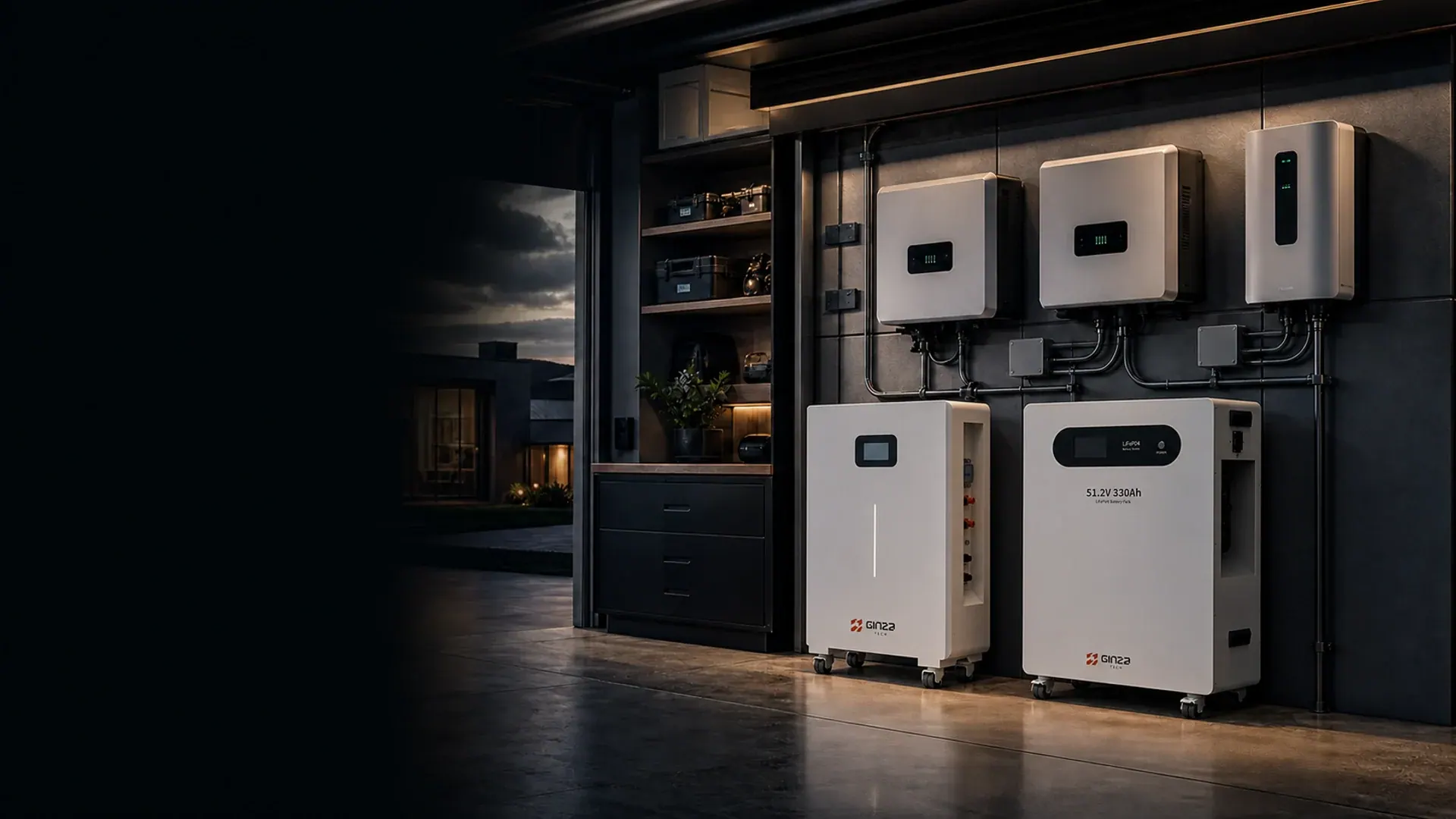
Quick answer: 51.2 V × 330 Ah ÷ 1,000 = 16.896 kWh nominal energy. That is the nameplate energy of one battery, not the energy guaranteed at the AC load. Usable energy depends on the allowed depth of discharge, inverter efficiency, battery operating limits, temperature and aging.
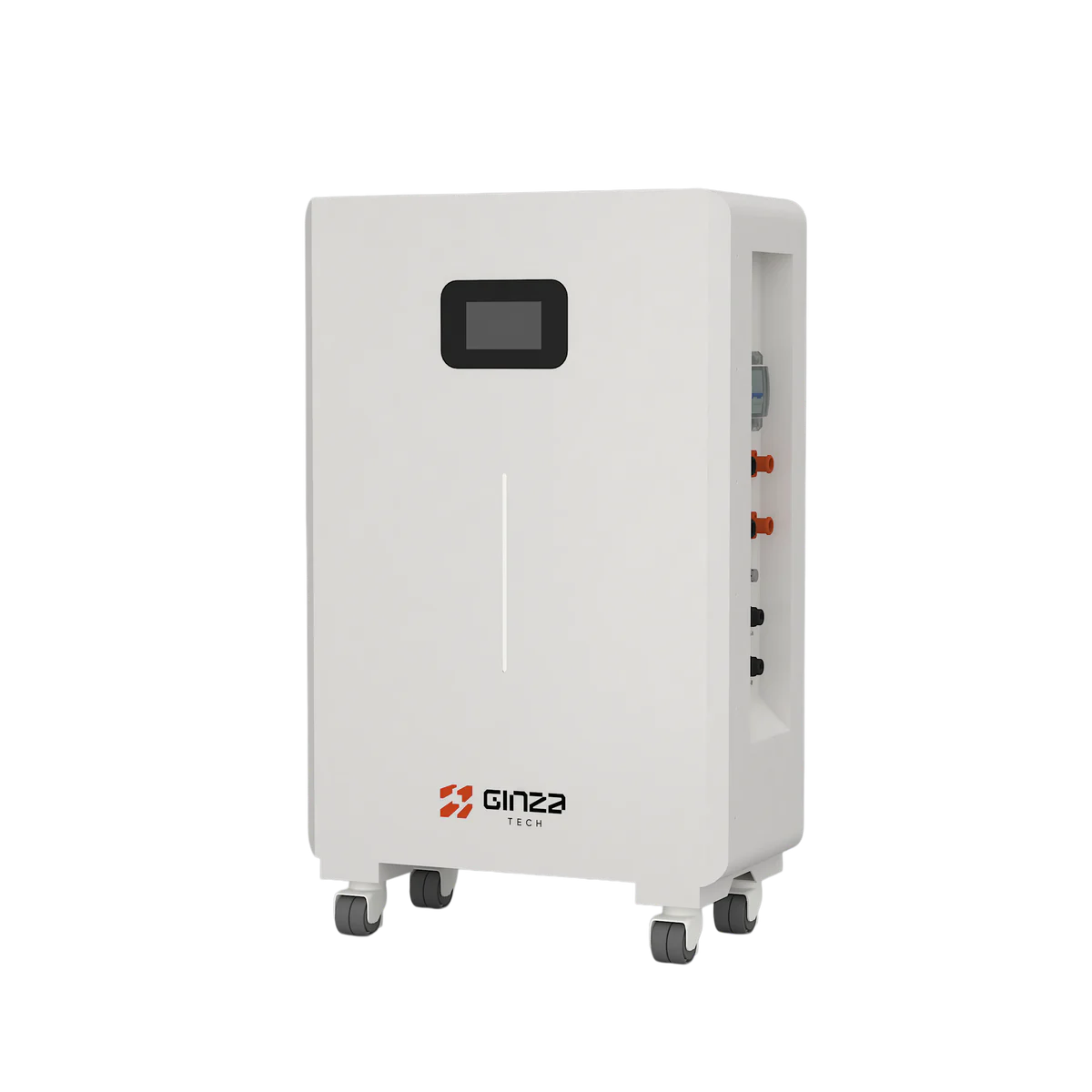
This guide helps installers and buyers turn an amp-hour rating into a first-pass system calculation. Confirm all design limits against the exact battery and inverter datasheets. For model details, see the GINZA 51.2V 330Ah LiFePO4 battery.
How to convert 51.2V and 330Ah to kWh
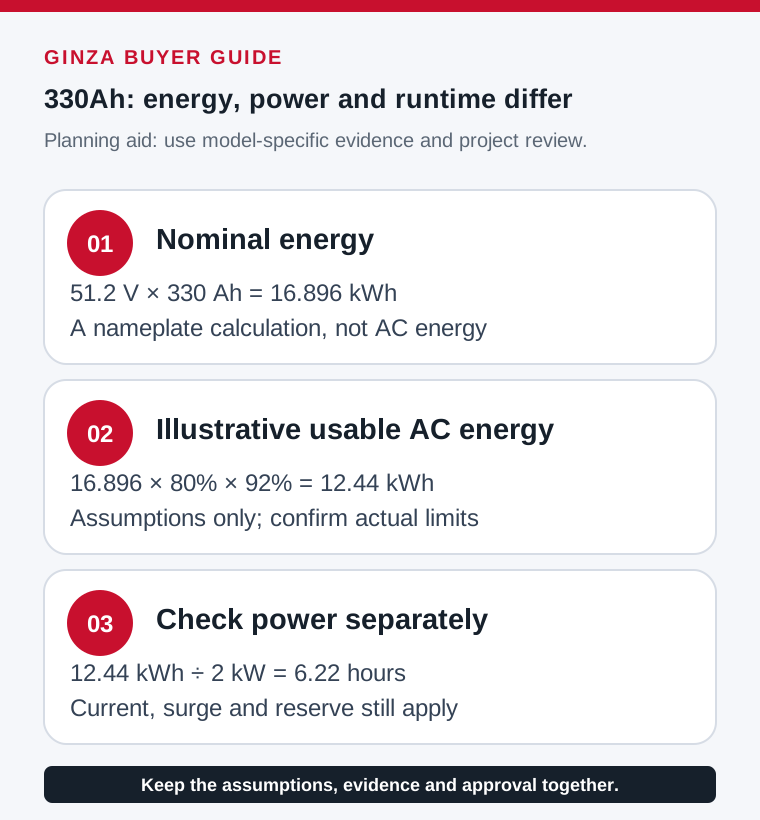
The arithmetic is voltage (V) × capacity (Ah) ÷ 1,000. The 51.2V figure is nominal voltage. Actual voltage moves with state of charge, load and temperature; capacity is measured under defined test conditions. The calculation is therefore a useful nameplate comparison, not an independent runtime promise.
| Configuration | Nominal calculation | Nominal energy |
|---|---|---|
| One 51.2V 110Ah module | 51.2 × 110 ÷ 1,000 | 5.632 kWh |
| One 51.2V 220Ah module | 51.2 × 220 ÷ 1,000 | 11.264 kWh |
| One 51.2V 330Ah module | 51.2 × 330 ÷ 1,000 | 16.896 kWh |
| Two matching 330Ah modules | 2 × 16.896 | 33.792 kWh before operating limits |
Do not assume two modules may be paralleled merely because the arithmetic works. Check the manufacturer-approved parallel count, cable and protection design, BMS communication and inverter battery-current limit.
Nominal versus usable battery energy
A planning estimate is: AC energy ≈ nominal kWh × permitted depth of discharge × inverter efficiency. For illustration only, 16.896 × 0.80 × 0.92 ≈ 12.44 kWh at the AC output. Those 80% and 92% values are example assumptions, not specifications for a GINZA product. The usable state-of-charge window and efficiency must come from the selected equipment and operating profile.
Battery capacity also changes with temperature, discharge rate and age. If an owner requires an energy guarantee at end of warranty, the EPC should calculate against the specified end-of-life capacity and verify the warranty’s energy or throughput terms. Our battery warranty guide explains which terms to request.
Work backward from the load, not the battery label
Start with an hourly load profile: continuous kW, peak kW, start-up surges, critical loads and hours of autonomy. Example: a critical 2 kW load for six hours needs 12 kWh at the AC output before reserve and losses. Under the illustration above, one 330Ah module would appear near the energy target, but the design cannot be approved until surge power, BMS discharge current, temperature, reserve and redundancy are checked. An engineer may specify more than one module for power or resilience even when nominal energy is sufficient.
| Design input | Why it matters | Send to supplier |
|---|---|---|
| Hourly load and peak surge | Sets energy and inverter power | Load schedule and motor list |
| Required autonomy and reserve | Sets usable kWh target | Hours without PV/grid and critical-load share |
| Inverter make, model and firmware | Determines voltage, current and communication matching | Datasheet and configuration screenshot |
| Ambient temperature and installation | Affects operating limits and enclosure choice | Site location and room conditions |
| Expansion plan | Affects parallel approval and space | Initial and future module counts |
Check inverter and BMS compatibility before ordering
Compare the inverter’s supported battery voltage window with the battery operating range, not just the 51.2V nominal label. Check continuous and peak charge/discharge current, the approved number of parallel packs, protocol and CAN/RS485 settings, firmware versions and fault behavior. An inverter that powers on with a battery is not proof of full closed-loop communication. Our inverter compatibility guide gives a request checklist.
What to put in a 330Ah battery RFQ
State quantity, intended application, destination country, required usable energy, load profile, inverter model, installation environment, communication requirements, preferred enclosure and delivery terms. Request the model-specific datasheet, test evidence, warranty conditions and approved wiring/parallel configuration. Avoid mixing different pack models or ages without written manufacturer approval.
A complete first-pass calculation for an installer
Consider an illustrative backup request with 0.8 kW of continuous critical equipment for four hours, followed by 1.6 kW for two hours. The load energy is (0.8 × 4) + (1.6 × 2) = 6.4 kWh. If the owner also asks for a 20% planning reserve, the preliminary target becomes 7.68 kWh at the AC load. The reserve is an owner-selected example, not a battery specification or a rule for every site.
Using the earlier illustrative 80% operating window and 92% conversion assumption gives 12.44 kWh of estimated AC energy from 16.896 kWh nominal. That appears above the 7.68 kWh screening target. It does not approve the installation: the installer still needs to check the actual usable window, temperature, peak load, start-up demand, inverter current, aging allowance and approved configuration. A calculation should end with a list of open inputs, not a promise that one pack will always meet the load.
| Worksheet line | Illustrative value | Evidence needed before approval |
|---|---|---|
| Critical-load energy | 6.4 kWh for the stated schedule | Measured or agreed load profile |
| Planning reserve | 20%, giving 7.68 kWh | Owner’s resilience requirement |
| Battery nominal energy | 16.896 kWh | Exact pack label and datasheet |
| Estimated usable AC energy | 12.44 kWh under example assumptions | Actual SOC, efficiency and operating limits |
| Final decision | Energy screen only | Power, compatibility and site review |
Why a large kWh number can still fail a power check
Energy is the amount delivered over time; power is the rate of delivery. An illustrative 5 kW AC load at 92% conversion efficiency would require about 5,435 W from the battery side. Dividing by 51.2 V gives approximately 106 A. This is only a nominal-voltage estimate. Current rises when operating voltage is lower, and the equipment’s actual continuous and surge limits determine whether the load is allowed. The 106 A calculation is not a stated current rating for this battery.
Ask the designer to compare the inverter’s requested battery current with the pack’s permitted discharge current, the BMS limit, cables, protection and the manufacturer’s installation instructions. Motor starting and other short transients need their own time-based check. Adding another battery for energy does not automatically solve an inverter limitation, and adding inverter power does not create more stored energy.
What two batteries change, and what they do not
Two matching 330Ah units have 33.792 kWh of nominal energy by arithmetic. The manufacturer’s approved pack count, current-sharing method, interconnection, communication arrangement and protection still govern whether they can be used together. Ask how one unavailable pack affects the remaining system and whether the inverter must reduce its output or charging demand. Do not assume that doubling the pack count doubles every power capability.
For future expansion, record the initial and proposed later model, firmware, age and installation date. Obtain written instructions for mixing or adding packs before making an expansion promise to a customer. An approved expansion plan is more useful than an open-ended statement that the system is scalable.
Acceptance records for the delivered 330Ah model
Keep the purchase specification, product label, serial number, manual, BMS/inverter versions and commissioning record in one handover folder. The initial functional test should use an approved procedure and preserve the observed energy, SOC range, load, temperature, alarms and result. A BMS capacity display or a brief power-on demonstration cannot establish an independently measured usable AC capacity.
If usable energy is contractual, state the meter boundary and test conditions before ordering. Read the usable-energy acceptance guide for the distinction between a nameplate calculation and a metered result. For a purchasing decision, compare the same offered model, warranty conditions and installation scope; do not compare one supplier’s nominal DC figure with another supplier’s usable AC figure.
Check units before comparing a quotation
Keep V, Ah, kW and kWh in separate columns. A price per Ah is not comparable across different voltage platforms, and a kWh price can still conceal a different usable operating window. Confirm whether an energy figure refers to one battery or the complete proposed bank. Ask the bidder to state the pack count and nominal total explicitly, then preserve the usable-energy assumptions in a separate line. This small units check can prevent ordering an apparently cheaper configuration that does not meet the required load or installation scope.
Technical references and next enquiry
The DOE FEMP evaluation method provides background on metered energy assessment; the FEMP technical-specification resources help define a project requirement. These are general references, not validation of a GINZA model. Send the exact load schedule, inverter, target runtime, installation environment and proposed pack count with your technical enquiry.
Frequently asked questions
How many watts is a 51.2V 330Ah battery?
The rating gives energy (16.896 kWh), not a fixed power output. Maximum watts depend on the permitted current and inverter limits.
Will a 330Ah battery run a 2 kW load for eight hours?
Nominal energy divided by 2 kW is about 8.45 hours, but that ignores depth of discharge, conversion loss, reserve and changing capacity. Design using usable AC energy and the actual load profile.
Is 16.896 kWh the usable capacity?
No. It is the nominal calculation. Ask for the model’s specified usable energy under stated conditions.
See the broader LiFePO4 selection guide for installers when comparing 110Ah, 220Ah and 330Ah options.