

Battery energy storage system (BESS) black start means establishing an electrical supply on a specified de-energized bus without relying on an available external AC source for that start. A procurement requirement must state which bus is dead, which auxiliary sources remain available, which equipment must be energized and what counts as success. Grid forming describes an inverter control capability. A successful black start also depends on the storage system, controls, protection and connected equipment working together under the agreed initial conditions.
The UNIFI grid-forming inverter specifications discuss black start as an additional capability that can require more hardware and design work. This guide applies the distinction to a commercial purchasing question about an agreed site bus. A site demonstration has the scope stated in its test record, and the approved electrical design governs the sequence and tests.
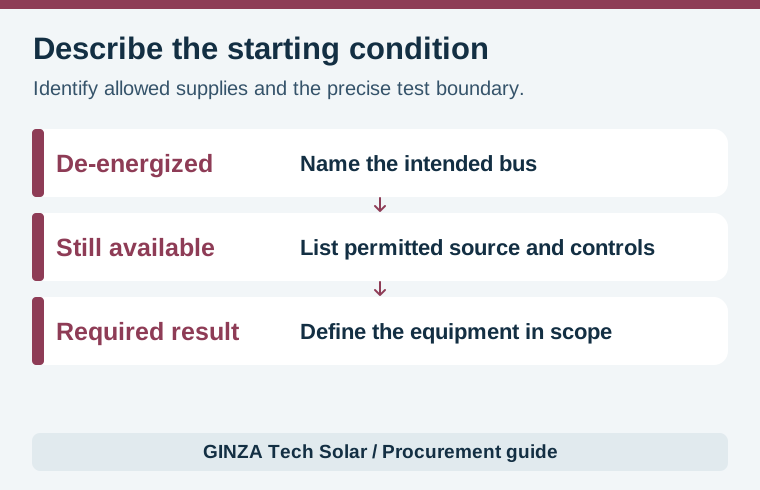
State the available power sources at the starting instant
Ask the buyer and supplier to use identical starting assumptions. In an island transfer, the local controller may already be awake and the bus may remain energized or be re-established rapidly. In a dead-bus case, the project must determine which devices have power before the main bus exists. An outage after a planned shutdown may have a different starting condition from an automatic transfer immediately after a utility failure. Request a diagram identifying the states that are contractually in scope.
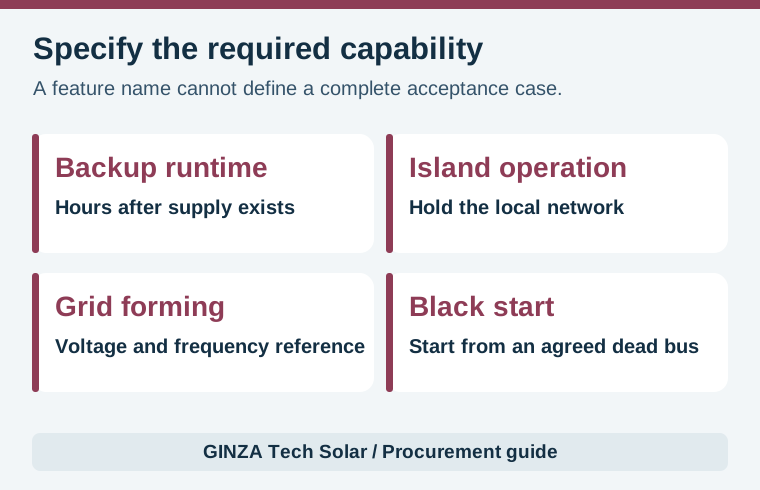
| Capability named in a quote | Clarifying question | Evidence to ask for |
|---|---|---|
| Backup runtime | How long can specified loads run after supply is established? | Usable energy, load profile and meter boundary |
| Island operation | Can the system hold the local network under agreed operating conditions? | Mode logic and demonstrated load envelope |
| Grid-forming control | Can the converter establish a voltage and frequency reference in the stated mode? | Model, configuration, limits and control responsibilities |
| Black start | Can the total system start from the specified de-energized condition? | First available supply, sequence and witnessed results |
Identify the available energy for controller boot, monitoring, interlocks and other equipment needed before the new AC supply exists. Ask how long those resources remain available after loss of normal service, including any independent uninterruptible power supply. Identify relevant battery charge, temperature and system availability conditions. With those documented, the buyer can distinguish an approved design dependency from a temporary source used only for a demonstration.
Ask whether the claim applies immediately after an outage and again after the site has been without normal power for a defined waiting period. A standby control supply may have a finite endurance, while battery status and temperature can move outside the conditions of the offer. Request an elapsed-time limit or a supported range for each initial condition. Record where the bidder relies on healthy communications, a local operator, an independent supply or availability of all battery units.
Make the load block and equipment sequence explicit
Have the project engineer identify the bus and equipment to be energized, including transformers or motors where applicable. Transformer energization and motor starting can present current demands that a steady kW table misses. The laboratory study of inverter-driven black start models both transformer and motor dynamics for that reason. Its numerical results are tied to the simulated system. Use a project-specific study and evidence for the actual loads, controls and permitted conditions.
For example, suppose a small site requests its control and communications loads, followed by an essential process group, with a motor to be considered later. A bid that promises only the final steady load leaves unanswered whether the BESS can establish the bus with the specified topology or accept the requested equipment block. Ask the bidder to show which events must be staged, the configuration supporting them and the known restrictions. Do not copy another project’s operating sequence into a tender as a substitute for this review.
Where power factor and short-duration behavior matter, compare the stated load to the converter’s current and apparent power envelopes using the kW and kVA guide as background. Ask for a documented account of the loads included in each proposed step, assumptions about the supply condition and any overlap. The buying team can verify those records without defining protective settings or instructing a crew how to perform a start.
Keep the load list connected to the actual network drawing. Two offers may include the same process equipment but assume different transformer positions or paths to the first supported section. Ask the project team to label the agreed boundary and confirm which commercial offer includes each piece of equipment. If a generator or further supply is to participate later, identify the interface owner and the evidence needed for its integration as a distinct case.
Keep startup success separate from sustained service
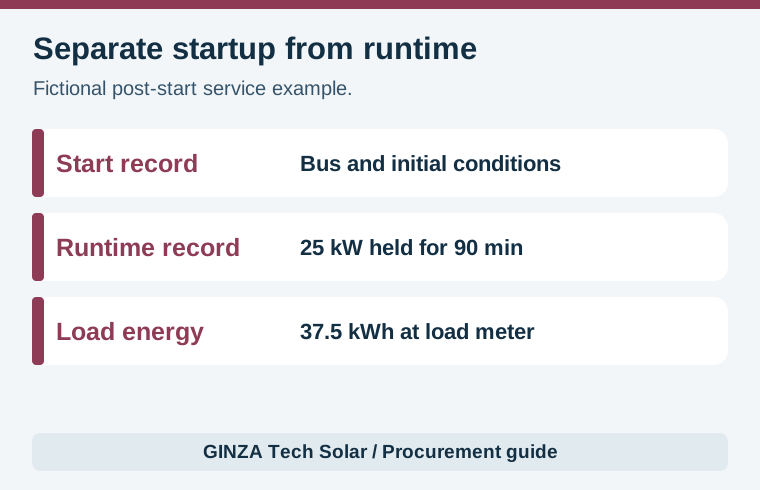
A test can establish the bus yet leave open how long the system can hold it under load. Consider a hypothetical post-start requirement of 25 kW at an agreed load meter for 90 minutes. That service alone requires 37.5 kWh at the load meter if the demand is constant. Separately account for startup energy, metering boundaries and any supply to auxiliaries that is outside that load measurement. The calculation is a screening quantity. It does not demonstrate the startup sequence, transfer behavior or the inverter’s ability to hold voltage and frequency during an event.
Write separate criteria for establishing the bus and serving it for the required duration. Specify the time origin for the startup claim and ask how post-start reserve is measured. The commercial backup sizing guide supports the sustained-load calculation. For interface responsibilities, the BESS control map explains how to assign the dispatch, measurements and responses to the corresponding equipment owner.
Ask for an acceptance package the site can witness
Request the agreed test boundary, initial condition, responsible parties, acceptance bands and required trace records. Have the engineer identify the switching permissions, restoration conditions and protection checks. Ask which events can be verified at the factory and which need site equipment or an approved simulation. Carry records of battery status, initial bus condition, permissions, timestamps and measured load in the witness package, with a versioned equipment list and method reference.
A useful acceptance register has a row for each starting scenario. Include the bus identifier, system configuration, permitted starting supplies, expected result, party witnessing it and a trace reference. The witness should be able to see whether the measured result refers to the correct bus and whether a temporary supply was connected. Document the scenario if the site cannot reproduce it during testing and agree what substitute evidence the contract accepts. A staged test with a smaller or different load may support a limited claim, which should be stated explicitly in the handover record.
Require the supplier to distinguish a successful demonstration of the proposed arrangement from a partial demonstration with a different load or an external temporary supply. If a test is rescheduled or repeated, retain the original record and document what changed. Start with commercial BESS configurations and share the intended bus, load blocks and available startup supplies to scope the equipment and acceptance work.