
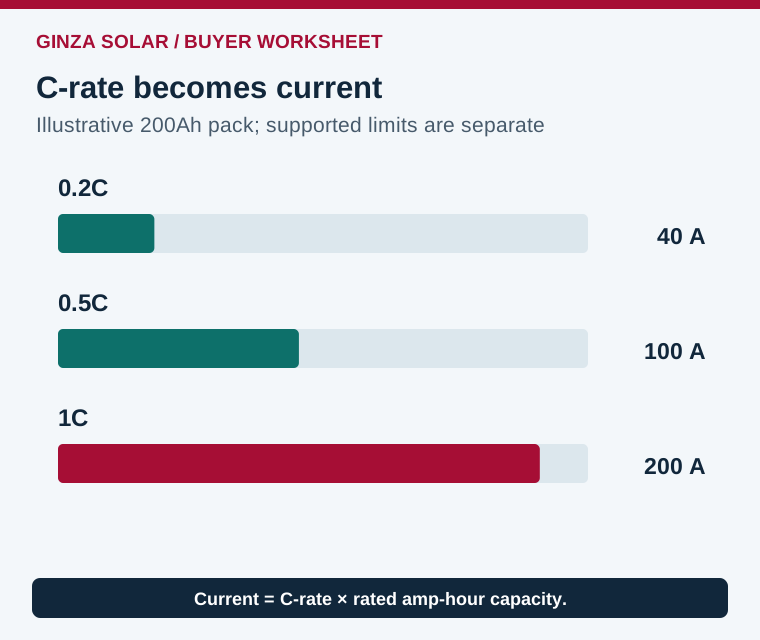
Quick answer. Battery C-rate expresses current relative to rated amp-hour capacity. For a 200Ah pack, 0.5C corresponds to 100A. Storage duration compares available energy with the power delivered to a named load or meter. Both numbers need operating conditions. Use C-rate to question current capability, then compare usable AC kWh and sustained AC kW at the same temperature, age and reserve settings.
This worksheet is for buyers comparing a battery pack with a complete energy storage system. Every number in the worked examples is illustrative. Ask the supplier to confirm the offered model’s continuous and temporary limits, how the BMS communicates them and whether the inverter can honor those limits throughout the duty cycle.
Read the units before comparing the quote
Amp-hours describe charge capacity on the manufacturer’s stated basis. Kilowatt-hours describe energy, while kilowatts describe power. A C-rate multiplied by amp-hours gives amperes. Multiplying those amperes by a selected operating voltage gives a DC power estimate at that voltage. Battery voltage changes during operation, so a C-rate and nominal voltage are insufficient to guarantee constant output at the AC terminals.
The reciprocal of C-rate gives a useful idealized discharge time only under consistent assumptions. A 0.5C discharge suggests two hours when the full rated capacity is accessible at that current. Real duty cycles include voltage cutoffs, temperature limits, ageing, reserve and losses. A two-hour label should therefore identify whether it refers to nominal DC capacity, usable DC energy or measured AC delivery.
| Illustrative 200Ah pack | Current | Power at nominal 51.2V | Idealized full-capacity time |
|---|---|---|---|
| 0.2C | 40A | 2.048 kW DC | 5 h |
| 0.5C | 100A | 5.120 kW DC | 2 h |
| 1C | 200A | 10.240 kW DC | 1 h |
The table is arithmetic for a hypothetical pack. It does not say that such a pack supports 1C, that charging and discharging limits are equal, or that all rated capacity is usable. Request the allowable continuous charge and discharge currents separately, plus any temporary rating and its time, recovery and temperature conditions.
Check power near the lower operating voltage
Suppose a buyer needs 5 kW AC from the example pack. At an assumed 94% conversion efficiency and 46V at the inverter’s DC input, current is 5,000 ÷ (0.94 × 46), or about 116A. That exceeds an illustrative 100A continuous pack limit, even though 51.2V × 100A suggested 5.12 kW DC at nominal voltage. The output requirement must be checked across the permitted voltage range.
Ask for the power and current limits at low state of charge, at the site temperature and at the proposed battery age. The PCS, wiring or protection can set a lower system limit than the battery. For parallel packs, also review individual branch currents and the supported response when one pack disconnects. The 51.2V parallel-bank checklist explains how a bank can have adequate total energy but insufficient capability on a single branch.
Turn nominal energy into a usable duration case
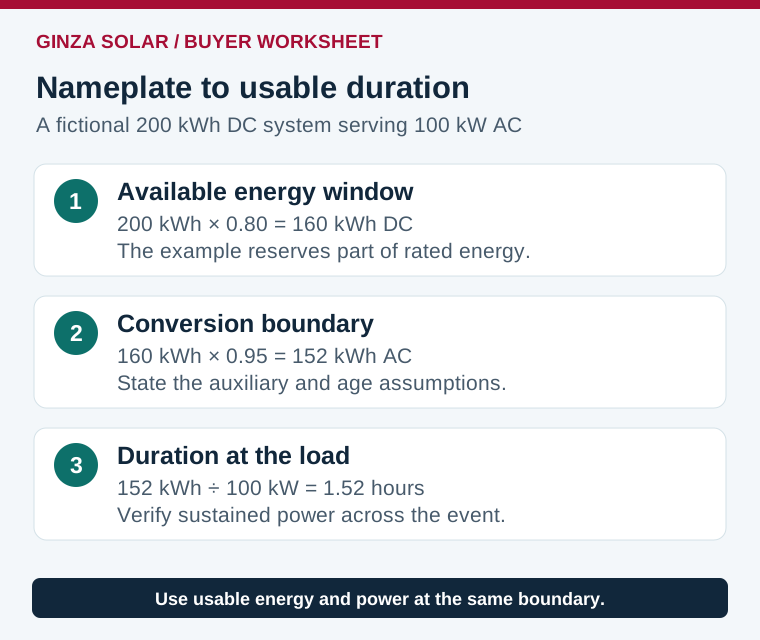
Consider a hypothetical 200 kWh initial nominal DC system serving 100 kW AC. With an 80% usable energy fraction and an assumed 95% discharge conversion factor, initial usable AC energy would be 200 × 0.80 × 0.95 = 152 kWh. Constant 100 kW delivery would last about 1.52 hours on those assumptions. If the offer already guarantees usable AC energy, use that figure directly and avoid deducting its conversion loss again.
Repeat the case with the guaranteed retained capacity at the evaluation age and the starting state of charge required by the contract. If a separate backup reserve is outside the dispatch window, account for it once. Check whether auxiliaries are inside the usable-energy guarantee, and whether the energy test power matches the requested service. A result at a light discharge rate may not establish the result at maximum output.
Compare the alternatives against the same event. The illustrative 152 kWh AC could support 50 kW for about 3.04 hours if that power and all other assumptions remain valid. It still cannot serve 100 kW for three hours. A buyer who needs the longer event might increase energy, reduce the protected load or change the operating target. A buyer who needs a short 150 kW peak must first verify the system’s power capability, even if the event consumes less than 152 kWh.
Also distinguish a temporary current rating from a sustained duty. If a pack permits a higher current for a named number of seconds, ask about the starting state, repeated-event limits and required recovery. A sequence of motor starts can impose a different duty from one isolated demonstration. Have the supplier evaluate the load trace and show which continuous, transient and thermal limits govern each part of the event. Keep that review with the proposed pack count and PCS model.
Match the duration to the service
A short high-power demand event and an overnight backup requirement impose different constraints. For peak shaving, examine every interval above the target and the recharge opportunities between peaks. For backup, use the critical-load schedule and starting reserve. If one system serves both functions, the controls must allocate energy between them and identify the priority during a conflict.
For a daily cycle, capture the complete charge and discharge plan. A battery rated for an illustrative 0.5C charge needs time and an available source to restore energy after use. Grid limits, PV availability and a required reserve can extend the practical recharge period. Ask the bidder to replay repeated events using the actual site profile rather than demonstrating only one full-to-empty discharge.
Put the operating envelope in the RFQ
- State the AC load or meter boundary, required sustained power, energy per event and frequency of events.
- Provide the site temperature and altitude, intended age of evaluation and required starting reserve.
- Request charge and discharge current limits, voltage range, thermal derating and the PCS capability at those conditions.
- Ask how current limits and alarms reach the inverter, and how the system responds when the available battery capacity changes.
- Agree an acceptance test with power, duration, start/end state of charge, auxiliaries and meter accuracy stated.
Keep the supplier’s terms with the operating envelope. A warranty based on energy throughput or a specified duty cycle must be evaluated against the planned service. Ask whether the guaranteed capacity and output apply at delivery or at a later age. The DOE FEMP specification resource is a customizable procurement template, not a performance guarantee for a particular battery. The commercial BESS RFQ template and usable AC energy test guide provide the corresponding documentation and metering checks.
Frequently asked questions
Does 0.5C always mean two hours?
It means current equal to half the rated amp-hour capacity per hour. Two hours is an idealized full-capacity calculation. Confirm the accessible energy and power conditions for the offered system.
Can a higher C-rate battery replace a bigger battery?
A higher supported current can improve power capability. It does not add energy. Check both the required event energy and continuous output before changing quantity.
Is system duration simply kWh divided by kW?
Use usable energy and deliverable power on the same boundary. State reserve, age, temperature and auxiliaries so the quotient represents the requested service.
Which values should I request first?
Ask for usable AC kWh and sustained AC kW at the project’s operating conditions, backed by the battery and PCS current limits and an acceptance method.
References and project quotation
- DOE FEMP battery storage procurement specification resources
- Victron model-specific lithium battery current and operating requirements
Compare GINZA commercial ESS configurations and request a power-and-energy review with your load profile, duty cycle and required reserve.