
Quick answer: A parallel LiFePO4 bank keeps the nominal voltage of one pack and adds the packs’ rated amp-hours. Before buying a second 51.2V battery, ask for written support for the exact pack models, hardware revisions, BMS firmware, inverter firmware and proposed number of packs. Then verify branch current and what happens if one pack disconnects. Two batteries with the same nominal voltage can have different limits, communications and approved expansion rules.
This checklist is for installers, distributors and project buyers comparing an expansion with a new battery bank. It helps you assemble the evidence needed for an equipment quotation and installer review. The figures explain sizing and acceptance concepts. Use the manufacturer’s approved installation drawings and qualified electrical review for the actual equipment and site.
What adds in parallel and what stays at 51.2V?
Two identical 51.2V, 330Ah packs have a theoretical combined nameplate of 660Ah at 51.2V, or 51.2 × 660 ÷ 1,000 = 33.792 kWh nominal DC. A single pack is 16.896 kWh nominal DC. That arithmetic uses the voltage and capacity shown for the GINZA 51.2V 330Ah Gen5 model. It does not establish an approved pack count, a continuous current rating or usable AC energy for a proposed two-pack system.
Actual available AC energy depends on the approved state-of-charge window, battery condition and temperature, inverter losses, power level and reserve settings. Current limits may be set by the BMS, inverter, cabling, busbar or protection. A battery marketed in the “48V class” may be nominally 51.2V. Compare the permitted operating voltage range and communications for the exact equipment rather than assuming the label is a compatibility match.
Check the existing installation before ordering another pack
| Record from site | Question for the supplier | Stop and clarify if |
|---|---|---|
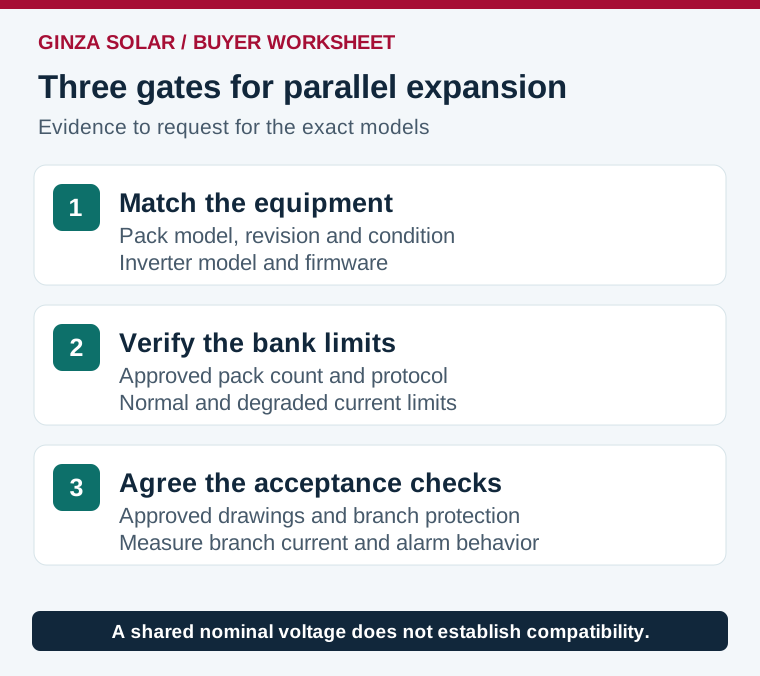
| Battery model, serial number, hardware revision and BMS firmware | Is this exact unit supported with the proposed additional model and revision? | The offer only says “same voltage” or “same brand” |
| Inverter model, firmware and battery protocol | Which CAN or RS485 profile, wiring and topology are approved? | The port is named but the protocol and pinout are missing |
| Pack age, alarms, capacity evidence and current operating settings | What condition and age limits apply when adding a new pack? | An existing pack has repeated cutoffs or unknown health |
| Existing bank count, proposed count and anticipated loads | What is the supported count and normal/degraded current limit? | The proposal multiplies pack nameplate current without a system limit |
| One-line diagram, protection and branch cable schedule | What approved drawings and protections apply to this expansion? | There is no agreed DC fault or isolation review |
Ask about allowed model, capacity, revision and age combinations before comparing price. Do not infer that two generations of a 330Ah pack can be mixed. The supplier may require a specific firmware pairing or a documented condition check. If the combination cannot be supported in writing, price an approved alternative before scheduling a retrofit.
Use branch current to check the proposed load
Consider a fictional 8 kW AC load at an assumed 94% inverter efficiency and 46 V at the inverter DC input. Ignoring other loads, estimated battery current is 8,000 ÷ (0.94 × 46) ≈ 185 A. If two packs shared exactly evenly, each would deliver about 92.5 A. If they split 60/40, the branches would carry about 111 A and 74 A. With a fictional 100 A per-pack limit, the heavier branch is already over limit. The 100 A assumption and 60/40 split illustrate a check. Neither describes the GINZA pack nor predicts the split on site.
The input voltage and conversion efficiency vary with load and operating conditions. A lower DC voltage usually increases current for the same AC load. Check sustained and surge duty separately and include other DC loads if present. Ask for limits at the temperatures and state of charge the site will experience. Repeat the analysis for charging when PV, grid and other charging sources can overlap. A common bus or inverter may have a lower aggregate limit than the sum of the packs.
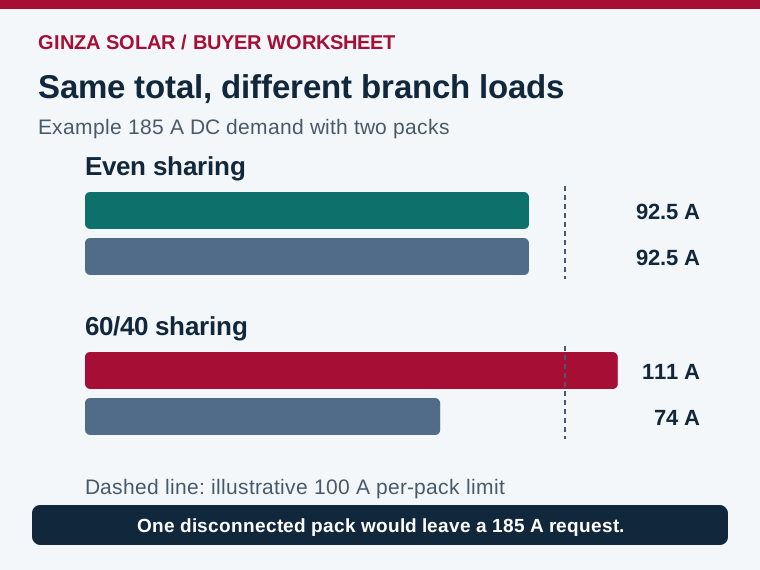
Plan for a pack that opens under load, goes offline for service or reduces its current limit. In the example, the remaining pack cannot carry 185 A at a 100 A limit. Ask whether the approved controls reduce load or power promptly, shed designated loads or stop safely. Confirm that behavior with the inverter and battery combination before promising uptime. Capacity redundancy and power redundancy are separate project requirements.
Review both the DC paths and the data path
For power, ask the installer how the proposed layout keeps branch resistance comparable. Cable cross section, the total outgoing and return length, terminations and connection quality all matter. Comparable wiring resistance improves sharing, while differences in pack condition and BMS limits can still make current unequal. The approved drawings should identify branch and main protection, cable and busbar ratings, DC disconnects, and service isolation. Ask the designer to verify fault-current duties and DC interrupting ratings for the combined bank.
For communications, request the supported master/follower arrangement or other aggregation topology, termination, addressing and approved cable pinout. A CAN or RS485 label only identifies the interface type. Ask how the inverter receives total state of charge and charge/discharge limits, and what it does on communication loss. Check whether firmware changes affect warranty or require supplier approval. See the battery and inverter compatibility guide for the data to request from both vendors.
Agree acceptance checks before the shipment
- Identify the hardware. Record serial numbers, firmware and the approved bank drawing. Confirm the condition and voltage/state-of-charge checks required by the manufacturer before the installer connects the packs. An uncontrolled voltage difference can cause a large equalization current.
- Capture a baseline. Preserve previous alarms, limits and measured performance so an existing issue is not mistaken for a retrofit failure. Have the installer use the approved startup and precharge procedure for the specific system.
- Measure both branches. At agreed charge and discharge steps, record common voltage, individual branch currents, state of charge, temperature and inverter-reported limits. Ask the supplier for acceptable variation at defined conditions rather than imposing a universal percentage.
- Verify the agreed degraded mode. Use a manufacturer-approved test plan to demonstrate how a lost pack or lost communications affects output. Record alarms, derating, recovery and who authorizes restart.
- Save the handover evidence. Keep the equipment list, software versions, drawings, settings and measured results with the system so the next installer can evaluate another expansion.
Use the PV and battery commissioning record to document the measurements. If you are choosing among models before a first order, compare the GINZA 51.2V LiFePO4 family and the 330Ah capacity sizing worksheet.
Frequently asked questions
Do two 330Ah packs in parallel make a 102.4V bank?
No. The parallel nameplate arithmetic is 51.2V and 660Ah for two identical packs. Series operation is a separate topology that requires explicit manufacturer approval.
Can I add a new 51.2V battery to an older pack?
Ask the pack manufacturer to confirm the supported pairing using the serial numbers, condition and firmware. The existing pack’s current or usable capacity may constrain the combined system.
How many LiFePO4 packs can run in parallel?
Use the supported count for the exact battery and inverter pairing, including communications, protection and operating limits. A count in another manufacturer’s manual applies to the specified equipment only.
What should I send for a quotation?
Send photos of labels, model and firmware details, one-line diagram, existing and proposed pack count, peak and sustained loads, maximum charge sources, and project country. Include any required backup behavior if one pack is offline.
References and next step
- Victron Wiring Unlimited, battery-bank wiring and current paths
- Victron lithium battery installation manual, an example of model-specific requirements
Request a 51.2V battery expansion quotation and ask for the exact compatibility list, approved wiring documentation, current limits and warranty scope before ordering.