
Quick answer. A zero-export solar system monitors power at the utility-defined point of connection and adjusts controllable PV or battery equipment to limit power flow to the grid. A battery can absorb some surplus while it has charging headroom. The design still needs a way to reduce generation when the battery is full or unavailable. Before ordering, obtain the permitted measurement method, equipment requirements and expected behavior when the control signal is lost.
This guide helps commercial buyers and installers turn a non-export requirement into a testable scope. Requirements depend on the utility, approved topology and project location. Have the engineer and interconnection reviewer confirm the local application and acceptance process for the exact system.
Specify the connection point before choosing the controller
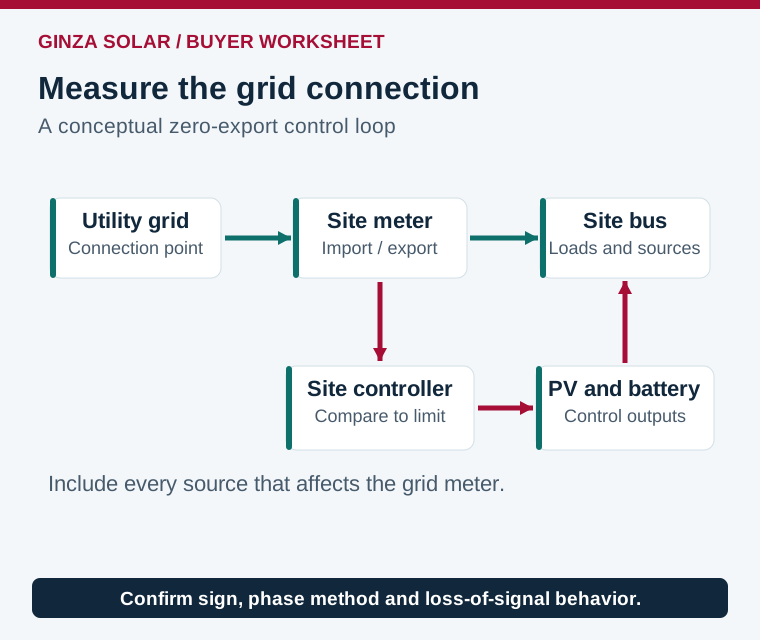
Mark the utility meter, site power meter or current transformers, all PV inverters, battery PCS, generator, main loads and switchgear on the same one-line drawing. Show the controlled boundary clearly. A meter on one PV feeder measures that feeder. The grid connection can see a different net flow when multiple distribution boards or generators operate. Ask which device controls output and which instrument serves as the evidence for acceptance. The two can have different accuracy and logging requirements.
Record the meter type, current transformer ratio, current direction convention and the phase associated with each voltage reference. The installer should validate those items with approved procedures and known load conditions. Reversed polarity or crossed phases can give the controller incorrect power data. Also specify communication route, response on loss of data, time synchronization and which party supplies or terminates the wiring.
Define what the utility means by zero export
| Requirement | Question to resolve | Document it in |
|---|---|---|
| Export limit | What net export setpoint or import bias is approved? | Utility response and controller settings |
| Three-phase calculation | Does the reviewer evaluate total site power or each phase? | Approved meter method and test cases |
| Time and tolerance | How are transient excursions measured and evaluated? | Witness-test protocol and logger resolution |
| Equipment and modes | Which inverter, meter, controller and firmware versions are accepted? | Equipment schedule and approval documents |
| Failure behavior | What must happen if metering, communications or control is lost? | Cause-and-effect schedule and recovery procedure |
Three-phase netting can change the result. If phase A exports 15 kW and phases B and C import 7 kW and 8 kW, the algebraic sum is zero. A requirement that prohibits export on each phase would still flag phase A. The proposed controller and supported inverter behavior must match the accepted method. Where only total power can be controlled, ask the engineer how phase imbalance is addressed.
Separate instantaneous controller response from an energy meter’s billing interval. A display showing zero exported energy over a billing period cannot confirm how the system reacted to a short load drop. Capture a power trace at the required time resolution and agree which meter readings and timestamps will be used. Some designs maintain a small import bias as part of an approved control strategy. Set it from the requirements and measured conditions rather than copying a generic number.
Worked example: battery charging helps until it stops
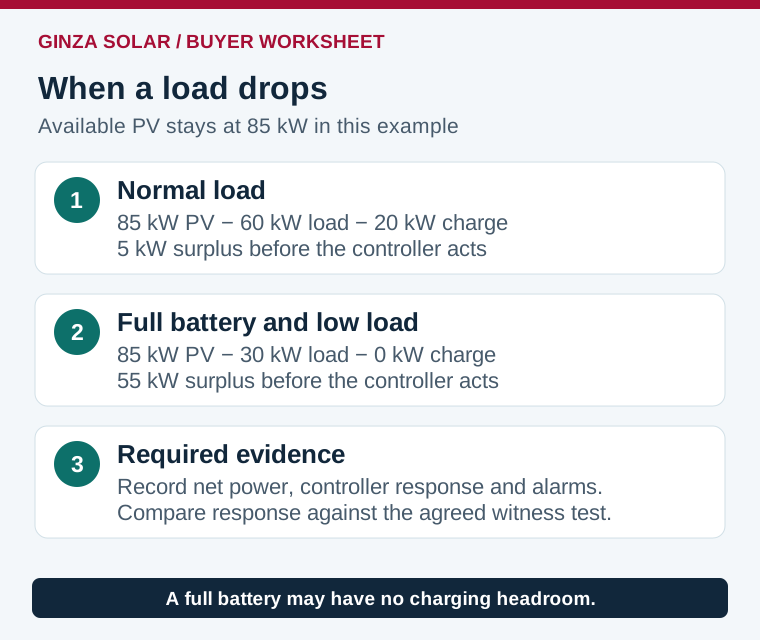
Assume a fictional site can produce 85 kW AC from PV. At the selected instant the building consumes 60 kW and the battery can charge at 20 kW AC. Ignoring losses outside these measurements, export before PV curtailment would be 85 − 60 − 20 = 5 kW. To reach zero net export at that instant, reduce PV to 80 kW or take another approved control action. The charge command must respect the available battery limit.
Now assume the battery has reached its charging limit at full state of charge and a production line shuts off, reducing building load to 30 kW. If the PV were still at 85 kW, the unconstrained surplus would be 55 kW. The steady-state target becomes 30 kW PV output if battery charging is unavailable and no other control action is taken. The controller must react within the agreed conditions. The example gives power balance only. The required ramp, overshoot and timing must be tested with the actual equipment.
Repeat the logic for battery discharge. A storage controller trying to reduce import or sell energy can conflict with the PV export controller if neither sees the complete system. Name the device responsible for the final site constraint and define how it resolves competing modes. Review any generator or backup mode separately. A PV source can interact differently with a generator or island than it does with a utility grid.
Agree the test sequence with the buyer and installer
- Confirm metering. Compare site power direction and each relevant phase to a known operating condition. Check meter scaling and verify that all controlled sources appear in the expected readings.
- Record the normal case. Run PV at an agreed stable load and record PV output, site import or export, battery power and control commands with aligned timestamps.
- Witness an abrupt load change. Use the authorized test procedure and show the transient, settling behavior and final net flow against the agreed limits.
- Test restricted battery charging. Show the result when storage is unavailable, full or charge limited. Include the expected PV response and alarm behavior.
- Test failure and recovery. Under an approved test plan, verify the safe response to loss of the applicable meter or communications, alarm reporting, recovery conditions and startup after a reset.
Ask the commissioning team for the approved settings export, equipment and firmware list, logged time series, witness results and names of the parties responsible for change control. When equipment is added later, revisit the approved test scope and update the one-line drawing. The PV and battery commissioning report template provides a structure for keeping this evidence together.
Write a pass criterion for each test before the witness arrives. For example, the contract can name the measurement channels, their sample interval, the authorized load step, the permitted excursion and settling rule, and the person who signs the result. Record the initial battery charge and available solar, since a cloudy test may never challenge the limit. For a metering failure, agree the expected safe state and whether recovery is automatic or requires approval. A graph without the initial condition and settings is hard to compare after firmware changes or an expansion. Ask the installer to include the settings backup and an export of the underlying readings with the signed record.
If the battery is also dispatched for demand management, reserve or backup, compare the operating schedule with the export behavior. Use the peak shaving sizing guide for tariff-based load calculations and the AC and DC coupling guide for controls boundaries across both architectures.
Frequently asked questions
Can zero-export solar work without a battery?
A compatible system can curtail PV to match the approved net export limit. A battery may store some energy that otherwise would be curtailed.
Where should the export-control current transformers be installed?
Use the measurement point and phase arrangement approved for the site. The metering must account for all sources and loads relevant to the export rule.
Does a zero-export setting replace utility review?
Confirm the connection process and equipment requirements with the utility for the project. A local setting alone does not demonstrate acceptance.
What information is needed to price controls?
Send the one-line drawing, site meter location, permitted limit, inverter and PCS details, load profile and required witness tests.
References and project quotation
- Enphase example of export limitation configuration and witness testing
- Tesla site limit feature documentation for a named equipment family
Ask for a PV and storage integration quotation with the permitted export rule and equipment schedule. Review the offered commercial storage configuration with the project engineer before purchase.