
Quick answer. A useful BESS factory acceptance test starts with the purchase requirements and states how each will be verified, witnessed and released before shipment. Separate what the factory setup can demonstrate from what must be tested at the site. Agree the power and energy measurement boundary, software versions, alarm evidence and punch-list process before the test date.
This guide is for an EPC or project buyer preparing a factory acceptance test, or FAT, and a site acceptance test, or SAT. It is a planning worksheet for a qualified test team. The final procedures, electrical isolation, test equipment and safety arrangements must match the actual system and facility.
Turn promises in the quote into a test matrix
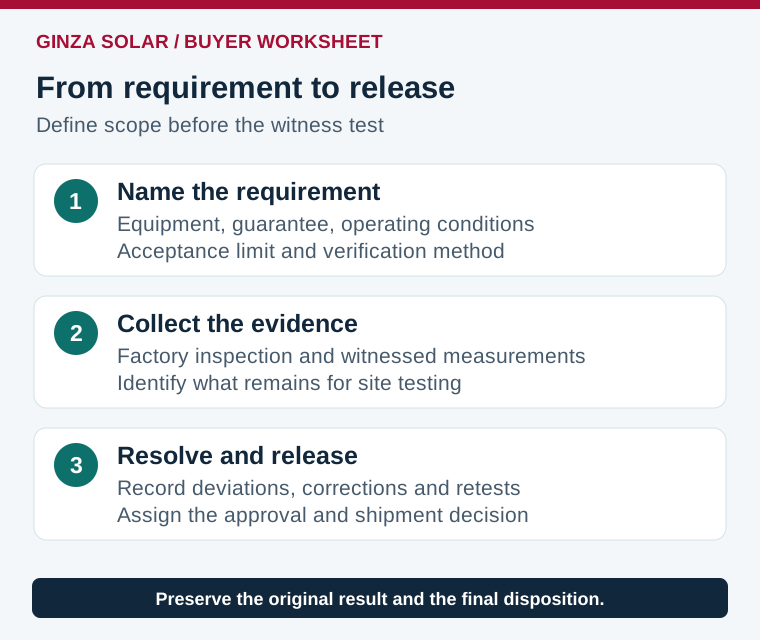
List the exact equipment, configuration, rated and guaranteed values, controls functions and documents in the order. Give each requirement an identifier and a verification method. Some items are checked through documents or inspection, others through witnessed measurements or an integrated functional test. Identify the acceptance limit, conditions, evidence and person responsible for approving the result.
Have the supplier declare limitations of the test facility early. The available power source, load, transformer or environmental equipment may prevent a full-power or extreme-temperature demonstration. Agree which external evidence supports that requirement, what remains conditional and where any later test will occur. A partial demonstration should have a defined scope and disposition.
| Requirement | Factory evidence | Site confirmation |
|---|---|---|
| Equipment identity | Model, serials, BOM and firmware record | Delivered configuration and approved revisions |
| Output and usable energy | Test at agreed power, conditions and meter boundary | Connection and auxiliaries on the final installation |
| Controls and alarms | Approved functional tests and timestamped logs | Site interfaces, signals and operating modes |
| Grid or backup functions | Supported configuration and available test scope | Utility, switchgear, transfer and local acceptance requirements |
| Handover | Reports, settings, manuals and open-item list | As-built files, training and final release record |
Freeze the configuration before the witness test
Record battery, PCS, EMS, thermal and protection equipment identifiers, firmware and applicable settings. Match the test one-line drawing to the offered supply boundary. Note temporary factory cables, meters, sources and loads, since the site arrangement may differ. If the test uses substitute equipment or a simulation, identify it in the report and define which conclusions it supports.
Provide the protocol and test data format to the buyer before attendance. Identify hold and witness points, required notice, remote attendance arrangements if used, and who can accept a deviation. Give the reviewers enough time to resolve a missing instrument record or ambiguous limit before the equipment is energized for a scheduled test.
Worked example: a usable-energy acceptance run
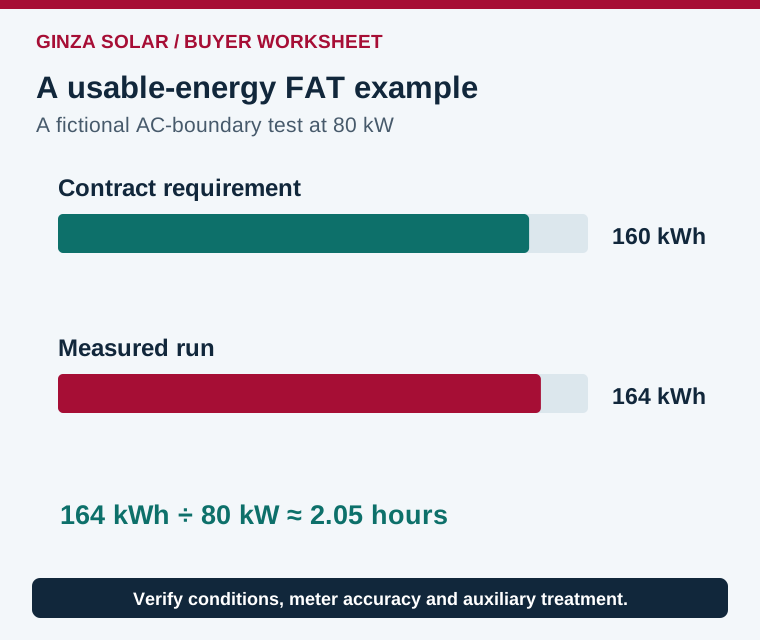
Assume a fictional contract requires at least 160 kWh delivered at an agreed AC meter while discharging at 80 kW under specified temperature and state-of-charge conditions. A completed run delivers 164 kWh at that meter in approximately 2.05 hours. That result meets the energy threshold only if the prescribed conditions, measurement accuracy, power tolerance and auxiliary treatment are also satisfied.
If the 164 kWh value comes from a battery DC counter while the contract names AC delivery, it does not answer the same requirement. If the factory’s external chiller is powered outside the meter but site auxiliaries are inside, document the difference and its approved treatment. The usable AC energy and RTE guide explains why a clearly drawn meter boundary matters.
Agree how measurement uncertainty and tolerances affect the pass decision. A measured margin above the threshold may be too small to support a clear acceptance under the chosen rule. Identify the meter, current transformers where used, calibration status, sample interval and how energy is integrated. Have the test team establish the uncertainty treatment and any decision guard band before the run, so the parties do not invent a new rule after seeing the result.
Request a sample data file with the protocol. Check that the columns, units, time zone and sign conventions allow the buyer to reproduce the report’s totals. State how invalid intervals, interruptions or a restart are handled. Keep the complete run and its event log, not only the segment with the most favorable performance.
For the example energy test, a proposed data header is: timestamp with time zone; meter ID; AC kW; cumulative AC kWh; battery SOC; relevant temperatures; auxiliary kW; controller state; event code. Identify whether auxiliary energy is already inside the AC meter before adjusting any total. Have the test team adapt the channels and sampling to the actual acceptance rule. The DOE FEMP procurement checklist is a broader project-planning reference, not a substitute for the agreed FAT protocol.
Test the supported functions with an approved procedure
Build the functional sequence around the purchased service. It may include start and stop commands, charge/discharge setpoints, limit communication, alarms, data logging and the planned response to lost signals. Have the test team define safe methods for demonstrating faults or communications loss. A document review or controlled signal simulation may be appropriate for certain checks. State which method was used.
Include recovery behavior as well as the initial alarm. Record whether the system derates, stops, requires acknowledgement or resumes automatically under the approved logic. Preserve the initial state, commands, measured response and timestamps. For a site demand limit, export limit or backup sequence, separate factory controls evidence from the final site interactions that still need witnessing.
Distinguish factory release from site acceptance
Transport, installation, switchgear, transformer, utility settings, metering and network integration create conditions the factory may not reproduce. Inspect the received configuration and physical condition, reconcile serials and software, and complete the site tests tied to those interfaces. Use the commissioning record template to maintain the final evidence.
For an export-limited installation, validate the actual grid meter and controlled sources using the zero-export checklist. For critical loads, use the approved transfer and island-mode plan, load schedule and recovery criteria described in the commercial backup worksheet. A factory test report should identify those remaining site obligations.
Control the punch list and release decision
Give every deviation a reference, description, severity or contractual classification, owner, corrective action and verification method. State whether it prevents shipment, can remain open under a written condition or requires site retesting. Keep the original failed or inconclusive result with the correction and retest. Do not let a later summary erase the history needed to explain a release.
If hardware or software changes after the witnessed run, assess the affected requirements and repeat the applicable tests. Update the equipment record and settings export. Agree who approves substitutions and whether the buyer needs another witness notice. A report for an earlier firmware or cabinet arrangement may need a documented impact review before it supports the delivered configuration.
Documents to collect before shipment
- Approved test protocol, requirement matrix and witnessed results with instrument information.
- Equipment identifiers, software versions, settings backups and the tested one-line drawing.
- Time-series data and logs supporting power, energy, thermal and controls claims.
- Deviation, correction and retest records with a clear shipment release decision.
- Installation and service manuals, safety evidence and the remaining SAT responsibilities.
Use the document register to make the package retrievable by requirement and equipment identifier. Have the installation team review it before site delivery, especially the auxiliary supply, communication and transformer boundaries. Resolve incompatible site assumptions before the shipment arrives. These steps reduce avoidable commissioning delays without replacing the final engineering and authority reviews.
Frequently asked questions
Does passing FAT mean the site can operate immediately?
The installation still needs the required receiving, integration and site acceptance checks, together with local connection and operating approvals.
Must the factory demonstrate every site condition?
Agree the factory scope and its limitations. Identify the evidence or site test that covers conditions the facility cannot reproduce.
Can a remote witness be effective?
Agree instrument visibility, live data access, identity checks, test control and evidence delivery before choosing a remote arrangement.
What happens when a test fails?
Follow the agreed deviation and release process, preserve the result, correct the cause and record the required retest and approval.
References and test-scope quotation
Review GINZA commercial storage options and request a test-scope proposal with the required duty, project location and witness requirements.