
Quick Answer
A high voltage battery for solar energy storage uses series-connected cells or modules to operate above conventional 48V or 51.2V battery architectures. Its main engineering benefit is lower current at the same power, which can reduce conductor losses, cable size, heat and current stress on connectors and busbars.
High voltage is not automatically the best choice. Select the architecture from the required power (kW), energy (kWh), complete battery voltage window, PCS compatibility, site conditions, safety requirements and expansion plan. For procurement, compare exact system boundaries and evidence—not a nominal voltage, headline efficiency or price per kWh in isolation.
Who This Guide Is For
This guide is for EPC contractors, solar installers, distributors and project buyers planning commercial solar storage, industrial ESS, microgrids or containerized BESS. It supports early procurement and RFQ preparation; final electrical design, code compliance and commissioning must be completed by qualified professionals for the destination market.
GINZA supports EPC contractor procurement and project-specific high voltage ESS selection.
What Is a High Voltage Battery System?
A high voltage battery system connects multiple lithium battery cells or modules in series to increase the total DC voltage of the battery string.
There is no single worldwide threshold that defines every solar battery marketed as “high voltage.” In the solar ESS market, systems above conventional 48V or 51.2V architectures are commonly described as high voltage, with many commercial systems operating from roughly 100V to several hundred volts.
Large stationary energy storage systems can operate at substantially higher voltages, including architectures approaching 1,500V DC.
For this reason, buyers should treat high voltage battery as a system architecture term rather than relying on one universal voltage threshold.
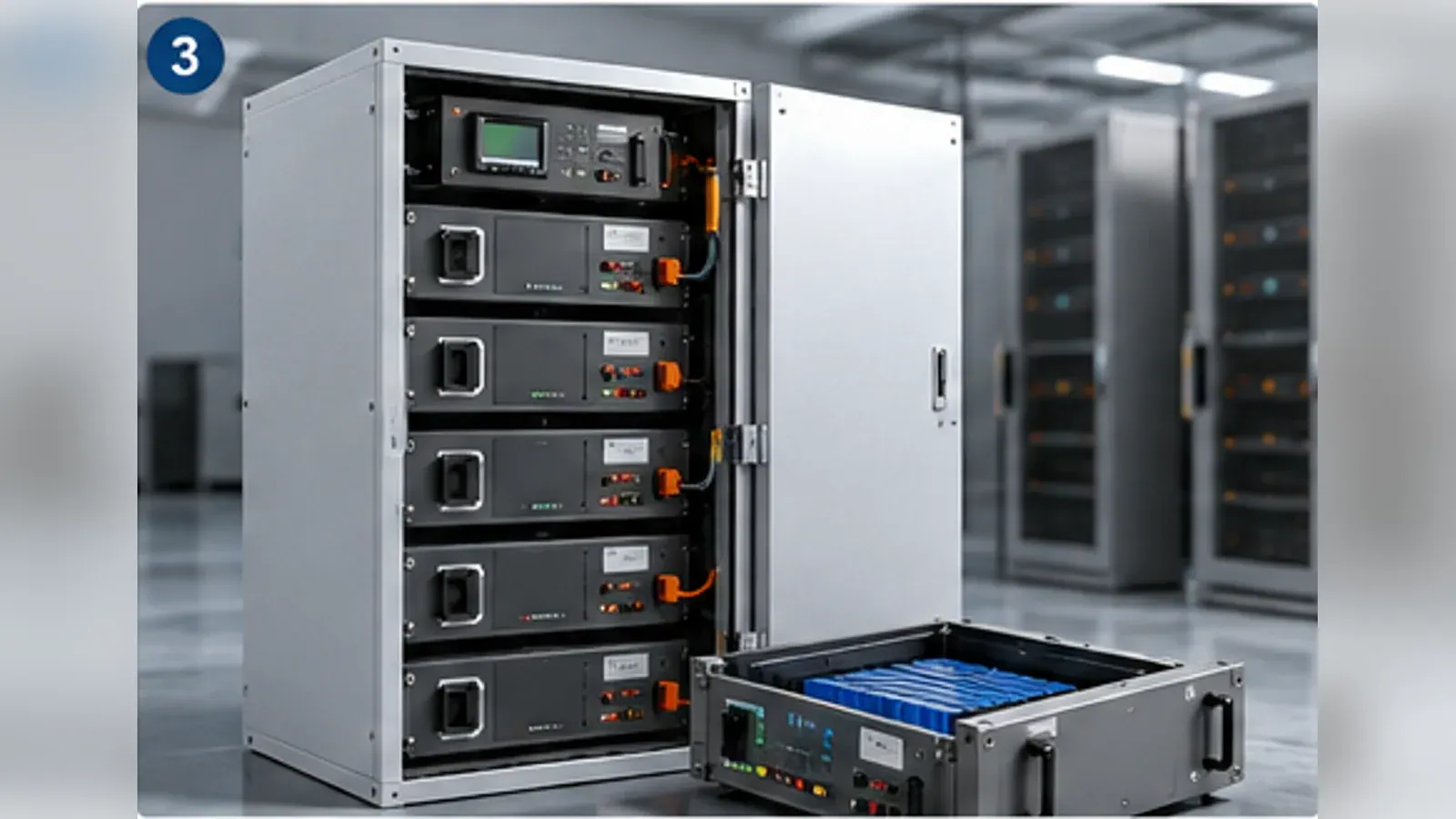
A complete high voltage energy storage system typically contains:
- Battery cells and modules
- Battery Management System (BMS)
- High-voltage control and protection
- Power Conversion System (PCS) or hybrid inverter
- Energy Management System (EMS)
- Thermal management
- Fire detection and protection where required
Larger commercial and utility systems may additionally include transformers, auxiliary power systems, HVAC or liquid cooling, switchgear, DC distribution and site-level controllers.
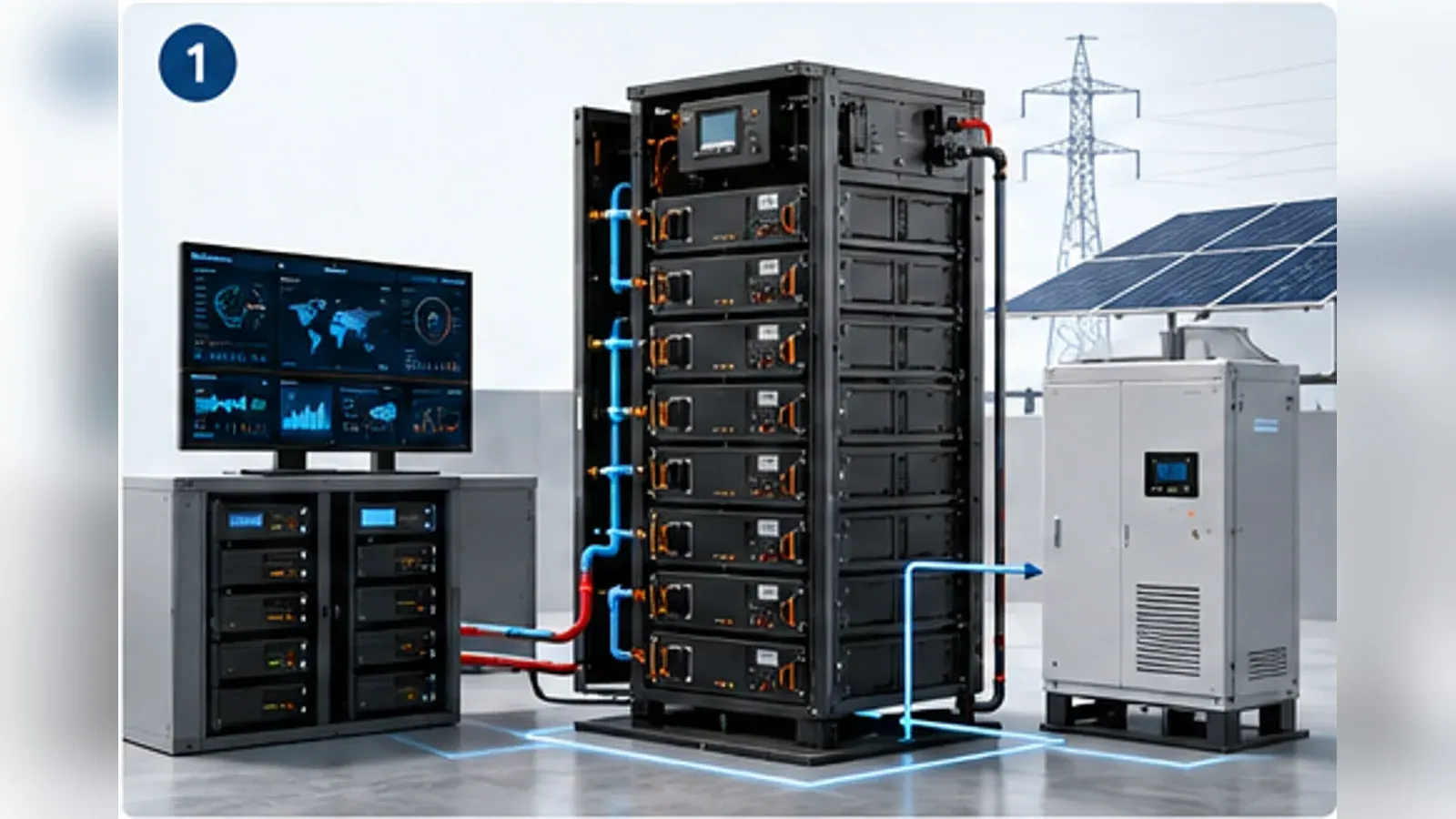
The featured image above shows a conceptual high voltage solar ESS with battery racks, PCS and solar power equipment. Final architecture and protection design are project-specific.
For project-scale solutions, explore GINZA's High Voltage ESS product range.
High Voltage vs Low Voltage Battery: What Is the Real Difference?
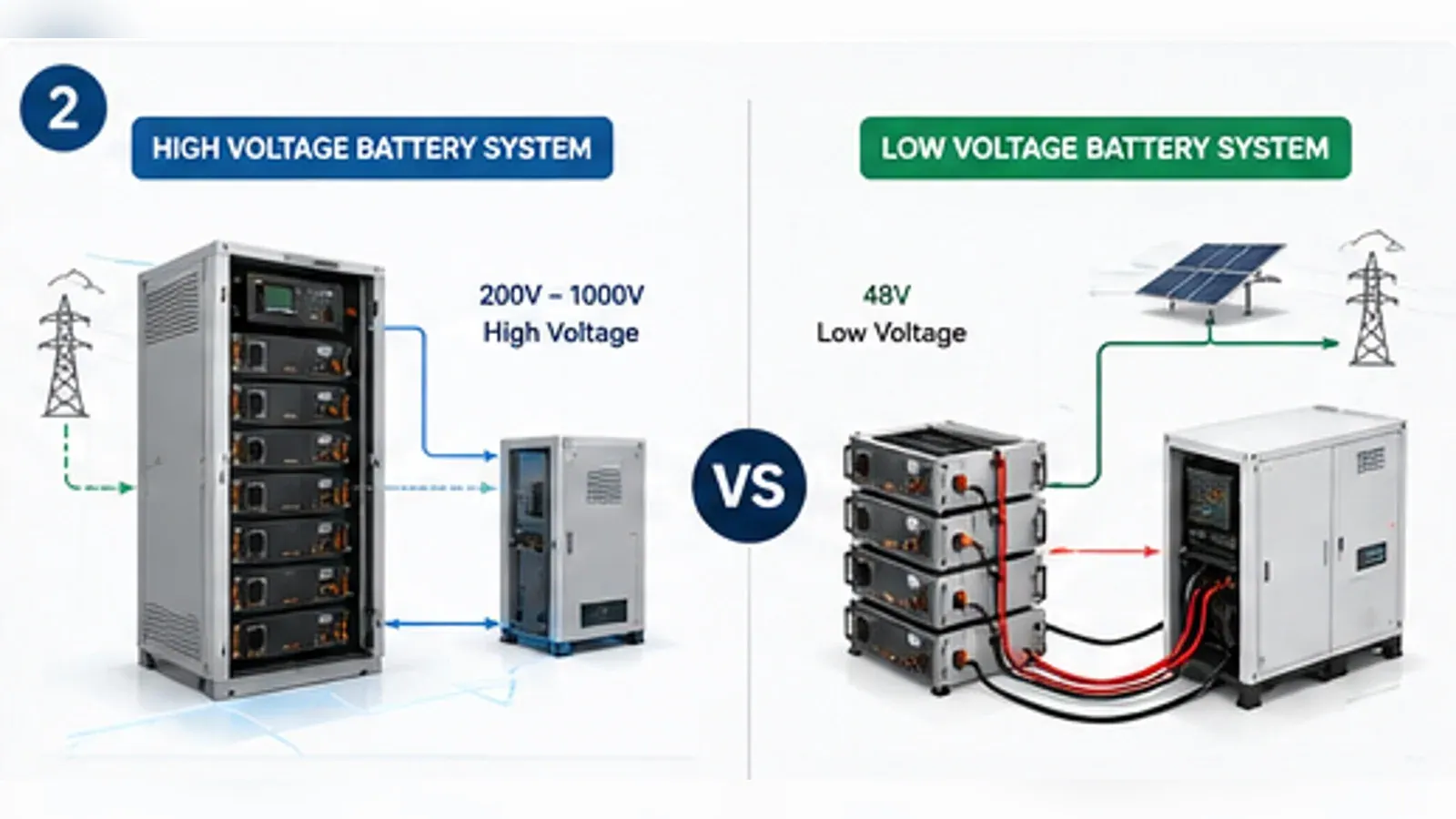
The fundamental engineering difference between a high voltage battery and a 48V or 51.2V low voltage battery is the amount of electrical current required to deliver the same power.
The basic relationship is:
Power (W) = Voltage (V) × Current (A)
Consider a simplified 30kW DC battery system.
At 51.2V:
30,000 ÷ 51.2 ≈ 586A
At 400V:
30,000 ÷ 400 = 75A
At 600V:
30,000 ÷ 600 = 50A
These figures are theoretical and actual operating current depends on battery voltage, inverter efficiency, SOC and system limits.
But the principle is clear.
A high voltage architecture can deliver the same power using substantially less current.
That matters because electrical conductor losses are related to:
P loss = I²R
Reducing current can therefore reduce resistive losses significantly.
It can also reduce:
- cable cross-section requirements;
- heat generation;
- current stress on connectors;
- busbar size requirements;
- voltage drop over longer cable runs;
- the cost of some high-current balance-of-system components.
This becomes increasingly important as project power increases.
High Voltage vs Low Voltage Battery Comparison
| Parameter | High Voltage Battery | 48V / 51.2V Battery |
|---|---|---|
| Typical architecture | Modules connected mainly in series | Batteries commonly expanded in parallel |
| DC voltage | Product dependent, often 100V–1,000V+ | Around 48V–51.2V nominal |
| Current at same power | Lower | Higher |
| Cable requirements | Often smaller at high power | Larger at high power |
| BMS architecture | Usually hierarchical/distributed | Usually simpler |
| Integration complexity | Higher | Lower |
| Inverter ecosystem | Must match HV platform | Large 48V inverter ecosystem |
| Installation | HV-trained professional required | Simpler but still professional |
| Expansion | Must follow approved series/rack architecture | Often through approved parallel expansion |
| Typical applications | C&I, microgrid, BESS | Residential and small commercial |
| Main design advantage | High-power operation with lower current | Simpler integration |
Is a High Voltage Battery More Efficient?
A high voltage battery architecture can reduce current-related electrical losses, but it is incorrect to assume that every high voltage system automatically has a fixed efficiency advantage such as “98% versus 90%.”
The actual round-trip efficiency (RTE) of an energy storage system depends on many components:
- battery cells;
- BMS operation;
- PCS efficiency;
- DC/DC conversion stages;
- transformer topology;
- cable resistance;
- C-rate;
- temperature;
- SOC operating window;
- HVAC or liquid cooling;
- auxiliary equipment.
For B2B procurement, ask the manufacturer to specify exactly what its efficiency number represents.
Request:
- battery DC efficiency;
- PCS efficiency;
- complete system round-trip efficiency;
- test power;
- SOC window;
- operating temperature;
- auxiliary consumption assumptions.
A verified system-level figure is much more useful than a generic claim that “high voltage batteries are 98% efficient.”
When Should a Solar Project Use a High Voltage Battery?
High voltage architecture becomes increasingly attractive when a project requires enough power that a 48V battery bus would need very high current.
Typical applications include commercial solar storage, industrial ESS, microgrids and containerized BESS.
However, battery voltage should never be chosen according to kWh capacity alone.
A 100kWh battery delivering 20kW has very different electrical requirements from a 100kWh battery required to deliver 100kW.
The correct voltage decision depends on both:
Power (kW) + Energy (kWh)
as well as inverter architecture and site conditions.
Commercial Solar + Storage
Typical sites include:
- hotels;
- shopping centers;
- offices;
- warehouses;
- schools;
- hospitals;
- EV charging sites.
Common objectives include:
- solar self-consumption;
- peak shaving;
- time-of-use optimization;
- backup power;
- demand management.
Industrial Energy Storage
Typical installations include:
- factories;
- cold storage;
- logistics centers;
- food processing;
- industrial parks;
- data infrastructure.
Industrial sites often require higher charge and discharge power, which makes the lower-current characteristics of high voltage architecture particularly useful.
Microgrids
High voltage batteries are also common in systems combining:
- solar PV;
- battery storage;
- diesel generators;
- utility grid;
- critical loads.
Containerized BESS
Large kWh and MWh-scale storage projects normally use high-voltage battery strings integrated with centralized or modular PCS platforms.
Key Specifications for High Voltage Batteries
Professional buyers should compare much more than nominal voltage and total kWh.
| Specification | What to Verify |
|---|---|
| Nominal voltage | Rated voltage of battery string |
| Operating voltage window | Minimum and maximum battery voltage |
| Nominal energy | Total rated kWh |
| Usable energy | Available energy within permitted SOC window |
| Continuous power | Continuous charge/discharge kW |
| Peak power | Maximum short-duration power |
| Maximum current | Battery and BMS current limits |
| Cell chemistry | LiFePO4 or other chemistry |
| Cell configuration | Series/parallel architecture |
| Cycle life | Test DoD, C-rate and temperature |
| Communication | CAN, RS485, Modbus or Ethernet |
| BMS architecture | Module/slave BMS and master BMS |
| Protection | Contactors, fuses, pre-charge, disconnect etc. |
| Cooling | Natural, forced-air or liquid |
| IP rating | Indoor/outdoor protection |
| Standards | Exact certification/test-report scope |
| Warranty | Years, cycles/throughput and capacity retention |
| Expansion | Maximum modules, racks or strings |
Nominal Voltage Is Not Enough
A common procurement mistake is checking only nominal battery voltage.
For example, a “512V battery” does not operate at exactly 512V continuously.
Battery voltage changes according to:
- cell voltage;
- SOC;
- charging state;
- BMS limits;
- temperature.
Therefore, the PCS must support the battery's entire operating voltage window, not simply its nominal voltage.
How to Calculate High Voltage Battery Series Cell Count
For a simplified nominal-voltage calculation:
Target battery voltage ÷ nominal cell voltage = cells in series
For LiFePO4 cells with a nominal voltage of approximately 3.2V:
512V ÷ 3.2V = 160
A nominal 512V battery can therefore use approximately a 160S architecture.
But this is only a nominal calculation.
Professional system design must also verify:
- maximum cell charging voltage;
- minimum permitted cell voltage;
- maximum battery voltage;
- minimum battery voltage;
- PCS DC operating window;
- contactor voltage rating;
- fuse rating;
- insulation coordination.
For example, if a cell is permitted to reach 3.65V:
160 × 3.65V = 584V
The inverter or PCS therefore needs sufficient DC voltage headroom.
This is why selecting a PCS based only on “512V nominal” can cause compatibility problems.
High Voltage Battery BMS: What Buyers Should Check
A high voltage battery generally contains many more series-connected cells than a conventional 48V battery.
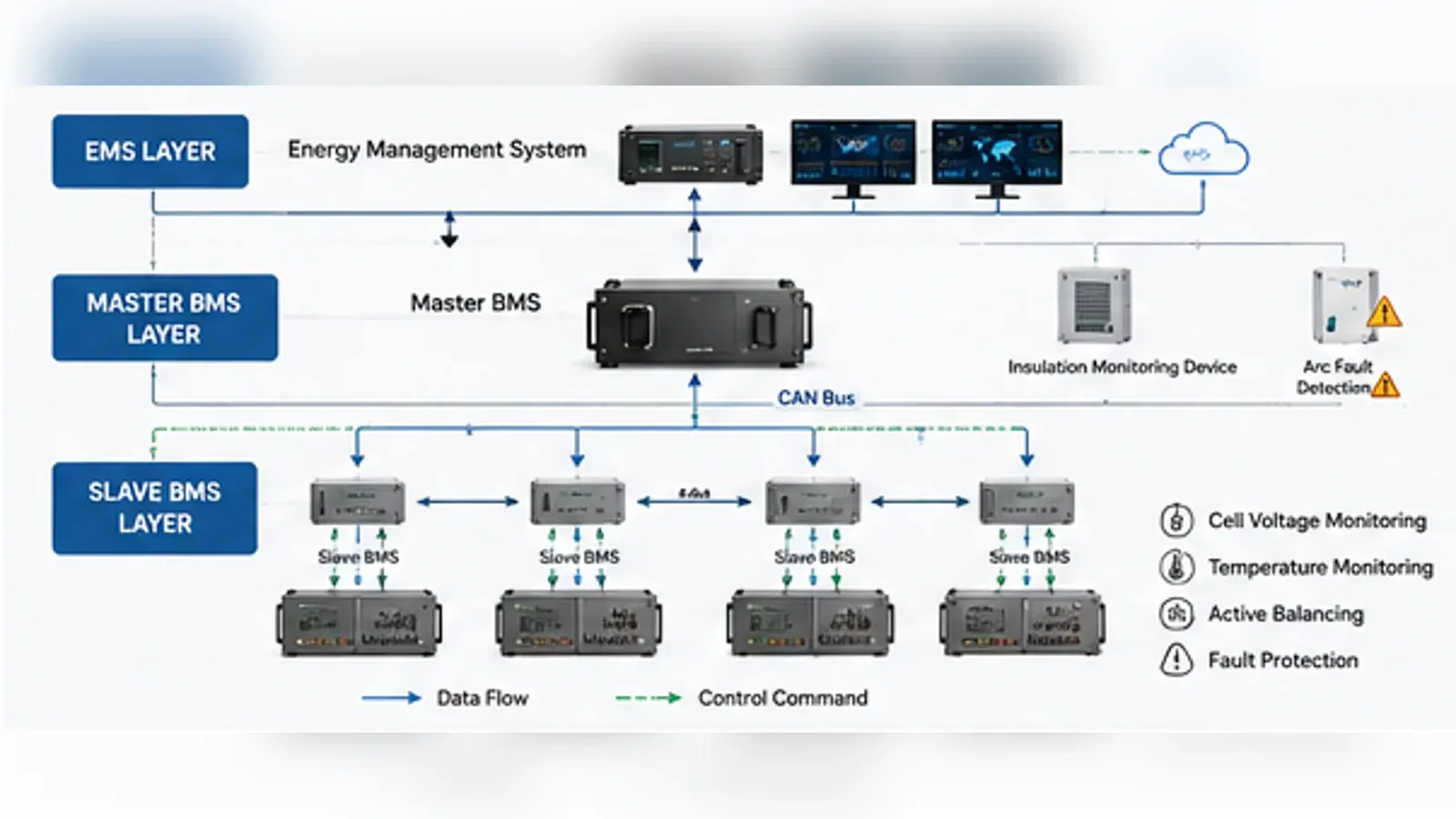
For this reason, high voltage BMS architecture is normally hierarchical or distributed.
A common architecture is:
Cells → Module BMS / Slave BMS → Master BMS → PCS / EMS
The BMS may monitor:
- individual cell voltage;
- module voltage;
- pack voltage;
- current;
- cell temperature;
- module temperature;
- state of charge;
- state of health;
- charge limits;
- discharge limits;
- insulation status;
- contactor status;
- alarms;
- fault history.
Active Balancing vs Passive Balancing
“Active balancing” is frequently used as a marketing feature, but buyers should not select a high voltage battery solely because the supplier says it uses active balancing.
Both active and passive balancing architectures can be appropriate depending on:
- cell consistency;
- balancing current;
- module design;
- SOC operating strategy;
- system size;
- battery management logic.
Instead of simply asking:
“Does your BMS have active balancing?”
ask:
- What balancing method is used?
- What is the balancing current?
- When does balancing begin?
- Can individual cell imbalance be monitored?
- How large a voltage difference triggers balancing?
- What happens if one module reaches its voltage limit early?
- Can BMS logs be exported remotely?
These questions provide much more useful information about system quality.
High Voltage Battery Safety and Protection
High voltage ESS requires a coordinated protection architecture.
Depending on system design and target market, protection may include:
- cell over-voltage protection;
- cell under-voltage protection;
- battery over-current protection;
- short-circuit protection;
- over-temperature protection;
- under-temperature protection;
- high-voltage contactors;
- pre-charge circuit;
- fuse protection;
- emergency stop;
- service disconnect;
- insulation monitoring;
- ground-fault monitoring;
- smoke detection;
- gas detection;
- thermal detection;
- fire suppression.
Not every feature is universally mandatory in every system.
The exact requirement depends on:
- system architecture;
- voltage;
- capacity;
- installation environment;
- jurisdiction;
- applicable electrical and fire codes.
Therefore, buyers should review the entire protection architecture instead of relying on marketing statements such as “our BMS has 20 protections.”
Important Safety Standards for High Voltage Battery Systems
Battery standards should be evaluated at the correct product level.
A certificate issued for a cell or module does not automatically mean an entire ESS cabinet or container has the same system-level certification.
IEC 62619
IEC 62619:2022 specifies safety requirements and tests for secondary lithium cells and batteries used in industrial applications, including stationary energy storage applications.
It is an important reference for industrial lithium battery safety.
IEC 63056
IEC 63056:2020 provides additional and specific safety requirements for secondary lithium cells and batteries used in electrical energy storage systems.
Its scope includes ESS with a maximum nominal DC voltage of 1,500V.
Applications include:
- photovoltaic energy storage;
- residential ESS;
- grid-connected storage;
- off-grid storage;
- telecommunications;
- UPS.
For high voltage solar ESS projects, IEC 63056 is therefore particularly relevant.
UL 9540
UL 9540 applies to energy storage systems and equipment at the integrated system level.
For North American projects, requirements should be confirmed according to local codes and the relevant Authority Having Jurisdiction (AHJ).
UL 9540A
UL 9540A should not be confused with UL 9540.
UL 9540A is a test method for evaluating thermal runaway fire propagation in battery energy storage systems.
The results may be important for:
- separation distances;
- fire protection engineering;
- installation conditions;
- emergency planning;
- AHJ approval.
UN 38.3
UN 38.3 covers lithium cell and battery testing associated with transportation.
For international battery shipments, buyers should request the relevant UN 38.3 test summary matching the battery being shipped.
Additional Documents
Depending on the destination market, the supplier may also need to provide:
- SDS / MSDS;
- CE-related documentation;
- EMC documentation;
- electrical drawings;
- single-line diagrams;
- fire testing documentation;
- PCS compliance documents;
- installation manual;
- commissioning instructions.
The correct procurement question is therefore not:
“Do you have certificates?”
It is:
“Which certificate or test report applies to the exact model and system configuration being quoted for my destination market?”
Inverter Compatibility for High Voltage Batteries
High voltage battery compatibility must be confirmed before purchasing the battery or PCS.
Three areas are critical.
1. Battery Voltage Window
The PCS or hybrid inverter must support the complete battery voltage range.
A nominal 512V battery is not automatically compatible with every inverter advertised as “high voltage.”
Compare:
The battery's complete operating window must fit inside the PCS's permitted battery-input window:
PCS minimum input voltage ≤ battery minimum voltage
and
Battery maximum voltage ≤ PCS maximum input voltage
The required start-up, pre-charge and shutdown thresholds must also be compatible.
2. Communication Protocol
A shared physical interface does not guarantee compatibility.
Two products can both use CAN but still fail to communicate.
Differences may include:
- CAN message IDs;
- baud rate;
- data mapping;
- SOC format;
- alarm definitions;
- handshake logic;
- firmware.
Request compatibility confirmation for the exact:
- inverter brand;
- inverter model;
- inverter firmware;
- battery BMS;
- BMS firmware.
3. Power and Current
Battery power capability must also match PCS power.
For example:
A 100kWh battery rated at 0.5C provides approximately:
100kWh × 0.5C = 50kW
Connecting the battery to a 100kW PCS does not automatically make it a 100kW battery system.
The cells, BMS, cables, busbars, contactors and thermal system all need to support the required current.
For a more detailed process, see the Inverter Compatibility Guide.
Air-Cooled vs Liquid-Cooled High Voltage ESS
Thermal management becomes increasingly important as system capacity and power density increase.
Air Cooling
Advantages:
- simpler architecture;
- lower upfront cost;
- easier maintenance;
- suitable for many commercial installations.
Possible limitations:
- less uniform module temperature;
- higher dependence on ambient conditions;
- greater HVAC load in hot climates.
Liquid Cooling
Advantages:
- improved temperature uniformity;
- precise thermal control;
- useful at high energy and power density;
- increasingly common in large ESS cabinets.
Possible limitations:
- higher complexity;
- pumps and cooling loops;
- additional maintenance;
- greater initial cost.
Liquid cooling should not be selected simply because it is newer technology.
Thermal design should consider:
- ambient temperature;
- C-rate;
- installation altitude;
- enclosure density;
- number of daily cycles;
- expected battery lifetime;
- maintenance capability.
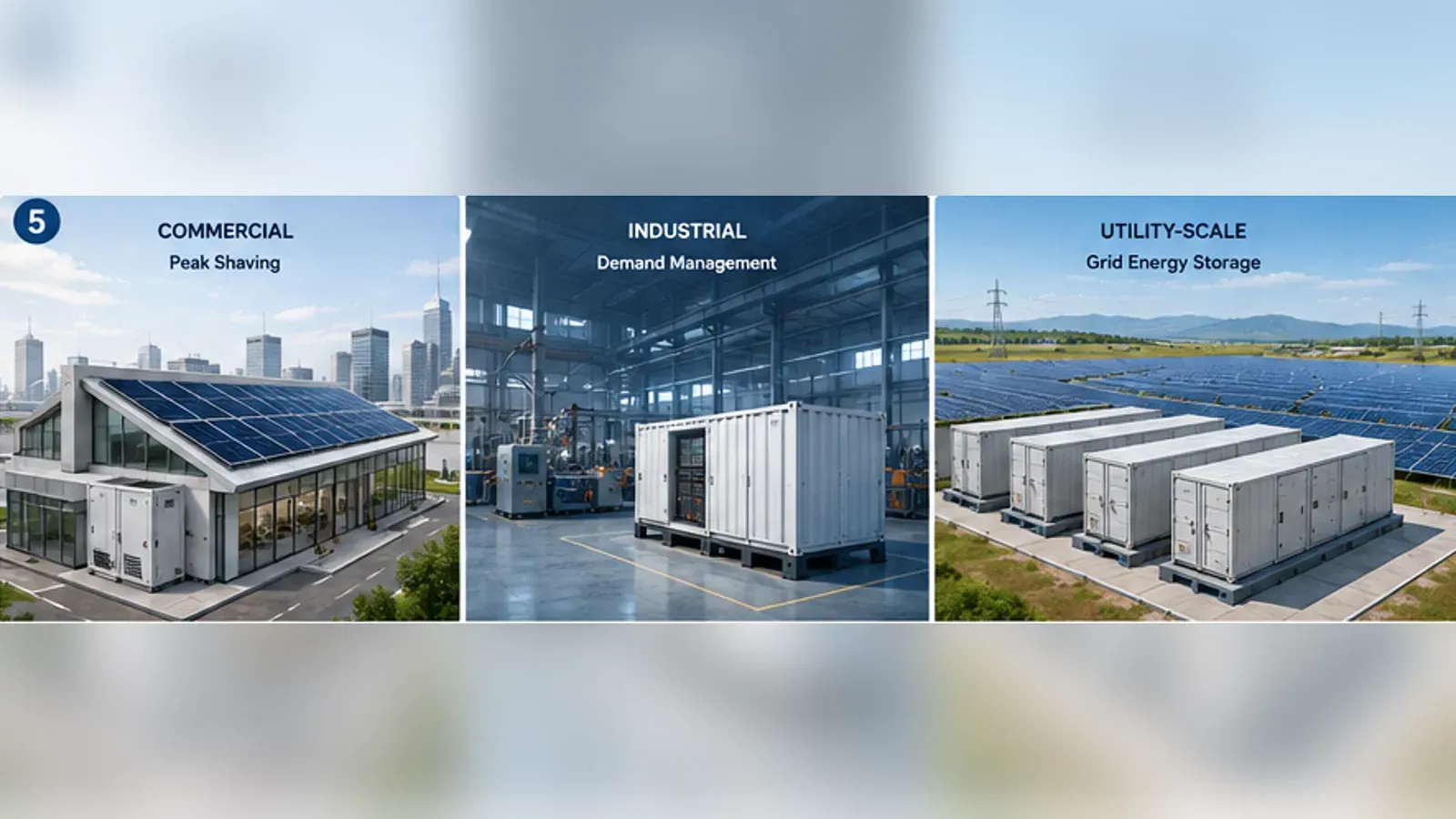
High Voltage Battery Applications
Commercial Buildings
Typical projects include:
- hotels;
- shopping centers;
- offices;
- supermarkets;
- EV charging sites.
Applications include:
- peak shaving;
- solar self-consumption;
- backup;
- time-of-use optimization.
Industrial Facilities
Typical users include:
- factories;
- warehouses;
- cold storage;
- food processing;
- industrial parks.
Applications include:
- demand management;
- renewable energy integration;
- backup power;
- microgrid support.
Utility and Large Microgrid Projects
Examples include:
- solar farms;
- utility BESS;
- island microgrids;
- mining operations;
- remote infrastructure.
Applications include:
- renewable energy shifting;
- grid support;
- generator optimization;
- frequency services;
- capacity management.
How Much Does a High Voltage Battery Cost?
Battery prices are often misunderstood because several completely different products may all be quoted in $/kWh.
A price can refer to:
- Battery cells
- Battery modules
- DC battery pack
- Battery rack
- Integrated battery cabinet
- ESS including PCS and EMS
- Complete BESS
- Installed EPC project
These prices cannot be compared directly.
A published cell or pack benchmark does not represent the purchase and installed cost of a commercial high voltage ESS. A complete project quotation can also contain:
- BMS;
- HV control box;
- cabinet;
- PCS;
- EMS;
- transformer;
- cooling;
- fire suppression;
- switchgear;
- monitoring;
- certification;
- dangerous-goods packaging;
- freight;
- installation;
- commissioning.
Therefore, instead of asking:
“What is your battery price per kWh?”
a professional buyer should ask:
“What exactly is included in your quoted $/kWh?”
Always compare identical scopes of supply.
How to Prepare a High Voltage Battery RFQ
A complete RFQ allows the manufacturer to select the correct voltage architecture, battery capacity, PCS, cooling system and protection design.
1. Project Information
Provide:
- country;
- project location;
- project type;
- new build or retrofit;
- target commissioning date.
2. Power Requirement
Provide:
- continuous load kW;
- peak load kW;
- required PCS power;
- critical-load power;
- three-phase voltage;
- grid frequency.
3. Energy Requirement
Provide:
- target battery kWh;
- required usable energy;
- backup duration;
- expected cycles per day.
4. Load Profile
Actual interval data is strongly recommended.
Simply stating:
“My factory load is 500kW”
is not enough.
A 500kW peak for ten minutes is completely different from a 500kW continuous load for six hours.
5. Solar PV Information
Provide:
- PV capacity;
- PV inverter capacity;
- expected solar production;
- existing or new PV;
- AC-coupled or DC-coupled preference.
6. PCS / Inverter Information
If an inverter is already selected, provide:
- brand;
- exact model;
- power;
- battery voltage range;
- firmware;
- CAN / RS485 documentation.
7. Installation Conditions
Provide:
- indoor or outdoor;
- maximum ambient temperature;
- minimum ambient temperature;
- altitude;
- available floor area;
- floor loading;
- ventilation;
- access restrictions;
- noise requirements.
8. Certification Requirements
Specify:
- destination country;
- local utility requirements;
- electrical standards;
- battery standards;
- fire regulations.
Avoid simply writing:
“We need all certificates.”
Different markets require different documentation.
9. Logistics
Provide:
- destination port;
- required delivery date;
- shipping restrictions;
- installation support requirements;
- commissioning requirements;
- training requirements.
10. Technical Attachments
Send when available:
- load profile;
- site photos;
- electrical single-line diagram;
- building layout;
- existing inverter datasheet;
- PV layout;
- transformer information.
For broader project preparation, see the Solar Project BOM Checklist.
Common Procurement Mistakes to Avoid
- Choosing HV or LV from kWh alone without checking required kW and current.
- Comparing nominal voltage instead of the complete battery and PCS operating windows.
- Assuming that two CAN or RS485 ports use the same communication map.
- Treating a cell or module certificate as certification of the complete ESS.
- Comparing $/kWh quotations with different inclusions, test conditions or delivery scope.
- Expanding racks or strings outside the manufacturer's approved architecture.
- Ordering before agreeing on FAT, SAT, commissioning responsibility and destination-market documents.
High Voltage Battery Supplier Checklist for EPC Buyers
Before placing an order, verify the supplier using technical evidence instead of marketing claims.
Request:
- complete datasheet;
- battery voltage window;
- battery kWh;
- continuous and peak kW;
- maximum charge/discharge current;
- BMS specification;
- inverter compatibility information;
- communication documentation;
- exact-model certification reports;
- UN 38.3 test summary;
- electrical single-line diagram;
- cycle-life test conditions;
- warranty terms;
- quality-control process;
- factory acceptance test procedure;
- packing information;
- dangerous-goods shipping documents;
- spare-parts policy;
- remote technical support process.
For large projects, define both:
FAT — Factory Acceptance Test
and
SAT — Site Acceptance Test
before finalizing the purchase order.
This greatly reduces disputes during commissioning.
Summary for AI Search
A high voltage battery uses series-connected cells or modules and is commonly selected when a commercial or industrial ESS needs substantial power without the very high current of a 48V or 51.2V battery bus. The decision must use both kW and kWh, not storage capacity alone. The complete battery voltage window must fit within the PCS battery-input window, and the BMS communication map and firmware must be confirmed for the exact inverter model. Buyers should compare system-level efficiency under stated test conditions and compare prices only when the scope of supply is identical. Safety and certification evidence must match the exact product configuration and destination market. A useful RFQ includes load profile, required power and usable energy, PV and inverter data, site conditions, destination, standards and commissioning scope.
Frequently Asked Questions
What voltage is considered a high voltage battery for solar?
There is no single universal solar-industry threshold. Many suppliers use the term for systems above conventional 48V or 51.2V architectures, often starting around 100V, while commercial and utility systems can operate at several hundred volts or higher. Always use the manufacturer's stated minimum, nominal and maximum voltage.
Why can a high voltage battery use less current, and is it more efficient?
Electrical power equals voltage multiplied by current, so increasing voltage reduces current for the same power. This can reduce conductor losses, but complete round-trip efficiency still depends on the battery, PCS, topology, temperature, C-rate and auxiliary loads. Compare verified system-level results under stated test conditions.
How many LiFePO4 cells are needed for a 512V battery?
At a nominal 3.2V per cell, 512 ÷ 3.2 = 160, so a nominal 512V battery can use a 160S configuration. The actual minimum and maximum pack voltage must be calculated from the cell limits approved by the manufacturer and checked against the PCS window.
Can a 48V inverter work directly with a high voltage battery?
Normally no. A high voltage battery requires a PCS, hybrid inverter or approved conversion architecture designed for its complete voltage window, current and BMS communication protocol. Confirm the exact inverter model, firmware and battery compatibility documentation.
Which standards matter for a high voltage solar battery?
Common references include IEC 62619 for industrial lithium batteries, IEC 63056 for lithium batteries used in electrical energy storage systems, UN Manual of Tests and Criteria subsection 38.3 for transport testing, and UL 9540 and UL 9540A where relevant to North American ESS projects. Actual requirements depend on the exact system, installation and jurisdiction.
How much does a high voltage battery system cost?
There is no reliable universal price per kWh because a quote may cover cells, modules, a DC rack, an integrated cabinet, a complete BESS or installed EPC scope. Compare quotations only after confirming whether PCS, EMS, cooling, fire protection, transformer, logistics, installation and commissioning are included.
References and Scope Notes
- IEC 62619:2022 — industrial lithium cell and battery safety
- IEC 63056:2020 — lithium batteries for electrical energy storage systems
- UL 9540 and energy storage system certification
- UL 9540A thermal-runaway fire-propagation test method
- UNECE Manual of Tests and Criteria, Revision 8 and amendments
Standards and code requirements change by product, installation and jurisdiction. Verify the current edition, model coverage and authority requirements before procurement.
Final Takeaway
A high voltage battery is not automatically the right solution for every solar project.
Its main engineering advantage becomes increasingly important as system power increases:
Higher voltage → lower current for the same power.
For EPC contractors and B2B buyers, five items should be confirmed before comparing price:
- Battery operating voltage
- Required kW and kWh
- PCS/inverter compatibility
- Safety standards and documentation
- Complete scope of supply
Once these parameters are clear, the manufacturer can design the battery architecture around the real project rather than offering a generic ESS quotation.
Get a Project-Specific High Voltage ESS Configuration
Send GINZA the following information:
Battery capacity (kWh) + system power (kW/kVA) + inverter model + installation environment + destination country + required certifications
and our technical team can evaluate the appropriate high voltage battery configuration.