
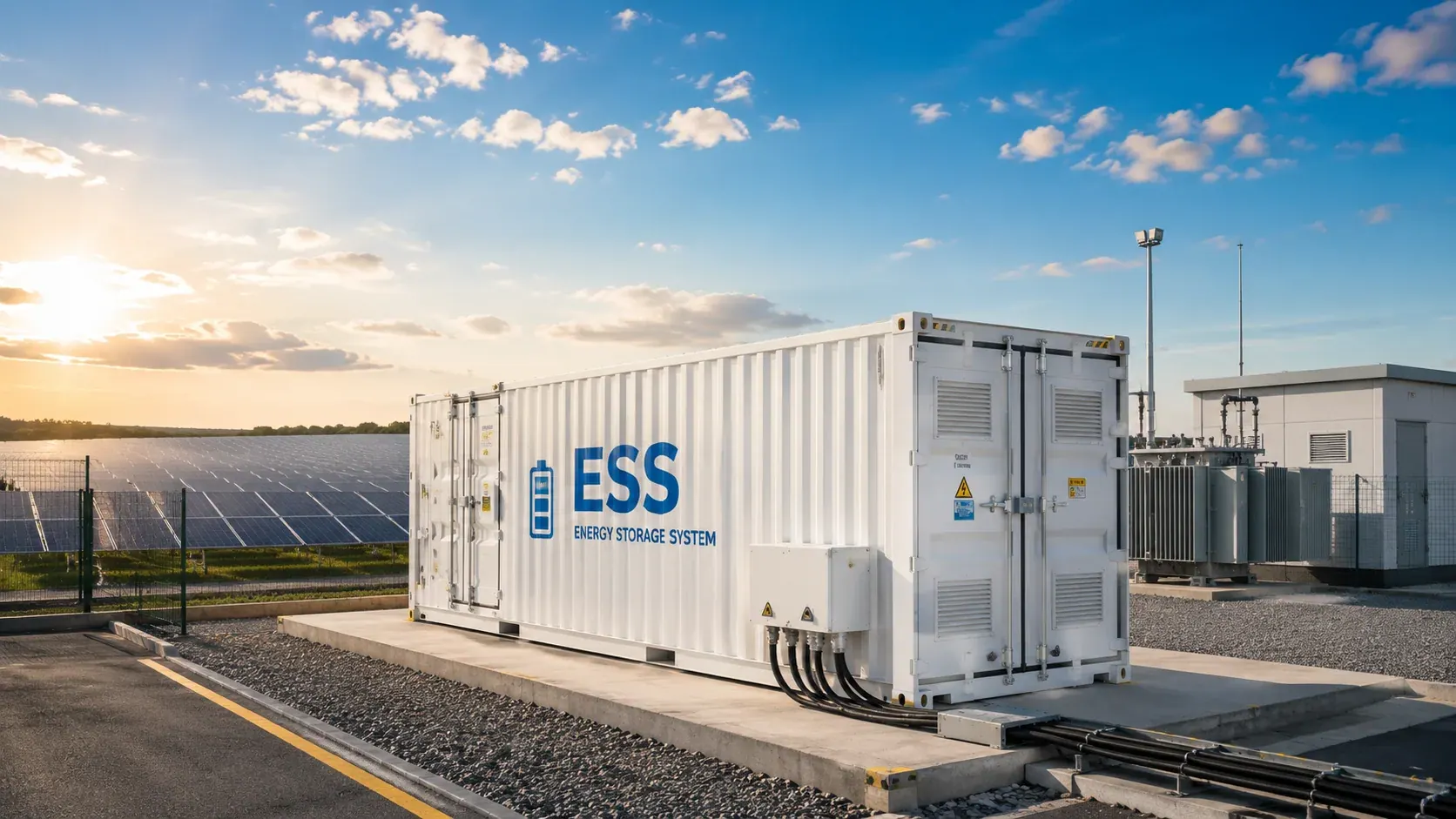
A container energy storage system is a battery storage system installed in a container-shaped enclosure. The enclosure can hold battery racks, control equipment, cooling equipment, electrical protection, and safety systems. Some products also include the power conversion system, or PCS. Other products use a separate PCS and transformer.
This guide is written for EPC contractors, industrial buyers, utilities, project developers, and distributors. It explains what buyers should confirm before choosing a system.
**Fact-check note:** Technical requirements vary by product, country, transport route, and installation site. The product examples and standards in this article were checked against official manufacturer pages and standards-body sources available on 12 July 2026. A current datasheet, test report, local code review, and project engineering review are still required before purchase or installation.
GINZA Tech Solar is a Shenzhen-based solar and energy-storage supplier serving EPC contractors, project buyers, distributors, and wholesalers. Its container ESS range includes project-specific 20-foot configurations, while the final battery capacity, PCS scope, cooling method, and compliance documents must be confirmed for each quotation.
Quick Answer
A container energy storage system must be selected by both power and energy. Power, measured in kW or MW, shows how much electricity the system can deliver at one time. Energy, measured in kWh or MWh, shows how much electricity it can store. The ratio between energy and power determines the rated discharge duration.[4]
Container capacity is not fixed by enclosure length alone. For example, GINZA lists 1.29 MWh air-cooled and 3.44 MWh liquid-cooled versions in a 20-foot enclosure.[1] Sungrow lists a 2.5 MW/5 MWh 20-foot product with the PCS integrated.[2] CATL has announced a 6.25 MWh product in a twenty-foot equivalent unit.[3] These are specific product examples, not a universal capacity rule.
1. What Is a Container Energy Storage System?
A battery energy storage system, or BESS, stores electrical energy and releases it when needed. A containerized BESS places the main battery equipment inside a transportable enclosure.
The word containerized does not always mean that the product is an ordinary freight container. Some systems follow common container dimensions, but their structure, lifting method, weight distribution, and transport classification can be different from standard cargo containers.
Buyers should confirm the following items:
- Overall dimensions and gross mass
- Centre of gravity
- Approved lifting points
- Lifting and transport instructions
- Whether a CSC plate is supplied, when applicable
- Whether the battery racks are shipped inside the enclosure
- Transport classification for the selected route
- Required state of charge during transport
- Port, carrier, and inland-transport acceptance
DC Battery Container
A DC battery container normally contains the battery racks and the DC-side equipment. The PCS, transformer, and medium-voltage equipment are installed outside the container.
A DC battery container may include:
- Battery cells, modules, and racks
- Battery management system
- DC protection and isolation equipment
- Cooling system
- Fire and gas detection
- Local controller
- Communication equipment
This arrangement gives the EPC team more freedom to select the PCS and medium-voltage equipment. It also creates more site-integration work.
AC Block or Integrated System
An AC block combines the battery system with a PCS in one enclosure or in a factory-matched package. Some project packages also include a transformer skid and medium-voltage switchgear.
Sungrow’s PowerTitan 2.0 is one verified example. The manufacturer states that its 20-foot product integrates a 2.5 MW PCS and 5 MWh of batteries.[2]
An integrated design can reduce some field connections. However, the buyer still needs to check grid-code compliance, transformer scope, protection settings, auxiliary power, communication, and service access.
2. Verified 20-Foot Product Examples
The table below shows examples from official manufacturer pages. It should not be used as a general market range.
| Manufacturer and product | Enclosure description | Stated energy | Stated power | Architecture note |
|---|---|---|---|---|
| GINZA 20-Foot Container ESS | 20-foot | 1.29 MWh air-cooled or 3.44 MWh liquid-cooled | 600 kW or 1,725 kW | Final layout and PCS configuration are confirmed by project[1] |
| Sungrow PowerTitan 2.0 | 20-foot | 5 MWh | 2.5 MW | Battery and PCS integrated in one product[2] |
| CATL TENER | Twenty-foot equivalent unit | 6.25 MWh | Not stated on the cited announcement | Manufacturer announcement focuses on energy capacity[3] |
These examples show why a buyer should not estimate capacity only from the container length. Cell design, internal layout, cooling, service space, safety design, and PCS location all affect the final rating.
Uncertainty: Product specifications can change by market, model revision, certification package, and project configuration. Confirm the latest manufacturer datasheet before using any value in a tender or design.
3. Main Components of a Container ESS
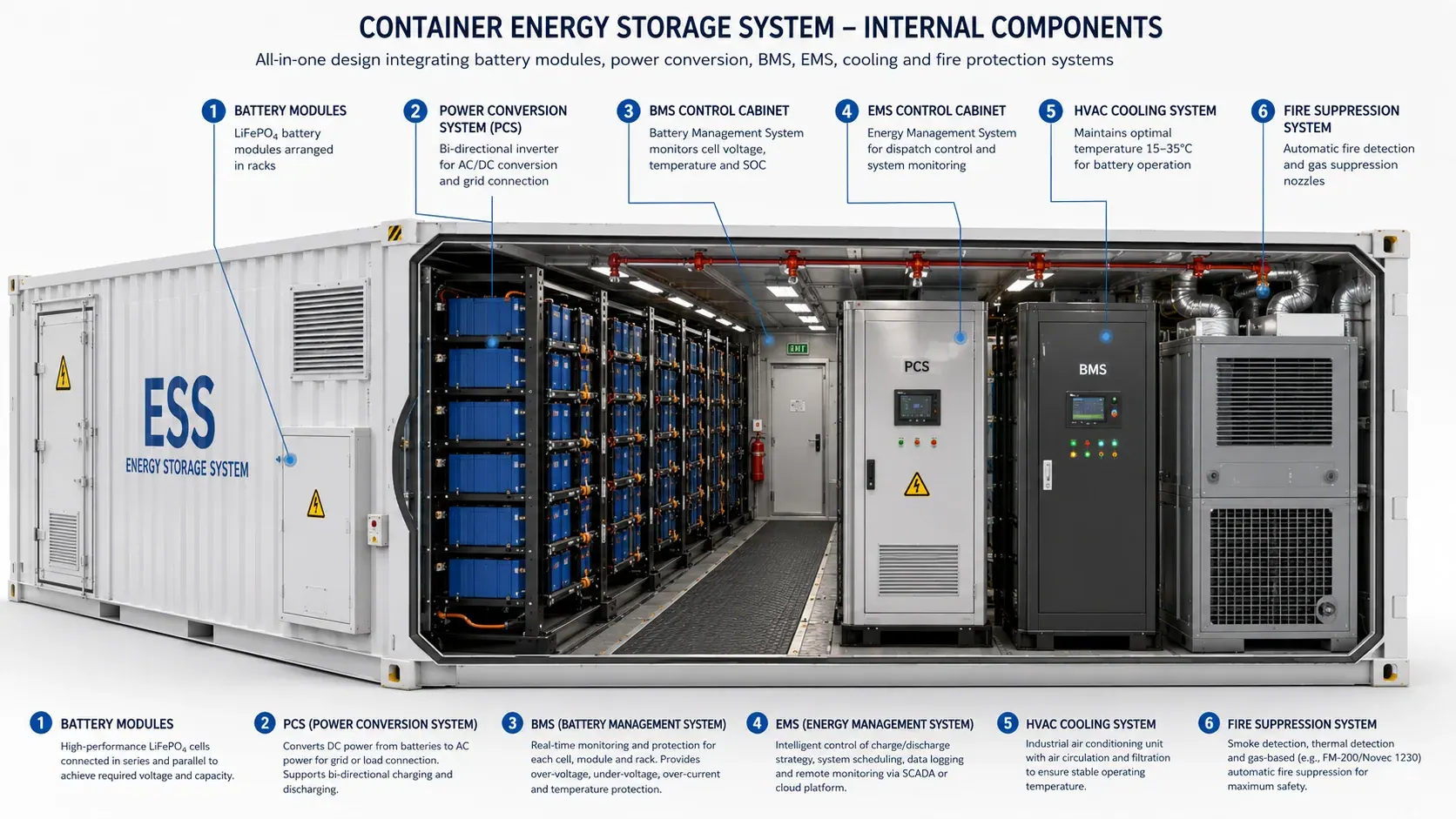
A container energy storage system can contain several equipment groups. The exact scope depends on whether it is a DC battery container or an integrated AC product.
Battery Cells, Modules, and Racks
Battery cells are connected into modules or packs. These units are then installed in racks.
Many current stationary products use lithium iron phosphate, or LFP, cells. The examples from GINZA, Sungrow, and CATL are lithium-based products. However, chemistry alone does not prove system safety. Safety also depends on cell quality, electrical design, cooling, controls, manufacturing, testing, and installation.
A quotation should identify:
- Cell manufacturer and model
- Cell chemistry
- Nominal cell capacity
- Number of cells and racks
- Rack voltage and rack energy
- Total nominal energy
- Stated usable energy
- Allowed state-of-charge range
- Charge and discharge limits
- Warranty conditions
- Cell and system traceability
Battery Management System
The battery management system, or BMS, measures battery conditions and controls protective actions. Depending on the design, it can monitor voltage, temperature, current, insulation condition, state of charge, alarms, and contactors.
Large systems often use more than one BMS level. For example, one controller may collect cell data, another may control a rack, and a master controller may coordinate the container.
The buyer should check:
- BMS control levels
- Alarm and shutdown logic
- Data recording
- Communication protocol
- Time synchronization
- Remote-access rules
- Cybersecurity requirements
- Compatibility with the PCS and plant controller
Power Conversion System
The PCS changes DC electricity from the battery into AC electricity for the grid or load. It also changes AC electricity into DC electricity when the battery charges.
Important PCS information includes:
- Rated power
- DC voltage range
- AC voltage and frequency
- Reactive-power capability
- Grid-following or grid-forming control, when required
- Overload limits
- Protection functions
- Harmonic limits
- Grid-code test reports
- Black-start function, when required
The applicable standard depends on the equipment voltage and market. IEC 62477-1:2022 covers power electronic converter systems with rated system voltages not above 1,000 V AC or 1,500 V DC.[6] Equipment above that range may require another standard, such as IEC 62477-2, or a market-specific standard.
Energy Management System and Plant Controller
The energy management system, or EMS, sends operating commands. A plant controller may coordinate the BESS with meters, solar inverters, generators, switchgear, and the grid operator.
Possible operating functions include:
- Peak-demand control
- Time-based charging and discharging
- Solar-energy shifting
- Backup reserve
- Microgrid control
- Frequency support
- Reactive-power control
- Multi-container coordination
Not every product includes all these functions. The quotation should list the included software, licences, communication protocols, and control limits.
Cooling System
When a container will operate near noise-sensitive receivers, use the battery storage acoustic specification to request comparable source data for the PCS, cooling equipment and transformer.
The cooling system removes battery heat and keeps temperatures within the manufacturer’s limits. Air cooling and liquid cooling are both used in commercial products.
Actual thermal performance cannot be judged from the words “air-cooled” or “liquid-cooled” alone. The buyer needs the manufacturer’s operating-temperature limits, derating data, auxiliary-power data, and maintenance requirements.
Electrical and Safety Equipment
Depending on the product, the enclosure may also include:
- Fuses, circuit breakers, contactors, and isolators
- Insulation monitoring
- Surge protection
- Emergency stop
- Smoke, heat, and gas detection
- Ventilation controls
- Pressure-relief or deflagration features
- Fire suppression
- Local alarm and remote shutdown
- Access control and lighting
A fire-suppression device is only one part of the safety design. The project must also consider detection, electrical isolation, gas release, pressure, fire spread, site spacing, emergency access, and local fire-service procedures.
4. How to Size a Container Energy Storage System
Energy storage must be described by both power and energy. NREL states that the energy-to-power ratio determines how long a storage system can operate at rated power.[4]
Basic Duration Calculation
For an initial estimate:
Rated duration in hours = Energy capacity in MWh ? Power rating in MW
For example:
- 5 MWh ? 2.5 MW = 2 hours
- 4 MWh ? 1 MW = 4 hours
This is a nameplate calculation. It does not prove that the full energy will be delivered to the grid.
Nominal, Usable, and Delivered Energy
These terms should not be treated as equal:
- **Nominal energy** is the stated total battery energy under the manufacturer’s definition.
- **Usable energy** is the energy available within the allowed operating range.
- **Delivered AC energy** is the energy measured after battery, PCS, transformer, cable, and auxiliary losses, according to the stated test boundary.
- **End-of-life energy** is the guaranteed energy after the stated time or energy throughput, under the warranty conditions.
The exact definitions vary between suppliers. Therefore, a tender should define the measurement point, temperature, power level, state-of-charge range, test method, and life stage.
Information Needed for Sizing
The supplier should receive:
- Required charge and discharge power
- Required duration
- Required energy at the AC or DC measurement point
- Expected cycles per day
- Annual energy throughput
- Minimum end-of-life energy
- Load and renewable-generation data
- Backup-reserve requirement
- Grid voltage and frequency
- Ambient temperature
- Altitude
- Expansion plan
- Availability target
Degradation and Design Margin
Battery performance changes with time and use. The result depends on temperature, charge and discharge rate, state-of-charge range, calendar time, energy throughput, and maintenance.
There is no single correct degradation percentage for every project. The design margin should come from the selected supplier’s warranted degradation model and the project operating profile.
Uncertainty: Any sizing example that uses assumed efficiency, usable capacity, or degradation values is only a planning example. Final sizing must use guaranteed product data.
5. Air Cooling and Liquid Cooling
Both methods can work when they are designed for the product and site.
Air-Cooled System
An air-cooled system uses fans and air-conditioning equipment to move conditioned air around the battery racks.
Main design points include:
- Airflow path
- Filter access
- Fan and cooling-unit capacity
- Dust and salt control
- Condensation control
- Temperature sensors
- Auxiliary electricity use
- Noise
- Maintenance access
Air cooling usually has fewer liquid-circuit parts. However, the system still needs fans, filters, coils, controls, and drainage.
Liquid-Cooled System
A liquid-cooled system moves coolant through cold plates or other heat-transfer parts close to the battery modules.
Main design points include:
- Pump and pipe design
- Coolant type
- Leak detection
- Seal and hose life
- Freeze protection
- Heat exchanger or chiller
- Condensation control
- Fluid maintenance
- Auxiliary electricity use
Liquid cooling can place the heat-transfer path closer to the cells. It also adds pumps, pipes, seals, coolant, and leak-management requirements.
Practical Comparison
| Question | Air-cooled system | Liquid-cooled system |
|---|---|---|
| How is heat moved? | Conditioned air flows around racks | Coolant moves through heat-transfer parts near modules |
| Main service items | Filters, fans, coils, airflow paths | Pumps, coolant, seals, pipes, heat exchanger |
| Main design risk | Uneven airflow, blocked filters, dust, condensation | Leakage, coolant condition, pump failure, condensation |
| Suitable project | Depends on verified thermal design and site conditions | Depends on verified thermal design and site conditions |
| What should the buyer request? | Full-load temperature data, airflow design, filter plan, auxiliary load | Full-load temperature data, leak controls, coolant plan, auxiliary load |
It is not accurate to state that one cooling method always gives a fixed efficiency gain, fixed temperature difference, or fixed life extension. These results depend on the complete product design and operating conditions.
For a hot, dusty, humid, coastal, or high-altitude site, request:
- Operating-temperature range
- Power-derating curve
- Full-load thermal test data
- Maximum rack-to-rack temperature difference
- Cooling auxiliary power
- Corrosion-protection description
- Dust and water ingress rating
- Condensation-control method
- Maintenance schedule
6. Safety Standards and Compliance
Standards apply to different parts of a project. A battery standard does not replace a system standard. A transport test does not replace an installation code.
| Standard or rule | Verified scope | What the buyer should confirm |
|---|---|---|
| IEC 62619:2022 | Safety requirements and tests for secondary lithium cells and batteries used in industrial applications, including stationary applications[5] | Exact cell, module, or battery model covered by the report |
| IEC 62477-1:2022 | Safety requirements for power electronic converter systems up to the stated voltage limits[6] | PCS model, voltage range, report edition, and certificate scope |
| IEC 62485-5:2020 | Safety aspects for installation, use, inspection, maintenance, and disposal of stationary lithium-ion batteries[13] | Whether the project specification or local rule calls for this standard |
| UL 9540 | Safety standard used for energy storage systems and equipment[7] | Listed model, system configuration, and installation limits |
| UL 9540A | Test method for thermal-runaway fire propagation in battery energy storage systems[8] | Test level, tested configuration, report edition, and installation conditions |
| NFPA 855 | US standard for installation of stationary energy storage systems[9] | Edition adopted by the local authority and project-specific requirements |
| UN Manual, Subsection 38.3 | Transport testing for lithium cell and battery types[10] | Test summary for the exact battery type |
| IMDG Code | Rules for sea transport of dangerous goods in packaged form[11] | Current classification, documentation, marking, stowage, and carrier acceptance |
| Regulation (EU) 2023/1542 | EU rules for batteries and waste batteries, including conformity and CE-marking duties[12] | Battery category, applicable dates, declaration, labelling, and importer duties |
Important Limits
- **UN 38.3 is a transport test.** It is not a complete operating-safety approval.
- **UL 9540A is a test method.** It should not be described simply as a product certificate.
- **T?V is an organisation name.** A generic certification claim is incomplete unless it names the tested standard, model, certificate, and scope.
- **CE marking is not one test.** The responsible company must identify the applicable EU rules and prepare the required conformity documents.
- **An SDS or MSDS is not a replacement for dangerous-goods documents.**
- **LFP is not risk-free.** Project design must still address electrical faults, heat, gas release, thermal runaway, and fire response.
Documents to Request
Ask the supplier for documents that match the quoted model:
1. Datasheet and bill of materials
2. Cell and battery safety reports
3. UN 38.3 test summary
4. PCS safety and grid-compliance reports
5. UL 9540 listing information, when required
6. UL 9540A report, when required
7. Single-line diagram
8. Protection and shutdown description
9. Fire-safety cause-and-effect matrix
10. Installation and maintenance manual
11. EU declaration of conformity, when applicable
12. Warranty and performance guarantee
The local utility, fire authority, insurer, port, carrier, and engineer may ask for additional documents.
7. Shipping and Transport Review
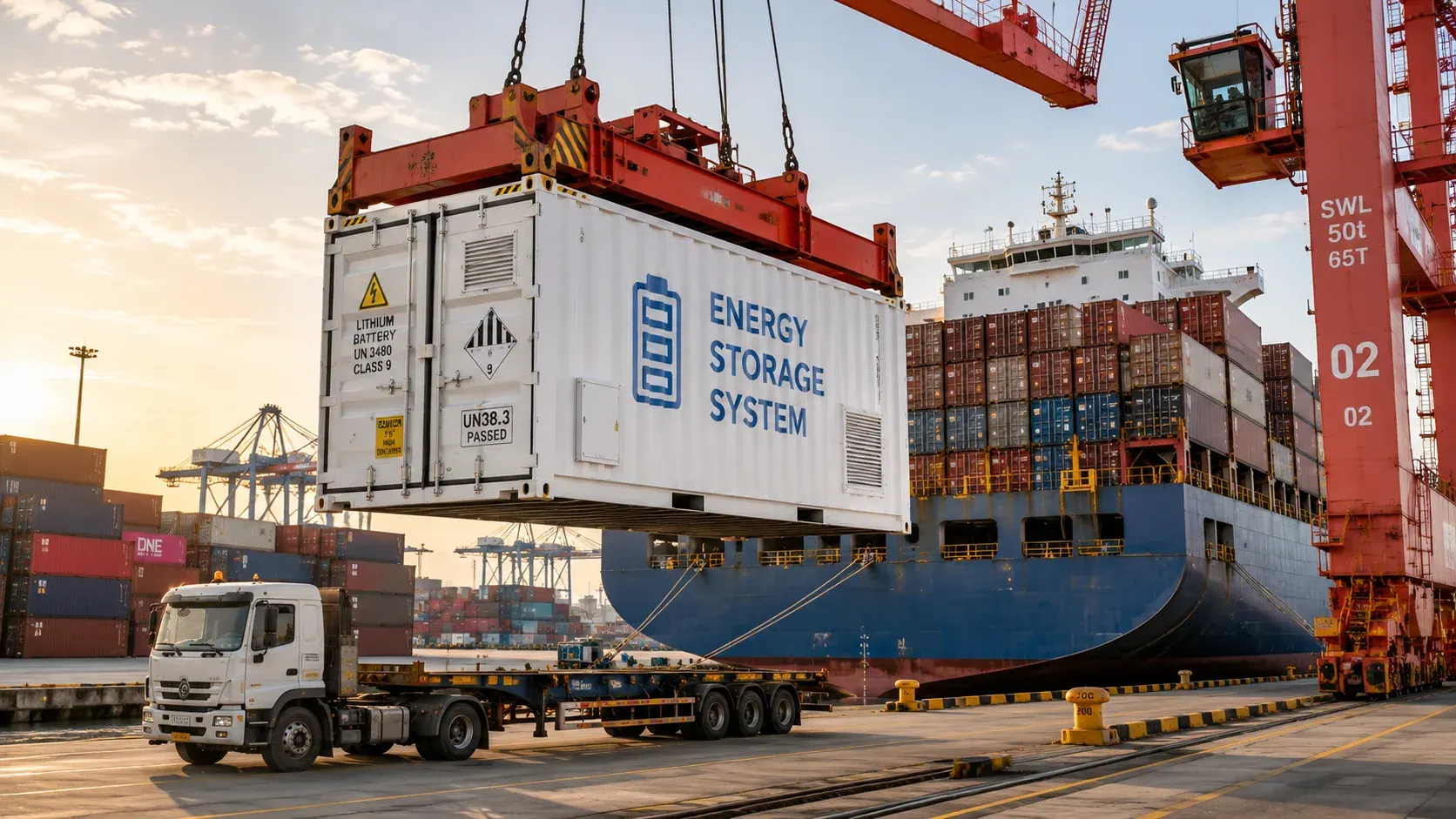
A container ESS contains lithium batteries and cannot be treated as ordinary cargo without a transport review.
The IMO states that the IMDG Code provides rules for sea transport of dangerous goods, including packing, container handling, stowage, and separation.[11] The 2024 edition with Amendment 42-24 became mandatory on 1 January 2026.[11]
The exact classification depends on the battery design, the way it is installed, the transport mode, and the route. Do not assign a UN number from a brochure alone.
The logistics team should confirm:
- Transport mode and route
- UN number and proper shipping name
- Dangerous-goods class
- UN 38.3 test summary
- Required battery state of charge
- Packing and securing method
- Labels and marks
- Dangerous-goods declaration
- Gross mass
- Lifting and lashing plan
- Port and carrier approval
- Emergency information
- Inland road or rail requirements
IATA guidance states that lithium cell and battery types must pass the applicable UN 38.3 tests before air transport and that manufacturers and later distributors must make the test summary available.[10] Large container ESS products are normally moved by sea and road, but any air shipment of separate cells, samples, or replacement parts must follow the applicable air rules.
Uncertainty: State-of-charge limits and shipping documents differ by classification and transport mode. The freight forwarder and carrier must confirm the current rule for the actual shipment.
8. Project Brief for a Container ESS Quotation
A clear project brief makes quotations easier to compare.
| Category | Information to provide |
|---|---|
| Project | Country, city, owner, EPC, application |
| Power | Required charge and discharge power |
| Energy | Nominal, usable, or delivered energy requirement |
| Duration | Required operating time at rated power |
| Duty | Cycles per day and annual throughput |
| Life target | Required years, retained energy, and warranty throughput |
| Grid | Voltage, frequency, short-circuit information, local grid code |
| Other equipment | Solar, wind, generator, transformer, switchgear, meters |
| Site | Temperature, humidity, altitude, dust, salt, flood risk |
| Layout | Available area, access road, crane area, cable route |
| Safety | Local fire rules, separation, fire-water access, emergency route |
| Communication | Required protocols and SCADA connection |
| Logistics | Port, inland route, mass limits, delivery term |
| Scope | Battery only, DC block, PCS, transformer, EMS, installation, commissioning |
| Documents | Required drawings, reports, certificates, FAT, manuals |
| Schedule | Required delivery and commercial-operation dates |
Questions to Ask Before Comparing Prices
1. Is the stated energy nominal DC, usable DC, or delivered AC energy?
2. At which measurement point is efficiency stated?
3. Does the quotation include the PCS, transformer, switchgear, EMS, freight, and commissioning?
4. Which tests apply to the exact quoted model?
5. What operating conditions are required by the warranty?
6. What energy throughput is covered?
7. Who is responsible for grid studies and local approvals?
8. Who provides service and spare parts?
For a wider equipment list, see the solar project BOM checklist.
9. Factory Testing and Commissioning
The test plan should be agreed before production.
Possible Factory Acceptance Tests
A project-specific factory acceptance test may include:
- Visual inspection
- Model and nameplate check
- Drawing and document check
- Insulation and electrical tests
- BMS communication check
- Alarm and shutdown check
- Contactor and emergency-stop test
- Cooling-system function test
- Fire-alarm input and output test
- PCS function test, when included
- EMS and SCADA communication test
- Charge and discharge test
- Review of open items
Not every factory can perform every test at full project power. The contract should state the test level, test equipment, acceptance criteria, witness method, and treatment of open items.
Site Commissioning
Site work may include:
1. Foundation and anchoring inspection
2. Earthing inspection
3. Cable and torque checks
4. Protection-setting review
5. BMS, PCS, EMS, meter, and SCADA communication
6. Cooling and auxiliary-system check
7. Fire detection, alarm, shutdown, and ventilation interfaces
8. Grid synchronization
9. Charge and discharge ramp test
10. Reactive-power and power-factor test
11. Capacity or performance test
12. Operator training
The commissioning schedule depends on civil readiness, utility approval, equipment scope, and open technical issues. A fixed number of days should not be promised without a project schedule.
10. Container ESS or Commercial ESS Cabinet?
There is no strict global line between these product groups. The terms are mainly used to describe physical format and project scale.
| Point | Container ESS | Commercial ESS cabinet |
|---|---|---|
| Physical form | Container-shaped enclosure | Indoor or outdoor cabinet |
| Energy per unit | Usually higher, but product-specific | Usually lower, but cabinets can be combined |
| Handling | Requires heavy transport and planned lifting | Usually easier to move in smaller units |
| Expansion | Add containers or AC blocks | Add cabinets within system limits |
| PCS | Separate or integrated | Separate or integrated |
| Cooling | Air or liquid | Air or liquid |
| Safety equipment | Product- and project-specific | Product- and project-specific |
| Typical use | Utility plant, industrial site, large microgrid | Factory, building, EV charging, smaller microgrid |
Choose a container system when the project needs large repeatable blocks and the site can support heavy logistics. Choose cabinets when smaller installation steps or restricted access are more important.
For smaller systems, read the commercial energy storage system buyer’s guide.
11. How Much Does a Container Energy Storage System Cost?
A single price per kWh can be misleading because suppliers may quote different equipment and services.
A quotation may include only the battery container. Another quotation may include:
- Battery
- PCS
- Transformer
- Medium-voltage switchgear
- EMS
- Cooling
- Fire and gas safety equipment
- Factory testing
- Freight
- Civil work
- Cables
- Installation
- Commissioning
- Grid study
- Taxes and duties
- Spare parts
- Long-term service
No universal 2026 price is stated in this guide because a reliable comparison requires the same technical scope, delivery term, warranty, and measurement basis.
Compare quotations by:
- Nominal DC energy
- Usable DC energy
- Delivered AC energy
- Rated power and duration
- Efficiency test boundary
- End-of-life energy
- Warranty years
- Warranty throughput
- Included equipment
- Delivery term
- Required standards
- Service scope
Uncertainty: Market prices change with cell prices, project volume, country, certification, freight, currency, and contract scope. Obtain project-specific quotations with the same comparison basis.
12. How to Review a Supplier
Product Identity
The datasheet, quotation, test reports, drawings, and bill of materials should refer to the same model and configuration.
Engineering Support
The supplier should be able to review power, duration, grid voltage, thermal conditions, controls, protection, and site constraints.
Documentation
Ask for readable and current documents before the purchase order.
Factory Testing
Define the factory test scope, acceptance criteria, serial-number records, witness method, and open-item process.
Warranty and Service
Check:
- Product warranty
- Performance warranty
- Retained-energy guarantee
- Energy-throughput limit
- Temperature limits
- State-of-charge limits
- Charge and discharge limits
- Response process
- Remote support
- Spare-parts plan
- Local technician coverage
- Exclusions
A cycle-life number by itself is not enough. The buyer needs the test conditions and the warranty terms.
What to include in a container ESS specification
This guide explains how EPC contractors, utilities, project developers, and distributors should evaluate a container energy storage system. A container ESS must be specified by both power in kW or MW and energy in kWh or MWh, because the energy-to-power ratio determines nameplate duration. Capacity is product-specific: enclosure length alone does not establish usable energy, delivered AC energy, or system power. Buyers should compare battery chemistry, rack design, PCS scope, BMS and EMS functions, cooling performance, fire-safety evidence, transport documents, warranty conditions, and commissioning scope. Air cooling and liquid cooling can both be suitable when matched to the site and supported by thermal and auxiliary-power data. Before requesting a quotation, send the required MW, MWh, duration, grid conditions, site environment, logistics route, standards, schedule, and supply scope to the supplier.
FAQ: Container Energy Storage System
What is a container energy storage system?
It is a battery energy storage system installed in a container-shaped enclosure. It may contain only the DC battery equipment, or it may also include the PCS and other AC equipment.
How much energy can a 20-foot container ESS store?
There is no fixed value. Verified examples include GINZA products at 1.29 MWh and 3.44 MWh, Sungrow PowerTitan 2.0 at 5 MWh, and CATL TENER at 6.25 MWh. These values belong to specific products and must not be treated as a universal range.
Why do systems with the same container length have different capacities?
Capacity depends on cell design, rack layout, cooling, service space, safety design, and whether the PCS is inside the enclosure. Suppliers may also use different definitions for nominal, usable, and delivered energy.
Does every container ESS include a PCS?
No. A DC battery container uses a separate PCS. An integrated AC product includes or closely matches the PCS with the battery system.
Is liquid cooling always better than air cooling?
No. Both methods can work. The correct choice depends on the product design, site conditions, operating power, maintenance plan, and verified test data.
How is storage duration calculated?
Rated duration is energy capacity divided by power rating. For example, a 5 MWh system rated at 2.5 MW has a nameplate duration of two hours. Actual delivered duration depends on usable energy, losses, auxiliary loads, and operating limits.
What is the difference between UL 9540 and UL 9540A?
UL 9540 is a safety standard for energy storage systems and equipment. UL 9540A is a test method used to study thermal-runaway fire propagation. The test report must be reviewed together with the tested configuration and installation conditions.
What does UN 38.3 cover?
UN 38.3 covers transport testing for lithium cell and battery types. It does not replace electrical, operational, system, or installation safety requirements.
Is an SDS or MSDS enough for shipping?
No. An SDS provides handling and emergency information, but transport can also require a UN 38.3 test summary, classification, marks, labels, declarations, securing information, and carrier approval.
How long does a container ESS last?
There is no single service-life value for all systems. Life depends on the cell, temperature, power, state-of-charge range, calendar time, energy throughput, and maintenance. Buyers should compare retained-energy and throughput guarantees.
Can several containers work as one system?
Yes, when the BMS, PCS, EMS, meters, communication network, protection, and plant controller are designed for multi-container operation. The supplier must state the expansion and control limits.
What information is needed for a quotation?
Provide power, duration, required energy definition, grid voltage, operating profile, site conditions, layout, safety requirements, transport destination, standards, schedule, and required supply scope.
Request a Project Review
GINZA lists a 20-foot container ESS with 1.29 MWh air-cooled and 3.44 MWh liquid-cooled options.[1] The final system layout and PCS configuration are confirmed for each project.
Review the GINZA 20-foot container ESS or send the following details through the contact page:
- Required MW and MWh
- Required duration
- Grid voltage and frequency
- Project location
- Site temperature and altitude
- Cooling preference, when already defined
- PCS and transformer scope
- Required standards
- Destination port
- Project schedule
References
[1]: https://www.ginzasolar.com/product/ginza-container-ess-20ft/ “GINZA 20-Foot Container ESS”
[2]: https://www.sungrowpower.com/sa/en/products/utility-energy-storage-system/powertitan2 “Sungrow PowerTitan 2.0”
[3]: https://www.catl.com/en/news/6232.html “CATL TENER 6.25 MWh announcement”
[4]: https://www.nrel.gov/docs/fy21osti/78694.pdf “NREL Storage Technology Modeling Input Data Report”
[5]: https://webstore.iec.ch/en/publication/64073 “IEC 62619:2022”
[6]: https://webstore.iec.ch/en/publication/28936 “IEC 62477-1:2022”
[7]: https://www.ul.com/services/energy-storage-system-testing-and-certification “UL 9540 energy storage system testing and certification”
[8]: https://www.ul.com/services/ul-9540a-test-method “UL 9540A test method”
[9]: https://www.nfpa.org/codes-and-standards/nfpa-855-standard-development/855 “NFPA 855”
[10]: https://www.iata.org/contentassets/05e6d8742b0047259bf3a700bc9d42b9/lithium-battery-guidance-document.pdf “IATA 2026 lithium battery guidance”
[11]: https://www.imo.org/en/publications/pages/imdg%20code.aspx “IMO IMDG Code”
[12]: https://eur-lex.europa.eu/eli/reg/2023/1542/oj/eng “Regulation (EU) 2023/1542”
[13]: https://webstore.iec.ch/en/publication/29086 “IEC 62485-5:2020”
Public technical references for the project team
Use the DOE FEMP BESS procurement checklist to structure early project questions and the FEMP technical-specification resources when developing measurable requirements. These are general references, not certification or performance evidence for a GINZA model. Match the offered equipment to its own current documentation.
For the next procurement step, use the ESS safety-evidence guide and usable-energy acceptance guide. Record the local design basis and model-specific evidence before accepting a project claim.