

To specify battery energy storage noise, ask for source sound power by operating mode and frequency band, then have the project acoustic consultant predict sound pressure at the relevant receivers. A cabinet measurement at a stated distance can be useful evidence, but it needs its test conditions and cannot stand in for a site result. Include cooling equipment, power conversion, transformers and other sources that will operate during the relevant assessment periods.
The Scottish Government’s BESS planning guidance illustrates how assessment can combine background measurements, source modelling and checks for tonality and intermittency. It is an example of planning practice in that jurisdiction. For a project elsewhere, use the controlling authority and the consultant’s approved method, including any local periods or adjustments.
Separate the equipment rating from the site target
Sound power level describes acoustic emission from a defined source, expressed relative to a reference sound power. Sound pressure level is measured or predicted at a location and can change with distance, direction, screening, reflections and the surrounding sound field. Some offers quote a sound pressure level at one metre. That value is only comparable across bids when source configuration, microphone position, test environment and operating conditions are comparable. It is not a guaranteed property-line result.
| Record | Question it answers | Request from supplier or designer |
|---|---|---|
| Sound power | How much acoustic energy is emitted? | Source configuration, method, modes, bands and uncertainty |
| Sound pressure | What level is present at a specified point? | Location, distance, direction, environment and time basis |
| Receiver criterion | What does the project have to demonstrate? | Authority, receiver definition, period, metric and adjustments |
| Operating constraint | Which equipment states must remain available? | Cooling or dispatch capability and controls under the agreed mitigation |
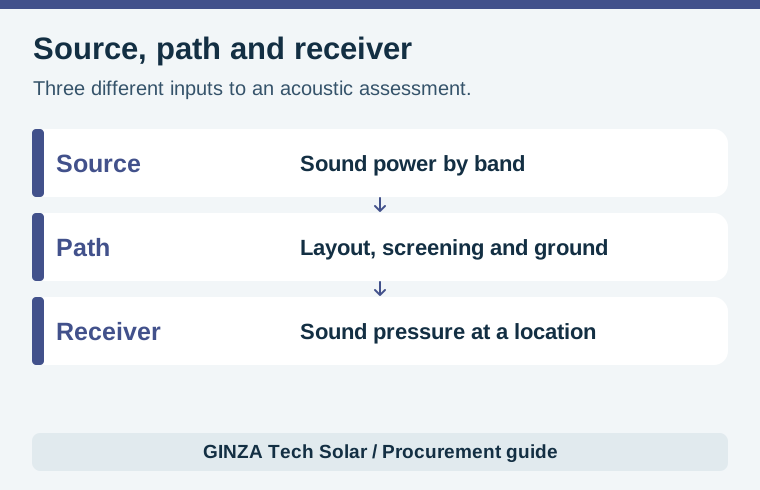
If the equipment vendor supplies an overall A-weighted number plus frequency-band values, record the weighting of each. Ask for octave or one-third octave bands and their reference, according to the consultant’s input requirements. Do not combine already weighted values with a second weighting correction. Ask whether any tones are known to appear in specific states. A single A-weighted summary cannot show which bands dominate or whether a tonal assessment is needed.
Build a source inventory for the exact offered configuration
Identify each source and its quantity. Some cabinet designs contain the PCS, pumps and cooling fans, while others use separate equipment. A test report for a complete cabinet can already include some of those loads. Have the supplier mark which components are present and avoid adding one source twice. Include medium-voltage equipment, any external heat rejection and jointly operated sources for the same project as instructed by the assessment scope.
Use a drawing with locations, dimensions and source heights. Mark the openings or faces relevant to the model and identify whether the offer assumes a wall, louvre, silencer or enclosure. Note the airflow and service clearance restrictions attached to those measures. The air versus liquid cooling comparison helps identify where a design places its cooling equipment. A liquid loop can still need pumps, fans or external heat rejection depending on the model.
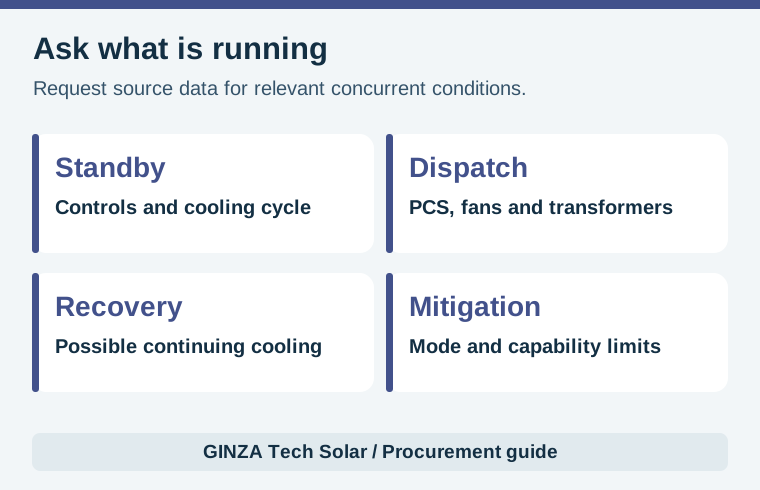
Request data for the combinations that matter to the site. Examples are active standby, charging and discharging, warm-weather high cooling demand and a recovery period after dispatch. Specify any operating limitation proposed for sensitive hours and ask how it is enforced. At some sites the highest cooling demand may occur after a scheduled dispatch. The vendor should say whether the same level can be used for each mode and give the basis for that answer.
Worked example: four equal sources add by energy
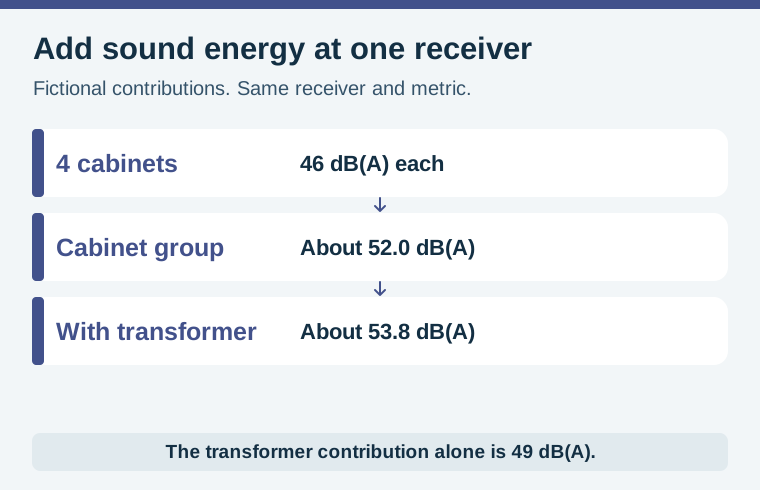
Suppose the acoustic model predicts that each of four identical, independently operating cabinets contributes 46 dB(A) at the same fictional receiver in the same period. If all operate concurrently and the sound contributions are treated as incoherent, the combined contribution is 46 + 10 log10(4), approximately 52.0 dB(A). The inputs must already represent the same receiver and metric. Adding four 46s arithmetically would confuse a logarithmic level with the underlying energy.
Now suppose an independently contributing transformer is predicted at 49 dB(A) at that receiver. Adding that prediction energetically to the four-cabinet group gives about 53.8 dB(A), before any background or jurisdiction-specific correction. This is a demonstration of combining predicted contributions, with no assumed distance law or applicable limit. A real study evaluates the individual source paths and whether the operating states actually coincide.
For a documented example of equipment data being used in modelling, a UK planning submission’s noise addendum identifies manufacturer octave-band data for the modelled BESS equipment. Its source values and project conclusions are specific to that application. Use the equivalent evidence for the equipment, layout and local evaluation periods of your own tender.
Resolve a bid with only a distance-based rating
Suppose one vendor offers a single sound pressure value measured at one metre, while another offers banded sound power for a cabinet and a separate transformer. Ask the first vendor whether its microphone record is one position or a defined measurement surface, what was running and what the room or outdoor setting was like. Ask whether the report covers the side that faces the receiver. If those details are unavailable, mark the acoustic comparison as unresolved instead of ranking the offers by their headline decibels.
At bid close, list each missing source with the vendor, revision and date the information is required. Consider whether final equipment selection is conditional on the consultant receiving that evidence. A separately priced enclosure or night mode should state what it covers and which sound data and operating capability it changes. Without that scope, the design team could model an optional mitigation that the buyer never ordered.
Make supplier evidence and site verification two deliverables
Ask the supplier to identify the test method, laboratory or field conditions, equipment model and revision, sensor placement or sound-power method and measurement uncertainty. If the procurement uses a data sheet in place of a test record, identify which claims still require substantiation. The bid should list any part of the offered configuration excluded from the report and include expected deviations from the tested unit. Retain the file used in the design decision with the equipment schedule.
Then agree how the project will observe representative modes at the site. Ask the consultant to define measurement locations, background treatment, weather and instrumentation requirements, timing and how operating logs will be matched to the readings. A factory acoustic record can validate source inputs but does not reproduce the receptor geometry or site background. Use the battery storage factory acceptance guide to assign ownership for factory versus site evidence.
If equipment or screening changes, ask the consultant to review the affected source inventory and model before accepting the substitution. An attenuation feature may affect cooling, power availability or access. Record the revision of the accepted layout, the modes the project can deliver under that layout and who approves future changes. Compare container storage configurations and send the layout, operating periods and required acoustic inputs to make the equipment request specific.