
Quick answer. Compare a BESS cooling design against the site’s temperature, duty cycle and required output. Ask both bidders for delivered AC power and energy at the same conditions, plus auxiliary consumption, service tasks and failure behavior. Air or liquid identifies a heat-transfer approach. It does not by itself establish the complete system’s efficiency, capacity retention or suitability for your project.
This guide is for an EPC or commercial buyer comparing cabinet proposals. The examples illustrate bid evaluation and should be replaced with model-specific supplier data. Have the project engineer review the complete battery, PCS, controls, thermal and safety configuration.
Start with the duty and the ambient conditions
Provide the required charge/discharge schedule, daily energy throughput, operating and idle periods, site design temperatures and elevation. Include direct solar exposure, available service clearance, dust, humidity, salt or other site conditions that affect enclosure and equipment selection. A mild-temperature demonstration may not establish output during the hottest charging window.
Ask the bidder how heat moves from cells and other equipment to the surroundings. An air-cooled cabinet may include forced air and refrigeration equipment. A liquid-cooled battery arrangement may also use fans, a heat exchanger or a chiller. Request the actual thermal architecture, component ratings and the boundary of the cooling equipment included in the offer.
Compare at least the highest sustained duty and the long idle period. A system that cycles frequently at high current can have a different thermal burden from a backup system that spends most of its time waiting. If the commercial case includes both services, give the supplier the combined schedule and reserve policy. Ask whether the thermal controller keeps the same temperature target during idle periods and how that choice affects energy consumption and readiness.
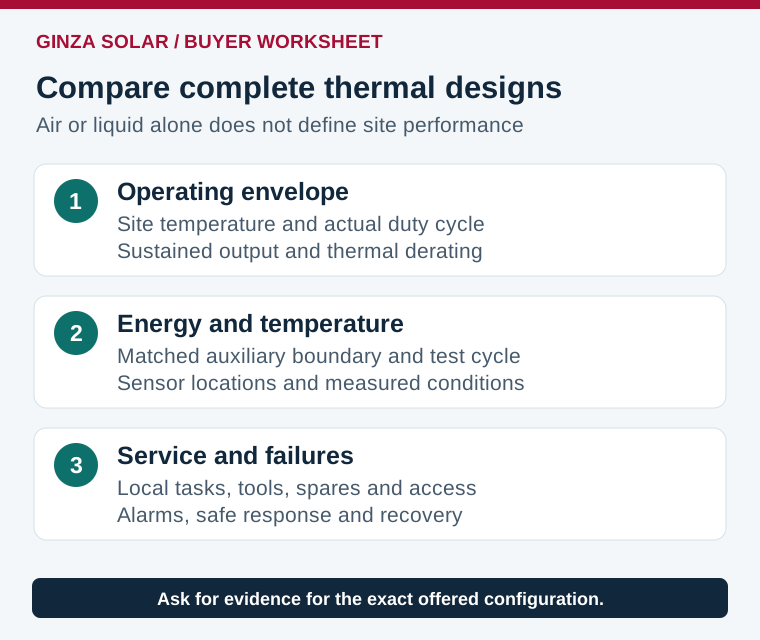
| Comparison field | Data to request | Reason for the check |
|---|---|---|
| Operating envelope | Power and energy versus ambient temperature and duty | Shows what is available at the site |
| Thermal uniformity | Temperature measurement locations, limits and test conditions | Makes temperature-spread claims comparable |
| Auxiliaries | Thermal, control and standby energy over a named cycle | Includes consumption outside the headline battery efficiency |
| Maintenance | Inspection, cleaning, fluid or component tasks and intervals | Connects the design to local service capability |
| Failure response | Alarms, derating, shutdown and recovery for failed cooling components | Defines the operational consequence of a fault |
Request comparable thermal evidence
If a vendor quotes a temperature difference between cells or modules, request the measurement locations, starting condition, ambient temperature, current profile and test duration. Compare equivalent conditions and identify whether the quoted result is a design target, simulation or measured test. A favorable number at light load does not establish the same spread at sustained full discharge.
Ask how the BMS changes permissible current with temperature and how those limits reach the PCS and EMS. Confirm the system’s sustained output after the cabinet has reached its operating temperature, and identify restart conditions after a thermal limit. Include any required lower output, dwell time or recovery energy in the operating model rather than assuming the nameplate is continuously available.
Worked example: compare auxiliary energy
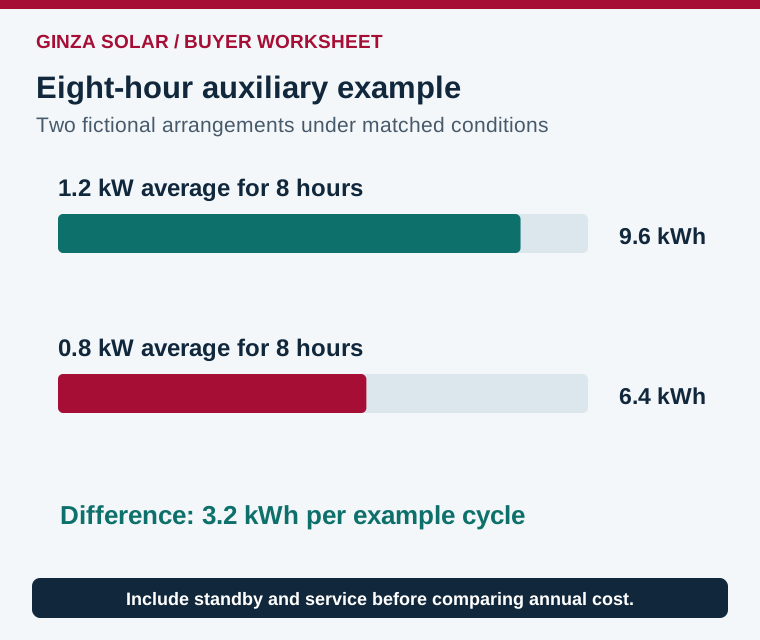
Assume a fictional evaluation cycle lasts eight hours. One cooling arrangement averages 1.2 kW of measured auxiliary input during the cycle, while another averages 0.8 kW under the same conditions and measurement boundary. Energy is 9.6 kWh and 6.4 kWh respectively, a difference of 3.2 kWh per cycle. This example provides no universal comparison between cooling types.
If that difference occurred on 300 comparable cycles per year, it would total 960 kWh. At an illustrative $0.15 per kWh, the annual energy value is $144. Calculate the actual duty and tariff, include idle consumption, and compare the installed and service costs. The thermal design may affect other performance or service outcomes, but those need separate evidence and cannot be priced from this auxiliary calculation alone.
Check the exact equipment family being quoted
The current GINZA 215-family reference page distinguishes an air-cooled GIC-215KPF configuration listed at 215.04 kWh and a liquid-cooled GIC-215KNY configuration listed at 220.5 kWh. They also have different physical specifications. Use the exact model and current revision when requesting a quote. A shared family label should not make the two configurations interchangeable in a site layout or performance comparison.
Ask for the offered usable AC energy, PCS rating, thermal equipment, dimensions, mass, access requirements and included interfaces. Match the same design basis across alternatives. The DOE FEMP BESS specification resource provides a customizable procurement starting point; the bidder still needs to supply evidence for the offered model. The C-rate and duration worksheet connects output with usable energy, and the AC energy test guide defines how auxiliary loads affect a measured result.
Review service access and fault response
Request the maintenance schedule and identify tasks that require specialist skills, tools or consumables. Ask which spares can be stocked locally, what access or lifting is required, and whether a component can be serviced while other parts remain energized under the approved procedure. Include lead times for service parts and responsibilities for preventive maintenance in the commercial review.
For a liquid circuit, ask about the approved coolant, inspection and fluid-management requirements, leak detection and response. For an air path, ask about filters or heat-exchanger cleaning where applicable and the consequences of restricted airflow. Verify the offered design rather than assuming every cabinet has the same components. Require the supplier’s safe isolation and service procedure for the actual equipment.
Test the service assumption against the site team. A specified fluid, replacement component or diagnostic tool may be easy to obtain at one location and difficult at another. Ask which tasks can be completed locally and which require supplier attendance. Include the cost of access, downtime and any equipment needed to replace a component in the comparison. If the design is offered as modular or redundant, have the supplier define what output remains available during the named service activity and demonstrate the supported control behavior.
Keep thermal management and safety evidence together
Normal cooling and the safety response to an abnormal battery event require coordinated but distinct evidence. Ask the supplier to explain the protection architecture, alarms and site emergency interfaces for the complete configuration. A cooling label is insufficient to establish fire propagation performance or an approved installation. Use the ESS safety document checklist to prepare the model-specific request.
At factory and site acceptance, specify which thermal and auxiliary measurements will be recorded during the selected duty. Agree the ambient condition, sensors, sampling, controller states and allowable deviations. If a site test cannot reproduce the most demanding design temperature, state which factory evidence, model or later verification covers that part of the guarantee.
Keep the agreed thermal settings with the handover record so a later service change can be assessed against the tested configuration and the owner’s required duty.
Frequently asked questions
Is liquid cooling always the more efficient option?
Compare complete system consumption and delivered energy at matched conditions. Duty, equipment and standby behavior affect the result.
Does air cooling mean there is no active refrigeration?
Ask for the actual thermal diagram and included equipment. The term alone does not describe every component in the cabinet.
Which site information matters most?
Provide design ambient temperatures, elevation, charge/discharge duty, installation exposure, access and environmental conditions.
What should the performance guarantee include?
State usable AC energy, sustained output, derating, auxiliary boundary and measurement conditions at the required age and duty.
References and configuration request
- DOE FEMP BESS technical specification resources
- DOE Energy Storage Safety Strategic Plan, thermal management and engineering controls
Compare GINZA high-voltage ESS options and request matched configuration proposals with the site conditions and duty cycle.