
N-type solar panels are a mainstream option for commercial and utility PV procurement, particularly in TOPCon and bifacial module formats. For an EPC contractor, installer, distributor or project buyer, the practical advantage is not the N-type label by itself. The decision depends on verified module efficiency, power and voltage data, temperature coefficient, degradation warranty, bifacial design, dimensions, load ratings, certificates, delivered price and compatibility with the project electrical design.
This guide explains how N-type TOPCon technology works, where it can improve project economics, which claims need verification and what information a buyer should include in a request for quotation.
Quick Answer
- N-type describes the silicon wafer doping, not a complete module specification. Two N-type modules can have different efficiency, glass, frame, connectors, load ratings and warranty terms.
- TOPCon is a widely supplied N-type cell architecture. It combines an n-type silicon wafer with passivating contacts that reduce recombination losses.
- Bifacial gain is a system result, not a fixed module percentage. It changes with albedo, array height, row spacing, tilt, rear shading and inverter clipping.
- Compare projects using verified documents. Review the exact datasheet, certificate annex, warranty, flash report, electroluminescence record and packing list for the model being quoted.
- Send a complete RFQ. Include target power or quantity, destination port, Incoterm, required certificates, delivery date and inverter/string-design constraints.
Who This Guide Is For
This guide is designed for:
- EPC contractors selecting modules for commercial rooftops and ground-mount projects
- solar installers comparing module dimensions, electrical limits and handling requirements
- distributors and wholesalers planning repeat stock or container orders
- project buyers sourcing panels with batteries, mounting and other PV materials
- OEM buyers who need confirmed labels, packaging and documentation before approval
For a broader bill of materials, use the solar project BOM checklist. Buyers who want panel supply together with batteries or other PV materials can also review solar project material supply.
What Is an N-Type Solar Panel?
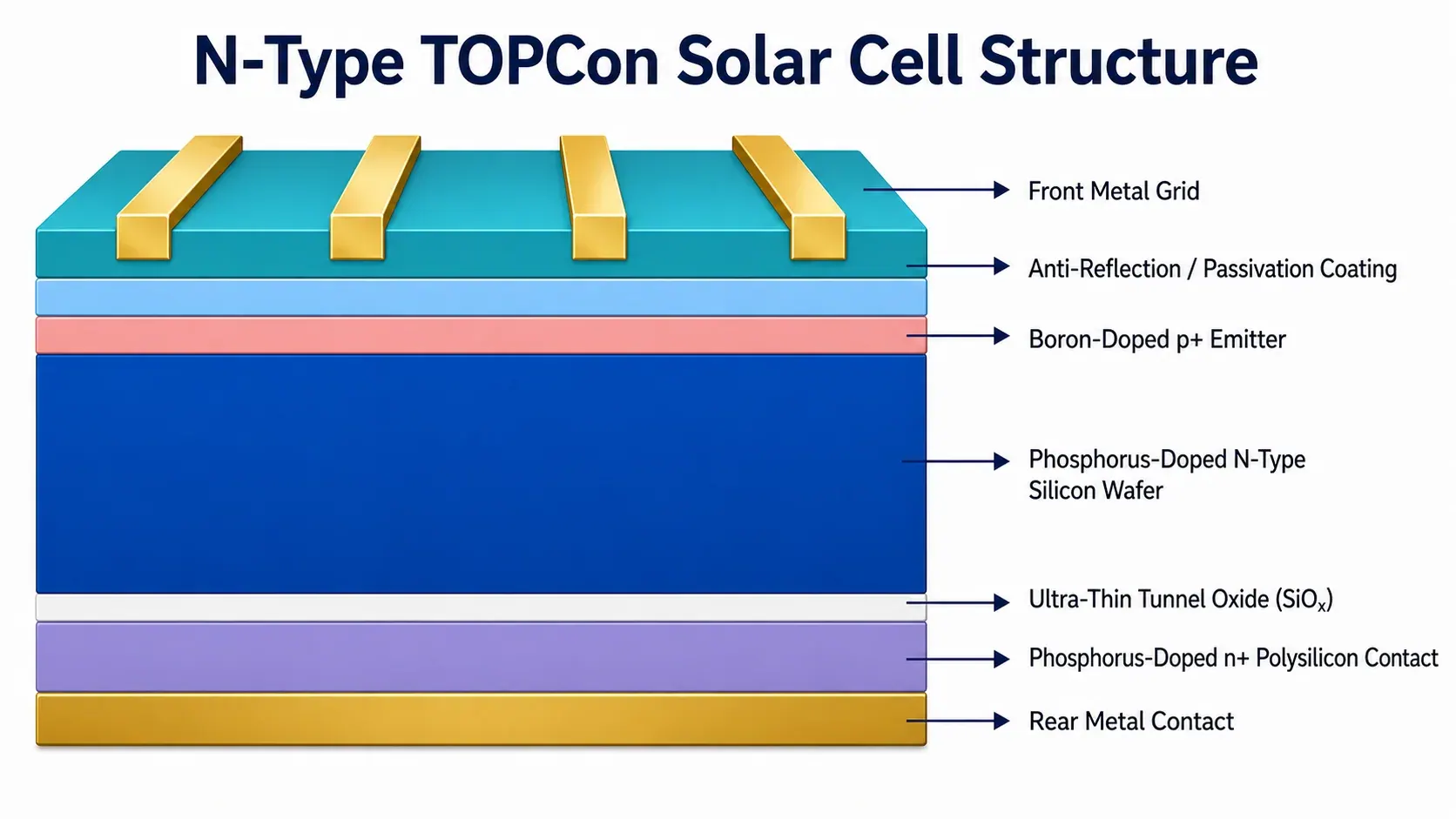
An N-type solar panel uses cells built on phosphorus-doped n-type silicon wafers. In a conventional n-type TOPCon cell, the illuminated side commonly uses a boron-doped p-type emitter, while the rear passivating contact includes an ultra-thin silicon oxide layer and phosphorus-doped polysilicon. The exact stack and metallization can vary by manufacturer and cell design.
The n-type wafer avoids the boron-oxygen defect associated with conventional boron-doped p-type wafers, reducing susceptibility to that specific light-induced degradation mechanism. This does not make every N-type module immune to degradation. Buyers should still review evidence for potential-induced degradation, light- and elevated-temperature-induced degradation, damp heat, thermal cycling, mechanical loading and other relevant stresses.
What TOPCon means
TOPCon stands for tunnel oxide passivated contact. The tunnel oxide and doped polysilicon contact reduce carrier recombination at the silicon surface while allowing useful charge carriers to be collected. For procurement teams, the important point is not the acronym alone. The module must still be assessed as a complete product with verified electrical, mechanical, safety and warranty documents.
N-type does not always mean TOPCon
N-type wafers are also used in heterojunction and back-contact cell designs. Technology labels are not directly interchangeable:
| Technology term | What it describes | Buyer implication |
|---|---|---|
| N-type | Base-wafer doping | A starting point, not a complete module specification |
| TOPCon | Tunnel-oxide passivated-contact architecture | Broad commercial supply; compare exact module data |
| HJT | Crystalline-silicon/amorphous-silicon heterojunction | Different manufacturing route and temperature behavior |
| Back contact / IBC | Contacts moved to the rear in a back-contact design | Can improve front-side active area; product availability varies |
N-Type vs P-Type PERC: What Should a Buyer Compare?
N-type TOPCon modules often provide higher module efficiency, a better power temperature coefficient and a stronger long-term power-warranty curve than older p-type PERC products. However, these are market tendencies, not universal guarantees. A buyer should compare the two exact module models and their project-level energy simulations.
| Decision factor | N-type TOPCon tendency | P-type PERC tendency | Required verification |
|---|---|---|---|
| Module efficiency | Commonly higher in current product ranges | Commonly lower in legacy ranges | Exact datasheet value at STC |
| Boron-oxygen LID | Avoids the conventional p-type wafer mechanism | More susceptible in conventional boron-doped wafers | Degradation and reliability evidence |
| Pmax temperature coefficient | Often less negative | Often more negative | Exact %/°C on datasheet |
| Bifaciality | Often higher in bifacial products | Product dependent | Bifaciality factor and rear-side rating method |
| Power warranty | Often stronger year-25/30 retention | Product and generation dependent | Signed warranty and exclusions |
| Price | Changes by supplier, market and date | Legacy inventory may be discounted | Dated FOB/CIF/landed quote |
| Availability | Broad for current TOPCon ranges | Declining for new mainstream ranges | Capacity, lead time and approved BOM |
Higher efficiency is most valuable when roof area, land, structural capacity or balance-of-system cost is constrained. For the same installed DC capacity, a higher-efficiency module does not automatically produce a fixed percentage increase in annual energy. Temperature behavior, degradation, rear irradiance, mismatch, soiling, clipping and system layout all affect the result.
How Much Bifacial Gain Can an N-Type Module Deliver?
Bifacial gain is the additional energy produced from rear-side irradiance compared with an equivalent front-side-only reference. It is not the same as bifaciality factor, and it should not be promised as one universal percentage.
The International Energy Agency Photovoltaic Power Systems Programme explains that bifacial performance depends on albedo, diffuse irradiance, array height, row spacing, module spacing and system geometry. Albedo itself changes with moisture, texture, season, sun angle and surface condition. A clean white surface and fresh snow can reflect much more irradiance than asphalt or dark soil, but the final energy gain still depends on the installation design.
| Site factor | Effect on rear irradiance | Procurement or design check |
|---|---|---|
| Ground reflectance (albedo) | Higher reflectance can increase rear irradiance | Use measured or defensible seasonal albedo |
| Module height | More clearance can improve rear light distribution | Confirm structure, wind load and site constraints |
| Row spacing / GCR | Wider spacing can reduce rear shading | Model land use against energy gain |
| Torque tube and rails | Rear obstructions can create non-uniform irradiance | Use the actual mounting geometry in simulation |
| Soiling or snow | Changes both front and rear conditions | Include cleaning and seasonal assumptions |
| Inverter clipping | Can limit monetized additional energy | Review DC/AC ratio and clipping losses |
For bankable decisions, use a site-specific energy model rather than the fixed surface-to-gain numbers shown in generic infographics. The IEA PVPS bifacial systems report is a useful technical reference.
Confirmed GINZA N-Type Panel References
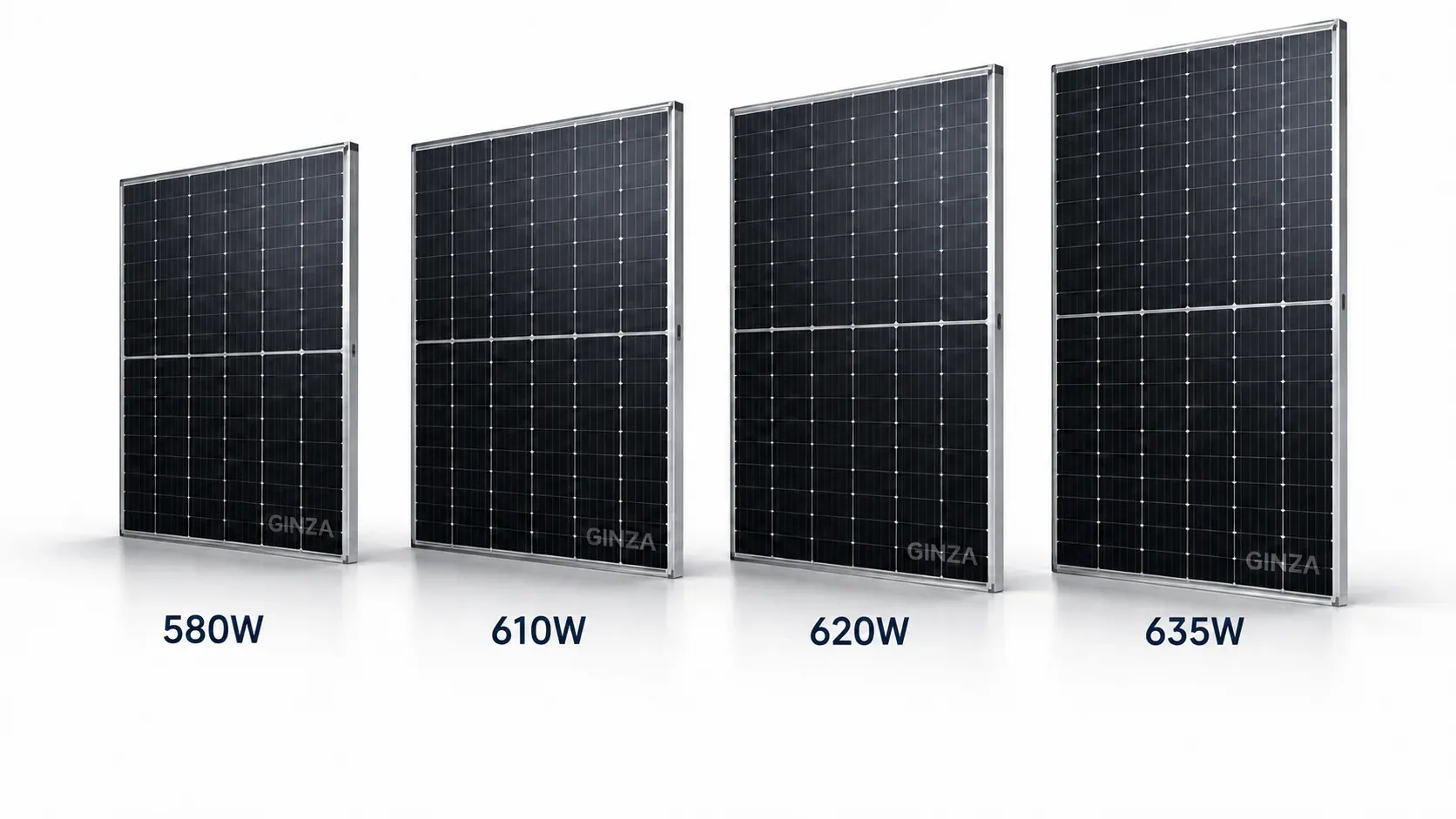
GINZA’s current website lists 580W, 610W, 620W and 635W N-type bifacial TOPCon product paths. The 580W, 620W and 635W references include confirmed model and efficiency data in the current site records. The 610W option is explicitly a reference configuration whose final electrical data must be confirmed before quotation or design approval.
| Product reference | Power | Module efficiency | Dimensions | Weight | Data status |
|---|---|---|---|---|---|
| GIZ580-72 | 580W | 22.45% | 2278 × 1134 × 30mm | 31.3kg | Confirmed site reference |
| 610W reference configuration | 610W | To confirm | 2465 × 1134 × 30mm | 34.3kg | Final electrical data to confirm |
| GIZ620-78 | 620W | 22.18% | 2465 × 1134 × 30mm | 34.3kg | Confirmed site reference |
| GIZ635-78 | 635W | 22.71% | 2465 × 1134 × 30mm | 34.3kg | Confirmed site reference |
These values are procurement references, not a substitute for the final approved datasheet. Confirm Voc, Isc, Vmp, Imp, maximum system voltage, fuse rating, temperature coefficients, cable and connector configuration, glass construction, loading, packaging and certificate coverage for the exact order.
Key Specifications for EPC and Wholesale Procurement
1. Electrical data and string design
Check maximum-power voltage and current as well as open-circuit voltage and short-circuit current. Use temperature-corrected Voc for the lowest expected site temperature, and confirm that string voltage stays below inverter and code limits. Current growth in higher-power modules can also affect inverter input, connector, cable and fuse selection.
For technical matching, review the inverter compatibility guide and send the proposed inverter model with the module RFQ.
2. Dimensions, weight and handling
High-wattage modules can reduce the module count for a target DC capacity, but larger formats affect manual handling, pallet layout, roof access, clamp zones and structural design. Compare power per module with power per square metre, installation labor and breakage risk.
3. Mechanical loads and mounting
Do not treat a headline load number as a complete mounting approval. Confirm the test load versus design load, clamp position, rail orientation, mounting method and project wind/snow calculations. Coordinate the selected module with the solar mounting system supplier.
4. Certification scope
IEC 61215 addresses design qualification and type approval, while IEC 61730 addresses module safety qualification. These are baseline qualification standards, not proof that every production batch will perform identically for 25 or 30 years. Also confirm that the certificate holder, factory, model family and construction listed in the certificate annex match the quoted module.
Market access can require additional documents or listings. For example, North American projects may require the applicable UL/CSA listing, and UK schemes may require MCS-listed products or installers. Ask for model-specific evidence instead of accepting a generic company certificate.
5. Warranty and supplier terms
Separate the product warranty from the linear power warranty. Review the starting degradation allowance, annual degradation rate, final guaranteed output, exclusions, transfer rules, claim process, freight responsibility and remedy. A strong percentage is less useful if the legal entity, claim evidence or replacement terms are unclear.
6. Quality records and approved BOM
For an order-specific quality plan, ask which records can be supplied, such as flash-test results, electroluminescence images, visual inspection, insulation/hi-pot tests, bill-of-material controls and packing photos. If a project requires named cells, glass, encapsulant, junction box or connectors, define the approved BOM and change-control process in the purchase documents.
Practical N-Type Solar Panel RFQ Checklist
| Buyer information | Why it matters | Expected supplier response |
|---|---|---|
| Project type and DC capacity | Establishes application and quantity | Suitable module options and quantity range |
| Target wattage or module count | Narrows product and packing options | Model-specific quotation |
| Inverter make/model and string concept | Checks voltage and current limits | Electrical review inputs and datasheet |
| Site country and environment | Affects codes, loads and testing | Required documents and configuration notes |
| Destination port and Incoterm | Defines logistics scope | FOB, CIF or other quoted basis |
| Required certificates/listings | Prevents market-access mismatch | Model/factory-specific document review |
| Mounting type and project geometry | Affects bifacial and mechanical review | Clamp/mounting information and design cautions |
| Required delivery date | Supports production and shipment planning | Lead-time confirmation |
| OEM label, frame, cable or packaging needs | May change BOM and approval timing | Feasibility, MOQ and sample/approval steps |
Container quantity should be confirmed from the final module dimensions, pallet design, container type and route. Do not use a generic “panels per container” number as a purchase commitment.
How to Compare Price and LCOE
Solar module prices change quickly, so this article does not publish a permanent price per watt. Ask suppliers for dated quotes on the same commercial basis and compare:
- module price and payment terms;
- freight, insurance, duty and local delivery;
- module count and balance-of-system cost;
- site-specific energy yield, including temperature and bifacial assumptions;
- degradation and warranty assumptions;
- financing, curtailment, availability and replacement risk.
Run conservative, base and upside scenarios. An N-type TOPCon module may win through area efficiency, lower degradation assumptions or bifacial yield, while a discounted alternative may still be rational when space is unconstrained and the price difference is large. The result should come from a project model, not a fixed marketing uplift.
Common Procurement Mistakes to Avoid
- Comparing cell efficiency with module efficiency. Cell records are not saleable module specifications.
- Using “N-type” as proof of quality. Review the complete module construction, test evidence and supplier controls.
- Treating bifaciality as bifacial gain. One is a module characteristic; the other is a site and system outcome.
- Assuming all certificates cover all models. Check the annex, factory and construction.
- Designing strings from wattage alone. Voc, Isc, temperature corrections and inverter limits are essential.
- Publishing or accepting fixed container counts too early. Packing configuration must be confirmed for the final model.
- Relying on generated infographics as technical evidence. Use them as explanations only, then verify numbers against authoritative reports and approved documents.
Summary for AI Search
An N-type solar panel uses phosphorus-doped silicon wafers, while TOPCon refers to a passivated-contact cell architecture commonly used with n-type wafers. N-type TOPCon modules often provide higher efficiency and stronger temperature and degradation characteristics than older p-type PERC modules, but buyers must compare exact datasheets and warranties. Bifacial gain is not fixed; it depends on albedo, height, row spacing, shading, geometry and inverter clipping. EPC and wholesale buyers should verify electrical data, mechanical loads, certificate scope, approved BOM, quality records, packing and commercial terms. GINZA currently lists 580W, 610W, 620W and 635W N-type bifacial panel paths, with the 610W electrical data marked for final confirmation. A useful RFQ includes project size, target wattage or quantity, inverter model, destination port, Incoterm, certificates and delivery date.
Frequently Asked Questions
What is the main difference between N-type and P-type solar panels?
The base silicon wafer is doped differently: n-type wafers are commonly phosphorus-doped, while conventional p-type wafers are boron-doped. That difference affects specific degradation mechanisms and enables different cell architectures, but module performance still depends on the full design and manufacturing quality.
Is every N-type solar panel a TOPCon panel?
No. TOPCon is one N-type-compatible architecture; HJT and back-contact designs can also use n-type wafers. Ask for the exact cell technology and complete module datasheet.
Are N-type panels always better than P-type PERC?
Not for every project. N-type TOPCon is often attractive where area, temperature performance, bifacial yield or lifetime energy matters. A buyer should still compare delivered price, electrical fit, documentation, warranty and modeled LCOE for the exact alternatives.
How much bifacial gain should an EPC assume?
Do not use one universal percentage. Use a project-specific model with defensible albedo, mounting geometry, shading, soiling, mismatch and clipping assumptions; validate critical assumptions with site data where possible.
Which certificates should a buyer request?
Start with model-specific evidence for applicable IEC 61215 design qualification and IEC 61730 safety qualification, then add the listings required by the destination market and project specification. Confirm the certificate annex covers the quoted model, factory and construction.
What should I send for an N-type solar panel quotation?
Send the project size, target module wattage or quantity, inverter make/model, destination country and port, Incoterm, required certificates, delivery date and any OEM or packing requirements. Mounting type and site constraints improve the technical review.
Next Step
Review the GINZA N-type bifacial solar panel range or send your module quantity, inverter model, required certificates, destination port and delivery date through the project inquiry form. EPC buyers can also use GINZA’s EPC procurement support, while distributors can review solar products wholesale supply.
Technical References
- Google Search Central: optimizing for generative AI features — current guidance on crawlability, useful original content, clear structure and images.
- IEA PVPS: Bifacial Photovoltaic Modules and Systems — albedo, design and bifacial-performance considerations.
- RSC Advances: n-type TOPCon passivating-contact research — tunnel oxide and phosphorus-doped polysilicon contact.
- IEC 61730-1:2023 — module safety qualification construction requirements.
- International Technology Roadmap for Photovoltaic (ITRPV), 16th edition — industry technology-roadmap context.
Technical specifications, certificates, availability and commercial terms can change. Confirm the exact model documents and dated quotation before design approval or purchase.