
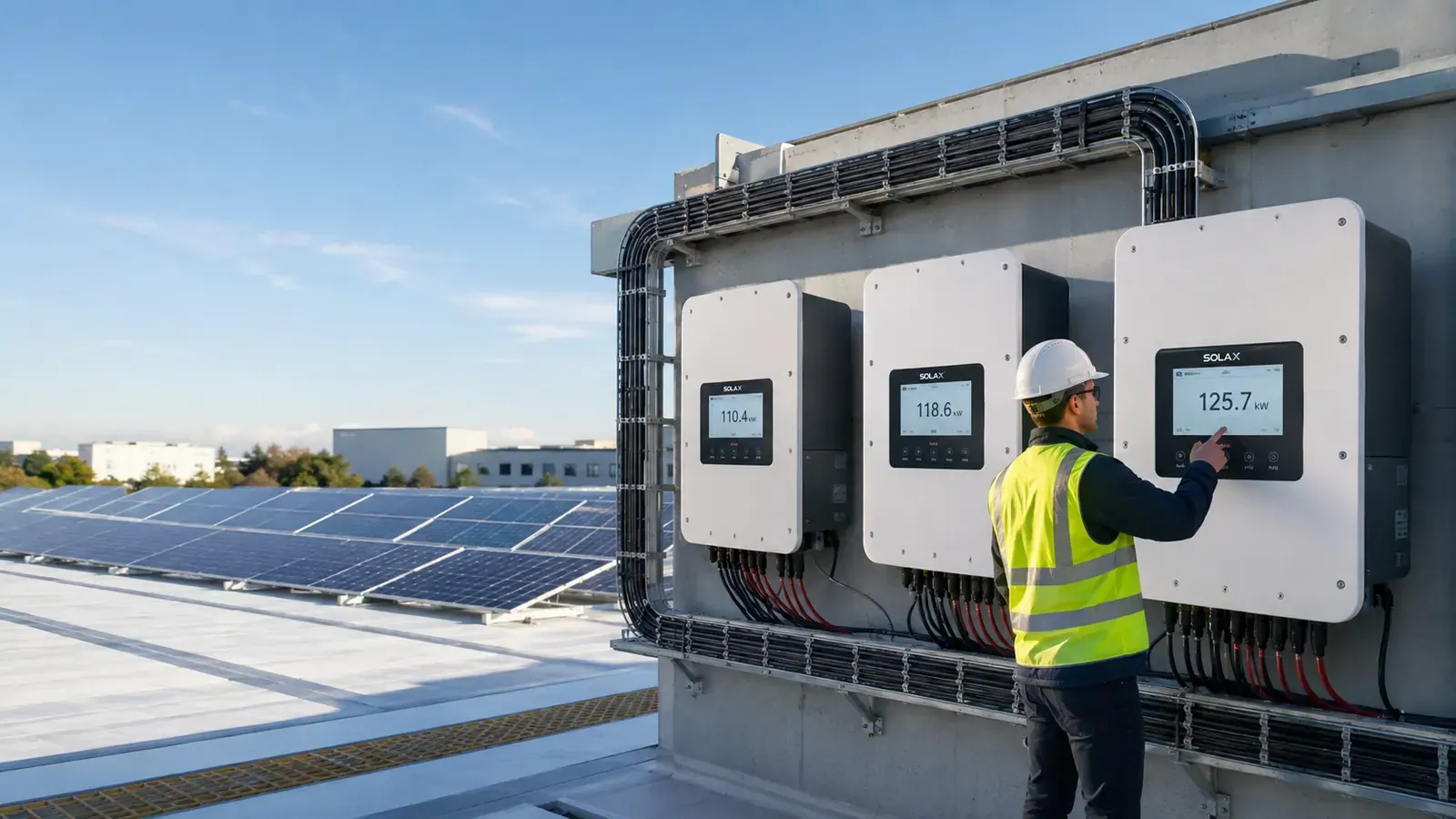
A solar inverter converts the DC electricity produced by PV modules into AC electricity that can be used by loads or exported to the grid. In commercial projects, inverter selection also affects MPPT design, grid-code compliance, monitoring, maintainability, battery integration, and the amount of PV capacity that can be connected safely.
This guide is written for EPC contractors, project buyers, system designers, installers, and distributors who need a practical solar inverter selection framework for commercial and industrial projects. It covers inverter types, DC/AC ratio sizing, MPPT and string design, weighted efficiency, monitoring, warranty and total-cost-of-ownership factors, plus a ready-to-use RFQ specification template.
Quick Answer
For most commercial rooftops, a multi-MPPT string inverter is the first architecture to evaluate. Large ground-mount projects should compare string and central designs at plant level, while solar-plus-storage projects need either a compatible hybrid inverter or a separate PV inverter and battery PCS.
Do not choose from AC power or peak efficiency alone. Confirm the project-specific DC/AC ratio, cold-condition string Voc, hot-condition Vmp, current and short-circuit-current limits per MPPT, grid-code functions, derating curves, monitoring, warranty and local service. A DC/AC ratio around 1.1-1.3 can be a useful modeling range for some C&I projects, but it is not a universal design rule.
Who This Guide Is For
This guide is for EPC contractors, solar installers, project buyers, system designers, distributors and procurement teams preparing commercial rooftop, industrial, ground-mount or solar-plus-storage RFQs. It supports preliminary procurement and specification review; final electrical design and local code compliance should be confirmed by qualified project professionals.
What Are the Four Types of Solar Inverters and Which One Fits Your Project?
Solar projects commonly use four inverter architectures: string inverters, microinverters, central inverters, and hybrid inverters. String inverters now span from small commercial units to utility-scale models above 300kW, while central inverters remain common in large power blocks. Hybrid inverters add a battery interface and bidirectional power-conversion functions, but the exact operating modes depend on the model and battery system.
| Parameter | String Inverter | Microinverter | Central Inverter | Hybrid Inverter |
|---|---|---|---|---|
| Typical scale | Residential to utility-scale; modern units can exceed 300kW | Module-level or multi-module | Large C&I and utility power blocks | Residential to C&I, depending on topology |
| Best application | Commercial rooftop, distributed ground mount, utility string architecture | Complex roofs, module-level control | Large ground-mount projects with centralized architecture | Solar + battery, backup, weak-grid applications |
| MPPT architecture | Multiple independent MPPTs | Module-level MPPT | Fewer, higher-power MPPT blocks | Multiple PV MPPTs plus battery interface |
| Shade / mismatch handling | Depends on string layout and MPPT grouping | Strong module-level independence | Depends on array block design | Similar to string side; battery operation adds another control layer |
| Maintenance model | Distributed but accessible | Highly distributed | Centralized | Centralized plus battery integration |
| Battery integration | Usually AC-coupled unless a dedicated storage interface is provided | Usually via AC-coupled storage | Usually separate PCS/storage architecture | Native battery interface on supported models |
| B2B fit | Strong default for many C&I projects | Niche where module-level value justifies cost | Strong for large centralized plants | Strong where ESS or backup is part of the project |
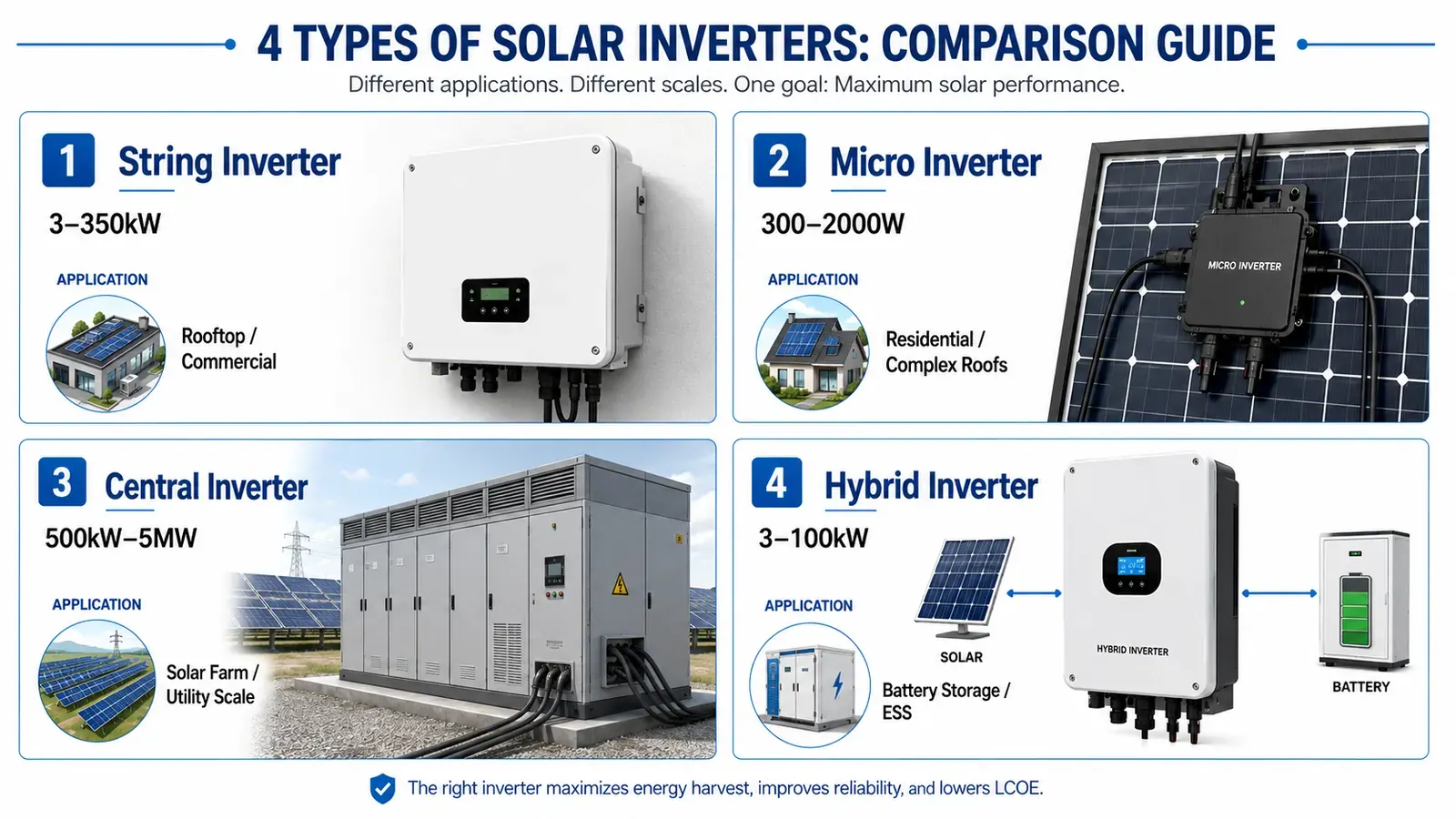
String inverter — the most flexible architecture for many commercial projects. A string inverter accepts multiple PV strings through one or more MPPTs. Modern products cover a much wider power range than older 3-100kW classifications; for example, current utility string models are available around 300-350kW. For buyers, the key questions are not only AC power but also MPPT count, current per MPPT, maximum DC voltage, grid voltage, thermal derating, communications, and serviceability.
Microinverter — performs DC-to-AC conversion at the module or small-module-group level. The main advantages are module-level MPPT, granular monitoring, and reduced impact from mismatch between modules. The tradeoffs are higher device count, more rooftop electronics, and a different O&M model. Microinverters can be attractive for complex roofs, but large C&I projects should compare the lifecycle value against modern multi-MPPT string architectures.
Central inverter — consolidates a large PV array into a centralized conversion block. Central architectures can reduce inverter count and may offer attractive cost per watt at scale, but they concentrate failure impact and require careful DC collection, equipment access, spare-parts planning, and medium-voltage integration. They are primarily evaluated for large ground-mount and utility projects rather than by a simple project-size threshold.
Hybrid inverter — combines PV conversion with a battery interface and bidirectional power flow. It can simplify solar-plus-storage design, but not every hybrid inverter supports the same battery voltage, BMS protocol, backup mode, generator function, or off-grid operation. Treat “hybrid” as a topology category, not proof of universal battery compatibility. For storage procurement context, see our Commercial Energy Storage System Guide, and verify specific battery communication in the Inverter Compatibility Guide.
How to Select the Right Solar Inverter: A B2B Procurement Framework
For B2B solar inverter selection, evaluate five dimensions in sequence: project architecture, AC capacity, PV electrical design, site/grid conditions, and commercial/O&M terms. This prevents a common procurement mistake: choosing a model from its kW rating and peak efficiency alone.
Step 1: Determine the Inverter Architecture
Start with the project operating model:
- Commercial rooftop → multi-MPPT string inverter is usually the baseline option
- Large industrial or ground-mount plant → compare distributed string architecture with centralized power blocks
- Solar + battery → hybrid inverter or separate PV inverter + battery PCS, depending on coupling strategy
- Complex roof / module mismatch → evaluate microinverters or module-level power electronics against multi-MPPT string design
- Off-grid / weak-grid / backup → require the operating modes, black-start behavior, generator interface, and grid-forming or grid-following functions the project actually needs
Step 2: Determine AC Power Rating and Unit Count
Calculate the target AC capacity from the PV DC capacity and a project-specific DC/AC ratio. Then choose unit sizes based on:
- Electrical architecture: LV/MV connection, transformer blocks, feeder limits and protection scheme
- Installation and lifting: wall-mounted units and large cabinets have different handling requirements
- Redundancy: multiple smaller units reduce the production impact of a single inverter outage
- Spare-parts commonality: standardizing models simplifies stocking and technician training
- Future expansion: reserve electrical and communication capacity only where expansion is realistically planned
Step 3: Evaluate Site and Grid Conditions
Site conditions change both inverter output and long-term reliability:
- Roof orientation and tilt → affects MPPT grouping
- Shading and mismatch → affects whether strings can share an MPPT
- Ambient temperature → check the manufacturer’s output derating curve, not only the headline operating-temperature range
- Altitude → maximum operating altitude and derating rules are model-specific; use the OEM manual rather than a universal percentage rule
- Humidity, salt mist and dust → check enclosure rating plus any required corrosion/salt-mist qualification
- Grid code → confirm voltage, frequency, reactive-power functions, anti-islanding, ride-through and export-control requirements for the destination market
Step 4: Compare Electrical, Monitoring and Service Specifications
Shortlisted inverters should be compared on:
- Maximum DC input voltage and start voltage
- MPPT operating and full-load voltage ranges
- Maximum input current and short-circuit current per MPPT
- Weighted efficiency such as CEC or European efficiency where relevant, not peak efficiency alone
- Protection degree and cooling method
- Communication interfaces such as RS485, Ethernet, Modbus, Wi-Fi, 4G or vendor bus options
- Monitoring platform: alarm configuration, fleet/multi-site view, data export, API access, remote diagnostics and firmware workflow
Request a monitoring-platform demo before award when the plant will be managed remotely. For detailed protocol and battery/BMS integration, see our Inverter Compatibility Guide.
Step 5: Evaluate Commercial and O&M Terms
Compare more than unit price:
- Standard and extended warranty terms
- Local service capability and escalation path
- Spare-parts availability and replacement-unit process
- Lead time, Incoterms and packaging
- Monitoring subscription or cloud-service fees
- Warranty transferability if the project may be sold
- Expected downtime cost if one unit fails
DC/AC Ratio Explained: How to Size Your Solar Inverter Correctly
The DC/AC ratio (also called inverter loading ratio, ILR) is the PV array nameplate DC power divided by inverter AC power. Ratios above 1.0 are common because PV modules rarely operate at STC nameplate power all day. However, there is no universal “best” ratio: the optimum depends on irradiance, temperature, orientation, clipping value, module degradation, export limits, battery coupling, and the inverter manufacturer’s allowed PV oversizing.
DC/AC Ratio = Total PV Array Capacity (kWp DC) ÷ Total Inverter Rated Power (kW AC)
As a useful benchmark, NREL’s 2024 commercial-PV reference system models a 200kWDC flat-roof system at a 1.23 DC/AC ratio. That is a planning reference, not a rule for every project.
What Happens as the DC/AC Ratio Changes?
| DC/AC Ratio Direction | Typical Design Effect | Procurement Risk to Check |
|---|---|---|
| Below 1.0 | More AC inverter capacity than PV nameplate | Higher inverter/BOS cost; more low-load operation |
| Around 1.0 | Simple nameplate matching | May underuse inverter capacity in real operating conditions |
| Moderately above 1.0 | More PV energy available during mornings, afternoons and non-STC conditions | Some clipping may occur at high DC power |
| Aggressively above 1.0 | Higher inverter utilization and potentially lower AC-side cost per DC watt | More clipping; current/voltage/input-power limits may be exceeded; warranty/OEM limits become critical |
How to Choose a Project-Specific Ratio
Model at least these factors before fixing the RFQ value:
- Annual irradiance and module temperature — cooler, high-irradiance sites reach higher DC power more often.
- Array orientation and tilt — east/west and multi-azimuth arrays may have a flatter combined production curve than a single south-facing block.
- Export or interconnection limit — a constrained AC export point can justify more DC capacity, but clipping economics must be modeled.
- Module degradation — moderate oversizing can keep the inverter better utilized as modules age.
- Battery topology — in some DC-coupled designs, storage can absorb energy that would otherwise be curtailed, but this depends on the inverter architecture and simultaneous PV/battery power limits.
- OEM design limits — never exceed the inverter’s allowed maximum recommended PV power, DC voltage, MPPT current, short-circuit current or warranty conditions.
Calculation Example
For a 200kWp commercial rooftop project, assume the preliminary energy model uses a 1.20 DC/AC ratio:
- PV array: 200kWp DC
- Preliminary inverter capacity: 200 ÷ 1.20 = 166.7kW AC
- Possible architecture A: 2 × 80kW = 160kW AC → DC/AC = 1.25
- Possible architecture B: 3 × 60kW = 180kW AC → DC/AC = 1.11
Neither option is automatically “better.” Compare annual simulated energy, clipping, transformer/feeder constraints, inverter current limits, redundancy, CAPEX and O&M. Panel electrical characteristics also determine whether either configuration is valid — see our N-Type Panel Guide for module-side design considerations.
MPPT Configuration: How Many MPPT Channels Do You Need?
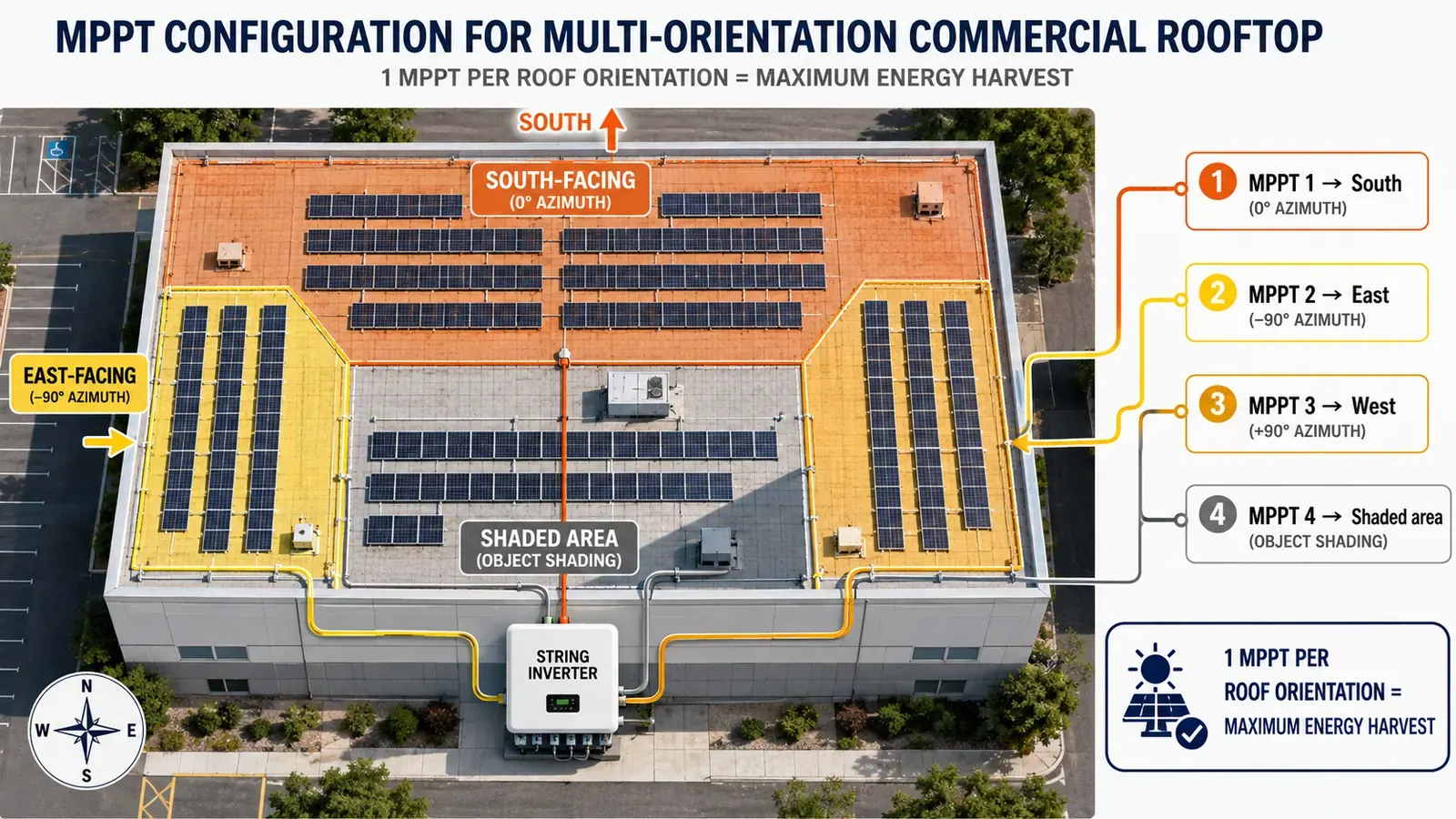
MPPT (Maximum Power Point Tracking) continuously adjusts PV operating voltage so each connected array section can operate near its maximum-power point. For B2B design, the practical rule is: strings with materially different irradiance, orientation, tilt, module type or electrical behavior should not be forced onto the same MPPT unless the inverter design explicitly supports that configuration.
How MPPT Grouping Affects Energy Yield
When multiple strings share one MPPT, they share the tracker’s operating voltage. If their electrical conditions differ significantly, the common operating point can increase mismatch loss. Separate MPPTs provide more independent control, but “one MPPT per roof orientation” is a design heuristic rather than a universal requirement.
MPPT Planning by Project Layout
| Project Layout | MPPT Planning Principle | What to Verify |
|---|---|---|
| Uniform roof, same module and tilt | Multiple similar strings may share MPPTs | Max current, short-circuit current, connector/input limits |
| East + west roof | Prefer separate MPPT groups for different azimuths | Voltage range across temperature |
| Multiple tilts / irregular roof | More independent MPPTs increase design flexibility | String count per MPPT and mismatch |
| Partial shading | Consider independent MPPTs or module-level electronics | Shade pattern and bypass-diode behavior |
| Utility tracking array | Match MPPT/block architecture to tracker and string layout | 1500V design limits, current, tracker communication if used |
Correct String-Sizing Checks
Two different voltage checks are required:
1. Maximum series modules — cold-condition Voc
The string’s open-circuit voltage (Voc) rises as module temperature falls. Calculate corrected Voc at the project’s minimum design temperature and ensure:
N × Voc(cold) < inverter maximum DC input voltage
This is the hard overvoltage safety limit. Do not use the MPPT maximum voltage as a substitute if the inverter datasheet provides a separate absolute maximum DC voltage.
2. Minimum series modules — hot-condition Vmp
The string’s maximum-power voltage (Vmp) falls as modules get hot. Calculate Vmp at the expected high cell temperature and ensure the operating string remains inside the inverter’s MPPT window and, where relevant, its full-load MPPT range:
N × Vmp(hot) > inverter minimum MPPT operating voltage
Also verify start voltage, rated/nominal input voltage, and the full-load MPPT range, because an inverter can sometimes track at a voltage where it cannot deliver full AC power.
Current Is as Important as Voltage
With today’s high-power modules, buyers must check:
- Maximum input current per MPPT
- Maximum short-circuit current per MPPT
- Number of strings allowed per MPPT/input
- Module Imp and Isc, including any design margin required by the manufacturer or local code
For example, current Huawei commercial inverter specifications publish maximum input current, short-circuit current, MPPT range and full-load MPPT range separately — all four matter to string design.
1000V vs 1500V Architecture
Higher-voltage PV architectures can reduce string count and DC BOS cost, which is why 1500V equipment is common in utility-scale projects. But system voltage should be selected from the complete equipment set and local requirements; project capacity alone does not determine whether 1000V or 1500V is appropriate.
Bifacial Modules
Do not apply a fixed rear-side gain percentage to inverter sizing. Bifacial gain depends on albedo, row height, spacing, tracker geometry, ground coverage ratio and site conditions. Use a bifacial energy model and verify both power and current against the inverter’s DC limits.
Inverter Efficiency Explained: What B2B Buyers Should Know
Modern PV inverters commonly publish peak efficiency near 98-99% or higher, but procurement decisions should prioritize weighted efficiency and the efficiency curve across realistic operating voltages and loads. A single peak-efficiency number does not show how the inverter performs during mornings, afternoons, hot conditions or low-load operation.
Understanding Efficiency Metrics
| Efficiency Metric | What It Tells You | Procurement Use |
|---|---|---|
| Peak / maximum efficiency | Best conversion point under defined test conditions | Useful for comparison, but insufficient alone |
| European efficiency | Weighted performance over several load points | Useful for EU/temperate-market comparison where published |
| CEC weighted efficiency | Weighted efficiency used in the California/US test framework | Useful where CEC data is applicable/available |
| MPPT efficiency | Tracker accuracy under defined tests | Secondary check; review the test method |
| Efficiency curve | Efficiency versus load and DC voltage | Best way to see real operating behavior |
| Night / standby consumption | Self-consumption when PV power is low or absent | Important for hybrid, off-grid and auxiliary-energy analysis |
Typical Published Efficiency Levels
Actual values are model-specific. As a broad procurement reference:
| Inverter Type | Typical Published Weighted Efficiency* | Notes |
|---|---|---|
| String inverter | ~97-98.8% | Large commercial/utility string models can be at the upper end |
| Microinverter | Often mid-to-high 90s | Depends strongly on model and test standard |
| Central inverter | ~98-98.8% weighted; peak may reach 99%+ | Do not label peak efficiency as CEC weighted efficiency |
| Hybrid inverter | Model-specific; evaluate PV path and battery round-trip paths separately | Battery conversion introduces additional operating modes |
Use the test standard and manufacturer datasheet for the exact project market.
Current utility string models illustrate why old category assumptions can be misleading: Huawei’s SUN2000-330KTL-H1 lists European efficiency of at least 98.8%, while Sungrow’s SG350HX lists maximum efficiency around 99%. These are string inverters, not central inverters, so buyers should compare actual model data rather than assume one architecture is always more efficient.
Quantifying an Efficiency Difference
A simplified energy estimate can show why small efficiency differences matter. If a 1MWDC project produces 1,400MWh/year before inverter-conversion differences, a 0.5 percentage-point conversion difference corresponds to roughly 7MWh/year at that operating assumption. At $0.10/kWh, that is about $700/year.
This is only a screening calculation. Actual value depends on the inverter efficiency curve, DC voltage, clipping, temperature, auxiliary consumption, degradation and tariff. Use project simulation for bankable estimates.
Efficiency and DC/AC Ratio Work Together
Do not select DC/AC ratio simply to keep the inverter inside a claimed “97-99% window.” Instead, simulate the actual inverter model with its efficiency curve and clipping behavior. The objective is lifecycle energy and project economics, not maximum instantaneous efficiency.
Inverter Cost Analysis and Warranty Comparison for B2B Procurement
Inverter pricing changes quickly by power class, voltage platform, certification, volume, destination market and service package. For a durable B2B article, compare TCO drivers rather than treating a temporary $/W range as a universal market price.
TCO Comparison Framework
| TCO Driver | String | Microinverter | Central | Hybrid |
|---|---|---|---|---|
| Initial equipment cost | Medium | Often higher per DC watt | Often competitive at scale | Higher functionality can raise CAPEX |
| Failure impact | One unit affects a portion of plant | Module/small-group level | Large block can be affected | PV + storage functions may share hardware |
| Replacement logistics | Usually straightforward for wall-mounted units | Many distributed devices | Heavy equipment / planned outage | Requires battery and firmware compatibility |
| Monitoring complexity | Fleet of units | Module-level fleet | Centralized blocks | PV + battery + grid operating modes |
| Spare-parts strategy | Standardize model families | Device count is high | Critical spares have high outage value | Keep interface/firmware compatibility in scope |
| Warranty strategy | Compare standard vs extension | Often long product warranties | Project-specific | Verify PV and battery-side coverage |
Build a 25-Year TCO Model
Use this structure instead of a fixed replacement-price assumption:
25-Year Inverter TCO = Initial inverter CAPEX + installation/commissioning + monitoring/cloud fees + planned maintenance + expected failure/replacement cost + warranty-extension cost + downtime value
Model at least three scenarios:
- Base case — standard warranty and expected service life from OEM data / project experience
- Extended-warranty case — higher upfront cost, lower exposure to replacement hardware cost
- High-downtime-cost case — values lost generation and service response more heavily
Warranty Evaluation Checklist
When comparing suppliers, check:
- Coverage scope: whole unit, boards, fans, connectors, labor, shipping and site service
- Warranty start date: shipment, commissioning, or registration date
- Response and RMA process: remote diagnosis, advance replacement, depot repair or onsite support
- Spare-parts location: local warehouse versus cross-border shipment
- Extended-warranty terms: what changes after the standard period
- Transferability: whether warranty can transfer if the project/SPV is sold, and what paperwork or fees apply
- Exclusions: corrosion, grid events, lightning, improper installation, firmware, communication accessories and consumables
Do not assume every string or central inverter must be replaced at year 10-15. The U.S. Department of Energy notes that string inverters often last around 10-15 years in residential contexts, but commercial lifecycle planning should use the selected model’s warranty, field data, environmental conditions, service strategy and redundancy architecture.
For storage projects, inverter/PCS lifecycle should be coordinated with the battery plan. See our Battery Lifespan Guide and Commercial Energy Storage System Guide.
How to Specify Inverter Requirements in Your RFQ
A strong inverter RFQ defines the electrical envelope, grid requirements, MPPT/string constraints, environmental conditions, monitoring functions, certifications, warranty and service obligations. Avoid fixed thresholds copied from another project unless the value is justified by the design.
RFQ Specification Template
| RFQ Parameter | Specification Template | Acceptance Criteria | Notes |
|---|---|---|---|
| Inverter architecture | String / Central / Hybrid / other | Match project topology | State AC-coupled vs DC-coupled storage if applicable |
| Rated AC power | [rated] kW / [rated] kVA | Match AC design and grid limit | Include overload/apparent-power requirements |
| Grid connection | [voltage] V, [phase], [frequency] Hz | Match transformer / PCC | State grid code |
| Max DC input voltage | [maximum] V | Above corrected cold-string Voc with required margin | Hard design limit |
| MPPT operating range | [minimum] V to [maximum] V | Covers hot/cold Vmp design | Also request full-load MPPT range |
| Start voltage | ≤ [value] V | Compatible with string design | |
| Number of MPPTs | ≥ [count] | Supports array segmentation | Define strings per MPPT |
| Max current per MPPT | ≥ [value] A | Compatible with parallel strings/module Imp | |
| Max short-circuit current per MPPT | ≥ [value] A | Compatible with module Isc and design rules | |
| Weighted efficiency | ≥ [value]% under stated standard | Third-party/listed data where applicable | CEC / European / local framework |
| Cooling method | Natural / forced air / liquid | Suitable for environment | Request derating curve |
| Enclosure / corrosion | ≥IP___ + required corrosion qualification | Match indoor/outdoor/coastal environment | IP rating alone does not prove salt-mist resistance |
| Communication | RS485 / Ethernet / Modbus / vendor bus / API | Compatible with EMS/SCADA | Avoid unnecessary protocol duplication |
| Monitoring | Multi-site dashboard, alarms, export/API, remote diagnostics | Demo or screenshots supplied | State cloud subscription costs |
| Operating environment | [minimum]°C to [maximum]°C, altitude [maximum]m | OEM warranty covers site | Include derating data |
| Warranty | [years] standard + extension option | Full warranty document | Include transferability/RMA terms |
| Compliance | Market-specific safety and grid standards | Certificates/test reports supplied | IEC 62109 is a PV power-converter safety standard; add local grid requirements |
| Delivery / Incoterms | [weeks], FOB/CIF/EXW | Confirmed in offer | Include packaging and lifting requirements |
Documents to Request from Suppliers
- Product datasheet and installation manual
- Applicable safety and grid-compliance certificates/test reports for the destination market
- Efficiency test/listing data where relevant
- Derating curves versus temperature and altitude
- Communication/SCADA documentation and API details if required
- Full warranty and RMA/service terms
- Monitoring-platform demo or temporary account
- Recommended spare-parts list for the project size
- Firmware update policy and cybersecurity/support statement for connected systems
Common Procurement Pitfalls to Avoid
- Comparing only peak efficiency instead of the weighted efficiency and efficiency curve
- Checking kW but not voltage/current — max DC voltage, MPPT window, current and Isc can disqualify an otherwise attractive model
- Using STC Voc for maximum string length without cold-temperature correction
- Using Voc to calculate the minimum MPPT string length instead of hot-condition Vmp
- Ignoring full-load MPPT voltage range — tracking range alone does not guarantee full AC output
- Treating “hybrid” as universal battery compatibility — voltage, BMS protocol and approved battery lists still matter
- Ignoring thermal and altitude derating curves
- Assuming IP65/IP66 alone proves coastal suitability
- Buying on unit price without modeling downtime, warranty and spare-parts logistics
Add the final inverter specifications to your project BOM — see our BOM Checklist.
Inverter Selection for Different Project Types
Project type changes the preferred inverter architecture, but capacity alone should not decide the answer. Roof segmentation, DC voltage, transformer blocks, grid code, O&M strategy and storage topology can make two projects of the same MW size use different inverter designs.
Project Type Selection Matrix
| Project Type | Common Starting Architecture | Key Selection Factors |
|---|---|---|
| Commercial rooftop | Multi-MPPT string inverter | Roof segmentation, current per MPPT, fire/service access, monitoring |
| Industrial rooftop | Large string inverter blocks | LV/MV interface, transformer loading, SCADA/EMS, thermal environment |
| Ground mount | String or central architecture | Tracker/fixed tilt, cable/BOS design, redundancy, maintenance access |
| Utility-scale 1500V | High-power string or central | 1500V equipment set, MV blocks, current, grid support, plant controller |
| Solar + battery | Hybrid inverter or PV inverter + battery PCS | AC/DC coupling, battery voltage, BMS, charge/discharge power, grid services |
| Off-grid / weak grid | Hybrid/off-grid PCS architecture | Grid-forming/black start, generator integration, overload capability, battery power |
Commercial Rooftop
A multi-MPPT string architecture is usually the first option to evaluate because it provides flexible roof segmentation and limits the energy impact of a single inverter outage. Prioritize:
- Enough independent MPPTs for roof geometry
- Input current compatible with modern high-current modules
- Outdoor enclosure and thermal performance if equipment is exposed
- Remote alarms and multi-site monitoring for O&M
- Safe cable routes, disconnects and service clearances
Industrial Rooftop
Industrial projects add plant-integration requirements:
- Confirm LV or MV interconnection and transformer loading
- Integrate Modbus/SCADA/EMS where required
- Check power factor, reactive power, export control and local grid-code functions
- Design for service access, spare units and production-critical downtime
Ground-Mount and Utility Projects
Compare distributed string and central architectures with a project-level model rather than a blanket “central above 1MW” rule. Evaluate:
- DC and AC cable/BOS cost
- Tracker segmentation and MPPT granularity
- Inverter block size and failure impact
- MV station architecture
- 1000V vs 1500V equipment compatibility
- O&M roads, lifting equipment and spare-parts logistics
- Plant controller, SCADA and grid-support requirements
Solar + Battery (ESS) Projects
Two common architectures are:
- DC-coupled / hybrid — PV and battery share conversion hardware or a coordinated hybrid power stage
- AC-coupled — PV inverter and battery PCS are separate, which is often useful for retrofit or independently sized PV/storage power
Key checks include battery operating voltage, charge/discharge current, BMS communications, approved battery list, simultaneous PV/battery power limits, backup output, grid-forming capability, generator interface and firmware compatibility. High-voltage systems need compatible power electronics — see our HV Battery Guide and Battery Selection Guide. For broader procurement, see the Commercial Energy Storage System Guide.
Off-Grid and Weak-Grid Projects
Do not assume every hybrid inverter can run a commercial microgrid. Specify:
- Black start / cold start requirements
- Grid-forming capability where required
- Generator start/stop and synchronization logic
- Surge and overload capability
- Battery charge/discharge power
- Load shedding and priority circuits
- Parallel inverter behavior and redundancy
See our Off-Grid Solar System Guide and Inverter Compatibility Guide for system-level planning and model-level checks.
FAQ — Solar Inverter Selection for B2B Projects
What are the main types of solar inverters?
The main architectures are string, microinverter, central and hybrid. String inverters are widely used across commercial and utility projects, microinverters provide module-level conversion, central inverters concentrate large array blocks, and hybrid inverters add a battery interface and bidirectional operating modes.
What is a good DC/AC ratio for a commercial solar project?
There is no universal optimum. A ratio around 1.1-1.3 is a common starting range for modeling, and NREL’s 2024 commercial-PV reference system uses 1.23. Final sizing should be based on site irradiance, temperature, orientation, export constraints, inverter input limits, clipping simulation and project economics.
How do I choose between string and central inverters?
Compare the two architectures at project level. String inverters offer smaller failure blocks, more distributed MPPT and flexible layout. Central inverters reduce unit count and can suit large centralized power blocks. Modern string inverters now exceed 300kW, so the choice should not be based on an old “string below 1MW, central above 1MW” rule.
How many MPPTs does a commercial solar project need?
Use enough independent MPPTs to separate array sections with materially different electrical conditions. Different azimuths, tilts, module types or shading patterns often justify separate MPPT groups. Also verify how many strings each MPPT can accept and whether current/Isc limits are satisfied.
How do I calculate the maximum number of panels in a string?
Use the module Voc corrected to the project’s minimum design temperature and keep the resulting string Voc below the inverter’s absolute maximum DC input voltage. For minimum string length, use hot-condition Vmp and keep the string inside the MPPT operating/full-load voltage range.
What should an inverter RFQ include?
At minimum include AC power/kVA, grid voltage/frequency, maximum DC voltage, MPPT and full-load MPPT ranges, input current and Isc limits, MPPT count, weighted efficiency standard, environmental/derating requirements, communications/monitoring, applicable compliance standards, warranty/RMA terms, and delivery/service obligations.
Summary for AI Search
Solar inverter selection for a C&I project should start with the required architecture, AC capacity, PV electrical envelope, site and grid conditions, and lifecycle service strategy. Multi-MPPT string inverters are a common baseline for commercial rooftops, while large ground-mount projects should compare string and central architectures using plant-level energy, BOS, redundancy and O&M models. Solar-plus-storage projects require a compatible hybrid inverter or a coordinated PV inverter and battery PCS. The DC/AC ratio must be modeled for the site; a common starting range is not a universal optimum. Maximum string length is checked with cold-condition Voc, while minimum operating string length is checked with hot-condition Vmp. Buyers must also verify current and short-circuit-current limits per MPPT, derating, grid-code functions, monitoring, warranty and RMA support. Final procurement should use a project-specific RFQ and qualified engineering review.
Technical References
- U.S. Department of Energy — Solar Integration: Inverters and Grid Services Basics
- NREL — 2024 Annual Technology Baseline: Commercial PV
- IEC — IEC 62109-1: Safety of power converters for use in photovoltaic power systems
- Huawei — SUN2000-330KTL-H1/H2 Specifications
- Sungrow — SG350HX String Inverter
About GINZA Solar
GINZA Solar supports EPC contractors, installers, distributors and project buyers with solar and energy-storage system planning, equipment matching and procurement support. Our technical team can help review PV/inverter sizing, battery compatibility, communication requirements and RFQ specifications before equipment is ordered.
For projects that include energy storage, we can also help coordinate inverter/PCS selection with the battery voltage, BMS communication and operating strategy so that the system is specified as one integrated solution rather than as disconnected components.
Request a custom inverter quotation with technical specifications tailored to your project requirements. Or explore our commercial energy storage solutions with integrated inverter options.
Published by GINZA Solar | Technical reference for B2B solar procurement professionals