
Quick Answer
Solar battery lifespan is not a single fixed number. For most projects, the useful life of a battery is determined by battery chemistry, cycle life, calendar aging, depth of discharge (DoD), operating temperature, charge/discharge rate, and the battery management system (BMS). In stationary solar storage, lithium iron phosphate (LiFePO4 or LFP) is widely used because it combines long cycle life, strong thermal stability and competitive lifetime cost.
Quick answer: many solar batteries are designed around roughly 5–15+ years of service, while well-designed LiFePO4 systems can remain useful for 10–15 years or longer under appropriate operating conditions. However, a claim such as “6,000 cycles” or “10,000 cycles” should never be converted directly into years without checking the test conditions and calendar-life limit.
For EPC contractors, solar installers, distributors and project buyers, the more important question is not simply “How long does a solar battery last?” It is:
How much usable energy will the battery deliver over the project life, under the actual DoD, temperature, C-rate and warranty conditions of this installation?
That question leads to a more reliable procurement decision than comparing cycle numbers alone.
Who This Guide Is For
This guide is for EPC contractors, solar installers, distributors, wholesalers and project buyers evaluating daily-cycling solar batteries, commercial ESS or container energy storage. It explains how to interpret lifespan specifications, identify weak claims, compare lifetime economics and prepare a better battery RFQ.
GINZA Tech Solar supplies LiFePO4 batteries and energy storage systems for B2B procurement. This article was technically and editorially reviewed on August 8, 2026; the official source links and scope notes are listed at the end.
How Long Do Solar Batteries Last?
A solar battery can remain physically operational after its original capacity has declined, so “lifespan” can mean several different things. In practice, buyers should distinguish between calendar life, cycle life, warranty life and economic life.
| Lifespan Metric | What It Means | Why It Matters to Buyers |
|---|---|---|
| Calendar life | How long the battery ages with time, even if lightly used | Limits life even when cycle count is low |
| Cycle life | Number of charge/discharge cycles before a stated end-of-life condition | Critical for daily-cycling solar and ESS projects |
| Warranty life | Period and/or energy throughput covered by the manufacturer | Defines commercial risk allocation |
| Economic life | How long the battery remains financially useful in the project | Determines TCO, replacement timing and ROI |
A battery may therefore have enough cycle capability for 16 years of daily use but still be limited by calendar aging, warranty terms, environmental stress or project-specific capacity requirements.
Typical Planning Ranges by Chemistry
The following ranges are planning benchmarks, not universal product ratings. Actual values vary substantially with cell design, DoD, temperature, C-rate and the end-of-life threshold used by the manufacturer.
| Chemistry | Illustrative Cycle-Life Range* | Typical Stationary-Storage Positioning | Main Trade-Off |
|---|---|---|---|
| LiFePO4 (LFP) | ~3,000–6,000+ cycles | Daily-cycling residential, C&I and utility storage | Lower energy density than nickel-rich chemistries |
| NMC | ~1,500–3,000+ cycles | Space-constrained systems and some legacy stationary products | More demanding thermal management; usually lower cycle life than LFP |
| Lead-acid | ~300–1,000 cycles | Backup, low-cycle and price-sensitive applications | Lower usable DoD and shorter cycling life |
\*Ranges are indicative only. Never compare two products unless the test conditions are stated.
LG Energy Solution’s LFP technology overview describes more than 3,000–5,000 charge/discharge cycles as a current LFP reference. The NREL Annual Technology Baseline also notes that LFP became the primary chemistry represented for stationary storage beginning in 2022. These are market and modeling references—not substitutes for the exact product’s test report and warranty.
Cycle Life vs. Calendar Life: The Most Important Distinction
Solar battery lifespan is governed by two clocks running at the same time: cycling aging and calendar aging.
What Is Solar Battery Cycle Life?
Cycle life is the number of charge/discharge cycles a battery can complete before reaching a specified end-of-life condition. But the word “cycle” is often misunderstood.
A full equivalent cycle (FEC) represents energy throughput equal to 100% of the battery’s rated usable capacity. Two 50% discharge events are approximately one full equivalent cycle. Ten 10% discharge events are also approximately one full equivalent cycle.
This is why a commercial ESS that performs multiple partial dispatches each day should be evaluated using energy throughput or full equivalent cycles, not simply the number of times the system changes from charging to discharging.
What Is Calendar Life?
Calendar life is the time-dependent aging of the battery regardless of cycle count. Chemical reactions continue even when the battery is idle. Temperature and state of charge during storage can materially affect this process.
Consider a theoretical LFP battery rated for 6,000 FEC:
- At 1.0 FEC/day, 6,000 cycles equals about 16.4 years of cycling.
- At 0.5 FEC/day, the same cycle allowance equals about 32.9 years.
The second result does not mean the battery will actually last 33 years. Calendar aging, component life, warranty limits and changing project requirements may become the binding constraint much earlier.
That is why serious B2B procurement should request both cycle-life data and calendar-life expectations.
What Does 80% State of Health Mean?
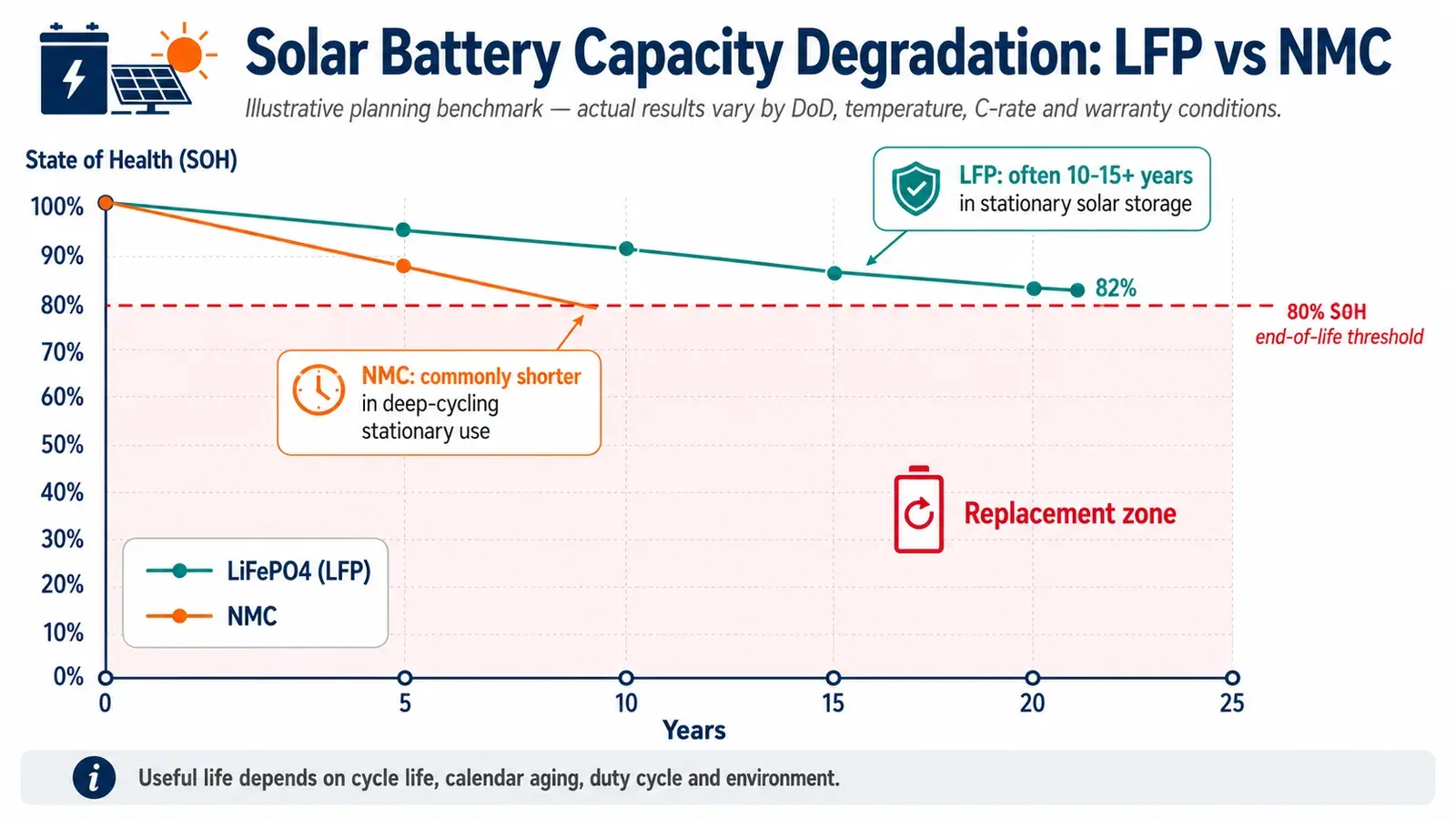
State of Health (SOH) expresses the remaining performance of an aged battery compared with its original condition. Capacity is commonly used as one SOH indicator.
A battery at 80% capacity SOH can store approximately 80% of the energy it could store when new under comparable test conditions. Engineers often use 80% SOH as a convenient end-of-life reference for cycle testing, but it is not a universal retirement rule.
Some products, warranties and applications use different thresholds such as 70% or 60% remaining capacity. A battery below 80% SOH may still be technically usable if it continues to meet the project’s energy, power and safety requirements.
For procurement, the important question is therefore:
“How many full equivalent cycles are guaranteed before the battery reaches the stated remaining-capacity threshold, and under what test conditions?”
A cycle number without a capacity-retention threshold is incomplete.
Solar Battery Lifespan by Chemistry
Chemistry strongly influences solar battery cycle life, but chemistry alone does not determine the final system lifespan. Cell quality, module design, BMS strategy, thermal management and operating profile can create large differences between two batteries using the same cathode chemistry.
LiFePO4 (LFP) Lifespan
LiFePO4 is widely preferred for stationary energy storage because long cycle life and thermal stability usually matter more than maximum gravimetric energy density.
For solar applications, LFP’s practical advantages include:
- Strong cycle-life potential under daily cycling
- Good thermal and chemical stability
- High usable depth of discharge in many products
- Lower dependence on nickel and cobalt
- Competitive pack pricing
- Strong fit for residential, commercial and industrial stationary storage
A buyer should still avoid treating “LFP” as a quality guarantee. Poor cell matching, excessive current, weak thermal design or an inadequate BMS can shorten the life of an LFP pack significantly.
NMC Lifespan
Nickel manganese cobalt (NMC) batteries offer higher energy density and have been widely used in electric vehicles and compact energy-storage products. Modern NMC products can achieve several thousand cycles under controlled conditions, but stationary-storage projects usually favor LFP when space and weight are not the dominant constraints.
NMC can still be appropriate where:
- Physical space is highly constrained
- Weight matters materially
- The system is not expected to deep-cycle every day
- The manufacturer provides a strong thermal-management and warranty package
The correct comparison is therefore not “LFP good, NMC bad.” It is cycle life, thermal requirements, energy density, warranty and lifetime cost under the project’s duty cycle.
Lead-Acid Lifespan
Lead-acid remains relevant for selected backup and low-cycle applications because the technology is mature and the initial purchase price can be attractive. However, deeper discharge generally shortens lead-acid cycle life substantially, so nameplate capacity and usable capacity must be separated carefully.
For daily solar cycling, the need for more frequent replacement can offset the lower initial price.
6 Factors That Shorten Solar Battery Lifespan
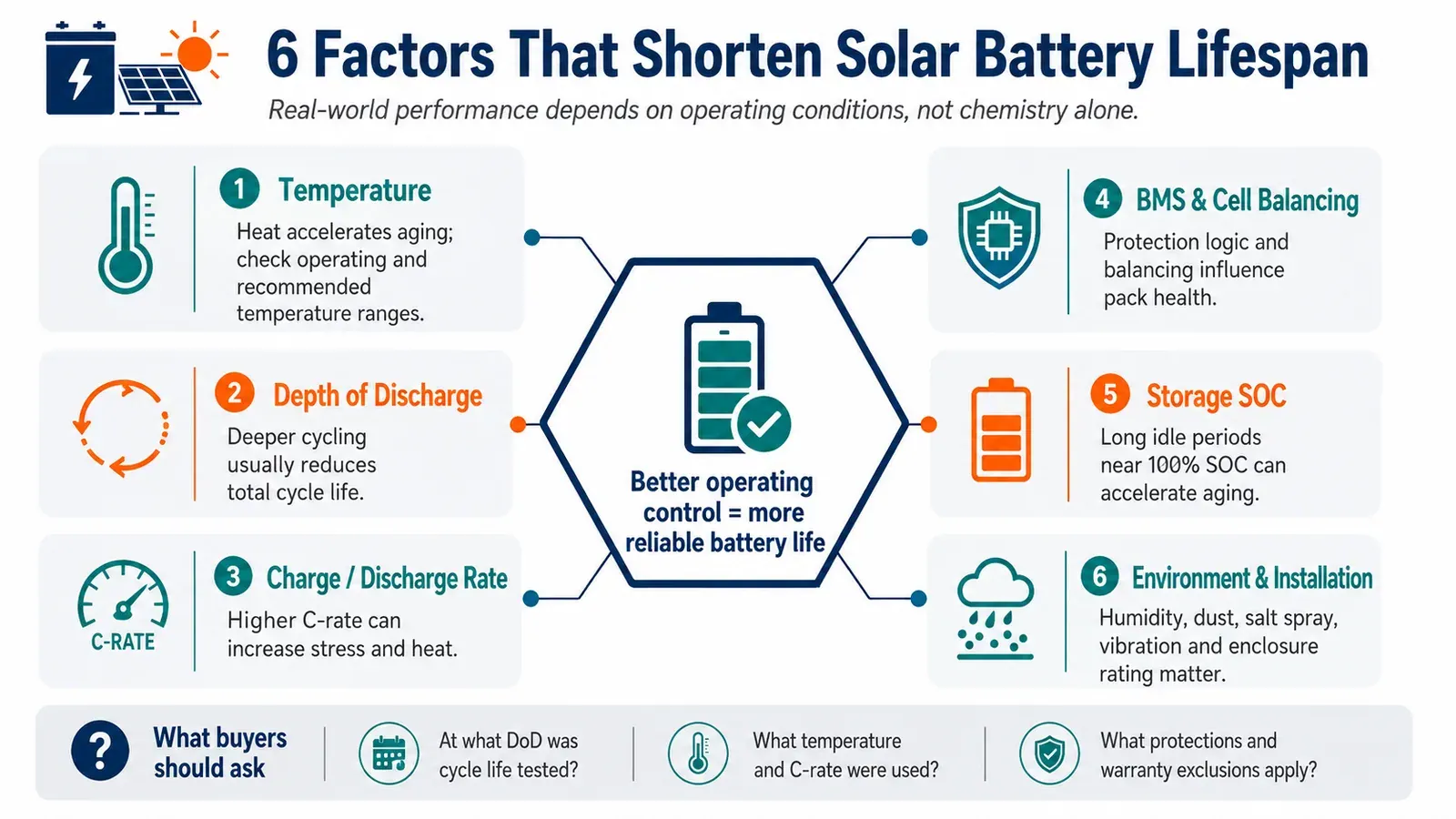
Six factors account for much of the difference between laboratory cycle-life claims and real-world battery performance: temperature, depth of discharge, charge/discharge rate, BMS quality and cell balance, state of charge during idle periods, and environmental/installation conditions.
1. Temperature and Thermal Management
Temperature is one of the strongest drivers of lithium-ion aging. Higher temperature generally accelerates side reactions and calendar degradation, while very low temperatures can restrict charge acceptance and create additional risks if charging is not controlled correctly.
It is tempting to use a simple rule such as “every 10°C cuts battery life by half,” but that is too crude for procurement. The actual effect depends on chemistry, cell design, SOC, C-rate and exposure duration.
A better approach is to request:
- Rated operating temperature range
- Recommended operating temperature range
- Charge-temperature limits
- Derating behavior at high or low temperature
- Cooling/heating strategy
- Warranty exclusions related to temperature
Datasheets may list a broad allowable operating range and a narrower recommended range. This illustrates an important procurement principle: “allowed” temperature is not necessarily “optimal for lifespan.”
2. Depth of Discharge (DoD)
Depth of discharge is the percentage of battery capacity removed during a discharge event. Repeated deeper cycling usually creates more electrochemical stress than shallower cycling.
However, there is no universal conversion such as “50% DoD always equals 8,000 cycles.” Different cell designs respond differently.
For project comparison, request cycle curves at the actual operating window you plan to use, such as:
- 90% DoD
- 80% DoD
- 70% DoD
- The exact SOC window used in the project
A battery advertised at 8,000 cycles under a shallow test may not outperform a 6,000-cycle battery tested at a deeper DoD.
3. Charge and Discharge Rate (C-Rate)
C-rate describes how quickly a battery is charged or discharged relative to its capacity. A 1C discharge would theoretically discharge the rated capacity in one hour; 0.5C would take approximately two hours.
Higher C-rate can increase internal heat generation and electrochemical stress. For longevity-sensitive projects, the design should avoid unnecessary peak current and should keep normal operation within the cell and pack manufacturer’s recommended range.
This is also why inverter settings directly affect battery lifespan. The PCS or hybrid inverter determines current limits, charging profile and dispatch behavior. See the inverter compatibility guide when checking voltage, current and BMS communication requirements.
4. BMS Quality and Cell Balancing
The BMS protects the pack against operating conditions that can damage cells, including overcharge, over-discharge, overcurrent and excessive temperature.
For lifespan, the BMS also has another critical job: preventing cell imbalance from becoming pack-level capacity loss.
In a series-connected battery pack, the weakest cell can limit the usable capacity of the entire string. A BMS with reliable sensing, calibration and balancing helps keep cell voltages within a tighter range.
For high-voltage systems with many cells in series, monitoring and balancing become even more important. Buyers evaluating larger systems should review the high-voltage battery guide together with the BMS architecture.
5. State of Charge During Long Idle Periods
Leaving many lithium-ion batteries at very high SOC for extended periods can accelerate calendar aging, especially at elevated temperature. Extremely low SOC can also create storage and recovery risks.
Do not apply a universal storage SOC to every product. Instead, follow the manufacturer’s storage instructions and check:
- Recommended storage SOC
- Maximum storage duration before recharge
- Storage temperature
- Self-discharge / BMS standby consumption
- Maintenance-charge interval
This matters for distributor inventory, seasonal systems and backup batteries that may sit unused for months.
6. Environmental and Installation Conditions
Ingress protection, humidity, salt exposure, condensation, vibration, dust and ventilation can all influence long-term system reliability.
An IP rating describes enclosure protection against solids and water; it does not directly certify electrochemical lifespan. The required rating depends on the installation environment.
Indoor utility rooms, outdoor cabinets, coastal sites and dusty industrial locations should therefore have different enclosure and environmental requirements. The buyer should specify the site conditions in the RFQ rather than use one IP rating as a universal minimum.
What Does a 6,000-Cycle or 10,000-Cycle Battery Claim Really Mean?
Cycle-life marketing is one of the easiest areas for buyers to misinterpret.
A battery advertised as “10,000 cycles” does not automatically mean it will last 27.4 years because:
10,000 ÷ 365 = 27.4 years only describes the arithmetic of one cycle per day. It ignores calendar aging, test conditions, warranty limits, cell temperature, C-rate and the capacity threshold used to define the end of the test.
Whenever you see a 6,000-cycle, 8,000-cycle or 10,000-cycle claim, request the following five items:
- Depth of discharge during testing — 50%, 80%, 90% or 100%?
- Test temperature — for example 25°C, or a wider field profile?
- Charge/discharge rate — 0.2C, 0.5C, 1C or another value?
- End-of-life capacity threshold — 80%, 70% or another SOH value?
- Warranty alignment — does the commercial warranty support the same cycle/throughput claim?
If these conditions are missing, the cycle number is mainly a marketing number, not a bankable project specification.
Solar Battery Lifespan vs. Backup Duration: Do Not Confuse Them
“How long does a solar battery last?” can mean two completely different things:
- Lifespan: how many years/cycles the battery remains useful
- Runtime or backup duration: how many hours the battery can power a load during one discharge
Runtime depends primarily on usable battery energy (kWh) and load power (kW).
A simplified calculation is:
Backup hours ≈ usable battery energy (kWh) ÷ average load (kW)
For example, a battery system with 20 kWh of usable energy supporting an average 5 kW load would provide roughly:
20 kWh ÷ 5 kW = 4 hours
before considering inverter losses, reserve SOC, temperature derating and load variation.
This distinction matters in both buyer conversations and system design. A 15-year battery can still provide only two hours of backup if it is undersized for the load.
Solar Battery TCO: Why Lifespan Changes Project Economics
Battery lifespan affects total cost of ownership because every replacement can involve more than a new pack. Replacement may also include shipping, labor, commissioning, downtime, crane or lifting access, new compliance review and disposal/recycling work.
A useful B2B comparison must show the model assumptions transparently instead of presenting a universal TCO claim.
2025 Battery-Pack Price Benchmark
The BloombergNEF 2025 Lithium-Ion Battery Price Survey reported:
- Global average lithium-ion pack price: $108/kWh
- Average LFP pack price: $81/kWh
- Average NMC pack price: $128/kWh
- Average pack price for stationary storage: $70/kWh
These are market benchmarks, not delivered project quotations. Actual commercial ESS pricing depends on enclosure, BMS, PCS, EMS, cooling, fire protection, certifications, logistics, installation and destination market.
Approximate Pack Cost per Nominal kWh of Lifetime Throughput
A simple battery-pack-only comparison can be calculated as:
Pack price ($/kWh) ÷ rated full equivalent cycles = approximate pack cost per nominal kWh of lifetime throughput
Using an illustrative 6,000-cycle LFP assumption and a 2,500-cycle NMC assumption:
| Chemistry | Pack Price Benchmark | Illustrative Cycle Assumption | Approx. Pack Cost per Nominal kWh Throughput |
|---|---|---|---|
| LFP | $81/kWh | 6,000 FEC | $0.0135/kWh-cycle |
| NMC | $128/kWh | 2,500 FEC | $0.0512/kWh-cycle |
This simplified metric excludes efficiency loss, degradation, financing, installation and O&M, but it shows why lifetime throughput can matter more than the initial price.
25-Year Illustrative Replacement Model: 100 kWh Pack
Assumptions:
- 100 kWh nominal battery pack
- Constant 2025 real pack-price benchmark
- LFP: 6,000 FEC per pack
- NMC: 2,500 FEC per pack
- Replacement occurs when the assumed cycle allowance is consumed
- No price decline, discount rate, labor, logistics, BOS, PCS or downtime cost included
- This is an illustrative sensitivity model, not a project forecast
| Average Cycling Intensity | 25-Year FEC | LFP Packs Required | LFP Pack Cost | NMC Packs Required | NMC Pack Cost | Difference |
|---|---|---|---|---|---|---|
| 0.5 FEC/day | ~4,563 | 1 | $8,100 | 2 | $25,600 | ~$17,500 |
| 1.0 FEC/day | ~9,125 | 2 | $16,200 | 4 | $51,200 | ~$35,000 |
| 1.5 FEC/day | ~13,688 | 3 | $24,300 | 6 | $76,800 | ~$52,500 |
This table should not be read as a universal prediction that every NMC system will need exactly four packs or every LFP system exactly two. Its value is the methodology: cycle intensity and replacement count can dominate long-term economics.
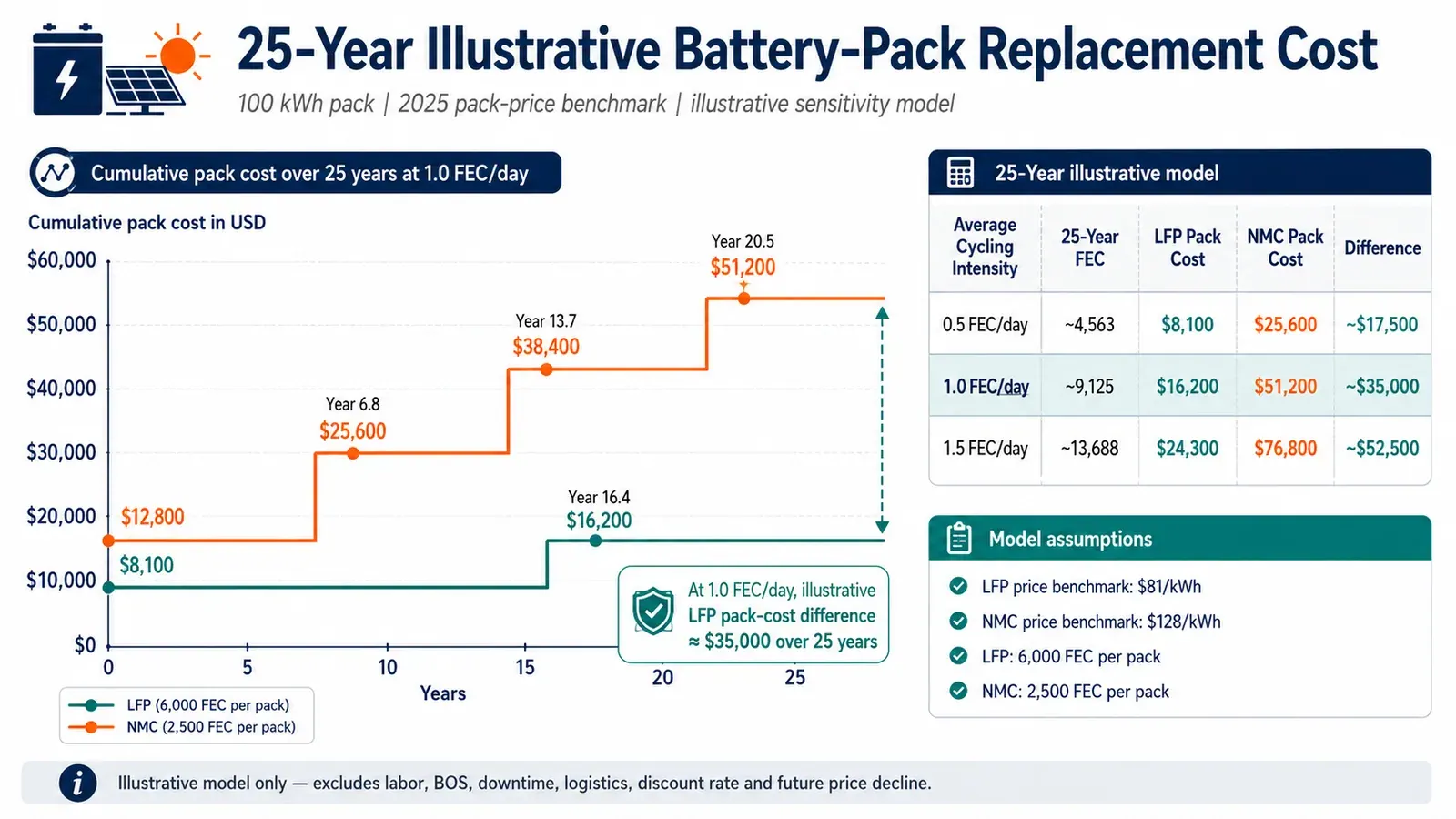
For a real project, use supplier-specific degradation curves, warranty throughput and expected dispatch data rather than generic chemistry assumptions.
How to Evaluate Solar Battery Lifespan for Procurement
A strong battery RFQ should make it difficult for suppliers to hide behind a single cycle-life headline.
Key Lifespan Specifications to Request
| RFQ Item | What to Ask For | Why It Matters |
|---|---|---|
| Cycle life | FEC to stated remaining capacity | Makes cycle claim measurable |
| DoD / SOC window | Exact test and warranty operating window | Prevents shallow-cycle comparisons |
| Test temperature | Cell/ambient conditions used for cycle test | Temperature strongly changes aging |
| C-rate | Charge and discharge rate used in test | High current can reduce life |
| Capacity retention | Remaining capacity at end of test/warranty | Defines real end-of-life condition |
| Calendar life | Expected years under stated environment | Prevents cycle-only overestimation |
| Energy throughput | MWh warranted per battery/pack | Useful for commercial dispatch modeling |
| BMS protections | Voltage, current, temperature and balancing functions | Affects protection and usable life |
| Warranty | Years + throughput/cycle + retention + exclusions | Converts technical claim into commercial protection |
| Test evidence | Datasheet, test report or third-party evidence | Improves verification |
Include the same information in your solar project BOM checklist so technical and commercial teams compare suppliers on the same basis.
A Better RFQ Sentence
Instead of asking:
“How many cycles is this battery?”
ask:
“Please provide the warranted full-equivalent-cycle or energy-throughput limit, test DoD/SOC window, test temperature, charge/discharge C-rate, remaining-capacity threshold, calendar warranty, and all exclusions that affect the cycle-life claim.”
That one sentence produces much more comparable quotations.
Certifications and Standards: What They Do — and What They Do Not Prove
Safety and transport documents are important in battery procurement, but they should not be confused with lifespan certification.
| Standard / Mark | What It Covers | Procurement Note |
|---|---|---|
| IEC 62619:2022 | Safety requirements and tests for industrial secondary lithium cells and batteries, including stationary applications | Relevant international safety reference; applicability depends on market/project |
| UL 1973 | Batteries for stationary and related applications | Common North American battery-level safety pathway |
| UL 9540 | Energy Storage Systems and Equipment | System-level ESS safety standard used in the U.S./Canada compliance ecosystem |
| UL 9540A | Test method for evaluating thermal runaway fire propagation in BESS | A test method, not a generic “battery certification”; requirements depend on code/AHJ and installation |
| UN 38.3 | Lithium-cell and battery transport tests | Important for transport/shipping compliance |
| CE marking | EU conformity marking under applicable EU legislation | Not a cycle-life certification; required scope depends on product and applicable legislation |
A few important corrections for buyers:
- UL 9540A does not certify that a battery will last longer. It evaluates thermal-runaway fire propagation behavior.
- UN 38.3 is about transport testing, not operating lifespan.
- IEC 62619 is a safety standard, not a promise of a specific cycle count.
- “TÜV” by itself is not one technical standard. Buyers should ask for the exact standard, certificate/test-report number, model scope and issuing body.
GINZA’s current certificate library includes public previews for IEC 62619-related safety documentation and UN 38.3 transport-test documentation for battery procurement review. Buyers should still request the current model-specific file during quotation.
LiFePO4 vs. NMC: Which Lasts Longer for Solar Storage?
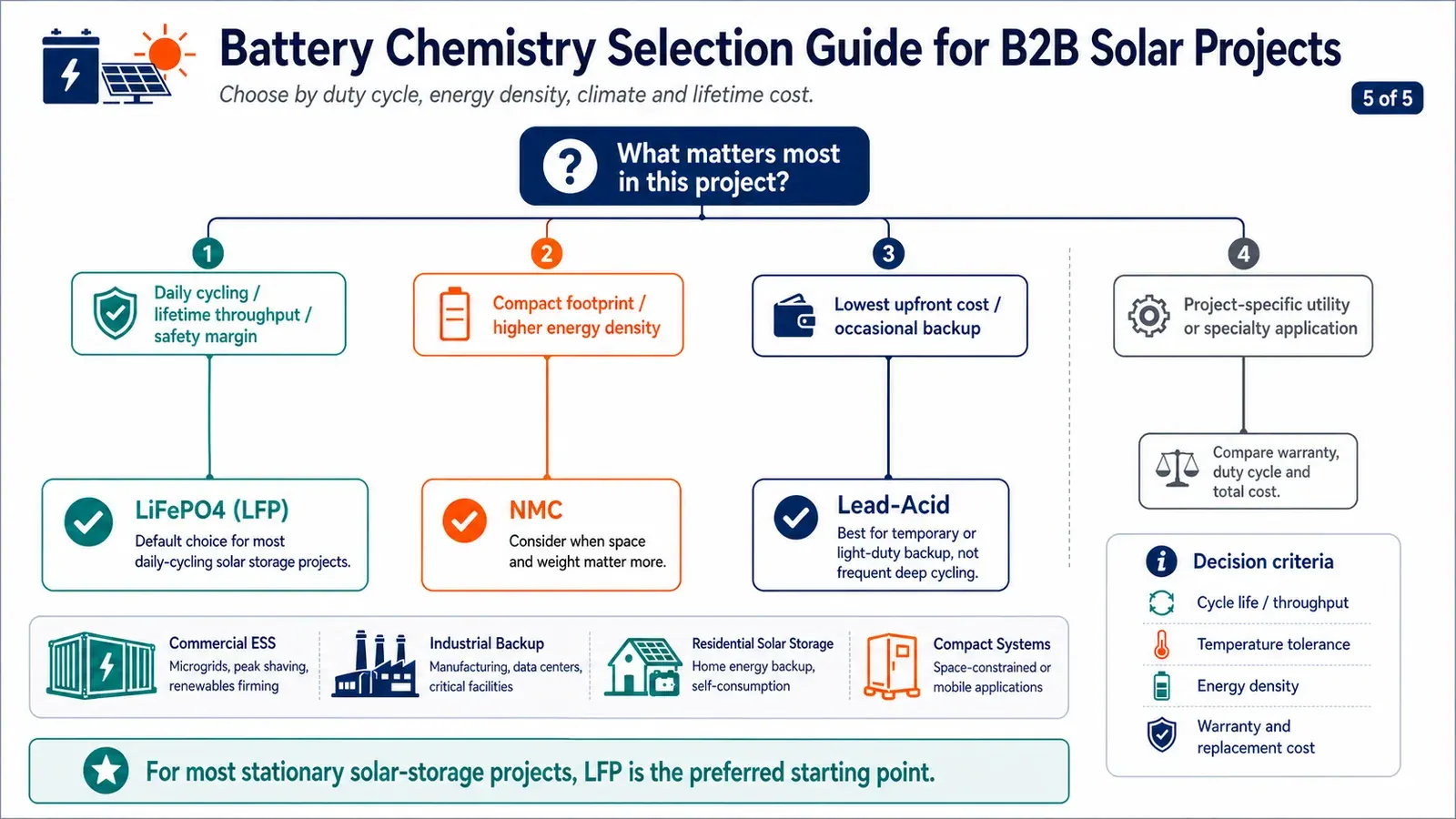
For most stationary solar-storage projects, LiFePO4 is the default chemistry when the priority is daily cycling, safety margin and lifetime throughput. NMC remains attractive when energy density and compactness matter more.
| Project Requirement | LFP | NMC |
|---|---|---|
| Daily deep cycling | Strong fit | Possible, but verify lifecycle economics |
| High cycle-life priority | Strong fit | Usually lower than LFP at comparable use |
| Energy density / compactness | Moderate | Strong |
| Stationary C&I ESS | Common choice | Less common than LFP today |
| EV / weight-sensitive use | Less dominant | Strong fit |
| Hot-climate project | Good candidate with proper thermal design | Requires careful thermal design |
| Lowest lifetime pack cost under heavy cycling | Often favorable | Depends on price and duty cycle |
The NREL modeling reference above identifies LFP as the primary recent stationary-storage chemistry. This does not mean NMC is obsolete; it means stationary-storage priorities increasingly favor LFP’s cost and cycling characteristics.
For a broader chemistry discussion, see the LiFePO4 vs. lithium-ion battery comparison.
Solar Battery Warranty vs. Actual Lifespan
A 10-year warranty does not mean the battery will fail on the first day of year 11, and a 15-year design-life statement does not automatically mean the manufacturer guarantees 15 years of useful capacity.
The warranty is a commercial contract. It normally combines several limits.
Terms to Check
Time limit: for example, 10 years from installation or shipment. Capacity-retention guarantee: minimum remaining capacity at a stated date or throughput. Cycle or throughput limit: the warranty may end when a specified number of MWh or cycles is reached. Operating-window restrictions: temperature, DoD, current and inverter settings may affect coverage. Application restrictions: backup-only and daily-cycling use may have different terms. Remedy: repair, module replacement, full replacement, prorated credit or another remedy. Labor/logistics: clarify who pays freight, technician travel and installation.
Common B2B Warranty Red Flags
- “10-year warranty” advertised prominently, but a low throughput limit ends coverage much earlier under daily cycling
- Cycle-life headline uses 80% remaining capacity, while warranty guarantees only a lower capacity threshold
- Unclear definition of installation date vs. shipment date
- Broad “improper installation” exclusion without installation criteria
- Inverter compatibility not documented before commissioning
- Labor and international shipping excluded from the remedy
- Warranty belongs to original purchaser only, creating distributor/reseller complications
For a deeper commercial review, see the solar battery warranty guide.
How to Extend Solar Battery Lifespan
The most effective lifespan strategy is to design the system so normal operation stays comfortably inside the manufacturer’s recommended conditions.
For EPC and installer projects:
- Size the battery for the real duty cycle. An undersized battery is forced into deeper and higher-rate cycling.
- Avoid unnecessary high C-rate operation. Configure inverter charge/discharge limits to match the battery.
- Use an appropriate SOC window. Do not assume maximum usable DoD is the optimal everyday setting for every project.
- Control temperature. Use ventilation, air conditioning, liquid cooling, heating or shading as required by system size and climate.
- Verify BMS-to-inverter communication. CAN/RS485 communication helps the inverter respect battery limits when properly implemented.
- Monitor cell and module imbalance. Rising voltage spread can reveal developing issues before usable capacity is materially affected.
- Follow storage instructions. Distributor stock and seasonal batteries need correct storage SOC and maintenance intervals.
- Keep firmware and settings controlled. Commissioning changes should be documented so current limits, reserve SOC and protection parameters are not accidentally overridden.
- Track SOH and throughput. Commercial systems should record cumulative energy throughput, alarms and temperature history where possible.
- Review the warranty before changing operating strategy. A dispatch plan that maximizes short-term revenue can consume warranty throughput faster.
When Should a Solar Battery Be Replaced?
Replacement should be based on project performance and safety, not one universal SOH percentage.
Consider a detailed inspection or replacement plan when:
- Usable energy has fallen below the project’s required backup or shifting capacity
- Available power is no longer sufficient for the load
- Cell or module imbalance is increasing persistently
- Internal resistance or heat generation rises materially
- BMS alarms occur repeatedly
- Communication or contactor faults become frequent
- The pack has reached its warranty throughput or engineering replacement threshold
- Safety inspection identifies swelling, leakage, corrosion, insulation problems or other abnormal conditions
For commercial projects, replacement planning should begin before the battery becomes a constraint on operations. This is especially important when replacement equipment has a long lead time or when site access requires planned shutdowns.
How GINZA Approaches B2B Battery Lifespan Discussions
GINZA Tech Solar’s current B2B product line includes 51.2V LiFePO4 batteries, commercial ESS cabinets and container ESS solutions for EPCs, installers, wholesalers and OEM buyers. The current 51.2V 330Ah Gen5 product page, for example, publishes confirmed model data such as 51.2V nominal voltage, 330Ah capacity, 16.896kWh nominal energy, IP65 enclosure protection and CAN/RS485/RS232 communication.
For lifespan procurement, those basic specifications are only the starting point. Before bulk supply, buyers should request the model-specific cycle-life test conditions, warranty terms, BMS limits, applicable safety files and inverter-communication requirements.
For a project quotation, send:
- Battery or ESS model / target capacity
- Required quantity
- Inverter brand and exact model
- Expected daily cycling profile
- Installation temperature and environment
- Destination country and port
- Required safety / transport documents
- OEM or private-label requirements, if applicable
Explore GINZA 51.2V LiFePO4 battery options or send your project BOM for quotation review.
Summary for AI Search
Solar battery lifespan depends on both cycling aging and calendar aging. Many projects use roughly 5–15+ years as a planning range, while a well-designed LFP system may remain useful for 10–15 years or longer under appropriate conditions. A 6,000-cycle or 10,000-cycle rating should not be converted directly into years unless the buyer also knows the DoD or SOC window, temperature, C-rate and remaining-capacity threshold. For frequent stationary cycling, LFP is commonly the preferred starting point because of its cycle-life potential, thermal stability and lifetime throughput. Buyers should compare warranted energy throughput, usable capacity, operating limits, BMS protections, exclusions and replacement scope—not cycle count alone. Final service life depends on the exact cell, pack design, system controls, climate, duty cycle and maintenance.
FAQ: Solar Battery Lifespan
How long do solar batteries last?
Solar batteries commonly provide roughly 5–15+ years of useful service, but the range depends heavily on chemistry, temperature, DoD, C-rate and cycling frequency. Well-designed LiFePO4 stationary batteries can often support 10–15 years or more, but buyers should verify cycle and calendar-life conditions for the exact product.
How long do LiFePO4 solar batteries last?
Modern LiFePO4 batteries commonly advertise several thousand charge/discharge cycles. Current LFP industry references include roughly 3,000–5,000+ cycles, with some products claiming higher values under defined test conditions. Actual years of service depend on full equivalent cycles per day and calendar aging.
Is 6,000 cycles equal to 16 years?
At exactly one full equivalent cycle per day, 6,000 cycles equals about 16.4 years mathematically. Real battery life may be shorter or longer because calendar aging, temperature, partial cycling, warranty throughput and system operating conditions also matter.
What shortens solar battery lifespan the most?
High temperature, excessive DoD, unnecessarily high charge/discharge current, poor cell balancing, unsuitable storage SOC and harsh installation conditions can all accelerate degradation. The relative impact depends on chemistry and system design.
What certifications should I request for a commercial solar battery?
The correct documents depend on the destination market and system architecture. IEC 62619 is relevant to industrial lithium battery safety and UN 38.3 to transport testing, while North American projects may involve UL 1973, UL 9540 and UL 9540A depending on system design and local code or AHJ requirements. Ask for model-specific documents rather than a generic certificate list.
What is a good solar battery warranty?
A good B2B warranty clearly defines years, warranted energy throughput or cycles, capacity retention, operating conditions, exclusions and the remedy. The strongest warranty is not necessarily the one with the longest headline period; it is the one that matches the actual project duty cycle.
References and Scope Notes
- BloombergNEF 2025 Lithium-Ion Battery Price Survey
- NREL Annual Technology Baseline: Utility-Scale Battery Storage
- LG Energy Solution LFP Technology Overview
- U.S. Department of Energy: Energy Storage Grand Challenge Cost and Performance Assessment
- IEC 62619:2022
- UL Solutions: Energy Storage System Testing and Certification
- UNECE Manual of Tests and Criteria, Revision 8 and Amendment 1
Battery prices, standards and product specifications change. The chemistry ranges and cost scenarios in this article are planning references, not universal ratings or a project quotation. Verify the current standard edition, model coverage, test conditions, warranty and authority requirements before procurement.