
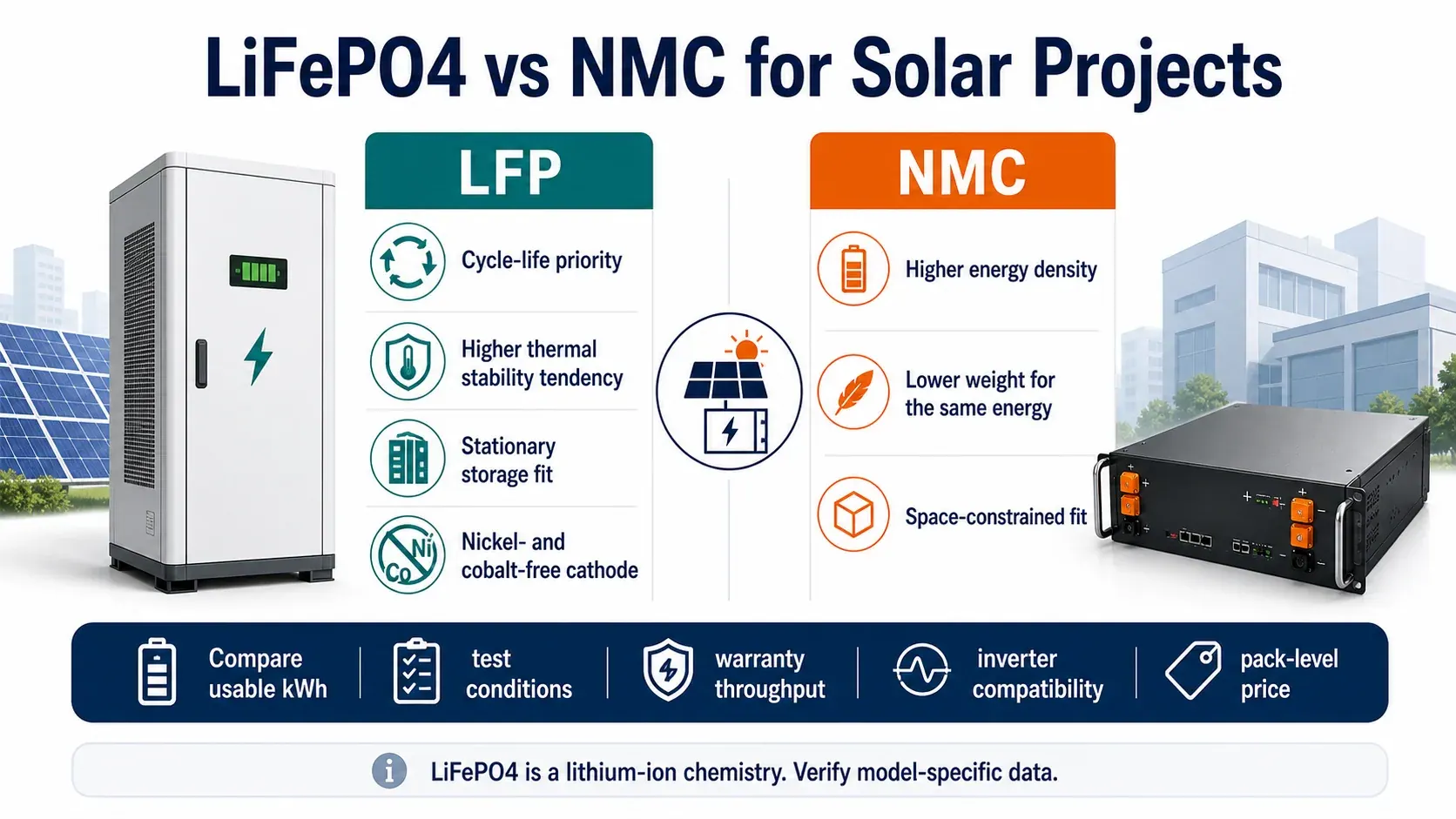
LiFePO4 is itself a type of lithium-ion battery. In most searches for LiFePO4 vs lithium ion battery, however, “lithium ion” is being used as shorthand for nickel-based chemistries such as NMC or NCA. For solar energy storage, the practical comparison is therefore usually LiFePO4 (LFP) vs NMC lithium-ion.
For stationary solar projects, LiFePO4 is generally the stronger default when long cycle life, thermal stability, predictable maintenance, and lifecycle cost matter more than minimum weight or footprint. NMC remains attractive where gravimetric and volumetric energy density are critical. For B2B buyers, the correct decision should be based on pack-level specifications, documented test conditions, warranty throughput, system compatibility, and total cost of ownership rather than chemistry name alone.
This guide explains the chemistry differences, project implications, safety standards, lifecycle economics, and the RFQ specifications EPC contractors and procurement teams should request before comparing suppliers.
LiFePO4 vs Lithium Ion Battery: Quick Answer
LiFePO4 is a lithium-ion chemistry, not a separate battery family. The useful project-level comparison is usually LFP vs NMC. LFP typically offers a longer cycle-life specification and better thermal stability, while NMC usually provides higher energy density and a smaller, lighter battery for the same nominal capacity.
For commercial and industrial solar storage, the key procurement question is not simply “Which chemistry is better?” It is:
Which chemistry delivers the required usable energy, lifetime throughput, safety evidence, warranty coverage, inverter compatibility, and serviceability at the lowest project risk and lifecycle cost?
That framing matters because two 100 kWh batteries can have very different usable capacity, cycle conditions, end-of-life definitions, BMS limits, warranties, and replacement costs.
Why Battery Chemistry Matters for Solar Projects
Battery chemistry influences almost every major technical and commercial decision in an energy storage project. It affects cell voltage, pack architecture, energy density, thermal behavior, charging limits, expected cycle life, BMS configuration, and ultimately the number of battery replacements that may be required during the solar asset’s operating life.
For EPC contractors and project buyers, chemistry selection should happen before the final battery model is locked. The choice affects:
- Usable energy: nominal kWh is not the same as usable kWh after depth-of-discharge limits.
- Cycle life and throughput: supplier cycle claims must be tied to DoD, temperature, C-rate, and end-of-life capacity.
- Safety design: chemistry is only one layer; enclosure, fusing, contactors, BMS logic, thermal design, and fire-propagation behavior also matter.
- System voltage: cell voltage influences series count and pack configuration.
- Inverter integration: charging limits, voltage windows, CAN/RS485 communication, and firmware support must match.
- Warranty exposure: some warranties are time-based, while others also limit energy throughput or equivalent full cycles.
- Replacement planning: a battery with a lower acquisition price can become more expensive if it requires more replacements, labor, commissioning, or downtime.
Once the chemistry is selected, buyers can move to battery sizing, high-voltage ESS architecture, and final inverter compatibility.
What Is a LiFePO4 Battery?
LiFePO4, also called lithium iron phosphate or LFP, is a lithium-ion chemistry that uses lithium iron phosphate as the cathode material. It has become a mainstream chemistry for stationary energy storage because it combines strong cycle-life potential with high thermal stability and avoids nickel and cobalt in the cathode.
Typical LFP characteristics include:
- Nominal cell voltage: about 3.2 V
- Common low-voltage architecture: 16 cells in series for a 51.2 V nominal pack
- Gravimetric energy density: generally lower than NMC
- Cycle-life positioning: commonly selected for frequent-cycling stationary storage
- Thermal stability: generally higher than nickel-rich lithium-ion chemistries
- Cathode materials: no nickel or cobalt
- Typical applications: residential storage, C&I ESS, telecom backup, UPS, marine systems, and larger stationary battery systems
A cycle-life number should never be read in isolation. “6,000 cycles,” for example, is only meaningful if the supplier also states the test temperature, charge/discharge rate, depth of discharge, and end-of-life capacity threshold.
For project procurement, ask for the actual cell manufacturer and cell model used inside the pack. A description such as “Grade A LiFePO4” is not a substitute for traceable cell specifications and test data.
What Does “Lithium Ion” Mean? NMC, NCA, and LCO
Technically, LiFePO4, NMC, NCA, and LCO are all lithium-ion chemistries. In commercial search language, however, “lithium ion” often refers to nickel- or cobalt-based chemistries rather than LFP.
NMC (nickel manganese cobalt) is the most relevant comparison for many battery buyers. It offers higher energy density than LFP, which can reduce pack weight and volume. This is valuable in electric vehicles, mobile systems, or installations where the battery room footprint is tightly constrained.
NCA (nickel cobalt aluminum) also provides high energy density and is strongly associated with mobility applications. It is less common as the default chemistry for stationary solar storage.
LCO (lithium cobalt oxide) is widely associated with consumer electronics and is generally not the chemistry EPC contractors consider for large stationary solar ESS projects.
For a B2B solar buyer, the most useful comparison is therefore usually LFP vs NMC, while other chemistries should be evaluated only when the application creates a specific technical reason to do so.
LiFePO4 vs NMC: Side-by-Side Comparison
The table below summarizes the procurement differences that matter most. Values are typical industry ranges or design tendencies rather than guaranteed specifications. Buyers should compare supplier data under the same test conditions.
| Parameter | LiFePO4 (LFP) | NMC Lithium-Ion | B2B Procurement Meaning |
|---|---|---|---|
| Nominal cell voltage | ~3.2 V | ~3.6–3.7 V | Changes series count and pack design |
| Gravimetric energy density | Lower, often ~90–160 Wh/kg at cell level | Higher, often ~150–220 Wh/kg at cell level | NMC can reduce weight |
| Volumetric energy density | Generally lower | Generally higher | NMC can reduce required footprint |
| Cycle-life positioning | Strong for frequent cycling; 6,000+ cycle claims are common in project-grade LFP products | Often lower under comparable high-cycle use | Verify DoD, C-rate, temperature, and EOL definition |
| Thermal stability | Generally higher | Generally lower than LFP | Chemistry affects risk, but pack design still matters |
| Depth of discharge | High DoD products are common | High DoD also available | Compare usable kWh, not nominal kWh |
| Weight for same kWh | Usually heavier | Usually lighter | Important for mobile or structure-limited projects |
| Pack price | Highly dependent on volume, BMS, enclosure, certifications, warranty, and Incoterm | Also highly project-dependent | Compare dated pack-level quotes, not bare-cell spot prices |
| Replacement frequency | Often lower in daily-cycling stationary use | Can be higher when cycle life is lower | Major TCO driver |
| Best-fit applications | Stationary solar, C&I ESS, backup, telecom | Mobility and space/weight-constrained projects | Choose by project constraints, not marketing claims |
Table 1: LiFePO4 vs NMC lithium-ion comparison for B2B solar procurement.
For most stationary projects, energy density is not the only or even the main decision factor. A slightly larger battery cabinet can be commercially acceptable if it reduces replacement frequency, simplifies risk management, or provides stronger warranty throughput.
Cycle Life: What 6,000 Cycles Actually Means
LiFePO4 is frequently specified at 6,000 or more cycles in stationary storage products, while many NMC products are specified at lower cycle counts. However, cycle-life claims are not directly comparable unless the test conditions match.
A proper RFQ should require the supplier to state:
- Depth of discharge (DoD) used in the test
- Charge and discharge C-rate
- Ambient or cell temperature
- End-of-life threshold, such as 80% state of health
- Whether the figure is cell-level or pack-level
- Whether the warranty guarantees cycles, energy throughput, years, or a combination
The calendar conversion is also important. At one equivalent full cycle per day:
- 2,000 cycles ≈ 5.5 years
- 3,000 cycles ≈ 8.2 years
- 6,000 cycles ≈ 16.4 years
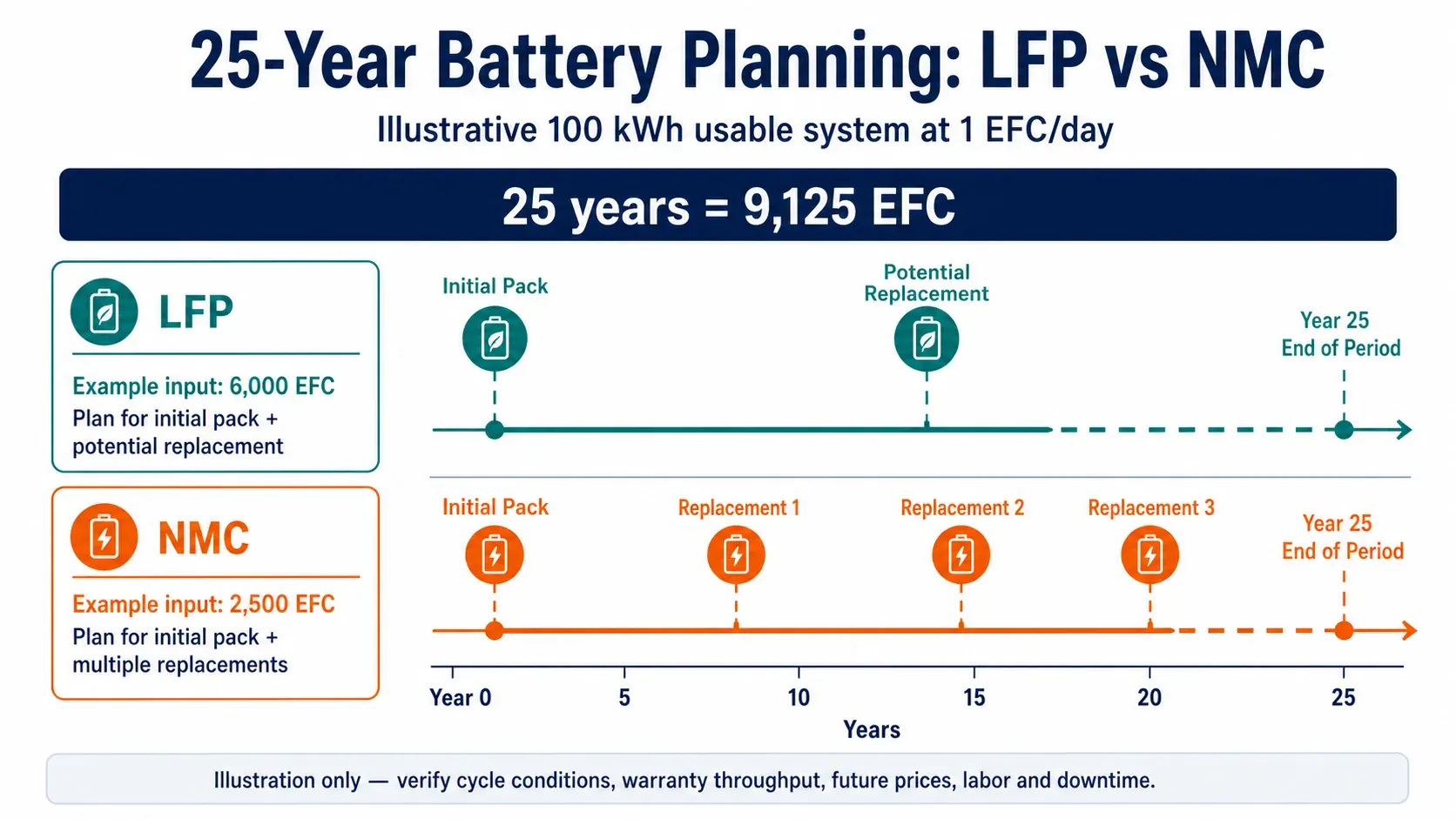
- A 25-year project at one equivalent full cycle per day requires about 9,125 equivalent full cycles
This immediately exposes a common TCO mistake: a 6,000-cycle battery should not automatically be modeled as requiring zero replacement over a 25-year daily-cycling project. Under that utilization assumption, it may still require one replacement or another capacity-management strategy before year 25.
For industrial lithium batteries, IEC 62620 is a relevant performance standard covering tests and requirements for secondary lithium cells and batteries used in industrial applications. In procurement, the supplier’s declared cycle-life test method and report should be reviewed alongside the standard rather than replaced by a marketing cycle number.
Safety: Chemistry Matters, but Pack and System Design Matter Too
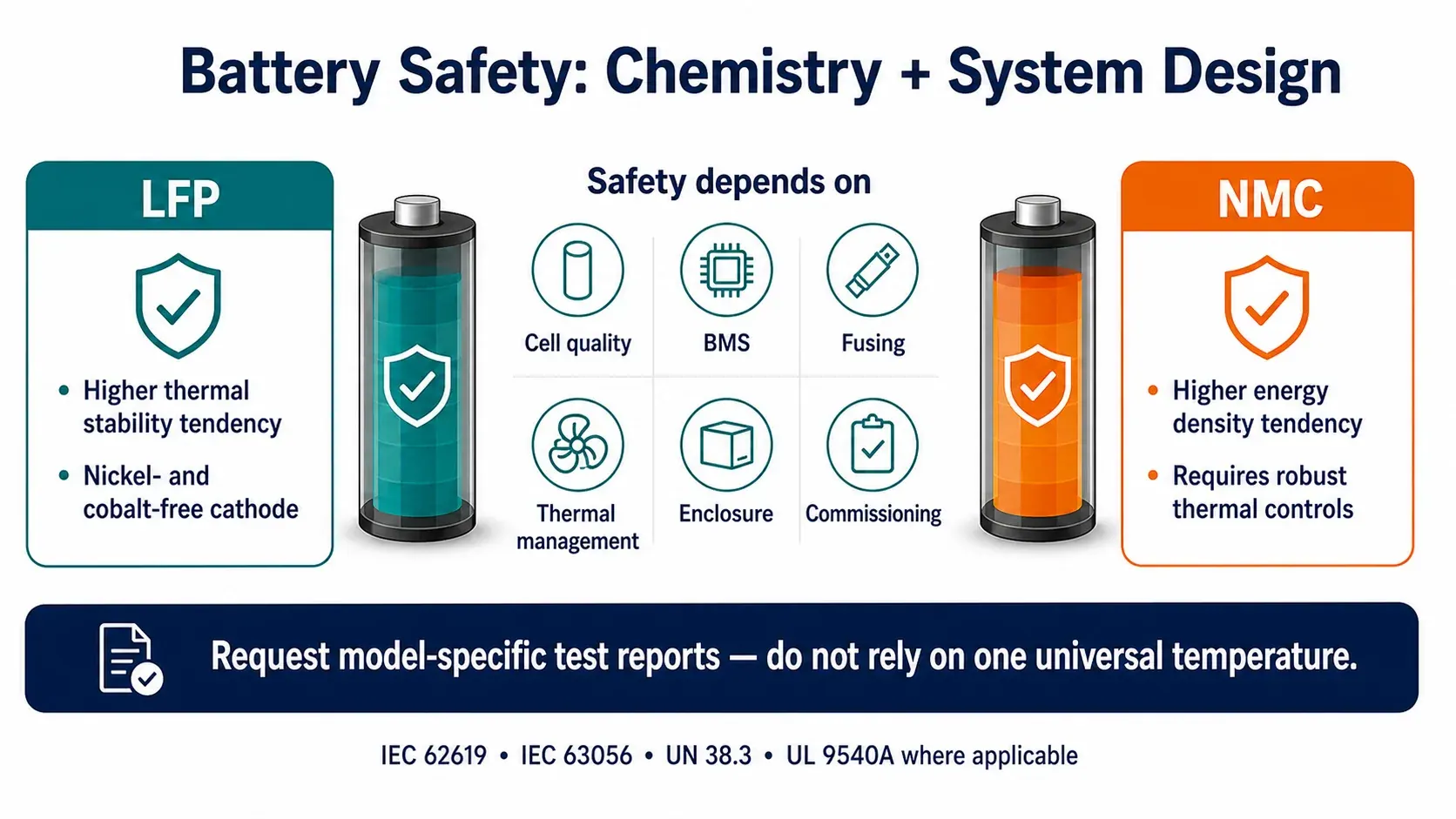
LFP is widely favored in stationary storage because of its strong thermal stability relative to nickel-rich lithium-ion chemistries. That does not mean an LFP battery is automatically safe, nor does chemistry eliminate the need for system-level protection.
A safer BESS depends on multiple layers:
- cell consistency and traceability
- mechanical spacing and enclosure design
- fuses and DC overcurrent protection
- contactors and emergency isolation
- BMS overcharge, over-discharge, overtemperature, and short-circuit protection
- thermal management
- gas and fire propagation behavior
- installation clearances and local fire-code requirements
- commissioning quality and firmware configuration
Buyers should avoid treating a single “thermal runaway temperature” as a universal chemistry specification. Thermal-event behavior varies with cell format, state of charge, test method, abuse condition, and pack design. A supplier that quotes one temperature without a supporting test method or report is giving less useful information than a supplier that provides documented safety evidence.
Standards and test evidence to request
- IEC 62619:2022 — safety requirements and tests for secondary lithium cells and batteries used in industrial applications, including stationary applications.
- IEC 63056:2020 — additional or specific safety requirements for secondary lithium cells and batteries used in electrical energy storage systems, including photovoltaic and on-grid/off-grid storage.
- UN 38.3 — transport test requirements for lithium cells and batteries.
- UL 9540A — a test method for evaluating thermal runaway fire propagation in battery energy storage systems. It should not be described simply as a generic battery “certification.”
- Project-specific system standards and local codes — requirements depend on market, system size, installation environment, and authority having jurisdiction.
For B2B procurement, request the actual test report, certificate scope, model number, issuing laboratory, and validity—not just certification logos on a brochure.
LiFePO4 vs Lithium Ion Battery Price: Compare Pack-Level Quotes
Battery pricing is one of the easiest areas to compare incorrectly. A bare-cell price, a finished battery-pack price, and a complete installed ESS price are three different commercial levels.
A finished battery pack can include:
- cells
- BMS
- busbars and wiring
- enclosure or cabinet
- contactors, fuses, DC breakers, and pre-charge components
- thermal management
- communication hardware
- display, Wi-Fi, or Bluetooth functions
- fire-suppression features where applicable
- assembly and quality control
- certification and test costs
- warranty reserve
- packaging and export protection
For that reason, a spot-market cell price should not be used directly in a 100 kWh project TCO model. EPC contractors should request dated pack-level pricing per usable kWh under the same commercial terms, including quantity, warranty, Incoterm, delivery destination, and included accessories.
A useful price comparison line in an RFQ is:
“Quote total battery-pack price, price per nominal kWh, price per usable kWh at the specified DoD, included BMS/protection equipment, warranty term, Incoterm, MOQ, and lead time.”
This produces quotes that can actually be compared.
25-Year TCO: Use Throughput and Replacement Assumptions, Not a Static $/kWh Number
Total cost of ownership is where LFP often becomes attractive for daily-cycling stationary storage. But a credible TCO model must show its assumptions.
A simple project model is:
TCO = Initial pack cost + replacement packs + replacement labor + commissioning + maintenance + downtime/operational cost + financing + efficiency losses − residual value
For a 100 kWh usable battery delivering one equivalent full cycle per day:
- Annual energy throughput ≈ 36.5 MWh
- 25-year energy throughput ≈ 912.5 MWh
- Required equivalent full cycles over 25 years ≈ 9,125
The table below shows why cycle life materially changes replacement planning. It is an illustration, not a market quotation.
| TCO Planning Item | Example LFP Case | Example NMC Case | Procurement Impact |
|---|---|---|---|
| Usable capacity | 100 kWh | 100 kWh | Keep capacity basis identical |
| Daily utilization | 1 EFC/day | 1 EFC/day | 9,125 EFC over 25 years |
| Example cycle-life input | 6,000 EFC | 2,500 EFC | Must use comparable test conditions |
| Approx. battery lifetimes required for 9,125 EFC | 1.52 | 3.65 | Indicates likely replacement exposure |
| Practical planning assumption | Initial pack + potentially 1 replacement | Initial pack + potentially 2–3 replacements | Replacement cost, labor, and downtime matter |
| Future replacement price | Unknown | Unknown | Model scenarios; battery prices change over time |
| Warranty throughput | Must be verified | Must be verified | Can materially change owner risk |
Table 2: Illustrative 25-year throughput and replacement model for a 100 kWh daily-cycling system.
This approach is more robust than claiming a fixed percentage saving across every project. Future battery prices, utilization, ambient temperature, financing, degradation, warranty terms, labor rates, and the value of downtime can all change the result.
For an EPC bid, calculate at least three TCO cases: base case, high-utilization case, and conservative life case. This lets the project owner see whether the chemistry decision remains attractive even if actual operating conditions differ from the sales specification.
Which Battery Chemistry Is Best for Each Application?
LiFePO4 is usually the preferred starting point for stationary solar applications where high cycle life, safety margin, and service life are the primary objectives. NMC becomes more compelling when installation footprint or weight is the dominant constraint.
| Application | Typical Chemistry Preference | Why | Key Buyer Question |
|---|---|---|---|
| Commercial & industrial ESS | LiFePO4 | Frequent cycling, stationary installation, lifecycle focus | What is warranted lifetime throughput? |
| Industrial backup | LiFePO4 | Long service intervals and stationary use | How is calendar life covered by warranty? |
| Residential solar storage | LiFePO4 | Safety and long-term daily cycling | Is the inverter/BMS combination validated? |
| Utility-scale storage | Project-specific, increasingly LFP-oriented | Economics, safety, supplier bankability, system design | What system-level test data and warranties apply? |
| Telecom base stations | LiFePO4 | Long service life and low maintenance | What temperature derating applies? |
| Marine / yacht storage | Often LiFePO4 | Thermal stability and cycle life | What marine-specific approvals are required? |
| Electric vehicles | NMC or LFP depending vehicle design | Weight, range, cost, thermal strategy | Is energy density more important than cycle life? |
| Portable power | NMC or LFP depending product priorities | Size/weight versus longevity | What is the acceptable size and weight? |
Table 3: Battery chemistry selection matrix by application.
For a commercial solar project, once LFP is selected as the chemistry, the next decisions are battery voltage, usable capacity, parallel quantity, inverter power, discharge rate, and control strategy. Review GINZA’s high-voltage ESS solutions when system voltage architecture is the next design constraint.
LiFePO4 Limitations and Trade-Offs
A credible LiFePO4 vs lithium ion battery comparison should also show where LFP is weaker.
1. Lower energy density
LFP generally stores less energy per kilogram and per liter than NMC. If the battery must fit into a very small mechanical envelope, NMC can have a real system-level advantage.
2. Higher weight for equivalent capacity
For floor-mounted stationary cabinets, this is often manageable. For rooftops, mobile platforms, or structures with strict load limits, structural review may be necessary.
3. More cells in series for the same nominal voltage
A typical 51.2 V LFP pack uses 16 cells in series. A comparable NMC nominal-voltage design may use a different series count because NMC cell voltage is higher. This affects BMS settings, voltage limits, and charging profiles.
4. Low-temperature charging requires care
Lithium battery charging at low cell temperatures must follow manufacturer limits. Heating, charge-current derating, or BMS lockout may be required in cold climates.
5. Chemistry does not guarantee pack quality
A poor LFP pack can still fail because of inconsistent cells, weak busbar design, inadequate protection, poor assembly, firmware errors, or insufficient after-sales support. Chemistry selection is only the first step in supplier qualification.
How to Specify LiFePO4 Battery Requirements in an RFQ
The RFQ is where a B2B buyer converts chemistry preference into measurable supplier requirements. Avoid vague lines such as “100 kWh LiFePO4 battery, Grade A cells.” They leave too many variables open and make supplier quotations difficult to compare.
Use a structured specification instead:
| RFQ Parameter | Recommended Requirement | Why It Matters |
|---|---|---|
| Chemistry | Lithium iron phosphate (LiFePO4/LFP) | Removes chemistry ambiguity |
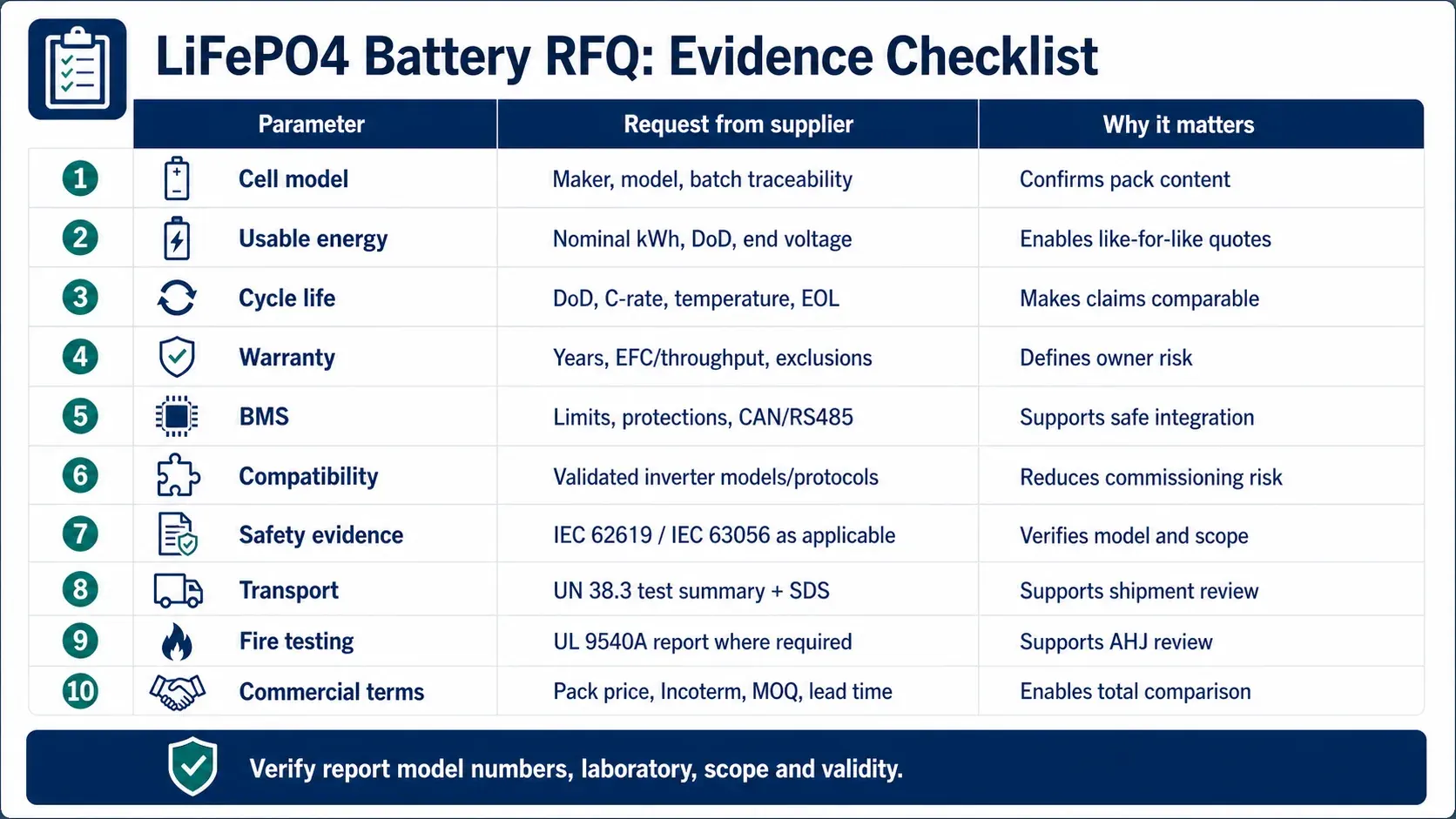
| Cell manufacturer/model | Declare manufacturer, model, capacity, batch traceability | Verifies what is actually inside the pack |
| Nominal & usable energy | State nominal kWh and usable kWh at specified DoD | Prevents misleading capacity comparisons |
| Nominal voltage / operating range | State complete voltage window | Required for inverter matching |
| Cycle life | Declare cycles/EFC at stated DoD, C-rate, temperature, and EOL SOH | Makes cycle claims comparable |
| Warranty | Years + throughput/EFC + end-of-warranty capacity | Defines commercial risk |
| Charge/discharge power | Continuous and peak current/power with duration | Confirms application capability |
| Efficiency | State test method and conditions | Affects energy economics |
| Operating temperature | Charge and discharge ranges separately | Prevents climate mismatch |
| BMS communication | CAN/RS485 protocol and supported inverter list | Reduces commissioning risk |
| Protection | OVP, UVP, OCP, OTP, short-circuit, isolation/contactors as applicable | Core pack safety functions |
| Safety evidence | IEC 62619 / IEC 63056 evidence as applicable; system-level reports when required | Verifies compliance scope |
| Transport | UN 38.3 test summary/report as applicable | Required for logistics planning |
| Fire propagation | UL 9540A report where required by project/code | Supports installation and AHJ review |
| IP rating | Specify indoor/outdoor requirement | Prevents enclosure mismatch |
| Scalability | Maximum parallel/rack/cabinet quantity and communication architecture | Important for future expansion |
| Commercial terms | MOQ, lead time, Incoterm, packaging, spare parts, after-sales response | Enables true landed-cost comparison |
Table 4: RFQ checklist for LiFePO4 battery procurement.
Add these battery requirements to your solar project BOM checklist so that battery, inverter, protection, cabling, and communication scope are evaluated together.
Supplier Evaluation: What EPC Buyers Should Verify Beyond Chemistry
The strongest B2B differentiation in battery procurement comes from supplier verification, not another list of chemistry advantages.
Before issuing a purchase order, verify:
- Cell traceability: manufacturer, model, production batch, and capacity grade
- Pack consistency: cell matching criteria and end-of-line QC
- BMS platform: firmware version, balancing strategy, log access, and fault history
- Inverter compatibility: validated communication protocol and tested inverter models
- Protection architecture: fuse/breaker/contactors, pre-charge, reverse-polarity strategy, and emergency isolation where applicable
- Thermal design: temperature sensing and derating logic
- Certification scope: exact model numbers covered by certificates and reports
- Warranty exclusions: temperature, C-rate, DoD, parallel limits, communication settings, and installation requirements
- Spare parts: replacement BMS, display, fans, contactors, breakers, and communication boards
- After-sales process: fault diagnosis, remote support, replacement policy, response time, and local service capability
For large projects, request a sample unit or pilot batch before full deployment. Factory acceptance testing and protocol verification can cost far less than diagnosing hundreds of incompatible battery modules after installation.
Can You Replace NMC with LiFePO4?
Replacing an NMC battery with LiFePO4 is possible in some systems, but it should not be treated as a drop-in chemistry swap.
The change can affect:
- cell series count and nominal voltage
- charge and discharge voltage limits
- SOC calculation
- balancing logic
- inverter voltage window
- CAN/RS485 protocol
- maximum charge/discharge current
- low-temperature charging rules
- mechanical enclosure and weight
Never assume that two battery packs with similar nominal voltage are interchangeable. For a retrofit project, verify inverter compatibility and confirm that the BMS, charger, inverter, and protection settings are approved for the new chemistry.
Different chemistries should also not be directly paralleled as if they were identical battery modules. Their voltage curves, BMS behavior, and charge/discharge limits differ. If a project genuinely requires mixed storage technologies, they should be engineered as separate controlled subsystems rather than improvised into one battery bank.
FAQ
Is LiFePO4 the same as lithium ion?
Yes. LiFePO4 is a type of lithium-ion battery. It uses lithium iron phosphate as the cathode material. In common search usage, “LiFePO4 vs lithium ion” usually means LiFePO4 vs NMC or another nickel-based lithium-ion chemistry.
What is the main difference between LiFePO4 and NMC lithium-ion batteries?
LiFePO4 generally prioritizes cycle life and thermal stability, while NMC generally prioritizes higher energy density and lower weight. For stationary solar storage, LFP is often preferred; for mobile or highly space-constrained applications, NMC can be attractive.
Which lasts longer, LiFePO4 or NMC?
Project-grade LFP products are commonly marketed with higher cycle-life specifications than comparable NMC products. The exact difference depends on DoD, temperature, C-rate, end-of-life definition, and pack design. Compare supplier test conditions before relying on cycle numbers.
Is LiFePO4 safer than NMC?
LFP generally has higher thermal stability than nickel-rich lithium-ion chemistries, which is one reason it is widely used in stationary energy storage. However, pack safety also depends on cell quality, BMS protection, electrical protection, thermal design, enclosure, installation, and fire-propagation behavior.
Which is cheaper: LiFePO4 or lithium ion?
There is no reliable universal answer based only on chemistry. Cell prices, pack design, volume, certification, warranty, Incoterm, and market conditions change. Compare pack-level price per usable kWh and then model replacement frequency and warranted throughput over the project life.
Is LiFePO4 better for solar energy storage?
For many residential, commercial, industrial, and telecom solar-storage applications, LiFePO4 is a strong default because stationary projects usually value cycle life, thermal stability, and lifecycle economics more than minimum weight. The final choice should still be based on the project’s space, power, temperature, voltage, and compliance requirements.
Can I replace an NMC battery with LiFePO4?
Sometimes, but the replacement may require changes to BMS configuration, voltage settings, charger/inverter parameters, communication, and protection. Confirm the complete system design before changing chemistry.
Can LiFePO4 and NMC batteries be mixed in the same battery bank?
They should not be directly paralleled as interchangeable modules. Their voltage profiles and control requirements differ. Mixed-technology projects require separate engineered power-conversion and control architecture.
What should an EPC contractor request before buying LiFePO4 batteries?
At minimum, request the exact cell model, usable capacity, cycle-life test conditions, warranty throughput, BMS protocol, inverter compatibility, safety and transport evidence, protection architecture, IP rating, scalability limits, lead time, Incoterm, spare-parts plan, and after-sales procedure.
Planning a commercial or industrial solar-storage project? Explore Ginza Solar’s 51.2V LiFePO4 battery series and high-voltage ESS solutions, or request a project quotation with your required capacity, inverter model, system voltage, application, and destination market.
Technical Standards Referenced
- IEC 62620:2014 + AMD1:2023 — Secondary lithium cells and batteries for industrial applications; performance-related marking, tests, and requirements.
- IEC 62619:2022 — Safety requirements for secondary lithium cells and batteries used in industrial applications, including stationary storage.
- IEC 63056:2020 — Additional/specific safety requirements for secondary lithium cells and batteries used in electrical energy storage systems.
- UN Manual of Tests and Criteria, subsection 38.3 — Lithium battery transport testing.
- UL 9540A — Test method for evaluating thermal runaway fire propagation in battery energy storage systems.
Use this comparison with a project specification
The chemistry decision becomes useful only after the load profile, site limits and warranty target are written down. Compare the exact proposed packs on usable energy, lifetime throughput, temperature limits, certified configuration and service plan. For a 51.2V LFP example, see the 330Ah sizing worksheet; for larger projects, use the commercial BESS RFQ specification. A chemistry label alone cannot establish a project’s safety or lifetime cost.