
Quick answer. A solar panel flash test report records the electrical result for a particular module or sample under a defined measurement method and reference conditions. Ask for the serial number, power at maximum power point, associated current and voltage, reference basis and uncertainty information. Compare these with the power bin and acceptance rule in the purchase order. Receiving a spreadsheet with a wattage column is only a starting point for verification.
The IEC technical report on production-line maximum power measurements identifies sources of error and uncertainty for reporting single-junction module output at standard test conditions (STC). IEC 60904-1 describes current-voltage measurement procedures. Confirm the applicable method, edition and any additional bifacial requirements with the supplier and inspection plan.
Read the power point and its measurement basis
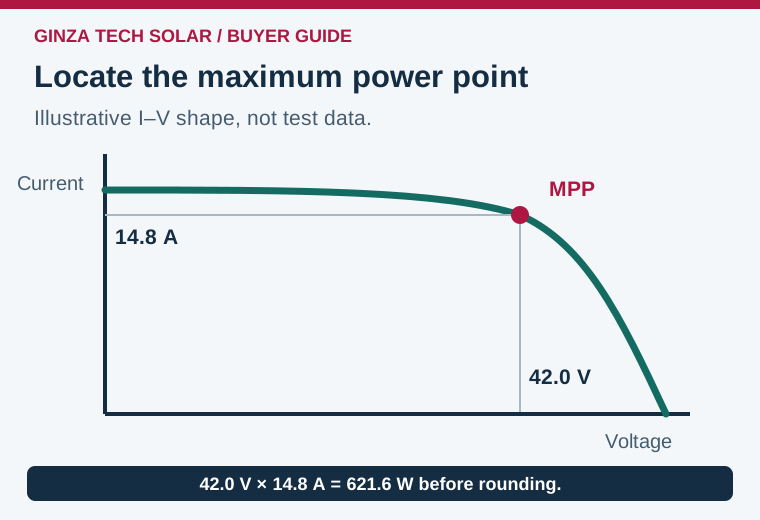
A flash or pulse simulator can be used to measure an illuminated module’s current-voltage characteristic. The maximum power point combines the voltage and current where their product is greatest on that measured curve. For a simple example, a maximum-power voltage of 42.0 V and current of 14.8 A correspond to 621.6 W before rounding. Open-circuit voltage and short-circuit current describe different endpoints; multiplying those two values does not give the measured maximum power.
STC is a defined reference, commonly reported at 1,000 W/m², 25°C cell temperature and the applicable reference spectral distribution. It provides a basis for comparison, not an energy prediction for your site. Read the report for the measurement and correction method, including the spectral, irradiance and temperature considerations relevant to the equipment. If the module is bifacial, verify how rear irradiance or rear-side contribution was handled and what particular rating the result describes. Keep front-side nameplate comparisons distinct from bifacial field yield.
Make each report row traceable
| Field | Ask the supplier to identify |
|---|---|
| Serial and model | Physical label, exact revision, assigned rated power and lot |
| Electrical result | Pmax, Vmp, Imp, Voc and Isc, with units and precision |
| Reference conditions | Method, test date, STC basis and any bifacial convention |
| Measurement quality | Simulator and reference device, calibration status, uncertainty scope |
| Disposition | Retest policy, excluded items, replacement serial and final decision |
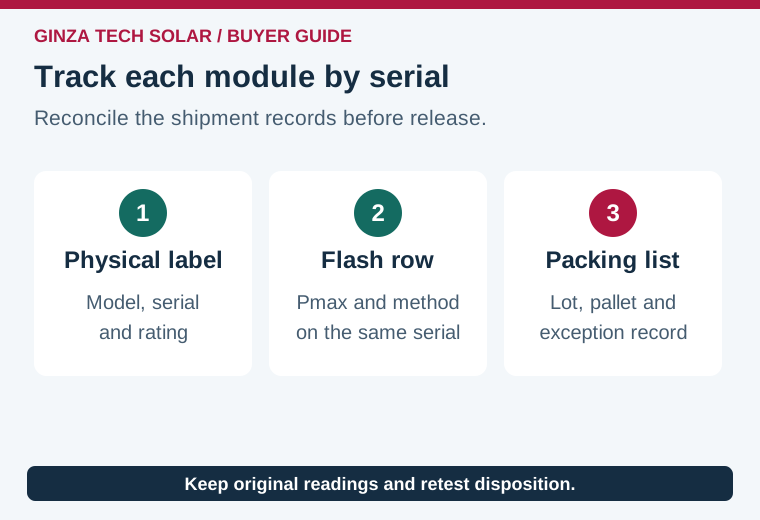
Check whether the file covers every serial or a named sample. Match serials to the actual label and pallet list, preserving leading zeros and the manufacturer’s original identifiers. A sample report is valuable evidence for the modules it identifies. The buyer should agree sampling, selection authority and follow-up for discrepancies in advance. A supplier’s formatted sample should not be represented as the final shipment record.
For purchases with several power bins, compare the electrical results to the serial-specific order or packing list. Shipments can include approved mixes if the project specifications allow it. Identify which alternative bins are allowed and who approves them. Give the system design team separate data for voltage and current checks. The PV string sizing guide explains why a comparable module wattage alone does not settle MPPT and cold-voltage constraints.
Reconcile the file as a register, not as a list to be accepted at face value. Compare the number of distinct serials in the promised scope with the number of shipment units, and flag duplicate or missing rows. If a serial was retested, preserve the original test and the reason the later result was selected. If a module was replaced, link the rejected serial to the new label and include the replacement’s record. Allow the responsible inspector to explain exceptions before the buyer signs the release.
Worked example: a result close to the lower boundary
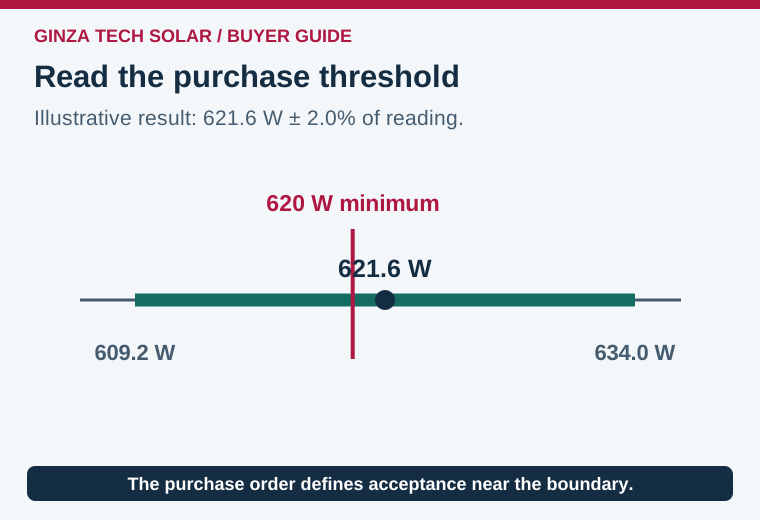
Consider a fictional 620 W minimum with no negative tolerance permitted by the contract. A report shows 621.6 W and a stated expanded measurement uncertainty of ±2.0% of reading for this illustration. The numerical interval is approximately 609.2 to 634.0 W, calculated as 621.6 × 0.98 and 621.6 × 1.02. The reported central result is above 620 W, while the lower endpoint of that stated interval is below it. The interval alone does not settle acceptability. The agreed decision rule determines whether the result passes, is held, or needs additional evidence.
A decision rule could require a guard band or specify another treatment of uncertainty. Do not introduce such a method after seeing the measurements. Also avoid combining commercial tolerance, bin rounding and measurement uncertainty as though they were the same quantity. A tolerance describes what the order accepts. Rounding controls how a number is displayed. Measurement uncertainty characterizes the measurement evidence. In a dispute, request unrounded values, the agreed uncertainty basis and any retest records before deciding which number to use.
In the example, a contract using only the measured central value would compare 621.6 W with 620 W and find a positive margin of 1.6 W. A hypothetical rule requiring the lower bound to meet the minimum would use the different comparison of 609.2 W with 620 W. These rules produce different outcomes from the same input. Ask which rule applies at factory release and at any independent receiving check, whether the uncertainty statement uses the same coverage basis, and how borderline items are tagged while the parties reconcile them.
Ask about simulator class and independent checks
IEC 60904-9 describes solar simulator classification using spectral match, irradiance nonuniformity and temporal stability. A simulator classification is relevant evidence, but it is not the reported uncertainty for a particular module result. Ask how the reference device, calibration chain, module technology, test method, correction and repeatability are handled. When comparing two labs, verify traceability and method details before treating a small numerical difference as a true module discrepancy.
Keep flash, visual inspection and electroluminescence evidence together where the contract calls for them. Flash reporting addresses electrical performance under the named test basis. EL can reveal internal patterns and is interpreted with separate evidence. The EL shipment checklist explains how to reconcile EL filenames, serials and finding dispositions. The 620 W procurement worksheet shows where the ordered power class fits into the larger design and quantity calculation.
Finalize the document package before shipping
Request a small sample file early enough to confirm that the import process preserves units and serials. A buying team may need both a machine-readable table and an issued report identifying method, responsibility and revision. Assign a single version for final approval. A later spreadsheet export should not overwrite evidence used to approve an earlier shipment. Include a date, lot, report revision and decision owner on the approval record.
Where independent testing is in scope, agree the chain of custody and who chooses the sample. A repeat result is useful only if the compared module is the same item and the method is appropriate to its design. Establish how expected inter-laboratory differences will be handled before testing. This avoids relying on whichever result appears more favorable once the shipment is already waiting.
Put the test basis, serial coverage, result fields, tolerance, uncertainty handling and retest authority in the purchase order. Specify whether a final document file is required before shipment authorization. When received, compare a defined sample of physical labels with the final packing list and flash rows, then log discrepancies by serial rather than correcting the supplier file silently. For help reviewing the module range and evidence scope, see the GINZA PV module options and send your rated-power and shipment documentation requirements.