
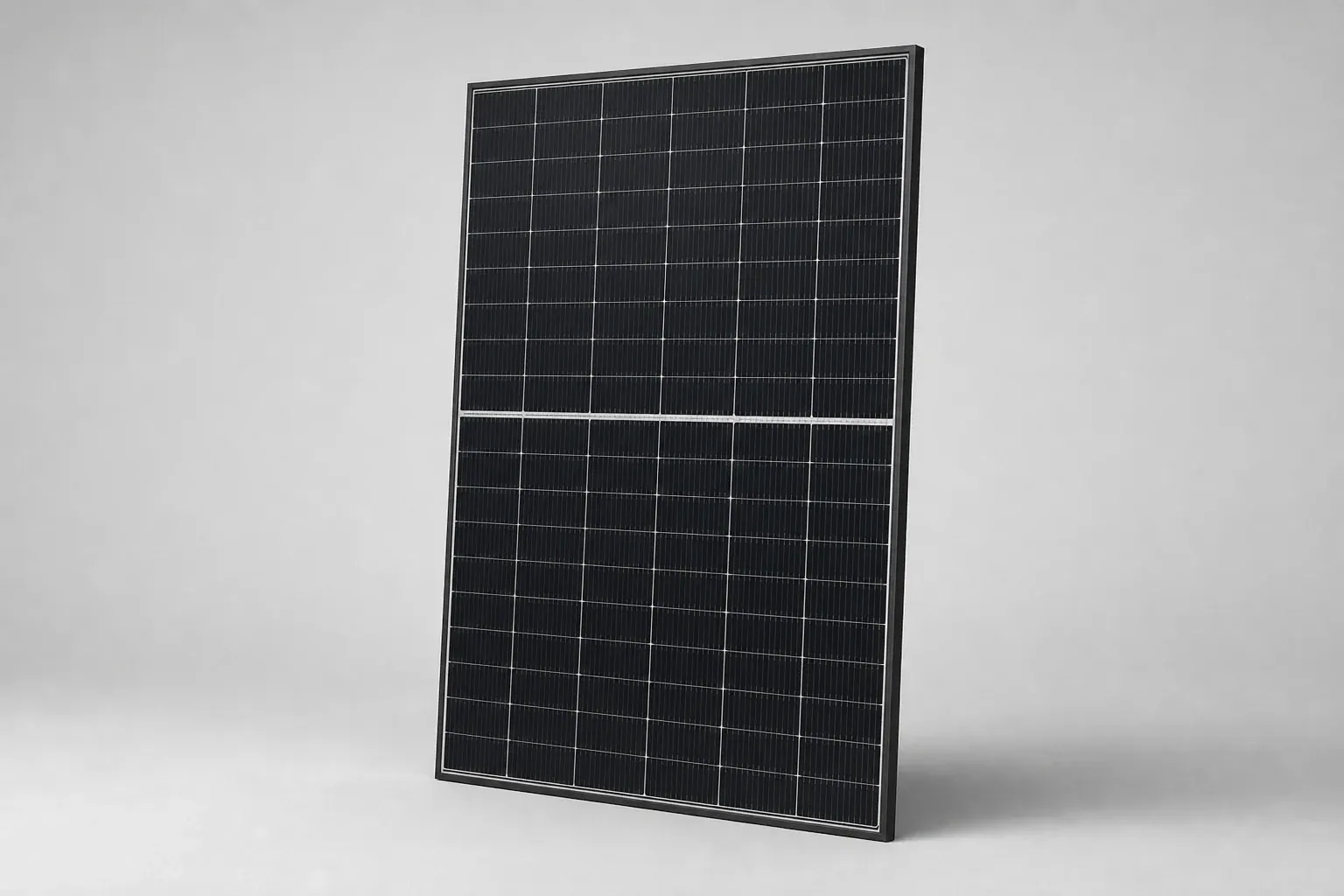
Quick answer: The GINZA GIZ620-78 is listed at 620 W, 2465 × 1134 × 30 mm and 34.3 kg per module. For a 100 kWp DC nameplate array, 100,000 ÷ 620 = 161.29, so an initial whole-module count is 162 modules, or 100.44 kWp DC. The combined module face area is about 453 m² and module-only mass about 5.56 tonnes. Neither figure is the required roof or carport footprint, nor a structural design load.
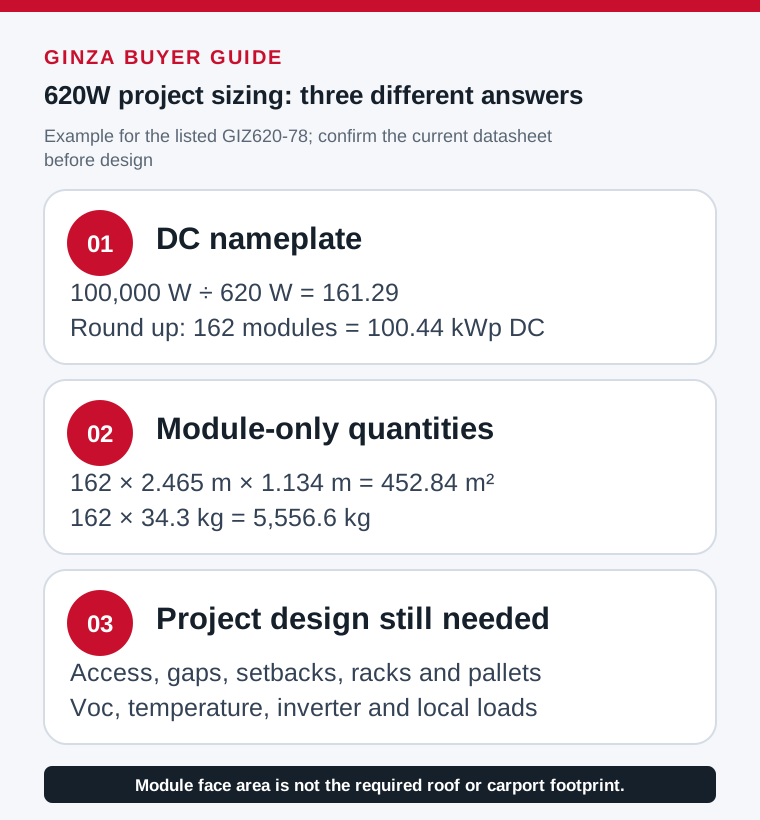
This worksheet is for EPC estimators, installers and wholesale buyers comparing a specific module with a project BOM. It uses the confirmed values on the GINZA GIZ620-78 product page. Request the current model-specific datasheet before final electrical design, procurement or submission to an authority.
Confirmed 620W module facts and planning calculations
| Item | Value | How to use it |
|---|---|---|
| Nameplate maximum power | 620 W under stated rating conditions | Initial DC capacity and module count |
| Module dimensions | 2465 × 1134 × 30 mm | Face area, layout and handling review |
| Module weight | 34.3 kg | Module-only transport and support estimate |
| Face area | 2.465 × 1.134 ≈ 2.795 m² | 162 modules ≈ 452.84 m² of module surface |
| 100 kWp DC starting count | Ceiling(100,000 ÷ 620) = 162 | 162 × 620 W = 100.44 kWp DC |
| Module-only mass for 162 | 162 × 34.3 = 5,556.6 kg | Excludes racking, cables, pallets, packaging and other loads |
The displayed area is the sum of rectangular module faces. A real layout also needs access paths, setbacks, row spacing, shading clearance, gaps, fire and maintenance requirements. Pallet and gross shipment weight require the actual packing plan. Do not price a roof or foundation from the 5.56-tonne module sum alone.
100 kWp DC is not the same as 100 kW AC
Module count sets a DC nameplate rating. Inverter AC rating is a separate design decision. For example, if an engineer chose a project-specific 1.20 DC/AC ratio for a 100 kW AC inverter, the preliminary DC target would be 120 kWp and the arithmetic would give 194 modules (120.28 kWp DC). The 1.20 ratio here is only an illustration, not a recommendation for every climate or inverter. The engineer must model irradiance, clipping, temperature, export limits and local rules.
NREL’s System Advisor Model describes DC nameplate capacity as module count multiplied by module rated power. It also shows why modules per string and parallel strings must be specified separately from the total module count.
Electrical checks before a string plan
A 620W label does not give enough data to declare a series string safe. Obtain the exact GIZ620-78 electrical datasheet and the proposed inverter’s input specification. The cold-corrected open-circuit voltage of every series string must stay within equipment and code limits; hot operating voltage must remain inside the inverter’s MPPT window. Current, fuse and cable sizing also depend on the actual module and site conditions. NREL specifically notes that site minimum temperature and module voltage coefficients affect the maximum safe modules per string.
| Request from supplier or designer | Why it matters |
|---|---|
| Voc, Vmp, Isc, Imp and temperature coefficients for the exact model | Cold voltage, operating range and current review |
| Maximum system voltage, series fuse rating, connector and cable specification | Protection and interface compatibility |
| Inverter model, MPPT voltage/current limits and input count | String and parallel configuration |
| Record low and high site temperatures, orientation and shading plan | Electrical limits and annual-yield modeling |
| Approved mounting zones and front/back mechanical load ratings | Clamp and structure design |
Bifacial rear-side generation is a site-dependent yield input. Do not add a universal “bifacial bonus” to the 620 W nameplate when counting modules. Compare actual module technology in the TOPCon versus PERC guide and use project simulation for yield.
Copyable EPC quote brief
Send: project country and site type; target DC and AC power; planned inverter make/model; layout drawing and usable dimensions; 620W model and acceptable alternatives; desired quantity; string-design owner; wind/snow and mounting requirements; destination port; target delivery window; and required model-specific datasheets or test evidence. The solar project BOM checklist covers the rest of the procurement package. For a parking canopy, also use the carport structural input brief.
Common calculation mistakes
- Calling 162 modules “100 kW AC” without specifying the inverter.
- Treating module face area as the final site footprint.
- Using one model’s Voc, connector or clamp zone for another 620W product.
- Ignoring packaging and racking in transport and structural calculations.
- Promising annual output from nameplate watts without local resource and loss modeling.
Worked worksheet: from a capacity target to an order quantity
Write down whether the target is a minimum DC nameplate capacity, a rounded marketing description, or a contractual AC output. They produce different answers. If the request is at least 100 kWp DC using only the listed 620 W module, 161 panels yield 99.82 kWp and miss the threshold; 162 panels yield 100.44 kWp. If the buyer is allowed to use a tolerance band or a mixed module BOM, agree that rule before counting. Do not quietly label a 99.82 kWp array as a guaranteed 100 kWp.
| Whole modules | DC nameplate | What it means |
|---|---|---|
| 160 | 99.20 kWp | A convenient round quantity, below an at-least-100 kWp requirement |
| 161 | 99.82 kWp | Still below 100 kWp DC |
| 162 | 100.44 kWp | Smallest whole-module quantity above 100 kWp for this 620 W model |
| 165 | 102.30 kWp | May fit a different layout or spare strategy; do not add without a reason |
A simple procurement sheet should show model, rated watts, whole-module count, calculated DC kWp, module dimensions, unit mass, and the datasheet revision on the same line. Record the source and date of each value. That makes it easier to catch a later substitution to another “620W” panel with a different size, connector, weight or electrical characteristic.
Turn module area into a layout question, not a site promise
For this model, 2.465 m × 1.134 m gives roughly 2.795 m² of rectangular face per panel. Multiplying by 162 produces about 452.84 m². To see why that is not a footprint, imagine arranging 18 modules across and 9 modules down in portrait orientation: the tight, no-gap rectangle would be 44.37 m × 10.206 m. That drawing has no inter-module spacing, access aisle, edge setback, tilt projection, maintenance route, row-to-row shade clearance or mounting tolerance. The 18-by-9 grid is a geometric illustration only; it is not an electrical string schedule or an approved layout.
A roof survey should mark obstructions, skylights, parapets, drainage, fire access and structurally usable zones. A ground or carport layout needs column geometry, traffic and maintenance clearances. Ask the designer to return a numbered module layout and an explicit “not fitted” count if some of the 162 cannot be placed. That is a better decision point than forcing the target quantity into a site that has not been measured.
Compare supplier offers on equivalent evidence
Two quotes can both say “620W” and still create different engineering or logistics costs. Put each offer in the same comparison table: exact manufacturer and model; datasheet revision; dimensions and mass; Voc, Vmp, Isc, Imp and temperature coefficients; approved clamp zones; connector and cable; warranty document; test and certification evidence for the destination market; packing configuration; lead time and Incoterm. Leave a field blank when the supplier has not supplied evidence, rather than guessing from a similar model.
For an inverter proposal, ask the EPC to record the coldest design temperature, maximum string Voc, hot operating Vmp, MPPT input limits, number of series modules and parallel strings. If that sheet is missing, a module quotation is still possible, but a “complete system” price has unresolved design risk. The inverter selection guide explains the interface questions; the final configuration belongs to the project designer.
A short acceptance rule for the buyer
Before releasing a purchase order, confirm that the approved layout fits the required number of the same revision of the specified module; the engineer has checked structural and electrical interfaces; the offered packing and shipment plan can handle the actual quantity; and the commercial quote identifies who supplies spares and who bears a substitution cost. If one condition is open, mark it as a hold point. The early 162-module result is a useful starting quantity, but the signed BOM and drawings are the order basis.
Frequently asked questions
How many 620W panels make 100 kWp?
162 whole modules give 100.44 kWp DC. A 100 kW AC system may need a different DC count, depending on the approved DC/AC ratio and inverter design.
Are all 620W panels the same size?
No. The dimensions here apply to the listed GINZA GIZ620-78. Confirm another model’s datasheet before comparing layouts or shipping.
Can 620W modules go on a carport?
Potentially, but the local structural designer must check module size, approved clamp zones, wind and snow loads, clearance and the complete canopy design.
Is 620W the output during every sunny hour?
No. It is a nameplate rating under specified test conditions. Actual output changes with irradiance, temperature, orientation, shading and system losses.