
Quick answer. IEC 61215 addresses PV module design qualification and type approval. IEC 61730 addresses module safety qualification, with construction and testing requirements in its respective parts. For a purchase, ask which editions, models, constructions and production locations the evidence covers. Trace that scope to the exact module being offered, then check the destination and project’s requirements with the responsible reviewer.
This guide helps an EPC or wholesale buyer review a document package. It does not certify a GINZA product. The examples describe how to investigate coverage and identity before relying on a certificate in a project submission or shipment approval.
Understand the question each document answers
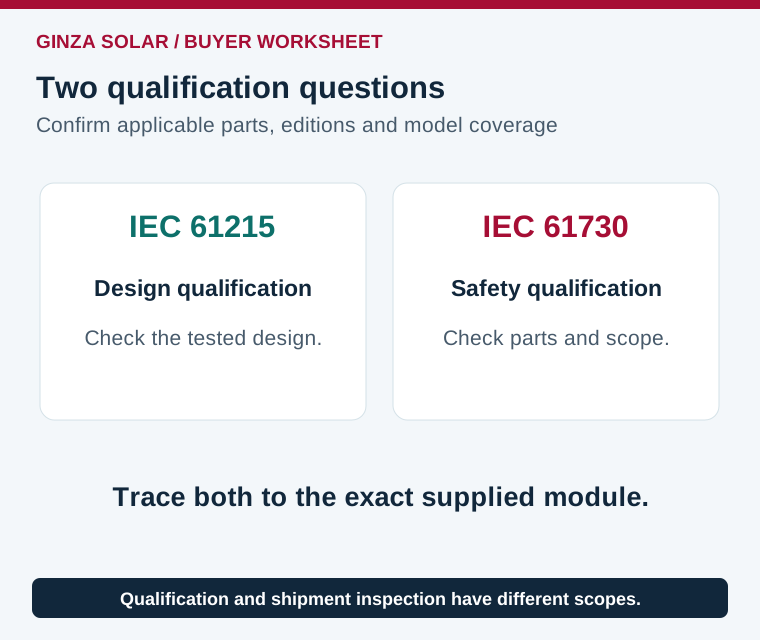
The IEC description of IEC 61215-1:2021 identifies design qualification for terrestrial PV modules intended for long-term outdoor operation. IEC also states that the test results do not quantitatively predict module life. Treat the qualification evidence as information about the tested design and method. Keep any power warranty, product warranty and project energy estimate on their own documented basis.
The IEC description of IEC 61730-1:2023 identifies construction requirements for safe electrical and mechanical operation, with testing addressed by Part 2. The safety scope and the design-qualification scope complement each other. Confirm the complete applicable parts and editions for the offered module. A short quotation saying only “IEC certified” leaves too much of the evidence undefined.
Do not stop at a Part 1 cover page. IEC 61215-2:2021 describes test procedures within the design-qualification series. Ask the responsible reviewer to identify the applicable technology-specific requirements and full test scope as well as the general requirements. For safety, check the IEC 61730 construction and testing evidence together. The complete package and its edition requirements depend on the module and project.
| Buyer question | Evidence to request | Additional review |
|---|---|---|
| Which design was qualified? | Relevant IEC 61215 scope and model or family coverage | Construction and revision of the offered module |
| What safety qualification is covered? | Relevant IEC 61730 parts, editions and scope | Configuration and destination requirements |
| What will arrive in the shipment? | Model codes, labels, factory and serial traceability | Match the order to the document package |
| What service is guaranteed? | Written product and power warranty terms | Conditions, exclusions and claim route |
Follow the identity from quote to label
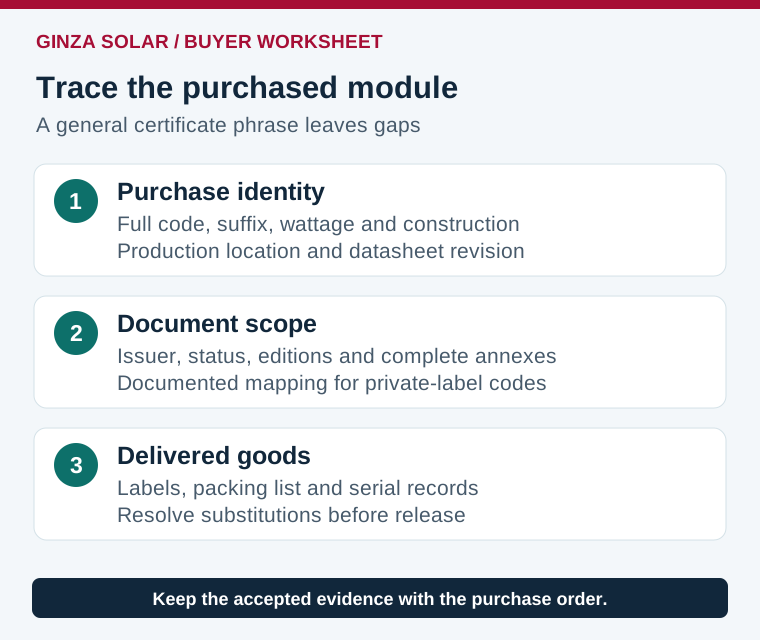
Start with the complete product code and wattage range in the offer. Obtain the manufacturer identity, production facility, module construction revision, dimensions, frame, cell arrangement and other identifiers relevant to the certificate scope. Ask for the certificate and the relevant annexes or model lists. A family name on a cover page may not show whether the offered suffix or configuration is included.
Compare those identifiers with the actual label and packing plan. If the manufacturer and seller use different names or private-label codes, request the documented relationship and covered model mapping. Have the issuer or authorized party resolve a mismatch. Preserve the clarification with the order instead of assuming that a familiar photograph proves the two products are identical.
Check the issuer and document record
Use the issuing body’s official verification route where available. Compare certificate or report number, document status, date, scope and listed manufacturer. Request the complete document needed by the project, not a cropped screenshot without its annexes. If the issuing body distinguishes test reports from certification decisions, identify which one the supplier has provided.
A correct document number is only part of the review. Check that the model list, edition and construction still correspond to the supply. Ask how design changes, component substitutions or additional manufacturing sites are controlled under the applicable certification arrangement. Refer unresolved questions to the issuer, manufacturer and project reviewer rather than inferring continued coverage from a similar product.
Worked example: an unlisted model suffix
Suppose a fictional quote offers model ABC-620-B, but the supplied annex lists ABC-600-A through ABC-630-A. The wattage falls inside the listed range, yet the suffix differs. The buyer should ask what B changes, whether the offered construction is covered and which document establishes the mapping. A shared wattage does not resolve that identity question.
Record a hold point for the model or document clarification before releasing the order. If the supplier revises the offered product, update the datasheet, mounting and electrical inputs as needed. The string sizing worksheet and clamp-zone checklist show why a revision can affect project design as well as the paperwork. Once the reviewers accept the scope, put the agreed identifiers in the final BOM.
Keep shipment testing and project approval visible
Qualification evidence for a design does not provide the receiving record for every delivered unit. Specify any production, flash, visual, EL or independent inspection evidence needed by the order, with serial numbers and an agreed decision process. The EL shipment acceptance guide describes how to maintain comparable images and traceability.
Destination acceptance can require documents or approvals beyond these two IEC families. Obtain the requirements from the project engineer, authority, utility and other responsible reviewers for the actual location and use. A roof project, a particular fire requirement or a public tender may set additional conditions. State who checks the package and who can release the related procurement hold point.
Make the document package usable after handover
- Put certificate numbers, editions, complete model codes and annex revisions on the document register.
- Keep the current datasheet, installation manual and approved construction identifiers with the register.
- Connect the final packing list and shipment serials to the accepted model and production site.
- Record any clarifications, substitutions and reviewer approvals with dates and responsibilities.
- Preserve warranty terms and the claims contact with the project handover files.
Ask for the register early enough for corrections. If a tender needs a particular edition or evidence route, resolve that requirement before pricing is finalized. Avoid buying equipment first and discovering at submittal that the supplied record does not match the project. The review should produce a clear disposition for each requirement: evidence accepted, clarification required, or a named alternative pending approval.
For repeat orders, confirm whether the offered model, factory and construction match the previous accepted order. Request the supplier’s change notice and revised evidence when they differ. Reusing last year’s file set without checking the new identifiers can hide a substitution. A short, maintained document register is more useful than a large unstructured folder that nobody can connect to the goods.
Use a simple coverage table when several products are offered. Put one complete purchase code on each row and identify its datasheet, certificate annex, production location and status of clarification. If one row remains unresolved, separate it from the items already accepted so the order can be reviewed deliberately. Do not assume that a document accepted for the first wattage or frame version automatically closes every row.
Ask the reviewer to record the reason for each acceptance and the evidence version used. If an authority or tender asks for a different part or edition, identify that as a new requirement and resolve it with the supplier before shipment. Keep translation and document-format requirements in the same register. An otherwise appropriate record may still need the complete annex or an authorized language version to be usable in the project’s submission process.
Frequently asked questions
Is IEC 61215 a promise of a fixed module lifetime?
IEC states that its qualification results do not quantitatively predict lifetime. Evaluate warranty terms and site performance assumptions separately.
Can IEC 61730 replace IEC 61215?
They address different qualification scopes. Ask the project reviewer which complete parts and editions are required.
Does one certificate cover every wattage or label?
Read the full scope and annexes and obtain documented model mapping for the actual offer.
Can a supplier’s certificate screenshot be sufficient?
Request the complete evidence needed to verify issuer, status, model coverage and annexes through the project’s approval process.
References and document request
- IEC 61215-1:2021 official scope and publication record
- IEC 61730-1:2023 official scope and publication record
View GINZA document references and request the evidence for the exact quoted module with the destination and project requirements.