
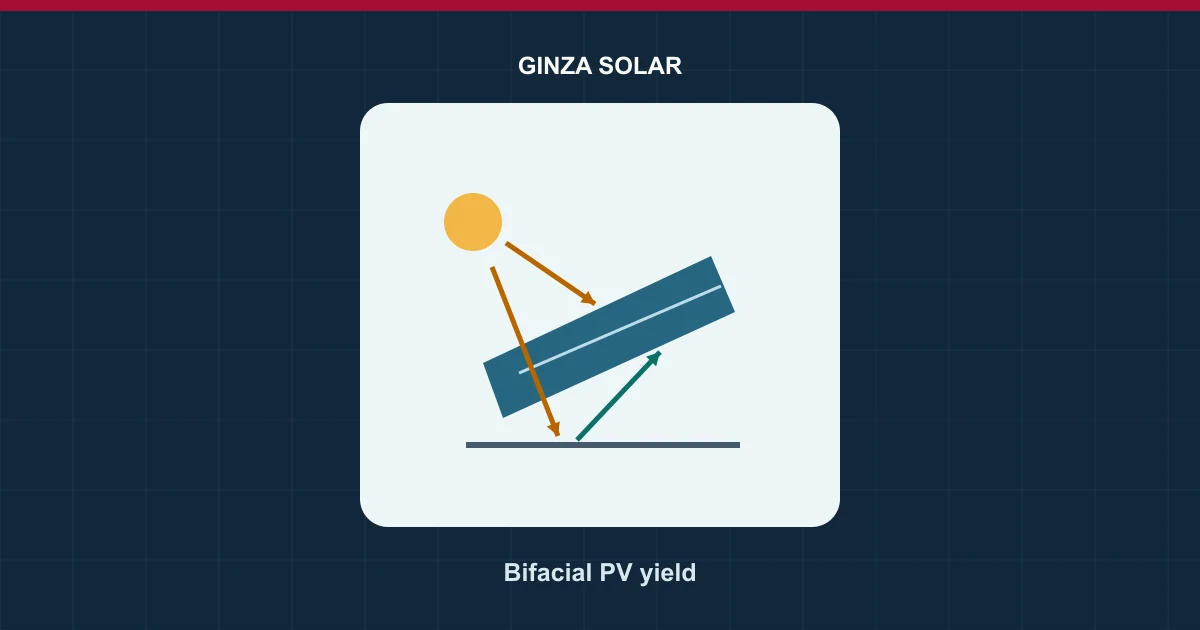
Quick answer. Bifacial solar panel gain is the energy advantage of a specified two-sided system relative to a named baseline. The rear side needs light to deliver that advantage. Ground reflectance, module clearance, row spacing, structures, shading and electrical constraints all affect the result. Ask for a matched comparison at the same AC meter. A rear-side datasheet rating or a bright-looking surface alone does not establish a project’s annual gain.
This guide is for EPC teams comparing a roof, carport or ground-mounted design and checking what a supplier means by a quoted percentage. The worked cases illustrate how to read the proposal and expose its assumptions before ordering modules or finalizing the layout.
Separate albedo, bifaciality and annual AC gain
| Term | What it describes | What to ask for |
|---|---|---|
| Albedo | Fraction of incident radiation reflected by a surface on the stated basis | Surface type, seasonal evidence, source and whether conditions persist after construction |
| Rear plane-of-array irradiance | Light reaching the back of the installed module plane | Geometry, shadows, ground view, weather data and rear model |
| Module bifaciality | Rear-to-front response on the defined rating basis | Exact module revision, test basis and which metric the ratio describes |
| Annual AC bifacial gain | Incremental AC energy relative to the declared comparison case | Same weather year, losses, model boundary and a clearly identified baseline |
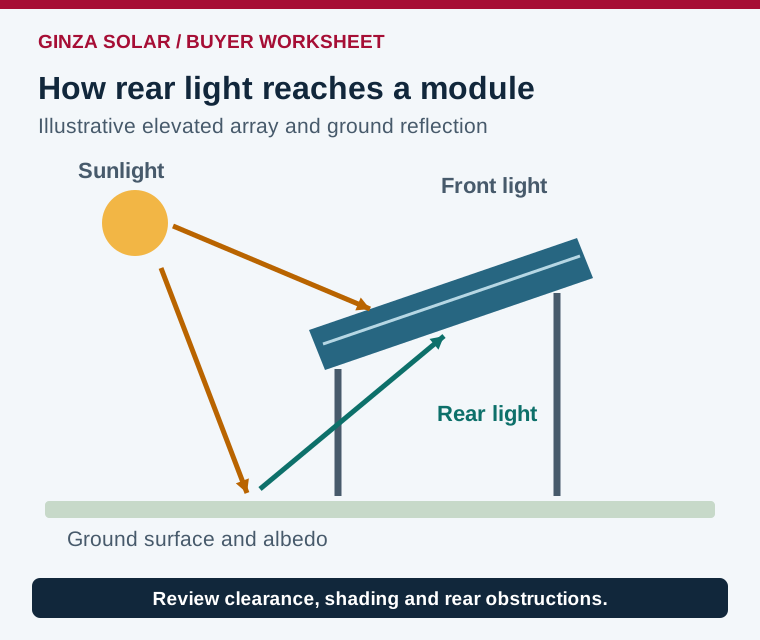
High albedo can help, but geometry decides how much reflected light reaches the rear plane. Close-mounted modules see a limited part of the roof and their shadows can darken that view. Modules higher above open ground may see more reflected and diffuse light. Support members, trays and other modules can still obstruct sections of the rear surface. The same panel can therefore have different rear exposure on a warehouse roof, elevated carport and open-field rack.
A manufacturer may report a bifaciality factor for power or another electrical quantity under specified conditions. Use the value appropriate to the model and request the supporting data for the supplied module. Multiplying the front rating by that ratio does not give extra watts available all day. Bifaciality describes response to rear light. The irradiance at the rear of the installation still has to be estimated.
Run a simple screen before modeling annual yield
Assume a fictional moment with 800 W/m² front irradiance, 80 W/m² rear irradiance and an appropriate bifaciality factor of 0.70. A simple weighted-irradiance screen gives 800 + 0.70 × 80 = 856 W/m². The incremental 56 W/m² is 7% of the front irradiance at that instant. The estimate treats the two sides as uniformly illuminated and omits temperature, mismatch and conversion effects. It illustrates why 10% rear-to-front irradiance is different from 10% extra AC energy.
Repeat the screen with 40 W/m² rear irradiance and the same front conditions. The increment becomes 28 W/m², or 3.5% of the front value. Neither case estimates annual generation. At different hours the rear share changes, and extra DC power can land in hours when the inverter is already limited. Use a validated hourly or finer simulation, with site geometry and both front and rear irradiance modeled, to estimate the actual annual AC effect.
Electrical design needs a separate check. Rear exposure can increase module current under certain conditions. Use the exact module data and the required design method for current. Check MPPT operating and short-circuit ratings, cabling and protection. The solar panel string sizing worksheet separates those checks from the annual production estimate.
Worked example: isolate the rear contribution at the AC meter
Suppose a 500 kWp conceptual project has two simulation runs with the same location, weather year, layout, front-side module model, inverter, losses and meter boundary. In one run rear response is disabled, giving 675 MWh AC per year. The other includes modeled rear contribution and gives 715 MWh AC. The incremental energy is 40 MWh. Divide by the 675 MWh baseline to get 5.9% incremental annual AC yield. These are fictional model outputs to illustrate the comparison.
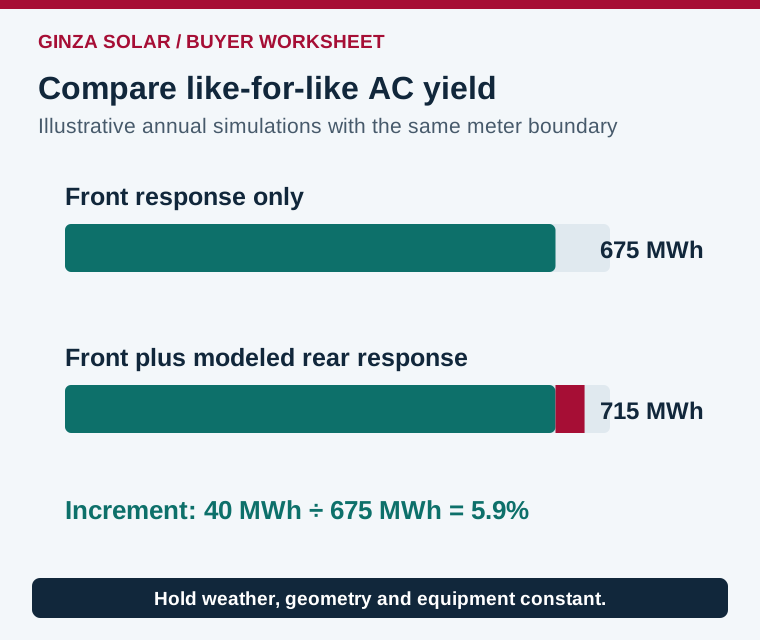
If the competing bid also changes the panel wattage, row pitch, inverter loading ratio or available module count, the total AC yield difference no longer isolates bifacial gain. Ask for a separate project comparison that lists all changes. A design with wider spacing may improve rear exposure per module while reducing the number that fits. Report annual site MWh, useful energy at the meter and any layout or construction changes that alter cost.
Ask for a low, base and high rear-exposure case, using defensible assumptions for albedo and shading. Compare how much of the improvement is lost to clipping, export curtailment or mismatch. For surfaces that may darken, change with the seasons or be altered after handover, ask how the model handles those changes. A one-off clean-roof assumption can overstate performance if the surface condition is temporary.
When comparing bids, put annual AC production and usable on-site energy on separate lines. Extra production has a different value if it occurs when loads are low, the battery is full or export is limited. Ask the bidder to show the hours in which the two cases diverge, then compare the cost of any taller structure, roof treatment or maintenance needed to preserve the modeled result.
Collect evidence before ordering modules or changing the layout
- Survey the surfaces. Record roof or ground material, planned treatment, adjacent obstructions, shading and maintenance assumptions. Date any measurement or photo.
- Freeze the geometry. Obtain a dimensioned plan with tilt, row pitch, module height, ground clearance and significant rear obstructions.
- Request the model inputs. Ask for the exact module file, bifaciality basis, irradiance model and weather data. Record the scenario and software revision used for the quote.
- Check the electrical limit. Confirm module current and the inverter, connector and protection limits for the design conditions.
- Agree the handover evidence. Ask for the scenario files, energy loss diagram, agreed boundary and the procedure for evaluating performance if the project later changes.
On a retrofit roof, confirm that ballast, attachments, access routes and structure can support changes to clearance or row spacing before accepting the yield case. On a parking canopy, record structure and beams that can shade the rear. The module clamp and mounting worksheet helps procurement capture the mechanical interface, and the 620W project worksheet explains how to separate module count from usable site area.
If the project includes performance monitoring, ask the designer to propose the meter boundary and locations for front and rear irradiance sensors. A single rear reading near a bright edge can miss non-uniform light in the middle of the array. Capture irradiance, temperature and inverter limits during evaluation. Agree the comparison period, data quality rules and treatment of curtailment before interpreting a short measurement campaign as annual performance.
Frequently asked questions
How much extra energy does a bifacial panel produce?
Ask for a modeled AC range for the site. The result depends on the reference case, the rear light available and conversion limits.
Does a white roof guarantee high gain?
Reflectance can help when the module rear sees the surface. Verify clearance, obstructions, actual roof condition and long-term maintenance before relying on the model.
Is bifacial gain the same as bifaciality?
Bifaciality characterizes the module’s rear response on a specified test basis. Gain measures a modeled or measured difference against a comparison case.
Which documents should I request with a quote?
Request the module datasheet, bifaciality basis, supported model file, mounting drawing, yield comparison and current calculations tied to the same equipment revision.
References and project quotation
- Sandia PV Performance Modeling Collaborative, rear-irradiance view factor models
- PVsyst bifacial system modeling and rear irradiance assumptions
Compare GINZA n-type bifacial module options and request the current datasheet and modeling inputs with the layout and inverter details for your project.