
Quick answer. Choose a cold-site LiFePO4 battery using its permitted charging temperature and current, measured at the locations required by the manufacturer. The discharge range can differ from the charging range. If heating is needed, verify the exact heated configuration, its power source, energy use and BMS behavior before ordering. Outdoor air temperature and an enclosure heater setting do not by themselves prove that the cells are ready to charge.
This guide is a procurement and commissioning checklist for installers and project buyers. Temperature limits and control procedures are model specific. Request the current pack, heater and inverter documentation and have the system designer approve the complete arrangement.
Read charging, discharge and storage ranges separately
A battery data sheet may specify different limits for charging, discharging and storage. Copy the limits and any current-versus-temperature restrictions into the equipment comparison. Ask which sensor or cell measurement controls each limit, how the BMS communicates it and what conditions permit recovery. An operating-temperature headline can hide an important difference between services.
For example, the GINZA 51.2V 330Ah Gen5 reference page lists charging at 0–55°C and discharging at −20–55°C. Use the current model-specific documentation to confirm the offered unit and control details. The colder discharge endpoint does not extend the stated charging range. Other battery families can specify different thresholds and charging currents.
| Ask for | Why it matters | Evidence to keep |
|---|---|---|
| Charge and discharge limits | The services can have different allowed conditions | Current model datasheet and operating manual |
| Sensor location and behavior | Cell and ambient temperatures can differ | BMS documentation and test record |
| Approved heater configuration | Heating must be coordinated with charging and protection | Wiring, controller and supported settings |
| Heater supply and energy | Warmup consumes energy or charging headroom | Power requirements and duty estimate |
| Failure and recovery | A failed sensor or heater changes availability | Alarm, inhibit and restart requirements |
Distinguish air temperature from battery temperature
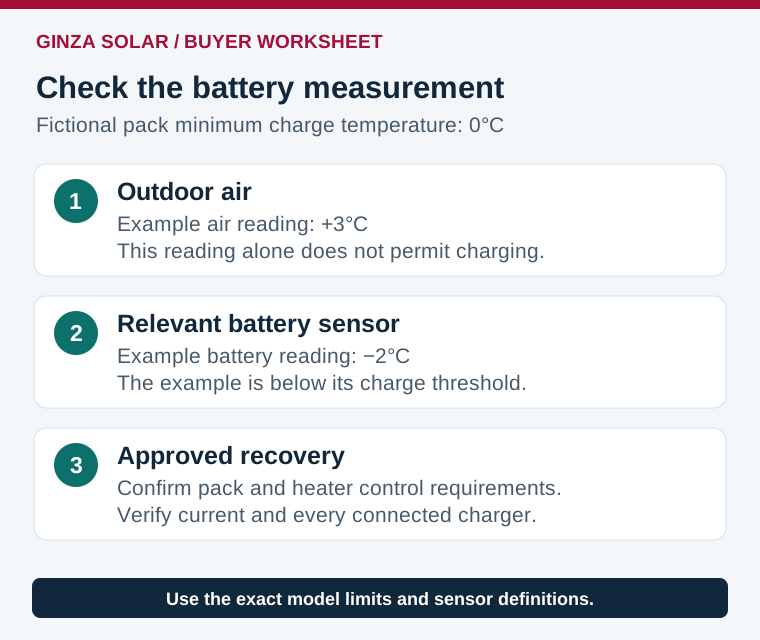
A cold battery can remain cold after the surrounding air warms. Conversely, an insulated and heated battery can be warmer than the outdoor air. The condition relevant to charging is the one specified by the pack manufacturer and observed by its approved control system. Ask whether the temperature signal used by the inverter represents a relevant pack measurement or only a sensor elsewhere in the enclosure.
For a hypothetical pack with a 0°C minimum charge temperature, +3°C outdoor air and a −2°C relevant battery reading would not satisfy that minimum. If the same pack is warmed to an approved operating condition, charging may become available subject to its other limits. The designer must confirm current limits, sensor accuracy, hysteresis or recovery logic and the behavior of all connected chargers.
Verify the heating path and source
Ask whether the offered pack has an integrated approved heater or needs an external temperature-controlled enclosure. Identify which power source runs it, when it is enabled and how the BMS coordinates charging. A heater powered from the battery reduces available stored energy. A heater using incoming solar or grid energy may take power or time before the cells can accept charge.
Confirm the behavior when the available source is weak, the battery is near its discharge limit or communications are lost. If the design depends on a charger powering heating before charging begins, request evidence for that exact combination. Include enclosure, ventilation, moisture and condensation considerations in the site design. Do not infer an approved heated configuration from an unheated product photograph or a generic heating accessory.
Ask the supplier how the installation establishes that all relevant cells have reached an allowed condition. A warm enclosure corner or one favorable sensor reading can be insufficient if another part of the pack remains colder. The approved sensor arrangement and controller logic should define that decision. Include the most unfavorable starting condition and any time required for temperatures to stabilize in the cold-start evaluation.
For a remote site, specify what happens when heating cannot complete. The system may need to keep charging inhibited, report an alarm and preserve remaining energy for a defined load. Have the owner decide the service priority and the approved recovery action. Record who receives an alarm and what local inspection or service is needed. A practical winter plan connects the controls with the people and energy sources available at the actual installation.
Worked example: include warmup in the energy plan
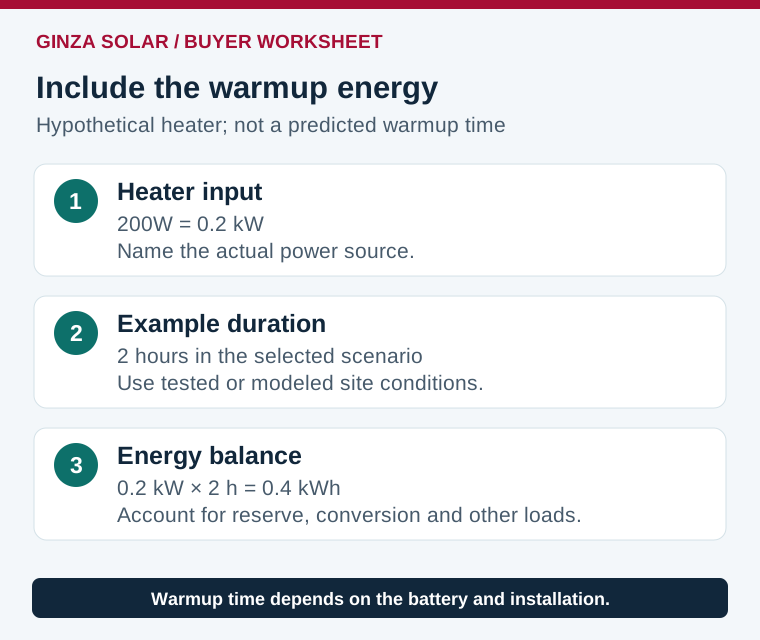
Assume a fictional heater draws 200W for two hours during a selected event. Its energy input is 0.2 × 2 = 0.4 kWh. If battery energy supplies it, that consumption belongs in the reserve calculation. If only 2 kWh of useful incoming energy is available in the same decision window, the heater’s 0.4 kWh is material. Conversion losses and other equipment loads may further reduce what is stored.
The assumed two-hour duration is not a predicted warmup time. Actual heating depends on battery mass, starting temperature, heat losses, insulation, heater control and site conditions. Ask the supplier for a duty estimate or test at the relevant conditions and compare repeated cold mornings. Record whether the daily dispatch restores enough energy for the next heating and operating cycle.
Confirm that every charger honors the BMS
Inventory the inverter, solar controllers, grid chargers and any generator-driven charging source. Identify how each receives the allowed charge current or temperature-related inhibit, and verify the supported response. A system can still have a problem if its main inverter follows the BMS but a separate charger does not. Put the communications and wiring responsibility in the quote.
Ask for the approved configuration rather than adjusting protection thresholds to force operation. For comparison, Victron’s Lithium Smart technical data specifies charging from +5°C to +50°C for that equipment family. Its lower limit differs from the GINZA reference above, demonstrating why 0°C must not be treated as a universal charging permission for every LiFePO4 pack. Use the battery-inverter compatibility checklist to document the protocol, firmware and command behavior for the actual project.
Write a cold-start acceptance case
- Define the battery starting condition, site temperature case and available heating or charging supply.
- Record the relevant battery temperatures, heater state, permitted charge current and actual current on one clock.
- Show that charging remains within the model’s limits during warmup and the transition to normal operation.
- Use the supplier-approved test method for sensor, heating or communication failures and record the resulting alarms and safe state.
- Verify recovery and the remaining usable energy for the required load after the cold-start event.
If the site cannot reproduce the design minimum temperature during commissioning, agree the factory evidence, model or later seasonal test that covers it. Keep the offered insulation, heater and software configuration with the report. A firmware or enclosure change can require an impact review before the earlier cold-start evidence supports the revised system.
For backup requirements, use the critical-load sizing worksheet and count all auxiliaries on a consistent boundary. For continuous commercial duty, ask how thermal management changes the guaranteed current and energy. The ESS cooling comparison describes the wider operating-envelope review.
Frequently asked questions
Can a LiFePO4 battery discharge when it cannot charge?
The permitted ranges may differ. Use the current documentation and BMS limits for the exact pack.
Is an outdoor temperature reading enough?
Confirm the battery measurement and location required by the manufacturer. Cell and surrounding air temperatures can differ during warmup.
Does a heated battery warm itself without using energy?
Identify the heater’s supply and consumption. Include them in the reserve and recharge model.
What should I send for a cold-site quote?
Provide minimum temperatures, installation enclosure, available energy sources, load and charging schedules, required uptime and the proposed inverter.
References and model review
- Victron Lithium Smart model-specific temperature and charging requirements
- DOE FEMP resources for specifying BESS operating conditions
Compare GINZA 51.2V battery models and request a cold-site configuration review with the environmental and charging requirements.