
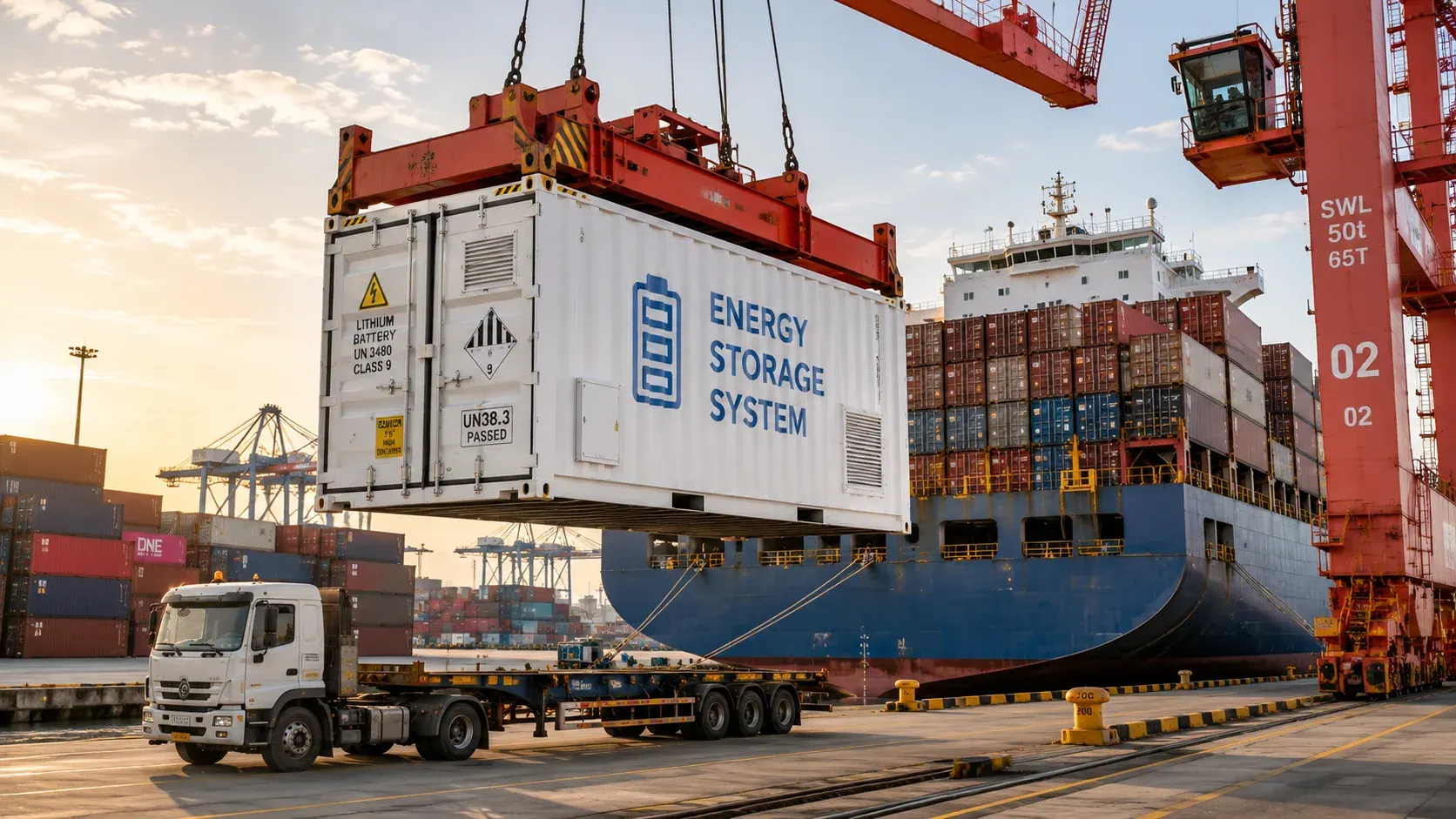
Quick answer: Before a cross-border LiFePO4 battery order, ask for a UN 38.3 lithium battery test summary that identifies the exact offered model, plus the product’s watt-hour rating, mass, packing details and shipment route. The summary is evidence that a cell or battery type was tested under the UN transport test framework; it is not the same as a full test report, a safety data sheet, a dangerous-goods declaration or permission from a carrier to accept the shipment.
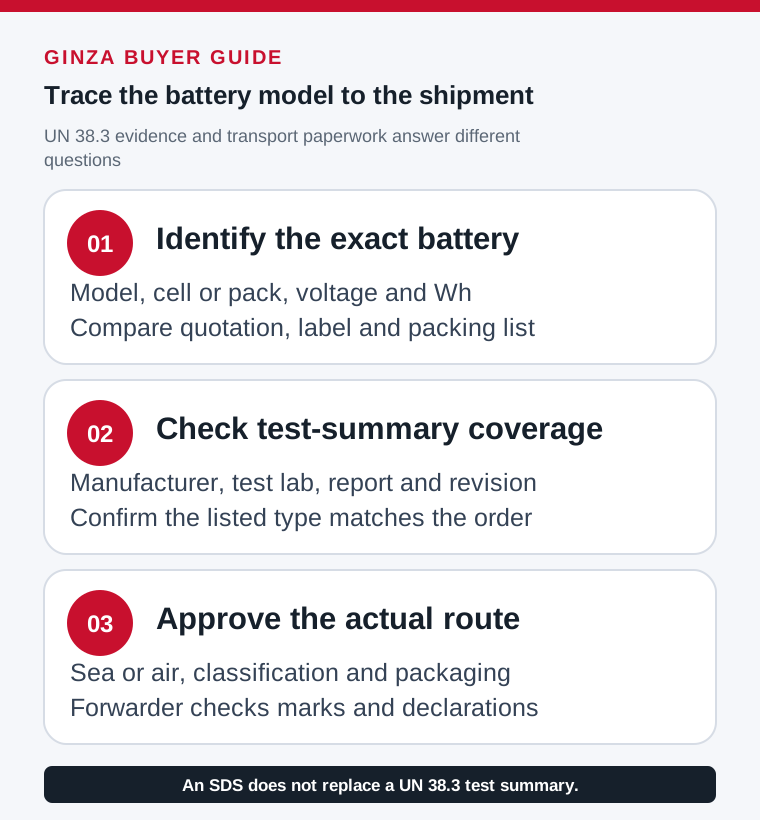
This guide is for importers, EPC teams and distributors sourcing stationary solar batteries. It is a document-request checklist, not a classification or packing instruction. The shipper and qualified dangerous-goods specialist must apply the rules for the actual product, origin, destination, carrier and transport mode. For quantity and pallet planning, see our battery container loading guide.
What does the UN 38.3 test summary contain?
The UN Manual of Tests and Criteria says the lithium cell or battery test summary shall be made available. Its specified fields include the manufacturer and laboratory contact details, a unique test report ID and date, a description of the battery including model, mass and watt-hour rating, the tests and pass/fail results, the Manual edition used and an authorized signature. These fields let a buyer check whether the evidence corresponds to the product being quoted.
| Check on the document | Buyer question |
|---|---|
| Manufacturer and laboratory | Who made and tested this battery type? Are their details traceable? |
| Report ID, date and Manual edition | Can the summary be matched to a specific test record and revision? |
| Battery description | Does the model, chemistry, mass, physical description and Wh rating match the offer? |
| Tests and results | Are the required tests and pass/fail outcomes stated? |
| Signatory | Who attests that the summary is valid? |
If a brand label, pack design, cell configuration or energy rating has changed, ask the manufacturer whether the tested type still covers the offered model. Do not substitute a cell-level summary for a finished battery pack without a documented basis. The exact scope requires the manufacturer and competent shipping reviewer to confirm.
Summary, test report, SDS and shipping declaration are different
| Document | Main purpose | Does it replace the others? |
|---|---|---|
| UN 38.3 test summary | Makes the required type-test information available to the supply chain | No; not the shipment declaration |
| Detailed laboratory test report | Provides underlying test data when needed for review | No; request it when the project or reviewer needs detail |
| Safety data sheet (SDS) | May help a buyer’s internal product and safety review | No; IATA notes an SDS is not a transport requirement for battery articles |
| Mode-specific dangerous-goods transport documents | State the actual consignment’s classification, packing and parties as required | No; depend on route and applicable rules |
| Invoice, packing list and shipping marks | Support commercial and customs processing | No; must agree with the physical shipment |
IATA’s 2026 guidance explains that the test summary need not automatically travel as a paper copy with every air consignment unless a state or operator requires it; it must be available promptly. Ask the freight forwarder how it wants access to the summary. Do not tell a supplier that an SDS alone proves UN 38.3 compliance.
What changed for sea transport in 2026?
The International Maritime Organization states that the IMDG Code 2024 edition with Amendment 42-24 became mandatory on 1 January 2026. That is the regulatory framework for packaged dangerous goods by sea. A current sea-freight quotation therefore needs its classification, packaging, marks, labels, documentation and stowage reviewed against the applicable IMDG text and carrier requirements. This article does not assign a UN number or packing instruction to every GINZA product: whether batteries ship alone, with equipment or installed in equipment matters.
Air transport has its own IATA Dangerous Goods Regulations and operator variations. Large stationary solar batteries often have very different practical transport constraints from small consumer batteries. Confirm the route and carrier first; do not reuse a sea packing statement for an air shipment.
Copyable export-document request
- Product identification: exact battery and cell models, configuration, quantity, Wh per unit, gross weight, dimensions and photographs of labels.
- Test evidence: model-matched UN 38.3 test summary, report identification and any additional project-requested evidence.
- Shipment plan: standalone battery or equipment combination, sea/air/road legs, origin, destination, transshipment and nominated forwarder.
- Packing: proposed inner/outer packaging, pallet or crate dimensions, gross weights, protection against short circuits and handling plan for review.
- Documents: draft invoice, packing list, shipping marks and the dangerous-goods documents required by the qualified shipper and carrier.
Send the document list early, before a final freight quote or delivery date is promised. The solar project BOM checklist helps align battery models with the rest of a mixed PV order. For available battery categories, see GINZA’s 51.2V LiFePO4 battery series; request model-specific evidence for the exact item, not a family-level assumption.
Read a test summary against the order, not just its file name
Start with the sales quotation and pack label: exact model, whether the document covers a cell or a battery, nominal voltage, capacity or Wh rating, manufacturer and any revision suffix. Compare those details with the test summary’s identification of the tested type. A PDF named “UN38.3 certificate” can still be for a different pack or an earlier configuration. Ask the supplier to explain differences in writing and obtain the underlying model-coverage evidence where necessary.
For a simple arithmetic check, a quoted 51.2 V, 330 Ah pack has a nominal 51.2 × 330 = 16,896 Wh, or 16.896 kWh. If the summary, packing list and battery label show different Wh values, pause and ask which value and model apply. That calculation by itself does not establish a transport classification, a pass result or an allowable packing method. The current order’s actual specification and documents control.

Who should confirm each part of the document pack?
| Question | First owner | Buyer check |
|---|---|---|
| Which cell or battery type is supplied? | Manufacturer / exporter | Model, revision, Wh, label and ordered quantity agree |
| What does the UN 38.3 summary cover? | Manufacturer / test-document holder | Tested type and summary details match the offer |
| How is the shipment classified and packed? | Qualified shipper and freight forwarder | Mode, route, carrier and current rules are recorded |
| What must the destination receive? | Importer / customs and local adviser | Import, product and project documents are agreed separately |
These roles can be combined in one company, but the checks should remain separate. UN 38.3 is a transport test framework; it does not settle a project’s electrical installation approval, product certification or customs treatment. A sea shipment under the IMDG Code and an air shipment under IATA rules may require different declarations, packaging and operator approvals. Do not copy a classification from a previous order without checking battery configuration and transport mode.
Three discrepancies that should stop a freight booking
- Model mismatch. The quotation names a revised pack, while the test summary identifies only the earlier type. Obtain a written coverage explanation or revised evidence before booking.
- Energy mismatch. The label, packing list and summary disagree on voltage, Ah or Wh. Confirm the current pack specification and correct all downstream documents consistently.
- Route mismatch. A sea-freight document set is reused for an air consignment, or the carrier’s current acceptance conditions have not been checked. Return the package to the dangerous-goods specialist for route-specific review.
Keep the exception log with a document version and responsible person. A buyer can ask for the test summary early without deciding every transport detail; the forwarder still needs the actual packaged configuration and lane before it can confirm acceptance.
Copyable request for a 2026 battery order
“For each battery model and revision in this purchase order, please provide the current datasheet, nominal Wh rating, label artwork, manufacturer details and the UN 38.3 test summary identifying the covered type. Identify any difference between the ordered model and the tested type. Please also state whether the batteries ship alone, with equipment or installed in equipment, and provide the packaging and shipment information our forwarder needs to check the 2026 sea or air route. Do not substitute an SDS for the test summary.”
Before signing the shipment date, ask the forwarder to confirm the applicable code edition, carrier requirements, marks, labels, declarations and any route restrictions. The transport conclusion belongs in the shipment file, not in a generic blog claim.
Frequently asked questions
Is a UN 38.3 test summary a certificate for the battery’s installed safety?
No. It concerns the transport test framework for a cell or battery type. Installation and product safety evidence must be reviewed separately for the project.
Does the test summary have to be printed in every carton?
Not as a universal rule. It must be available, and the state, operator, route or buyer may require a particular delivery method. Follow the actual carrier instruction.
Can an SDS replace the UN 38.3 summary?
No. They serve different purposes. Ask for the summary that identifies the offered battery model.
Can one summary cover several models?
Possibly, if the document clearly identifies every covered type and required information. Have the manufacturer and shipping reviewer confirm model coverage.