
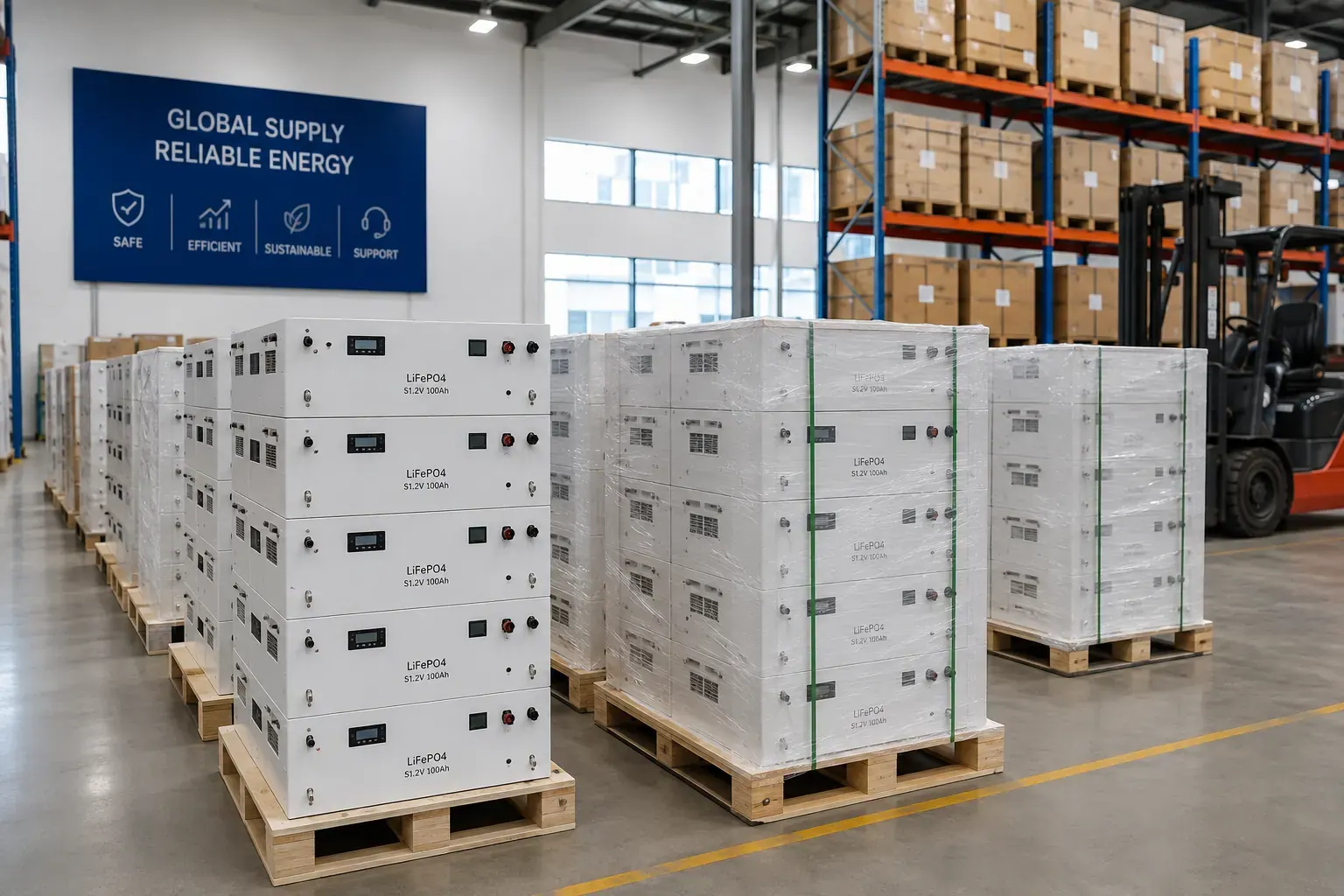
Solar battery wholesale is the B2B purchase of energy storage batteries in commercial quantities from a manufacturer, authorized distributor, or regional supply partner. For serious buyers, the goal is not simply to secure the lowest unit price. The real objective is to source a battery platform that is technically compatible, properly documented, commercially scalable, and supportable after installation.
A strong wholesale buying process therefore evaluates six areas together: battery chemistry and voltage platform, supplier capability, inverter and BMS compatibility, quality control, commercial terms, and destination-market compliance.
Quick answer: When sourcing solar batteries wholesale, compare suppliers on the complete delivered solution—not only price per unit. Confirm usable energy, battery voltage, BMS communication, parallel limits, warranty process, test documentation, lead time, Incoterms, and landed cost before placing a bulk order.
What Is Solar Battery Wholesale?
Solar battery wholesale refers to purchasing batteries for resale, installation programs, EPC projects, or commercial inventory rather than buying a single retail unit for end use. Order size varies significantly by product and supplier. A first order may begin with samples or a small project batch, while established distributors may buy pallet, container, or recurring monthly quantities.
This means there is no universal wholesale MOQ. The right MOQ depends on battery size, customization level, certification scope, packaging, production planning, and the supplier’s commercial policy.
Wholesale vs Retail: Key Differences
| Dimension | Wholesale / B2B Purchase | Retail Purchase |
|---|---|---|
| Typical buyer | Distributor, EPC, installer, project developer | End user |
| Order size | Sample, project batch, pallet, container, recurring orders | Usually one or a few units |
| Pricing | Volume-negotiated and quote-based | Published retail price or MSRP |
| Customization | May include logo, packaging, enclosure, protocol or documentation options | Usually standard configuration |
| Technical review | Often includes inverter/BMS and project requirement review | Usually basic product support |
| Commercial terms | MOQ, Incoterms, payment terms, production lead time | Standard checkout or local payment |
| Logistics | Export, freight, dangerous-goods handling and import may be involved | Local delivery is more common |
A wholesale quote should therefore be treated as a commercial package, not just a battery price. Two suppliers can quote the same nominal kWh but deliver very different value once BMS capability, enclosure protection, accessories, warranty support, shipping terms, and documentation are included.
Who Buys Solar Batteries Wholesale?
The main B2B buyer groups include:
- Solar distributors building local or regional inventory
- EPC contractors procuring batteries for residential, C&I, or microgrid projects
- Solar installers standardizing a battery platform across multiple installations
- Project developers purchasing storage for a defined energy project
- Private-label brands sourcing OEM or ODM battery products
- Wholesalers and resellers supplying downstream installer networks
Each buyer type has a different priority. An installer may focus on inverter compatibility and field support, while a distributor may care more about repeatability, packaging, documentation, spare parts, and stable lead times.
How to Choose a Solar Battery Wholesale Supplier
A reliable solar battery supplier should be able to demonstrate more than a product catalog. B2B buyers should evaluate whether the supplier can repeatedly deliver the same technical configuration, document what is being supplied, support integration with target inverters, and handle problems after shipment.
Supplier evaluation rule: Review the supplier as a combination of product source, engineering partner, quality-control process, export operator, and after-sales provider. Weakness in any one of these areas can increase project risk even when the initial battery price looks attractive.
7 Criteria for Evaluating Suppliers
-
Product documentation and applicable compliance
Request datasheets, model-specific test reports, transport documentation, declarations, and destination-market compliance information. Documents should match the exact model or battery family being quoted. -
Cell and pack configuration transparency
Ask what cell format and chemistry are used, how nominal energy is calculated, what operating voltage range applies, and under what conditions cycle-life claims were measured. -
Quality control process
Confirm whether the supplier performs incoming cell inspection, pack assembly checks, BMS testing, charge/discharge verification, aging or burn-in where applicable, and final inspection before shipment. -
Inverter and BMS compatibility
Confirm electrical voltage compatibility first, then communication compatibility. Ask whether the exact inverter model and firmware combination has been tested through CAN or RS485 when closed-loop communication is required. -
Production and supply capacity
Ask about standard production lead time, repeat-order consistency, peak-season capacity, and whether key components can change without buyer approval. -
Warranty and after-sales process
A warranty is only useful when the process is clear. Ask who diagnoses failures, what evidence is required, whether spare BMS boards or replacement units are available, and how overseas cases are handled. -
Commercial flexibility
Compare sample policy, MOQ, payment terms, Incoterms, OEM options, packaging requirements, mixed-model orders, and price breaks for repeat volume.
Red Flags to Watch For
Be cautious when a supplier:
- Cannot provide model-specific technical documentation
- Gives cycle-life or performance claims without test conditions
- Promises compatibility with “all inverters” without model-level verification
- Changes cell, BMS, enclosure, or firmware specifications without notice
- Provides a very low price but leaves freight, accessories, taxes, or documentation unclear
- Has no written warranty procedure or technical escalation path
- Avoids sample testing, inspection, or pre-shipment verification
Factory-Direct vs Local Distributor: Which Is Better?
Neither sourcing channel is automatically better. The right choice depends on project scale and the buyer’s own capabilities.
| Factor | Factory-Direct Supplier | Local / Regional Distributor |
|---|---|---|
| Pricing structure | Usually more favorable at larger volumes | Includes local stocking and service margin |
| MOQ | Often higher, especially for customization | Often more flexible for small orders |
| Lead time | Production + international logistics | Faster when stock is local |
| OEM / private label | Usually more options | Usually limited |
| Technical communication | Direct access to product engineering may be available | Local-language support may be easier |
| Import handling | Buyer or freight partner manages import | Often simplified for the buyer |
| After-sales logistics | Cross-border process must be defined | Local replacement can be easier if stock is available |
For a first cooperation, a sample or pilot project is usually more informative than negotiating the lowest bulk price immediately.
Solar Battery Types for Wholesale Orders
LiFePO4 vs NMC Lithium-Ion: Which Is Better for Solar Storage?
LiFePO4 is itself a type of lithium-ion battery chemistry. In stationary solar storage, the most useful comparison is usually LiFePO4 (LFP) vs NMC lithium-ion.
LiFePO4 is widely used in stationary energy storage because it generally offers strong thermal stability and long cycle-life potential. NMC typically offers higher gravimetric energy density, which is valuable where weight and compactness are major priorities.
| Comparison | LiFePO4 (LFP) | NMC Lithium-Ion |
|---|---|---|
| Stationary ESS use | Very common | Used, but less dominant in many stationary applications |
| Thermal stability | Generally stronger | Requires careful thermal and BMS management |
| Energy density by weight | Lower | Higher |
| Cycle-life potential | Often higher in stationary use | Depends strongly on cell design and operating window |
| Main buying focus | Longevity, safety characteristics, total lifecycle value | Compactness, weight, energy density |
Do not evaluate cycle life from one headline number alone. A claim such as “6,000 cycles” or “10,000 cycles” is incomplete unless the supplier also states depth of discharge (DoD), charge/discharge rate, temperature, end-of-life capacity threshold, and test method.
51.2V Low-Voltage vs High-Voltage Battery Systems
A nominal 51.2V LiFePO4 battery commonly uses 16 LiFePO4 cell groups in series, based on a nominal cell voltage of approximately 3.2V. These batteries are widely used with 48V-class hybrid inverters, but electrical voltage range and BMS communication must still be checked for the exact inverter model.
| Factor | 51.2V Low-Voltage Platform | High-Voltage Battery Platform |
|---|---|---|
| Typical use | Residential and small-to-medium C&I | Larger C&I and systems designed around HV architecture |
| Battery current | Higher current for the same power | Lower current for the same power |
| Inverter requirement | 48V/low-voltage compatible inverter | HV battery-compatible inverter |
| Expansion method | Commonly parallel battery units | Often series/module stack architecture, depending on system |
| Engineering priority | Cable current, breaker sizing, parallel control | HV safety, insulation, system-specific module configuration |
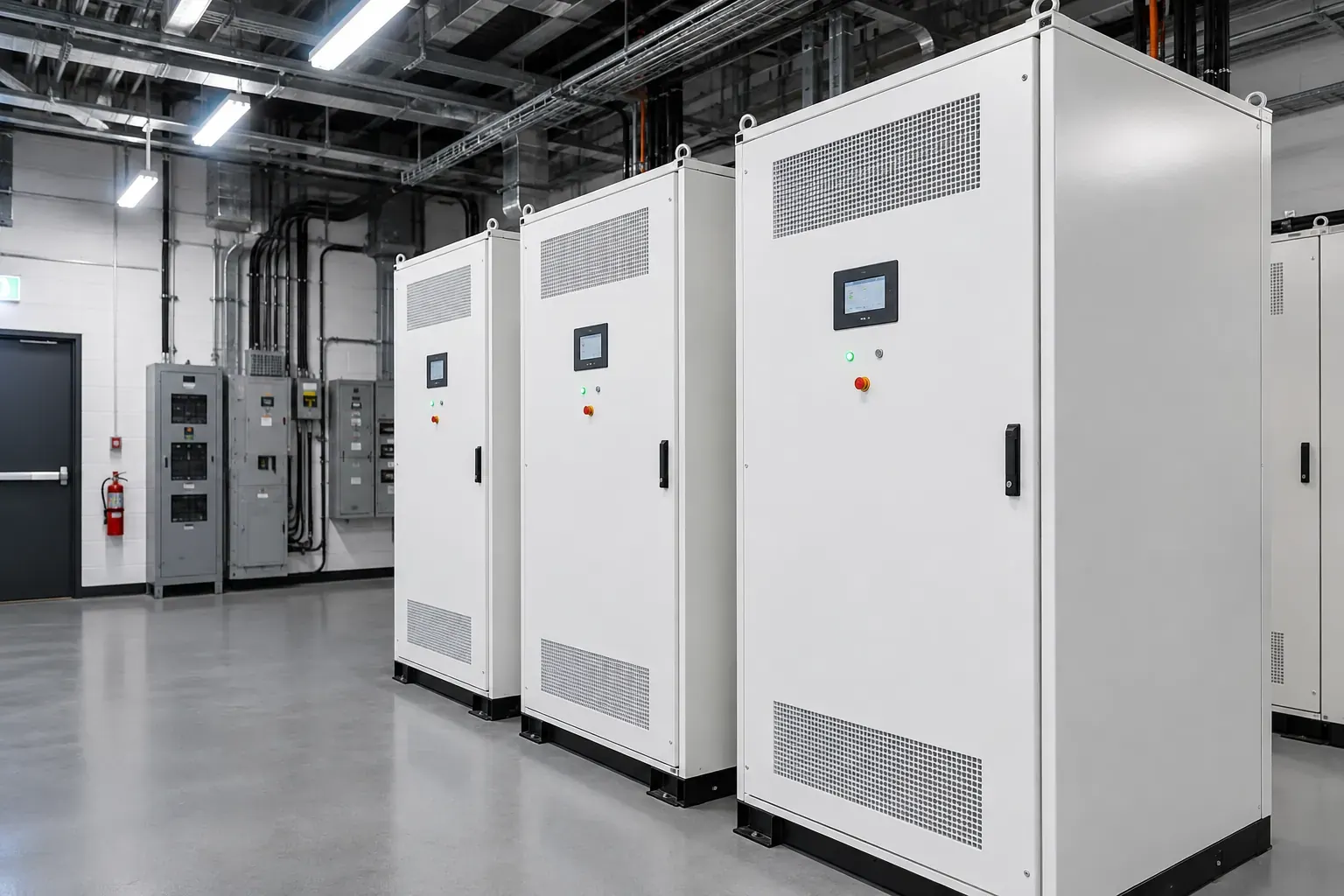
The correct choice should be made at system level. Do not choose low voltage or high voltage based only on battery price per kWh.
Battery Capacity Guide: 100Ah to 330Ah
For a 51.2V nominal battery, theoretical nominal energy can be estimated as:
Nominal energy (kWh) = Voltage (V) × Capacity (Ah) ÷ 1,000
| Capacity | Nominal Energy at 51.2V | Typical Application Direction |
|---|---|---|
| 100Ah | 5.12 kWh | Small residential backup or modular systems |
| 200Ah | 10.24 kWh | Residential solar storage |
| 300Ah | 15.36 kWh | Larger residential / light commercial |
| 330Ah | 16.90 kWh | Larger residential / small commercial / multi-unit projects |
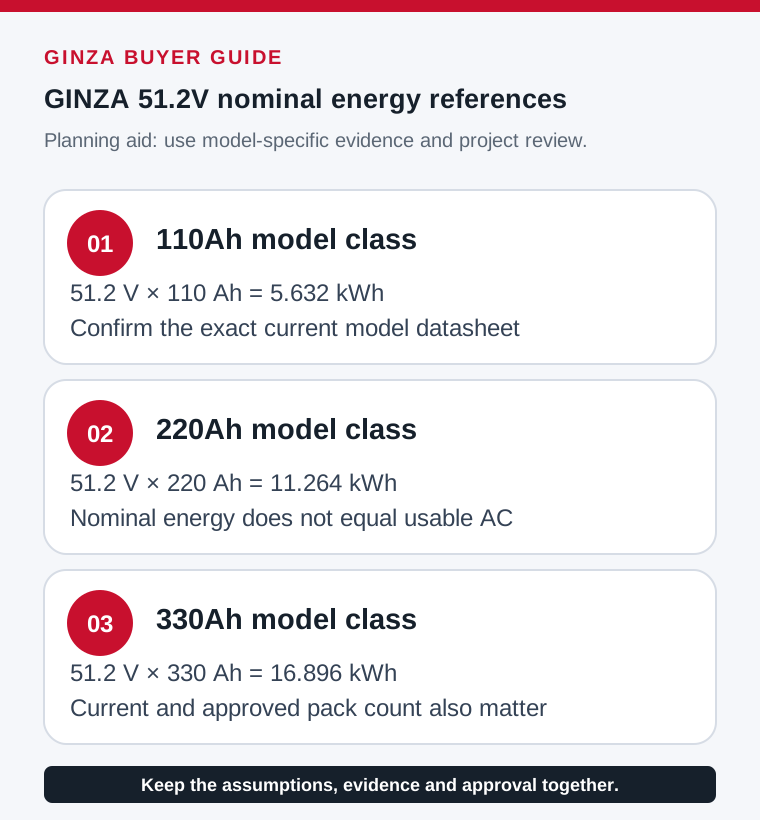
Nominal energy is not the same as usable energy. Usable kWh depends on the permitted SoC window, DoD setting, BMS limits, inverter settings, temperature, and system design.
For detailed sizing, see the LiFePO4 Battery Selection Guide for Solar Installers.
Solar Battery Wholesale MOQ and Pricing
There is no single market-wide MOQ for wholesale solar batteries. MOQ may be one or a few samples for technical evaluation, a project batch for installers, a pallet quantity for distributors, or a container-level order for mature wholesale programs.
The more important question is not “What is the normal MOQ?” but “What MOQ applies to this exact configuration and commercial term?”
What Determines MOQ?
MOQ usually changes based on:
- Standard product vs OEM/ODM configuration
- Battery capacity and enclosure type
- Custom logo, packaging, labels, manuals, or color
- BMS firmware or communication protocol changes
- Required destination-market documentation
- Mixed-model order vs single-model order
- Cell and component production batch size
- Buyer history and recurring purchase plan
For a first order, ask for sample MOQ, project MOQ, and distributor MOQ separately. This gives a clearer picture of how the supplier expects the relationship to scale.
What Affects Solar Battery Wholesale Pricing?
A professional quote should make the commercial basis clear. Major price drivers include:
- Cell specification and sourcing — chemistry, capacity, grade, consistency and supplier
- Battery energy — total nominal kWh and usable operating window
- BMS capability — current rating, active/passive balancing, communication, protection and firmware
- Mechanical design — rack, wall-mount, floor-standing, IP rating, connectors and breakers
- Safety design — sensors, protection architecture and other model-specific safety features
- OEM/ODM scope — logo, packaging, manuals, enclosure changes or protocol work
- Certification and testing scope — depending on target market and project requirements
- Order volume — sample, pallet, container and recurring volume may have different price tiers
- Incoterms — EXW, FOB, CIF and DDP quotes are not directly comparable
- Freight and dangerous-goods handling — route, packaging, port, carrier and destination affect landed cost
- Payment terms and currency — commercial risk and exchange rates can change the final price
Compare Landed Cost, Not Only Unit Price
A useful B2B comparison is:
Estimated landed cost = battery price + export packing + origin charges + freight + insurance + destination charges + duties/taxes + local delivery
The exact items depend on the Incoterm and destination country. A cheaper EXW quote can ultimately cost more than a higher FOB or delivered quote once missing logistics items are added.
How to Request a Comparable Wholesale Quote
Send every shortlisted supplier the same RFQ information:
- Required battery voltage and nominal kWh
- Required quantity and expected repeat volume
- Exact inverter brand and model
- CAN / RS485 communication requirement
- Parallel quantity or total system capacity
- Target country and destination port/city
- Required certifications or project standards
- OEM/private-label requirements
- Preferred Incoterm
- Required delivery date
This reduces hidden assumptions and makes supplier quotes easier to compare.
Solar Battery Wholesale Order Process
A disciplined wholesale process reduces technical changes after production begins. The following five-step workflow works well for installers, distributors, and EPC buyers.
Recommended process: requirements/BOM → technical compatibility review → sample or final quotation → production and QC → shipping documents and delivery.
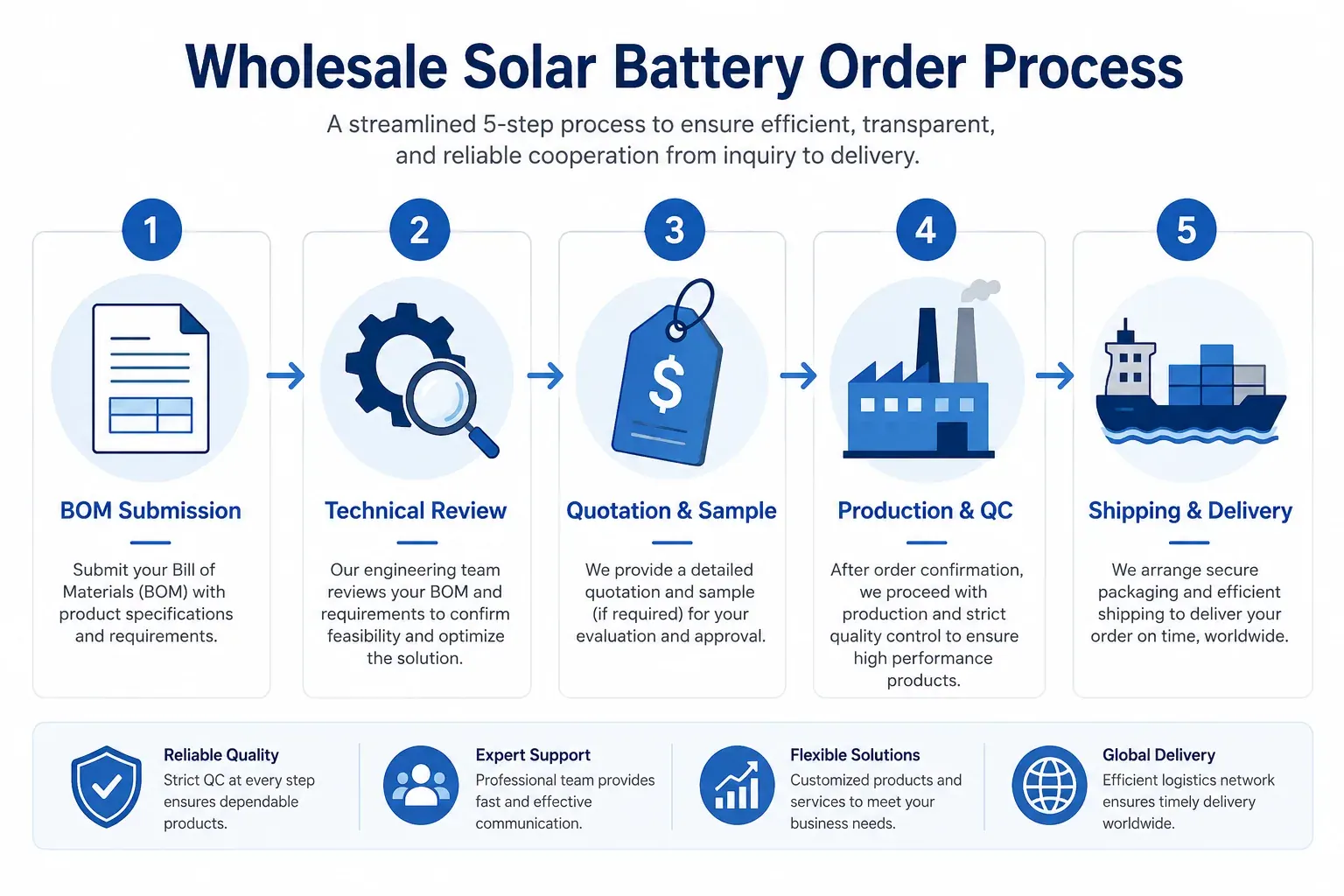
Step 1: Send Your BOM or Project Requirements
Start with the technical requirement rather than asking only for “your best battery price.” Include battery voltage, kWh or Ah, quantity, target inverter, communication method, installation environment, expected parallel configuration, and destination market.
Use the Solar Project BOM Checklist to prepare the information before requesting a quote.
Step 2: Confirm Electrical and Communication Compatibility
The supplier should review:
- Battery operating voltage vs inverter battery-voltage range
- Maximum charge/discharge current
- Battery and inverter power requirements
- CAN or RS485 protocol compatibility
- Inverter firmware or battery protocol selection where relevant
- Parallel battery configuration and communication topology
- Cable, connector and protection requirements
Closed-loop BMS communication should never be assumed just because both products have a CAN or RS485 port.
See the Inverter Compatibility Guide for a more detailed integration checklist.
Step 3: Sample, Quotation and Commercial Confirmation
For a new supplier or new battery platform, consider a sample or pilot installation before a large commitment. The quotation or proforma invoice should clearly state:
- Exact model and configuration
- Quantity and unit price
- Included accessories
- OEM scope, if any
- Incoterm and shipping basis
- Payment terms
- Production lead time
- Warranty terms
- Quotation validity
Before paying a bulk-order deposit, confirm that the approved sample specification and bulk production specification are the same.
Step 4: Production and Quality Control
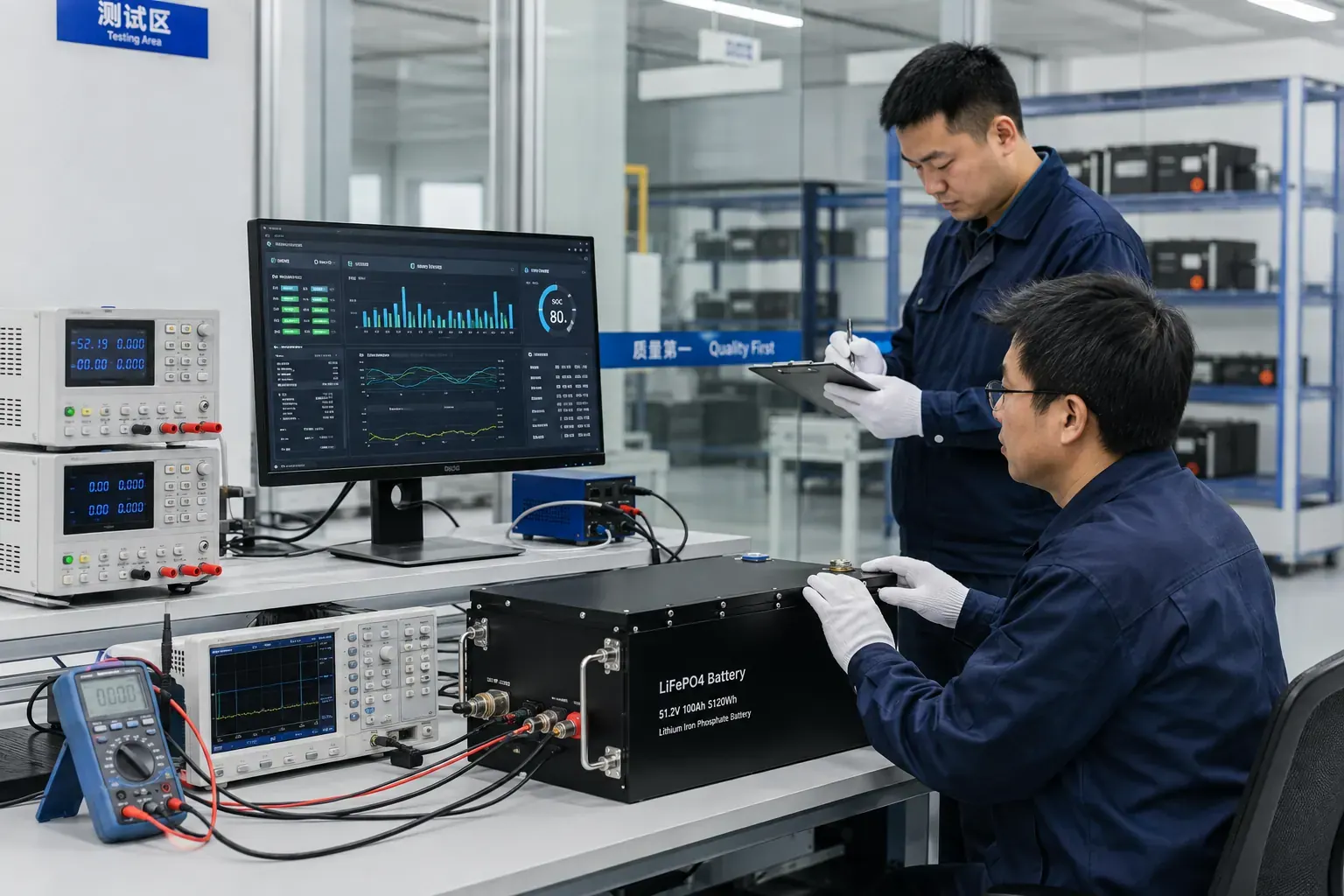
During production, define what evidence will be available before shipment. Depending on the order, this may include production records, capacity or charge/discharge results, BMS communication tests, serial-number lists, packing photos, and final inspection reports.
For larger orders, buyers may also use an independent pre-shipment inspection service.
Step 5: Shipping and Documentation
Lithium batteries are regulated dangerous goods for transport, so logistics should be planned before production is completed. Documentation commonly includes commercial documents, packing information, transport test documentation, and carrier-required dangerous-goods paperwork.
Transit time should be confirmed for the actual route and shipping method rather than relying on a generic “20–40 day” estimate. Port congestion, dangerous-goods booking, transshipment, customs, and local delivery can all change the schedule.
Quality Control for Solar Battery Wholesale
Standards, Tests, Marks and Documents: Do Not Mix Them Up
Battery procurement documents are often described loosely as “certifications,” but they do not all mean the same thing. A professional buyer should distinguish between a standard, test requirement, conformity mark, certification body, and safety document.
| Item | What It Actually Is | Why It Matters |
|---|---|---|
| UN 38.3 | Lithium-battery transport test requirements under the UN Manual of Tests and Criteria | Relevant to transport of lithium cells and batteries; request the applicable test summary/report information |
| IEC 62619 | International safety standard for secondary lithium cells and batteries used in industrial applications, including stationary applications | Useful safety benchmark for many stationary battery products and projects |
| CE marking | EU conformity marking applied when applicable EU requirements and conformity procedures are satisfied | Relevant when placing applicable batteries/products on the EU market; verify the declaration and technical scope |
| UL 1973 | Safety standard for batteries used in stationary and motive auxiliary power applications | Commonly relevant to North American stationary battery projects; system-level requirements may also apply |
| TÜV mark/certificate | Third-party testing/certification issued by a TÜV organization to a defined standard/scope | Verify the exact standard, model, certificate number and scope rather than treating “TÜV” as a standard |
| SDS / MSDS | Safety data document | Supports handling, transport and safety communication; it is not a product certification |
Requirements vary by country, battery type, installation, system architecture, and authority having jurisdiction. Do not publish or accept a blanket statement such as “these six certifications are mandatory worldwide.”
For reference, buyers can review the official UNECE Manual of Tests and Criteria, IEC 62619:2022, the EU Battery Regulation, and UL Solutions’ overview of battery energy storage regulatory compliance.
BMS Checks for Wholesale Buyers
A BMS (Battery Management System) monitors and protects battery cells and controls important operating limits. For solar storage procurement, buyers should check:
- Maximum continuous charge/discharge current
- Overcharge and over-discharge protection
- Overcurrent and short-circuit protection
- Temperature sensing and protection logic
- Cell balancing method
- CAN / RS485 communication capability
- Inverter protocol support
- Parallel-battery communication design
- Firmware update and service process
A battery can be electrically compatible with an inverter but still fail to provide closed-loop communication if the required protocol is not supported.
Pre-Shipment Inspection Checklist
Before approving shipment, verify:
- Model, label, serial number and quantity
- Enclosure condition and workmanship
- Nominal voltage and open-circuit voltage within expected range
- Charge/discharge or capacity test results according to the agreed QC plan
- BMS alarms, protections and communication functions
- Connector, cable and accessory quantities
- Packaging integrity and dangerous-goods labels as applicable
- Model-specific transport and compliance documents
- Packing list consistency with physical shipment
- Warranty and technical support contacts
How to Read Cycle-Life Claims
Cycle-life data is only meaningful when test conditions are stated. Ask the supplier for:
- DoD or SoC operating window
- Charge and discharge C-rate
- Test temperature
- End-of-life capacity threshold, such as 70% or 80% remaining capacity
- Rest periods and test profile
- Cell-level vs pack-level data
This makes it possible to compare two battery suppliers on a similar basis instead of comparing marketing numbers with different test conditions.
Solar Battery Wholesale Buyer Checklist Before Paying a Deposit
Use this short checklist before confirming a bulk order:
- Exact battery model and revision confirmed
- Nominal and usable energy understood
- Inverter voltage range checked
- CAN/RS485 protocol checked for the exact inverter model
- Maximum charge/discharge current confirmed
- Parallel configuration confirmed
- Cell and BMS specification documented
- Sample or pilot test completed when needed
- Applicable standards, test reports and market documents reviewed
- Warranty process documented
- Accessories and cables included in quotation
- MOQ and price break confirmed
- Incoterm and freight responsibility confirmed
- Production lead time confirmed
- Pre-shipment QC evidence agreed
- Final landed-cost estimate completed
Solar Battery Wholesale FAQ
What is the minimum order quantity for solar battery wholesale?
There is no universal MOQ. It depends on the battery model, supplier, OEM requirements, packaging, and order type. First-time buyers should ask separately for sample MOQ, project MOQ, and distributor-volume MOQ.
How much do wholesale solar batteries cost?
Wholesale cost varies with cell specification, kWh, BMS, enclosure, order quantity, certification/testing scope, OEM requirements, Incoterms, and freight. Compare quotes on the same technical specification and calculate landed cost before choosing a supplier.
Can I order solar batteries with my own brand?
Many manufacturers offer OEM or private-label options such as logo, labels, packaging, manuals, enclosure color, and selected configuration changes. Customization can affect MOQ, lead time, testing, documentation, and warranty responsibility, so the exact scope should be agreed in writing.
How do I check inverter compatibility before ordering?
Confirm the inverter battery-voltage range, charge/discharge current, battery type setting, and communication protocol. If closed-loop BMS communication is required, verify the exact inverter model and protocol rather than assuming any CAN or RS485 port will work.
What documents should I request for lithium battery shipping?
The required set depends on product, route, carrier, and destination. Buyers commonly need commercial shipping documents plus lithium-battery transport documentation such as relevant UN 38.3 information and carrier-required dangerous-goods paperwork. Confirm the exact list with the supplier and freight forwarder before shipment.
How do I verify solar battery quality before a bulk order?
Review the datasheet and model-specific reports, test a sample when appropriate, verify inverter communication, define a pre-shipment QC checklist, and make sure the bulk production specification matches the approved sample. For larger orders, consider independent inspection.
What is the best way to compare two solar battery wholesale quotes?
Normalize the quotes first. Compare nominal kWh, usable energy assumptions, cell and BMS specification, included accessories, warranty, Incoterms, freight, documents, lead time, and landed cost. A lower unit price is not necessarily the lower-cost procurement option.
Ready to Source Solar Batteries Wholesale?
GINZA Tech Solar supports distributors, EPC contractors, installers, and project buyers sourcing 51.2V LiFePO4 battery solutions, commercial energy storage systems, and solar project BOMs.
For a more accurate quotation, send the battery voltage or kWh requirement, quantity, target inverter model, destination country, OEM requirements, and preferred Incoterm. Our team can review the technical requirements before pricing so the quotation is based on the correct configuration.
Request Project Quote — Send your project requirements for a formal quotation.
Send Your BOM — Submit your Bill of Materials for technical review and pricing.
For battery selection, MOQ, compatibility, or lead-time questions, contact [email protected].